Have you seen Slumdog Millionaire yet? What about the Wrestler? Both of these outstanding films offer many poignant scenes, powerful performances, and excellent dialogue. Both movies should collect at least a few Oscars tonight.
Yet one often overlooked feature of both films remains their depiction of the allure and danger of crowds. A mob scene, fueled by religious hatred, leads to a brutal massacre in Slumdog Millionaire that haunts the main character. Unfortunately, as the recent televised terrorist attacks in Mumbai show, religious intolerance remains a huge problem both within India and between India and Pakistan.
Likewise, The Wrestler shows the pleasures for a star pe- whether as a wrestler or stripper - of a crowd's attention and brief affection. Yet the film also discloses both the fragility of the crowd's affection - and ugly underside that can emerge. Wresting crowds scream for righteous violence, pushing performers to both abuse their rivals and themselves to appease the calls for literal blood. How far have we really come since ancient Roman gladiators?
Further, both award-winning films show how individuals need to connect and overcome isolation. Authentic, private conversations offer a chance for characters to find solace, friendship, and love.
The Wrestler gives glimpses into the possibilities for a broken father-daughter relationship with seaside walks and talks. Yet it also painfully portrays the gap between vague intentions and actual commitment when a father fails to ask questions, listen to, and pay attention to his daughter.
In the film, the wrestler knows almost nothing about his daughter - and can only relate on a superficial role to role manner. Without giving away too much of the plot, the main character's inability to really talk to and care about females leads to dangerous dependence on worshiping crowds. He could relate to groups of people - and his profession encouraged relating based on stereotypes. This failure to engage with individuals instead of abstract types causes many painful mistakes - and helps push the Wrestler over the edge.
I recognize that creating space for authentic classroom conversations, especially in a second, third, or fourth language is difficult. Private English tutors often form a closer, more natural bond while teaching English than many adult education English teachers working with large classes. That's probably inevitable since numbers do matter. After all, tutors can tailor their private English lessons to their clients and allow natural conversations to evolve.
Yet caring, thoughtful English teachers can also carve out some space for students to express their thoughts and share their experience in both classroom discussions and private conversations. Conversation practice, however, makes English class far more student-centered and gives students a chance to learn by doing. In fact, I consider teaching conversation skills to be an essential skill for everyone - parents, children, immigrants, workers, wrestlers, policeman, and family members. Conversation allows us to learn about others, explore our own lives, and overcome loneliness. Just asking questions, listening to responses, and exchanging a few reflective words can deepen and improve relationships - inside a classroom and outside in the world.
Authentic conversations as the healthy counter to mindless violence of crazed crowds can be clearly seen in both Slumdog Millionaire and The Wrestler. Perhaps that message will reach some of the estimated 1 billion people watching the Oscar show later tonight on television and at parties. I hope so.
As Thomas Mann wrote, "Silence isolates... Conversation is civilization itself."
Ask more. Know more. Share more.
Create Compelling Conversations.
Visit www.CompellingConversations.com
Showing posts with label ESL. Show all posts
Showing posts with label ESL. Show all posts
Sunday, February 22, 2009


Friday, January 16, 2009
Classroom Experience Trumps Paper Credentials - But Only in the Classroom!
Experience trumps pieces of paper – but only in the classroom!
Let me explain. Many educational institutions, especially in some places, remain paper-driven. Let me give a sad example. I currently teach English at an elite private university and write articles for numerous publications, but I couldn't get a teaching position in a California public school teaching English because I lack the right MA.
Expertise and experience, for many educational institutions, remain of limited use. Former President Clinton could not teach government, history, or social studies in California public schools. Academy Award winning actors can not teach theater in the schools. World class musicians can't teach music. It's utterly absurd.
As a result of this obsession with paper credentials and undervaluing of experience, experts and experienced teachers work with more upper-income students and elite institutions. The considerable gap between public schools and private schools becomes even larger. The public school system continually turns away experienced, quality teachers because of their very narrow notions of what qualifies one to teach students. Sometimes creative, talented teachers decide to teach English abroad to practice their craft, see more of our fascinating world, and share their love of English.
It's also self defeating for public school systems. Students and parents are voting with their feet, and leaving the system. The charter school movement is a direct response to this bureaucratic paradigm. Flexibility and commonsense would encourage professions to teach in schools and make mid-career shifts. I personally know three professionals - a banker and two lawyers - that would also love to teach high school for a few years as a change. Yet rigid regulations and narrow definitions of what makes someone qualified to teach in a California public school classroom prohibit this possibility. Again, students, parents, and potential teachers lose. Who wins by this obsession with paper credentials?
"We learn to walk by stumbling", goes the Bulgarian proverb. Teachers, and students, learn by doing and making good mistakes. Larry M. Lynch, a prolific author, recently examined this problem in “Are Some Credentials Overrated?” on his BetterEFLteacher blog. He nailed the problem with reading 500 books to become a recognized expert instead of just throwing yourself in and gaining experience.
The best teachers are often autotelic (self-directed), and share their passion for learning and model love of knowledge. Adding a PhD after your name doesn't magically transform a student into a dynamic, quality English teacher. Nor does proving one’spatience with boring bureaucratic procedures and reciting the latest educational jargon.
As Ms.Lucy, another English teacher and coordinator, notes, "you either have it - or you don't."
Ask more. Know more. Share more.
Create Compelling Conversations.
Visit www.CompellingConversations.com
Let me explain. Many educational institutions, especially in some places, remain paper-driven. Let me give a sad example. I currently teach English at an elite private university and write articles for numerous publications, but I couldn't get a teaching position in a California public school teaching English because I lack the right MA.
Expertise and experience, for many educational institutions, remain of limited use. Former President Clinton could not teach government, history, or social studies in California public schools. Academy Award winning actors can not teach theater in the schools. World class musicians can't teach music. It's utterly absurd.
As a result of this obsession with paper credentials and undervaluing of experience, experts and experienced teachers work with more upper-income students and elite institutions. The considerable gap between public schools and private schools becomes even larger. The public school system continually turns away experienced, quality teachers because of their very narrow notions of what qualifies one to teach students. Sometimes creative, talented teachers decide to teach English abroad to practice their craft, see more of our fascinating world, and share their love of English.
It's also self defeating for public school systems. Students and parents are voting with their feet, and leaving the system. The charter school movement is a direct response to this bureaucratic paradigm. Flexibility and commonsense would encourage professions to teach in schools and make mid-career shifts. I personally know three professionals - a banker and two lawyers - that would also love to teach high school for a few years as a change. Yet rigid regulations and narrow definitions of what makes someone qualified to teach in a California public school classroom prohibit this possibility. Again, students, parents, and potential teachers lose. Who wins by this obsession with paper credentials?
"We learn to walk by stumbling", goes the Bulgarian proverb. Teachers, and students, learn by doing and making good mistakes. Larry M. Lynch, a prolific author, recently examined this problem in “Are Some Credentials Overrated?” on his BetterEFLteacher blog. He nailed the problem with reading 500 books to become a recognized expert instead of just throwing yourself in and gaining experience.
The best teachers are often autotelic (self-directed), and share their passion for learning and model love of knowledge. Adding a PhD after your name doesn't magically transform a student into a dynamic, quality English teacher. Nor does proving one’spatience with boring bureaucratic procedures and reciting the latest educational jargon.
As Ms.Lucy, another English teacher and coordinator, notes, "you either have it - or you don't."
Ask more. Know more. Share more.
Create Compelling Conversations.
Visit www.CompellingConversations.com
Wednesday, December 31, 2008
New Year: Old Dilemmas for Assessing Listening and Speaking Skills for English Language Learners
As we welcome the new year, we can anticipate some familiar pleasures and puzzles.
For English language teachers, establishing reasonable standards for oral communication remains a complicated, difficult challenge. Students must be able to clearly communicate their ideas with adequate pronunciation, but we must allow for a rich variety of accents too. Some ESL teachers also find themselves placed in the role of both gatekeeper - upholding standards of admission to university courses - and coach. Some tension between these roles occurs when evaluating a student's oral skills for mandatory courses.
English teachers, especially ESL and ESOL working with adult English language learners, can build on the experience of international organizations working with refugees and immigrants.
Check out this practical chart with ten categories for listening comprehension and speaking skills developed by the United States Office of Refugee Resettlement and revised by the Spring Institute for Intercultural Learning. Where did I find it? As so often, I went to the Center for Applied Linguistics website.
What are reasonable standards for listening comprehension and speaking skills for adult English language learners? That’s a difficult question, and context matters. This chart, however, seems quite sensible.
SPL stands for Student Performance Level here. The descriptors for listening comprehension and oral communication are intended to establish a standard that government agencies, educational institutions, and non-profits can all use to share evaluations. Despite the bureaucratic title, the chart itself contains excellent descriptions that English teachers and testers can use for adult English language learners.
After having been in several long faculty discussions over standards for oral skills, I appreciate the explicit standards combined with some flexibility.
This chart, developed for adult refugees, resembles other charts, yet includes more details and an explicit acknowledgment of economics. I like that awareness even if this factor can sometimes be misused to justify low standards in adult education programs. (After all, illiterate peasants move to the United States, Canada, England, and Australia in hopes of improving their economic and social status.)
Our job as educators is to provide our students with the language skills to live fuller, more satisfying lives – in English – wherever they choose to live and work.
Student Performance Level (SPL) Descriptors for Listening Comprehension and Oral Communication
SPL General Language Ability
Listening Comprehension Oral
Communication
0
No ability whatsoever
No ability whatsoever
No ability whatsoever
1
Functions minimally, if at all, in English. Can handle only very routine entry-level jobs that do not require oral communication, and in which all tasks can be easily demonstrated. A native speaker used to dealing with limited English speakers can rarely communicate with a person at this level except through gestures.
Understands only a few isolated words, and extremely simple learned phrases.
Vocabulary limited to a few isolated words. No control of grammar.
2
Functions in a very limited way in situations related to immediate needs. Can handle only routine entry-level jobs that do not require oral communication, and in which all tasks can be easily demonstrated. A native English speaker used to dealing with limited English speakers will have great difficulty communicating with a person at this level.
Understands a limited number of very simple learned phrases, spoken slowly with frequent repetitions.
Expresses a limited number of immediate survival needs using very simple learned phrases.
3 Functions with some difficulty in situations related to immediate needs. Can han¬dle routine entry-level jobs that involve only the most basic oral communication, and in which all tasks can be demonstrated. A native English speaker used to dealing with limited English speakers will have great difficulty communicating with a person at this level.
Understands simple learned phrases, spoken slowly with frequent repetitions.
Expresses immediate survival needs using simple learned phrases.
4 Can satisfy basic survival needs and a few very routine social demands. Can handle entry-level jobs that involve some simple oral communication, but in which tasks can be easily demonstrated. A native English speaker used to dealing with limited English speakers will have difficulty communicating with a person at this level.
Understands simple learned phrases easily, and some simple new phrases containing familiar vocabulary, spoken slowly with frequent repetitions.
Expresses basic survival needs including asking and responding to related questions, using both learned and a limited number of new phrases. Participates in basic conversations in a few very routine social situations. Speaks with hesitation and frequent pauses. Some control of basic grammar.
5 Can satisfy basic survival needs and some limited social demands. Can handle jobs and job training that involve following simple oral instructions but in which most tasks can also be demonstrated. A native English speaker used to dealing with limited English speakers will have some difficulty communicating with a person at this level.
Understands learned phrases easily and short new phrases containing familiar vocabulary spoken slowly with repetition. Has limited ability to understand on the telephone.
Functions independently in most face-to-face basic survival situations but needs some help. Asks and responds to direct questions on familiar and some unfamiliar subjects. Still relies on learned phrases but also uses new phrases (i.e., speaks with some creativity) but with hesitation and pauses. Communicates on the phone to express a limited number of survival needs, but with some difficulty. Participates in basic conversations in a limited number of social situations. Can occasionally clarify general meaning.
6
Can satisfy most survival needs and limited social demands. Can handle jobs and job training that involve following simple oral and written instructions and diagrams. A native English speaker not used to dealing with limited English speak¬ers will be able to communicate with a person at this level on familiar topics, but with difficulty and some effort.
Understands conversations containing some unfamiliar vocabulary on many every¬day subjects, with a need for repetition, rewording or slower speech. Has some ability to understand without face-to-face contact (e.g. on the telephone, TV).
Functions independently in most survival situations, but needs some help. Relies less on learned phrases; speaks with creativity, but with hesitation. Communicates on the phone on familiar subjects but with some difficulty. Participates with some confidence in social situations when addressed directly. Can sometimes clarify general meaning by rewording. Control of basic grammar evident, but inconsistent; may attempt to use more difficult grammar but with almost no control.
7
Can satisfy survival needs and routine work and social demands. Can handle work that involves following oral and simple written instructions in familiar and some unfamiliar situations. A native English speaker not used to dealing with limited English speakers can generally communicate with a person at this level on familiar topics.
Understands conversations on most everyday subjects at normal speed when addressed directly; may need repetition, rewording, or slower speech. Understands routine work-related conversations. Increasing ability to understand without face-to-face contact (telephone, TV, radio). Has difficulty following conversation between native speakers.
Functions independently in survival and many social and work situations, but may need help occasion¬ally. Communicates on the phone on familiar subjects. Expands on basic ideas in conversation, but still speaks with hesitation while searching for appropriate vocabulary and grammar. Clarifies general meaning easily, and can sometimes convey exact meaning. Controls basic grammar, but not more difficult grammar.
8 Can participate effectively in social and familiar work situations. A native English speaker not used to dealing with limited English speakers can communicate with a person at this level on almost all topics.
Understands general conversation and conversation on technical subjects in own field. Understands without face-to-face contact (telephone, TV, radio); may have difficulty following rapid or colloquial speech. Understands most conversations between native speakers; may miss details if speech is very rapid or colloquial or if subject is unfamiliar. Participates effectively in practical and social conversation and in technical discussions in own field. Speaks fluently in both familiar and unfamiliar situations; can handle problem situations. Conveys and explains exact meaning of complex ideas. Good control of grammar.
9 Can participate fluently and accurately in practical, social, and work situations. A native English speaker not used to dealing with limited English speakers can communicate easily with a person at this level.
Understands almost all speech in any context. Occasionally confused by highly colloquial or regional speech.
Approximates a native speaker’s fluency and ability to convey own ideas precisely, even in unfamiliar situations. Speaks without effort. Excellent control of grammar with no apparent patterns of weakness.
10
Ability equal to that of a native speaker of the same socioeconomic level.
Equal to that of a native speaker of the same socioeconomic level. Equal to that of a native speaker of the same socioeconomic level.
Original chart from http://www.cal.org/caela/esl_resources/slspls.html
These standards, of course, remain more relevant for adult educators and workplace programs than more academic programs. English teachers should, however, create classroom activities where students can engage in extended conversations in English on a wide variety of topics. The higher levels of this chart (SPL 9-10) articulate an excellent standard for all English language learners, including academic English and Business English students.
Ask more. Know more. Share more.
Create Compelling Conversations.
Visit www.CompellingConversations.com
For English language teachers, establishing reasonable standards for oral communication remains a complicated, difficult challenge. Students must be able to clearly communicate their ideas with adequate pronunciation, but we must allow for a rich variety of accents too. Some ESL teachers also find themselves placed in the role of both gatekeeper - upholding standards of admission to university courses - and coach. Some tension between these roles occurs when evaluating a student's oral skills for mandatory courses.
English teachers, especially ESL and ESOL working with adult English language learners, can build on the experience of international organizations working with refugees and immigrants.
Check out this practical chart with ten categories for listening comprehension and speaking skills developed by the United States Office of Refugee Resettlement and revised by the Spring Institute for Intercultural Learning. Where did I find it? As so often, I went to the Center for Applied Linguistics website.
What are reasonable standards for listening comprehension and speaking skills for adult English language learners? That’s a difficult question, and context matters. This chart, however, seems quite sensible.
SPL stands for Student Performance Level here. The descriptors for listening comprehension and oral communication are intended to establish a standard that government agencies, educational institutions, and non-profits can all use to share evaluations. Despite the bureaucratic title, the chart itself contains excellent descriptions that English teachers and testers can use for adult English language learners.
After having been in several long faculty discussions over standards for oral skills, I appreciate the explicit standards combined with some flexibility.
This chart, developed for adult refugees, resembles other charts, yet includes more details and an explicit acknowledgment of economics. I like that awareness even if this factor can sometimes be misused to justify low standards in adult education programs. (After all, illiterate peasants move to the United States, Canada, England, and Australia in hopes of improving their economic and social status.)
Our job as educators is to provide our students with the language skills to live fuller, more satisfying lives – in English – wherever they choose to live and work.
Student Performance Level (SPL) Descriptors for Listening Comprehension and Oral Communication
SPL General Language Ability
Listening Comprehension Oral
Communication
0
No ability whatsoever
No ability whatsoever
No ability whatsoever
1
Functions minimally, if at all, in English. Can handle only very routine entry-level jobs that do not require oral communication, and in which all tasks can be easily demonstrated. A native speaker used to dealing with limited English speakers can rarely communicate with a person at this level except through gestures.
Understands only a few isolated words, and extremely simple learned phrases.
Vocabulary limited to a few isolated words. No control of grammar.
2
Functions in a very limited way in situations related to immediate needs. Can handle only routine entry-level jobs that do not require oral communication, and in which all tasks can be easily demonstrated. A native English speaker used to dealing with limited English speakers will have great difficulty communicating with a person at this level.
Understands a limited number of very simple learned phrases, spoken slowly with frequent repetitions.
Expresses a limited number of immediate survival needs using very simple learned phrases.
3 Functions with some difficulty in situations related to immediate needs. Can han¬dle routine entry-level jobs that involve only the most basic oral communication, and in which all tasks can be demonstrated. A native English speaker used to dealing with limited English speakers will have great difficulty communicating with a person at this level.
Understands simple learned phrases, spoken slowly with frequent repetitions.
Expresses immediate survival needs using simple learned phrases.
4 Can satisfy basic survival needs and a few very routine social demands. Can handle entry-level jobs that involve some simple oral communication, but in which tasks can be easily demonstrated. A native English speaker used to dealing with limited English speakers will have difficulty communicating with a person at this level.
Understands simple learned phrases easily, and some simple new phrases containing familiar vocabulary, spoken slowly with frequent repetitions.
Expresses basic survival needs including asking and responding to related questions, using both learned and a limited number of new phrases. Participates in basic conversations in a few very routine social situations. Speaks with hesitation and frequent pauses. Some control of basic grammar.
5 Can satisfy basic survival needs and some limited social demands. Can handle jobs and job training that involve following simple oral instructions but in which most tasks can also be demonstrated. A native English speaker used to dealing with limited English speakers will have some difficulty communicating with a person at this level.
Understands learned phrases easily and short new phrases containing familiar vocabulary spoken slowly with repetition. Has limited ability to understand on the telephone.
Functions independently in most face-to-face basic survival situations but needs some help. Asks and responds to direct questions on familiar and some unfamiliar subjects. Still relies on learned phrases but also uses new phrases (i.e., speaks with some creativity) but with hesitation and pauses. Communicates on the phone to express a limited number of survival needs, but with some difficulty. Participates in basic conversations in a limited number of social situations. Can occasionally clarify general meaning.
6
Can satisfy most survival needs and limited social demands. Can handle jobs and job training that involve following simple oral and written instructions and diagrams. A native English speaker not used to dealing with limited English speak¬ers will be able to communicate with a person at this level on familiar topics, but with difficulty and some effort.
Understands conversations containing some unfamiliar vocabulary on many every¬day subjects, with a need for repetition, rewording or slower speech. Has some ability to understand without face-to-face contact (e.g. on the telephone, TV).
Functions independently in most survival situations, but needs some help. Relies less on learned phrases; speaks with creativity, but with hesitation. Communicates on the phone on familiar subjects but with some difficulty. Participates with some confidence in social situations when addressed directly. Can sometimes clarify general meaning by rewording. Control of basic grammar evident, but inconsistent; may attempt to use more difficult grammar but with almost no control.
7
Can satisfy survival needs and routine work and social demands. Can handle work that involves following oral and simple written instructions in familiar and some unfamiliar situations. A native English speaker not used to dealing with limited English speakers can generally communicate with a person at this level on familiar topics.
Understands conversations on most everyday subjects at normal speed when addressed directly; may need repetition, rewording, or slower speech. Understands routine work-related conversations. Increasing ability to understand without face-to-face contact (telephone, TV, radio). Has difficulty following conversation between native speakers.
Functions independently in survival and many social and work situations, but may need help occasion¬ally. Communicates on the phone on familiar subjects. Expands on basic ideas in conversation, but still speaks with hesitation while searching for appropriate vocabulary and grammar. Clarifies general meaning easily, and can sometimes convey exact meaning. Controls basic grammar, but not more difficult grammar.
8 Can participate effectively in social and familiar work situations. A native English speaker not used to dealing with limited English speakers can communicate with a person at this level on almost all topics.
Understands general conversation and conversation on technical subjects in own field. Understands without face-to-face contact (telephone, TV, radio); may have difficulty following rapid or colloquial speech. Understands most conversations between native speakers; may miss details if speech is very rapid or colloquial or if subject is unfamiliar. Participates effectively in practical and social conversation and in technical discussions in own field. Speaks fluently in both familiar and unfamiliar situations; can handle problem situations. Conveys and explains exact meaning of complex ideas. Good control of grammar.
9 Can participate fluently and accurately in practical, social, and work situations. A native English speaker not used to dealing with limited English speakers can communicate easily with a person at this level.
Understands almost all speech in any context. Occasionally confused by highly colloquial or regional speech.
Approximates a native speaker’s fluency and ability to convey own ideas precisely, even in unfamiliar situations. Speaks without effort. Excellent control of grammar with no apparent patterns of weakness.
10
Ability equal to that of a native speaker of the same socioeconomic level.
Equal to that of a native speaker of the same socioeconomic level. Equal to that of a native speaker of the same socioeconomic level.
Original chart from http://www.cal.org/caela/esl_resources/slspls.html
These standards, of course, remain more relevant for adult educators and workplace programs than more academic programs. English teachers should, however, create classroom activities where students can engage in extended conversations in English on a wide variety of topics. The higher levels of this chart (SPL 9-10) articulate an excellent standard for all English language learners, including academic English and Business English students.
Ask more. Know more. Share more.
Create Compelling Conversations.
Visit www.CompellingConversations.com
Thursday, September 25, 2008
California Immigrants Are Learning English - and Want to Speak English Better!
Do American immigrants want to learn English? Are the children of Spanish-speaking adult immigrants learning English? What are the recent trends in California and Los Angeles?
A recently released Census Bureau report, based on the 2007 Census information, shows that – shock, shock – immigrants overwhelmingly want to improve their English skills. It also shows that a slight majority (51%) of immigrants in Los Angeles claim that they can speak English fluently – an increase from just a few years ago. The study also notes that 88% of immigrant children claim to speak English – and want to learn more.
Yesterday’s Los Angeles Times editorial “Speak English? Yes, more immigrants do “ provides a solid introduction to the heated debate over language and immigration in California. The editorial also argues that immigration reform should include a provision to keep families united so the American children of illegal immigrant parents are not separated from their parents. Finally, the editorial concludes that both the United States and the English language continue to evolve and Americans should embrace change.
The fine editorial, however, could and should have called for both expanding and improving the quality of public education programs so immigrants – including adult immigrants - can learn English quicker. A better Census report also would have included the legal status of immigrants and gone beyond self-reported data by immigrants with evolving language skills.
The editorial’s strong, humane conclusion is worth repeating verbatim:
“American culture grows and adapts as new immigrants redefine it over the generations, and the same can be said of the English language. We should embrace that evolution, not hold it at bay with false and alarmist arguments about the threat to American values.”
Los Angeles Times, September 24, 2008 editorial
Doesn’t that sound sane and civilized?
Ask more. Know more. Share more.
Create Compelling Conversations.
Visit www.CompellingConversations.com
A recently released Census Bureau report, based on the 2007 Census information, shows that – shock, shock – immigrants overwhelmingly want to improve their English skills. It also shows that a slight majority (51%) of immigrants in Los Angeles claim that they can speak English fluently – an increase from just a few years ago. The study also notes that 88% of immigrant children claim to speak English – and want to learn more.
Yesterday’s Los Angeles Times editorial “Speak English? Yes, more immigrants do “ provides a solid introduction to the heated debate over language and immigration in California. The editorial also argues that immigration reform should include a provision to keep families united so the American children of illegal immigrant parents are not separated from their parents. Finally, the editorial concludes that both the United States and the English language continue to evolve and Americans should embrace change.
The fine editorial, however, could and should have called for both expanding and improving the quality of public education programs so immigrants – including adult immigrants - can learn English quicker. A better Census report also would have included the legal status of immigrants and gone beyond self-reported data by immigrants with evolving language skills.
The editorial’s strong, humane conclusion is worth repeating verbatim:
“American culture grows and adapts as new immigrants redefine it over the generations, and the same can be said of the English language. We should embrace that evolution, not hold it at bay with false and alarmist arguments about the threat to American values.”
Los Angeles Times, September 24, 2008 editorial
Doesn’t that sound sane and civilized?
Ask more. Know more. Share more.
Create Compelling Conversations.
Visit www.CompellingConversations.com
Saturday, August 23, 2008
Conversation Tip #15: Seek First to Understand - ESL Worksheet
Seek to Understand
Have you ever seen two emotional people talk past each other? Both talk and neither listen. Both want to tell the other, and don’t want to hear – or understand – what the other person is saying. This happens too often in stressful workplaces.
Stephen Covey, author of the international bestseller called “Seven Habits of Highly Effective People, advises people “to seek first to understand, then to be understood.” Following this traditional wisdom can improve workplace relationships and communication.
What are some techniques that can help understand other people? Here are some tips:
• Listen first and avoid interrupting.
• Pause before speaking.
• Look people in the eye.
• Be curious.
• Ask “what” and “how” questions to get more information.
• Keep the voice down. Stay calm. Talk slow.
• Repeat or rephrase what people say to avoid misunderstandings.
What are some other tips to avoid misunderstandings or conflicts at work?
1.
2.
3.
4.
What are some advantages of staying calm at work?
1.
2.
3.
Ask more. Know more. Share more.
Create Compelling Conversations.
Visit www.CompellingConversations.com
Have you ever seen two emotional people talk past each other? Both talk and neither listen. Both want to tell the other, and don’t want to hear – or understand – what the other person is saying. This happens too often in stressful workplaces.
Stephen Covey, author of the international bestseller called “Seven Habits of Highly Effective People, advises people “to seek first to understand, then to be understood.” Following this traditional wisdom can improve workplace relationships and communication.
What are some techniques that can help understand other people? Here are some tips:
• Listen first and avoid interrupting.
• Pause before speaking.
• Look people in the eye.
• Be curious.
• Ask “what” and “how” questions to get more information.
• Keep the voice down. Stay calm. Talk slow.
• Repeat or rephrase what people say to avoid misunderstandings.
What are some other tips to avoid misunderstandings or conflicts at work?
1.
2.
3.
4.
What are some advantages of staying calm at work?
1.
2.
3.
Ask more. Know more. Share more.
Create Compelling Conversations.
Visit www.CompellingConversations.com
Saturday, August 16, 2008
How do you teach the difference between "make" and "do" in your English classes?
Make vs. Do
What do you do? What do you make?
These simple words cause lots of confusion for English language learners. I’ve spent time helping a very wide range of ESL classes – from advanced adult education and community college students to intermediate English students in summer courses and regular university courses – struggle with idioms with “make” and “do.”
Here is a quick, imprecise guide that helps clarify the issue.
Look at some common expressions with “do”.
• Do the dishes.
• Do some chores.
• Do your work.
• Do exercises.
• Do your best.
• Do it over.
• Do the report.
Do is used to describe an activity that you have to do, often over and over again. For instance, we “do the dishes” and “do the laundry” many times. Do also contains an element of duty and responsibility.
Now, take a look at some expressions with “make”.
• Please make time.
• You make dinner.
• You make drawings.
• You make decisions.
• You make plans.
• Your make reservations.
• You make money.
• You make friends.
Make is used to describe a creative activity or something you choose to do. You choose, for instance, to make plans, make friends, and make decisions. You have choices.
Why do we say “make dinner” if we have to do it over and over? Perhaps because cooking is seen more as a creative activity than a chore. But cleaning the table, and cleaning the dishes are just chores so we say “do the table” and “do the dishes.” That’s also why Americans say “make money” instead of “do money.” Making money is seen as both creative and a choice. Idioms are cultural. Sometimes Americans will use the verb “make” in a way that might seem strange, but “make a decision” to “do your best” and learn practical workplace expressions.
Finally, I encourage students to work together in small groups and create their own list of idioms with make and do. When I’m lucky and have time, I like to ask students to come to the white board and write their collection of idioms on the board. Homework, of course, is asking them to choose 5-10 idioms and write complete sentences.
So how do you teach the difference between do and make to your English students?
Ask more. Know more. Share more.
Create Compelling Conversations.
Visit www.CompellingConversations.com
What do you do? What do you make?
These simple words cause lots of confusion for English language learners. I’ve spent time helping a very wide range of ESL classes – from advanced adult education and community college students to intermediate English students in summer courses and regular university courses – struggle with idioms with “make” and “do.”
Here is a quick, imprecise guide that helps clarify the issue.
Look at some common expressions with “do”.
• Do the dishes.
• Do some chores.
• Do your work.
• Do exercises.
• Do your best.
• Do it over.
• Do the report.
Do is used to describe an activity that you have to do, often over and over again. For instance, we “do the dishes” and “do the laundry” many times. Do also contains an element of duty and responsibility.
Now, take a look at some expressions with “make”.
• Please make time.
• You make dinner.
• You make drawings.
• You make decisions.
• You make plans.
• Your make reservations.
• You make money.
• You make friends.
Make is used to describe a creative activity or something you choose to do. You choose, for instance, to make plans, make friends, and make decisions. You have choices.
Why do we say “make dinner” if we have to do it over and over? Perhaps because cooking is seen more as a creative activity than a chore. But cleaning the table, and cleaning the dishes are just chores so we say “do the table” and “do the dishes.” That’s also why Americans say “make money” instead of “do money.” Making money is seen as both creative and a choice. Idioms are cultural. Sometimes Americans will use the verb “make” in a way that might seem strange, but “make a decision” to “do your best” and learn practical workplace expressions.
Finally, I encourage students to work together in small groups and create their own list of idioms with make and do. When I’m lucky and have time, I like to ask students to come to the white board and write their collection of idioms on the board. Homework, of course, is asking them to choose 5-10 idioms and write complete sentences.
So how do you teach the difference between do and make to your English students?
Ask more. Know more. Share more.
Create Compelling Conversations.
Visit www.CompellingConversations.com
Wednesday, July 30, 2008
It was an Earthquake, not a Lifequake! We're Lucky!!
It was an Earthquake, not a Lifequake!
As CNN and the other global news organizations rushed to tell the world, a 5.4 earthquake hit
Yet nobody was killed, no bridges fell, and very few injuries were reported. This hometown earthquake was, in many ways, a non-event.
It was an earthquake, not a lifequake!
A lifequake, as slang experts and blog readers know, is an event that suddenly changes your life. Being hit by a falling building, injured in a car accident, getting diagnosed with a terrible illness, or losing a job is a lifequake. The 5.4 earthquake spooked many
Let’s hope that the next earthquake is just as harmless – and lifequakes stay far away!
--------------------------------------------------------------------------------------------------
P.S. Yesterday’s earthquake reminds
Bake cake fake lake
make take wake shake
quake earthquake milkshake lifequake
Ask more. Know more. Share more.
Create Compelling Conversations.
Visit www.CompellingConversations.com
Saturday, July 26, 2008
Make Change Your Friend: Lesson for ESL class
How do you close an excellent ESL summer class that has shared experiences, insights, and laughs for a short month?
Create Compelling Conversations.
Visit www.CompellingConversations.com
Class bookends, both beginnings and endings, deserve special attention. This teaching proverb becomes more important in short term summer English programs where ESL students have traveled thousands of miles to study English.
As so often, I tend to learn by stumbling. Yet, over the years, I’ve developed a rather effective last class ESL lecture around a simple theme: Make Change Your Friend.
Working in an Intensive English Program (IEP) during the summer provides many satisfactions., but sometimes it feels like the course ends just when you have finally begun to really know your students. The students, often college age and less focused on grades than regular university students, come to study English, but also to enjoy themselves in Southern California. The classes tend to more relaxed, looser, and casual than my usual teaching situations, but more goal-focused and academic than adult education classes filled with working immigrants. The students, often unused to choosing their own readings and talking with an interested instructor, appreciate the personal feedback. Many students are also on their first trip to California and the United States, and have had rather disappointing experiences with rigid educational institutions back in their native countries.Therefore, many students enter their last class feeling rather down. Vacation is almost over. Few exude excitement about returning home. How do you change that atmosphere to emphasize the positive and provide an exceptional last ESL class?
What are you looking forward to? That's the question I ask on the attendance sheet.
Next, the lesson begins with a review of changes in their own lives over the last 10 years, and small personal chit-chats with each student. I tend to focus, just a bit, on the present perfect as they write 5 questions to ask their conversation partner and classmates. Most students are in college, but a few are working professionals a bit older. Studying - and living in -
By zooming out a bit more, we shift the conversation to changes - social, economic, or cultural - in our native countries over the last 10 years. The students usually provide a wide range of examples. Sometimes we also indicate how we would like our countries and cultures to change.
We soon shift to technological changes - and students share their experiences with different technologies. Of course, technology continues to improve - providing an optimistic twist. Computers are faster, video editing easier, and cell phones better. The evidence for material progress seems overwhelming.
Taking this theme a bit further, I note how the many uses of medical technology. People can live longer, new hearts installed, even limbs restored. From implants to cosmetic surgery, medical devices are changing our experience as humans. Are humans changing too? We live in fantastic times - unlike any previous generation.
I proceed to review themes from previous class readings and discussions from healthy relationships and elections to changes in human reproduction and evolving definitions of marriage. With a nod toward the great science fiction film Blade Runner, I ask “what makes humans human?” Let’s be humane as long as we human, as a Roman stoic philosopher advised.
Finally, quoting former President Clinton, I urge them to embrace change. “Make change your friend,” advised
Then, students write down three ways they can make change their friend. It’s a positive, look forward conclusion to a short English program. Soon class ends, students snap pictures with digital cameras, and exchange emails.
We make change our friend - even if the change is ending a wonderful, educational vacation. Students say goodbye to their
The journey of life continues. Make change your friend.
What do you on your last lesson?
Create Compelling Conversations.
Visit www.CompellingConversations.com
Saturday, July 19, 2008
What is the opposite of jealous? "Gratitude is Heaven itself."
A bright college student asked a simple vocabulary question that threw me this week. "What is the opposite of jealous"?
What is the opposite of jealous? Generous? Selfless? Confident? I found myself discussing various possibilities with students adding in situations. The simple vocabulary building exercise (create 25 pairs of opposite adjectives) took a more philosophical turn. We had a lively, if a bit wandering, class discussion. I apologized for my memory lapse, urged them to check a dictionary, and promised to get back to students with a better answer.
In the teacher's room, a fellow teacher noted "The world jealousy includes the word lousy." We shared a laugh. That's a good answer. How did he instantly come up with that? Why couldn't I do that?
I felt discontent, dissatisfied, and displeased with my weak classroom answers. Perhaps the opposite of "jealous" is content, satisfied, and pleased.
Stress comes naturally when driving in Los Angeles, and my commute back home fit the familiar pattern. Many words popped into my head that captured negative feelings, including jealous. Could I be jealous of bus riders? Really? I started to visualize a bus ride home from UCLA, sitting - no, probably standing up, for 40 minutes next to exhausted strangers. Memories of less pleasant commutes on subway rides in New York from 20 years ago returned. No, I didn't envy or feel jealous of the bus riders.
I eventually arrived home. Boomer, my dog, barked to announce my arrival and licked my face as I entered the front door. He's great. "Dogs are our link to paradise," wrote Milan Kundera. Absolutely.
Gratitude. That's the opposite of jealousy. Gratitude. Why didn't I think of that in class? Next time.
"Gratitude is heaven itself." Who said that? Blake? Yeah, William Blake. The great poet-painter-mystic man. Remember that quote the next time an English student asks, "what is the opposite of jealous?"
Teaching English, especially to bright international college students, helps keep me focused and clear. This week I learned the opposite of jealousy and rediscovered a favorite quotation. Consider me satisfied, content, and grateful.
Ask more. Know more. Share more.
Create Compelling Conversations.
Visit www.CompellingConversations.com
Friday, July 18, 2008
What is a lifequake? Is that a real word?
Earthquakes remain a concern for people living in many places, including Southern California. This awareness, and fear of sudden shaking and buildings falling, enters into many conversations.
I recently read a wonderful term and vocabulary word: lifequake. What does it mean? An event that suddenly changes your life – a car accident, being laid off, terrible illness, or getting divorced – in the same dramatic way that an earthquake might destroy a building.
Now I have a new way to ask friends to share more about awkward situations.
- How did you deal with that lifequake?
- What lifequakes have you survived?
- How will you manage that lifequake?
Is lifequake a real word? Can educated English speakers use it? Absolutely. New words and slang terms enter English dictionaries all the time, partly because our world continues to change and evolve. Lifequake clearly describes a common experience. It's pithy and practical. While I would might hesisitate about using the term on a TOEFL or TOEIC test, I plan to incorporate into my daily vocabulary with family, friends, and students.
A fellow ESL teacher and longtime California resident believes that “lifequake” was a widely used term in the 1970s among “young, hip people.” Perhaps. Whether old hipster slang or a new Californian term, lifequake conveys an understanding that sometimes life can shock and hurt. Lifequake is a fast way to communicate a harsh reality. Lifequakes happen.
Don't you agree?
Ask more. Know more. Share more.
Create Compelling Conversations.
Visit www.CompellingConversations.com
Tuesday, May 20, 2008
Do you teach the difference between "a" and "the" in conversation class?
Does teaching articles (a, an, the) make sense in a conversation class?
Context matters.
Conversation class should encourage English students to express their ideas, practice familiar words and syntax, and develop greater confidence in effectively communicating in English. Content remains king. Given how little most of our ESL students speak English outside of classes, we need to provide many speaking opportunities for them to develop greater fluency.
Starting from these assumptions, I generally prefer indirect correction of student errors during conversation class. I often circle around a class, listen in, join small discussion groups, and make a few notes. If I hear some grammatical error, I usually demonstrate correct language – but without explicitly or publicly correcting the student.
This indirect correction – modeling the correct syntax – seems especially important with adult students with limited academic backgrounds. I prefer encouraging these sometimes reluctant, shy and often insecure students to insisting on perfect grammar.
Yet article errors matter in English, and provide what native speakers consider significant information. Just as some languages divide nouns or adjectives into masculine and feminine, English highlights the difference between a definite (or known) member of a group and an indefinite (or unknown) member of a group. Article errors are also very common – even with immigrants who have lived in the
After collecting overheard student errors during conversation lessons, I tend to pick one “good mistake” and give several examples when the class comes back for a general discussion. It is here, more for college students and future college students, that I remind students of the differences between articles “a”, “an” and “the”. Because I teach in the
Create Compelling Conversations.
Visit www.CompellingConversations.com
Monday, May 12, 2008
Choosing to Speak English Opens Doors
Our students have chosen to speak English because it opens more doors. We should help them realize their ambitions, support their dreams, and avoid judging their motives.
For better or for worse, knowing English makes life easier and better. For instance, the ability to speak English allows individuals to communicate with millions of other people from around the world. Some globalization critics and ethnic nationalists, especially in smaller countries, have attacked English as subverting national and group identities. English speakers tend to be the more educated, more affluent, and more successful individuals in several developing countries. This fact apparently offends many people, including a surprisingly number of ESL teachers, who feel seeking worldly success, money, status, or an international spouse is elitist.
You will also find a rich literature on the use of English in advertisements in non-English speaking countries for the same reasons. Modern technological products and companies, such as LG, advertise inEurope in English their message that "Life is Good". The clear implication is that buying their LG product makes "Life Good" and as does speaking English since only English speakers can understand their ads. Hence, English has also become a symbol of modernism and stylish consumerism. LG is a Korean company!
Attacking the prevalence of English remains popular, and questioning the "morality" of choosing to speak English in some academic circles. This obsession seems misguided and ironic. As English teachers and tutors, we need to carefully assess the full range of aspirations and skills that our students as we choose and develop materials. But assessing does not mean judging them! A teacher should support the legal goals of their students.
If our students need a certain score on a standardized exam (TOEFL, TOEIC, citizenship), we need to choose appropriate materials to meet their immediate goals – including active skills like speaking and writing. The new TOEFL, by the way, is a huge improvement over the old, grammar-focused one used for decades. Speaking has been recognized as a vital life skill.
Yet we also need to help students develop authentic language skills that transcend immediate test scores. Many administrators, for understandable reasons, attempt to force all instruction toward standardized tests. Many English instructors feel that standardized test scores have displaced traditional educational goals. Professor Charles Talcott, for instance, has passionately argued against “The Tyranny of Standardized Testing in English Language Classrooms.”
How many times have you encountered ESL students who have collected impressive test scores yet struggled to express themselves in a simple conversation in English? Students need the chance to develop their conversation skills – in and out of the classroom. Listening and speaking remain essential skills so students can express themselves – even be themselves – in English.
For better or for worse, knowing English makes life easier and better. For instance, the ability to speak English allows individuals to communicate with millions of other people from around the world. Some globalization critics and ethnic nationalists, especially in smaller countries, have attacked English as subverting national and group identities. English speakers tend to be the more educated, more affluent, and more successful individuals in several developing countries. This fact apparently offends many people, including a surprisingly number of ESL teachers, who feel seeking worldly success, money, status, or an international spouse is elitist.
You will also find a rich literature on the use of English in advertisements in non-English speaking countries for the same reasons. Modern technological products and companies, such as LG, advertise in
Attacking the prevalence of English remains popular, and questioning the "morality" of choosing to speak English in some academic circles. This obsession seems misguided and ironic. As English teachers and tutors, we need to carefully assess the full range of aspirations and skills that our students as we choose and develop materials. But assessing does not mean judging them! A teacher should support the legal goals of their students.
If our students need a certain score on a standardized exam (TOEFL, TOEIC, citizenship), we need to choose appropriate materials to meet their immediate goals – including active skills like speaking and writing. The new TOEFL, by the way, is a huge improvement over the old, grammar-focused one used for decades. Speaking has been recognized as a vital life skill.
Yet we also need to help students develop authentic language skills that transcend immediate test scores. Many administrators, for understandable reasons, attempt to force all instruction toward standardized tests. Many English instructors feel that standardized test scores have displaced traditional educational goals. Professor Charles Talcott, for instance, has passionately argued against “The Tyranny of Standardized Testing in English Language Classrooms.”
How many times have you encountered ESL students who have collected impressive test scores yet struggled to express themselves in a simple conversation in English? Students need the chance to develop their conversation skills – in and out of the classroom. Listening and speaking remain essential skills so students can express themselves – even be themselves – in English.
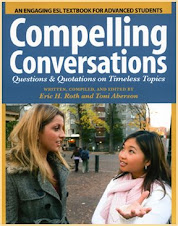
English, an optional language for a majority of the globe, remains a smart choice for our students. They have chosen to be English language learners. Compelling Conversations: Questions and Quotations on Timeless Topics helps English language learners go from students to authentic speakers. Speaking English opens many doors. Can you think of a door you would like to open for your students?
Saturday, May 3, 2008
Word Lovers and World Lovers Should Visit FreeRice.Com
As the price of rice, corn, and other basic food staples increased daily and food riots return to the headlines, we might want to reflect on ways to help the world’s poorest poor. One way that English teachers, dedicated students, and idealists can make a small contribution is by visiting www.FreeRice.com .
This outstanding educational site asks a wide range of vocabulary questions that often appear on standardized exams. Are you studying for the TOEFL, TOEIC, SAT, LSAT, or GRE? Are you trying to expand your English language vocabulary? Do you know relatives, friends, or co-workers in poor countries? Are you an English student, an ESL teacher, a language school administrator, or a global citizen? FreeRice provides practical assistance to adult education students, ESL teachers, immigrants, test takers, and refugees. FreeRice is a powerful vocabulary resource with 50 levels of vocabulary questions, and its addictive too!
Whether you are a word lover or a world lover, this site should appeal to you. For each correct answer, the site sponsors donate 20 grains of rice to the United Nations Food Program. Check Free Rice out, test your vocabulary skills, and make a small – yet significant – contribution today. Thanks!
“The satiated man and the hungry man do not see the same thing when they look upon a loaf of bread.”
Rumi (1207-1273), Persian poet
Ask more. Know more. Share more.
Create Compelling Conversations.
Visit www.CompellingConversations.com
Thursday, May 1, 2008
What are the 1000 most common words in English? Should you care?
Wiktionary, an offshoot of the wonderful Wikipedia, offers this answer . Looks, sounds, and feels right to me.
Do I recommend memorizing this list? No. Language is to be used, discovered, and enjoyed. Memorizing long lists of vocabulary words in English, while sometimes effective for standardized tests, seldom helps create compelling conversations.
Vocabulary lists, however, can provide a sense of satisfaction and order.
Should you care? Do you have to care? Sometimes lists like this can also help us review and trigger new connections. You probably want to know these words if you are planning to study in English at a university, college, or community college - but I wouldn't stress. Learning English takes time, and you will find the words that you need when you need them.
Yet exploring a personal interest in English will help you generate a more personal, authentic, and meaningful vocabulary in English. So what interests you today? What do you want to learn more about? Where can you find two quality articles on that topic? Why not create your own vocabulary list to match you and your interests? After all, shouldn't your vocabulary journal reflect you?
Rudyard Kipling (1865-1936), British author and Nobel Prize winner in Literature
Ask more. Know more. Share more.
Create Compelling Conversations.
Visit www.CompellingConversations.com
Thursday, April 24, 2008
Please speak a bit louder so I can hear you
Student conferences, especially with shy students worried about their grade or academic performance, can often be a bit awkward for both the professor and student. ESL students, sometimes insecure about their pronunciation or vocabulary, can feel particularly anxious. ESL teachers have to find ways to reduce student anxiety, provide a safe place for students to speak, provide feedback on student work, and uphold standards.
In general, I love student conferences because you get a chance to really work with a student on their writings and assignments. I often feel that I learn as much as I teach in these 20-30 minute conferences.
Sometimes, however, I have awkward conferences. If the student has plagiarized, then this can’t be avoided. Those moments, which I dread, can not be avoided. So it goes.
Yet sometimes, as occurred last semester, an ESL student is so shy, so timid, and so unsure that they speak so softly that I can’t even hear. Sometimes I lean forward and ask them to please speak a bit louder. If a student continues in the same low volume, I might apologize for my poor hearing and again request they speak up. What does one do on the third request?
“Please speak a bit louder so I can hear you.”
Was this too direct? I wanted to say, “If I can’t hear you, you will be misunderstood. I want to understand you. Speak up!!”
Patience, this time, paid off. The student raised her voice to an audible level, and replied, “okay.”
“Good to hear you,” I replied. We proceeded to have a productive end of semester conference.
Bottomline: students must speak up in conversations, conferences, and class discussions. Volume matters.
Ask more. Know more. Share more.
Create Compelling Conversations.
Visit www.CompellingConversations.com
Monday, April 21, 2008
Investing in quality ESL classes improves daily life
A good society helps its citizens flourish and visitors feel welcome.
A good society also invests in education, including teaching immigrants enough English that they can use their considerable intelligence, creativity, and skills in the workplace.
Unfortunately, low standards in public education have eroded support for government sponsored education programs. Worse, the few underfunded English as a Second Language programs usually provide the most basic English skills. Students learn to listen and read at about 4th grade level, and speak like a child with a very limited vocabulary.
From my perspective as an English instructor and former adult ESL teacher, the current adult ESL standards too often only teach immigrants passive skills like listening and some minimum reading. English language programs, whether designed for vocational skills or general language, must include speaking and writing. If people can’t hold a conversation in English, their job prospects remain rather limited!
A frontpage article in today’s Los Angeles Times points out the obvious problem.
When will the employers and voters decide to invest in real, serious, quality English languages for immigrants? And why are immigrants trained in English programs abroad so much stronger, better, and more effective than the adult ESL programs here? After all, immigrants have many more opportunities to speak English and learn outside of the classroom than students in
Again, the case for dramatically expanding and raising the standards of our English as a Second Language programs seems clear.
Unfortunately, reason and government policy do not always co-exist in the
Ask more. Know more. Share more.
Create Compelling Conversations.
Friday, April 18, 2008
Does Uncle Sam Want Immigrants to Learn English?
Learning to read, write, and speak English remains a legal requirement for legal immigrants to become citizens in the
Yet funding for English language classes, especially for adults, remains quite limited. Government programs only help students learn rather basic English, often around 1200 essential words. Students can "pass" all their ESL classes and learn enough English to hold low-level jobs. ESL students learn to listen more than speak, and read more than write. These low standards, by the way, also include a very, very low level definition of "can read, write, and speak" English for citizenship. (More on this subject in future posts.)
Many states, like
" Uncle Sam wants you to speak English" reads a popular bumper-sticker. Uncle Sam, the traditional symbol for the
I saw this bumper-sticker on the way back from an English teacher's conference again last week. I also wondered about the driver. Does he support helping immigrants learn English? Does he really think immigrants who don't speak English will understand his message? Would a Spanish speaking immigrant, for instance, know who Uncle Sam is? Or is the driver simply stating that immigrants - who might speak two, three, four, or more languages - should only speak English in the
Unfortunately, I never had a chance to talk with the gentleman who placed this provocative message on his car. I don't really know what he meant by his "Uncle Sam wants you to speak English" bumper-sticker. I hope, however, that he supports adding, not cutting, English language classes. We both would like more people to be able to speak to him and ask him questions in his best language too. How does the driver expect his wish to come true?
Perhaps if "Uncle Sam wants you to speak English", than he could find more ways to help immigrants and refugees learn English!
Create Compelling Conversations.
Visit www.compellingconversations.com .
Wednesday, April 16, 2008
Negative headlines and trendlines for ESL in California public schools
Yet the gap between "ought" and "is" remains very wide in Bush's America and in California's public schools.
The dollar continues to decline in value. The national budget, seldom balanced, has zoomed deep into mega-debt during the Bush II era with two expensive wars, a deepening recession, and record tax cuts for the wealthy. The
In
These abstract concerns about cutbacks took a very visible shape at the statewide California Teachers of English to Speakers of Other Languages convention last week. Total attendance was officially down by more than 25% since school districts had few available funds to send administrators, let alone teachers, to the conference. Yet I suspect the real numbers are far, far more dramatic than the reduction from 1600 t0 1200 attendees. Here are some signs of pervasive cutbacks:
- only a single school district recruited teachers
- the exhibition hall seemed like a ghost town
- publishers and vendors were eager to talk about the freezing of public education spending in many districts
- vendors expressed hope that teachers would buy even more supplies from their personal pockets
- many workshops collected rather sparse crowds
- the few job board postings were for summertime Intensive English Programs that attract private, international students
- the mood, despite many fantastic new educational resources and software programs, seemed very downbeat
Perhaps it's unfair to juxtapose a very hectic, chaotic international teachers' convention in
Teaching English, on a global level, continues to dramatically improve and expand. The development of new software for English language learners, better teaching techniques that respect students and encourage authentic communication, and the increase in international educational point to a better tomorrow. Meanwhile, the news from
Teaching at an elite private university in Los Angeles, I could pretend these cutbacks don't matter to me. Yet that's a dangerous illusion. The collapse of public education, especially for immigrants, will have both immediate and long-term consequences. The expanding gap between the wealthy who can afford a truly wonderful 21st century education and the expanding number of under-educated, over-stressed poor indicates a worsening future for too many Californians. As a stoic philosopher Epictetus noted so long ago, "only the educated are free."
As an American, a Californian, and an English teacher, I don't like the trendlines and headlines for American public education. Do you?
Ask more. Know more. Share more.
Create Compelling Conversations.
Visit www.compellingconversations.com
Thursday, April 10, 2008
Excellent ESL Teaching resources at TESOL convention
Time flies. Or, as the Romans used to say, "tempus fugit."
Five days after the TESOl convention in New York City ended, I'm finally having a chance to sort through the numerous books, doublecheck website leads, and evaluate materials that I picked up. Sometimes "the eyes are too hungry", and I went a bit overboard in collecting ESL materials and resources for advanced English language learners. Of course, English teachers love books, new curriculum materials, and free ESL materials. I also have the excuse of working as a consultant for a workplace ESL program so I went hunting for some particular products for healthcare workers.
Here is a short list of promising materials:
VSOE ideas from TESOL convention
- software and textbook designed for foreign doctors and nurses
- great reviews from professional journals (medical, language)
- Effective Practices in Workplace Language Training (TESOL)
- Getting Ahead in the
- New Citizenship DVD for future naturalization tests. This free DVD, perfect for adult educators, confirms that the new citizenship test will only require a "high beginning" level of ESL to qualify for American citizenship. Personally, I consider this an absurdly low standard that implies new American citizens can speak worse English than at least a half a billion English speakers outside of the United States, the United Kingdom, Canada, and Australia.
Of course, low standards have many fans in the world of adult education and with many immigrant groups. More on this topic later. - The Center for Applied Linguistics www.cal.org continues to offer wider and deeper variety of resources for ESL teachers, especially for adult education.
- I had several fascinating conversations about various English competency tests and their possible use in the workplace. The TOEIC test, on its merits, seems the strongest by far. Unfortunately, this test - used by millions in the workplace worldwide - has become almost forbidden due to lawsuits claiming discrimination in the United States. What does this mean? Millions of applicants and employees in Japan, Korea, Taiwan, France, Germany, and other non-English speaking countries have taken this test of English skills. Why? Because English has become a global language and competency in English has become an essential workplace skill.
- But not in the United States! So-called labor and civil rights activists have promoted the concept that requiring English proficiency, as tested by the TOEIC, is discrimination unless the ad explicitly states "English skills required." This strange situation means that American workers can, and so often do , speak at a lower level than educated workers in Asia and Europe. What's wrong with this picture!!!
- Software programs continue to become stronger day by day, minute by minute. English language learners, international ESL students, and adult ESL educators have more choices than ever. I will spend a solid chunk of time researching these language programs during my summer break. So far, however, it's clear that www.openbookenglish.com and www.spokenskills.com offer great values for administrators, teachers, and students. ESL teachers will also find www.lessonwriter.com a wonderful, innovative, and time-saving site.
Ask more. Know more. Share more.
Create Compelling Conversations.
Visit www.CompellingConversations.com
Thursday, March 27, 2008
Are you going to the TESOL convention next week?
Are you going to the TESOL conference next week? Did you see all those narrow, niche topics? Have you created a schedule? How did you decide which workshops to attend?
Personally, I found the selections simply overwhelming. For work, I'm going to focus on the workshops on testing language skilsl, especially oral skills and writing. For personal interest, I'll probably go to the workshops on technology and ESL. I might also wander into a few workshops on the internationalization of higher education. But consider me flexible. Do you have any recommendations?
For now, I’m playing it by ear.
Eric
eric@compellingconversations.com
www.compellingconversations.com
Subscribe to:
Posts (Atom)

 Posts
Posts