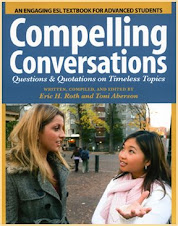
During these difficult economic times, English teachers should take every possible opportunity to focus on job interview skills. As blog readers know, I'm a big fan of both videotaping practice interviews and having ESL/EFL students conduct research for possible jobs with information interviews.
Here is an excellent, concise list of simple practical steps for English language learners to take when preparing for a job interview - and a few post-interview suggestions worth noting. The fine article comes from the Q Blog for English language learners. It's a fine resource. Check it out.
Official Q Blog: How to Succeed in an Interview
Ask more. Know more. Share more.
Create Compelling Conversations.
Visit www.CompellingConversations.com
Showing posts with label adult ESL. Show all posts
Showing posts with label adult ESL. Show all posts
Monday, March 23, 2009


Friday, January 30, 2009
More Ideas for Using Videoclips in English Lessons
Are you looking for more excellent videoclips for your English classes or private lessons?
As blog readers know, I'm a huge fan of encouraging students to find their own materials to summarize for homework on particular topics. For instance, students in my high intermediate oral skills found and reviewed videos offering advice on job interviews. Students emailed me their recommended clips with a short descriptive paragraph and a few sentences evaluating the video. Then I edited their writing, combined their reviews into a single document, and emailed the entire class the videoclips.
"Use or lose" was my comment. "Viewing these videoclips is an opportunity, not an obligation. Enjoy!" Almost every student chose to watch the videos and our 10-15 minute mock job interviews were quite strong. Allowing students to select their own materials lead to more authentic, student centered learning both in and out of the classroom.
Yet sometimes both students and teachers lack time. It's a real pleasure to have someone systematically collect and sort through potential video materials for class.
Hall Houston, the author of The Creative Classroom: Teaching Languages Outside the Box, recently posted about Jamie Keddie's excellent website TEFLclips.com on his blog:
Hall writes, "This website ( http://www.teflclips.com/ ) contains over 30 clever lesson plans for using video clips in the TEFL classroom. The lessons are well-written and contain teacher's notes and handouts. I am looking forward to using some of these lessons in my classes this year (2009)." As so often, I share Hall's tastes and concerns for creating a dynamic, creative classroom where students learn English and critical thinking skills.
By the way, Hall recently wrote a long, very positive review of Compelling Conversations: Questions and Quotations on Timeless Topics for English Teaching Professional. (Here's a shout out to Hall. Thanks for the review and tip on videoclips!)
We live in a wonderful time to teach English. The technology allows us to gently cajole students to become autotelic, or self-directed, in their studies. Teaching with videoclips, both as homework and in class, adds visual information and builds rapport with our 21st century English students.
Use it or lose it. You choose. Will video work in your class?
Ask more. Know more. Share more.
Create Compelling Conversations.
Visit www.CompellingConversations.com
As blog readers know, I'm a huge fan of encouraging students to find their own materials to summarize for homework on particular topics. For instance, students in my high intermediate oral skills found and reviewed videos offering advice on job interviews. Students emailed me their recommended clips with a short descriptive paragraph and a few sentences evaluating the video. Then I edited their writing, combined their reviews into a single document, and emailed the entire class the videoclips.
"Use or lose" was my comment. "Viewing these videoclips is an opportunity, not an obligation. Enjoy!" Almost every student chose to watch the videos and our 10-15 minute mock job interviews were quite strong. Allowing students to select their own materials lead to more authentic, student centered learning both in and out of the classroom.
Yet sometimes both students and teachers lack time. It's a real pleasure to have someone systematically collect and sort through potential video materials for class.
Hall Houston, the author of The Creative Classroom: Teaching Languages Outside the Box, recently posted about Jamie Keddie's excellent website TEFLclips.com on his blog:
Hall writes, "This website ( http://www.teflclips.com/ ) contains over 30 clever lesson plans for using video clips in the TEFL classroom. The lessons are well-written and contain teacher's notes and handouts. I am looking forward to using some of these lessons in my classes this year (2009)." As so often, I share Hall's tastes and concerns for creating a dynamic, creative classroom where students learn English and critical thinking skills.
By the way, Hall recently wrote a long, very positive review of Compelling Conversations: Questions and Quotations on Timeless Topics for English Teaching Professional. (Here's a shout out to Hall. Thanks for the review and tip on videoclips!)
We live in a wonderful time to teach English. The technology allows us to gently cajole students to become autotelic, or self-directed, in their studies. Teaching with videoclips, both as homework and in class, adds visual information and builds rapport with our 21st century English students.
Use it or lose it. You choose. Will video work in your class?
Ask more. Know more. Share more.
Create Compelling Conversations.
Visit www.CompellingConversations.com
Thursday, January 29, 2009
English Teaching Professional Reviews, Recommends Compelling Conversations!
Consider my global soul satisfied this morning!
English Teaching Professional, a glossy magazine for ESL teachers and language school directors, gave a glowing review and strong recommendation to Compelling Conversations: Questions and Quotations on Timeless Topics. "In sum, Compelling Conversations is a recommended resource for teachers who want to make their conversation classes more learner-centered," wrote reviewer Hall Houston. "It should be especially appealing to those who who to escape the confines of the Presentation-Practice-Production approach and do without a formal grammatical or functional syllabus. It reflects the authors' considerable professional experience, and would be a notable addition to any English teacher's bookshelf." The review also features a large copy of the book cover. Wow!
Houston also writes, "In my own teaching, I have found questions and quotations to be highly effective in promoting student discussion." The review continues. "Questions are useful in that they require a response from the listener. Asking them also helps students master the tricky rules of the interrogative."
"Quotations are brilliant flashes of wit expressed in the shortest space possible, often just a sentence or two," observes Houston. "The authors have compiled a formidable collection of quotations by famous people from Napoleon and Aristotle to Tom Cruise and Sylvester Stallone. Some will have the students roaring with laughter 'My movies were the kind they show in prisons and airplanes because nobody can leave.' - Burt Reynolds), while others require careful introspection ('Love is not just looking at each other; it's looking in the same direction.' - Antoine de Saint Exupery)."
The reviewer goes on. "The authors also add some wise proverbs here and there. My two favourites were 'Recite "patience" three times and it will spare you a murder' and 'When money talks, truth keeps silent', which are from Korea and Russia."
My co-author Toni Aberson appreciated that Houston, an English teacher and writer in Luzhu, Taiwan wrote the review in a British magazine about a book self-published in the United States. This international element adds a special delight to a long, three column review. "I just love it!", exclaimed Aberson. We certainly live in a wonderful time to be English teachers.
While I my copy of English Teaching Professional two days ago, the January 2009 issue has been out for at least a week. The review appears on p.44 in Issue 60. Subscribers can access the full review at www.ETProfessional.com .
This positive book review might help explain the recent surge of class set orders. It also helps explain the sudden collection of emails and calls from Vietnam, Russia, Italy, and Canada in the last week about Compelling Conversations and possible collaborations. The appreciation of fellow ESL professionals gives me additional confidence, joy, and popularity. Sweet!
Today, the sun is shining and life is good.
Ask more. Know more. Share more.
Create Compelling Conversations.
Visit www.CompellingConversations.com
English Teaching Professional, a glossy magazine for ESL teachers and language school directors, gave a glowing review and strong recommendation to Compelling Conversations: Questions and Quotations on Timeless Topics. "In sum, Compelling Conversations is a recommended resource for teachers who want to make their conversation classes more learner-centered," wrote reviewer Hall Houston. "It should be especially appealing to those who who to escape the confines of the Presentation-Practice-Production approach and do without a formal grammatical or functional syllabus. It reflects the authors' considerable professional experience, and would be a notable addition to any English teacher's bookshelf." The review also features a large copy of the book cover. Wow!
Houston also writes, "In my own teaching, I have found questions and quotations to be highly effective in promoting student discussion." The review continues. "Questions are useful in that they require a response from the listener. Asking them also helps students master the tricky rules of the interrogative."
"Quotations are brilliant flashes of wit expressed in the shortest space possible, often just a sentence or two," observes Houston. "The authors have compiled a formidable collection of quotations by famous people from Napoleon and Aristotle to Tom Cruise and Sylvester Stallone. Some will have the students roaring with laughter 'My movies were the kind they show in prisons and airplanes because nobody can leave.' - Burt Reynolds), while others require careful introspection ('Love is not just looking at each other; it's looking in the same direction.' - Antoine de Saint Exupery)."
The reviewer goes on. "The authors also add some wise proverbs here and there. My two favourites were 'Recite "patience" three times and it will spare you a murder' and 'When money talks, truth keeps silent', which are from Korea and Russia."
My co-author Toni Aberson appreciated that Houston, an English teacher and writer in Luzhu, Taiwan wrote the review in a British magazine about a book self-published in the United States. This international element adds a special delight to a long, three column review. "I just love it!", exclaimed Aberson. We certainly live in a wonderful time to be English teachers.
While I my copy of English Teaching Professional two days ago, the January 2009 issue has been out for at least a week. The review appears on p.44 in Issue 60. Subscribers can access the full review at www.ETProfessional.com .
This positive book review might help explain the recent surge of class set orders. It also helps explain the sudden collection of emails and calls from Vietnam, Russia, Italy, and Canada in the last week about Compelling Conversations and possible collaborations. The appreciation of fellow ESL professionals gives me additional confidence, joy, and popularity. Sweet!
Today, the sun is shining and life is good.
Ask more. Know more. Share more.
Create Compelling Conversations.
Visit www.CompellingConversations.com
Friday, January 23, 2009
Cultivate Student Curiosity in ESL Classes - and Homework Assignments
Cultivate Student Curiosity in ESL Classes
“Curiosity is the best teacher,” goes the ancient proverb. Push your English language students to develop their own interests and passions. ESL students- adult, high school, or college - will remember the language they want and need to know to deepen their life experiences in English
Ironically, our job remains helping students become autotelic – or self-directed. Encouraging students to find and create their own vocabulary logs is just one useful, too seldom used technique in English language classrooms.
My standard homework assignment for English students remains having students find, summarize, and present newspaper articles on a topic (elections, housing, job interviews). The worksheet asks them to list core citation information, summarize the main idea, identify the best supporting evidence, etc. The worksheet also includes finding five new vocabulary words or phrases and writing new sentences. When the students complete their homework, they get together in groups of four and "present" their articles. I circulate around the room checking homework and having small chats. Students, meanwhile, build their own vocabulary logs from their own readings and discussions – and deepen their own interests.
Once students master the format, they choose both the subject and articles. In my high-intermediate writing course for international students, these homework readings provide the foundation for their research papers and final project. Students soon move beyond the worksheets and simply provide concise article summaries and evaluations.
Bottomline: We must find ways to gently cajole students to take responsibility for their own education – and become more self-directed.
Ask more. Know more. Share more.
Create Compelling Conversations.
Visit www.CompellingConversations.com
“Curiosity is the best teacher,” goes the ancient proverb. Push your English language students to develop their own interests and passions. ESL students- adult, high school, or college - will remember the language they want and need to know to deepen their life experiences in English
Ironically, our job remains helping students become autotelic – or self-directed. Encouraging students to find and create their own vocabulary logs is just one useful, too seldom used technique in English language classrooms.
My standard homework assignment for English students remains having students find, summarize, and present newspaper articles on a topic (elections, housing, job interviews). The worksheet asks them to list core citation information, summarize the main idea, identify the best supporting evidence, etc. The worksheet also includes finding five new vocabulary words or phrases and writing new sentences. When the students complete their homework, they get together in groups of four and "present" their articles. I circulate around the room checking homework and having small chats. Students, meanwhile, build their own vocabulary logs from their own readings and discussions – and deepen their own interests.
Once students master the format, they choose both the subject and articles. In my high-intermediate writing course for international students, these homework readings provide the foundation for their research papers and final project. Students soon move beyond the worksheets and simply provide concise article summaries and evaluations.
Bottomline: We must find ways to gently cajole students to take responsibility for their own education – and become more self-directed.
Ask more. Know more. Share more.
Create Compelling Conversations.
Visit www.CompellingConversations.com
Saturday, January 10, 2009
How Many American Adults Can't Read this Blog? Literally Can't Read This Blog!
How Many American Adults Can’t Read this Blog?
How many American adults can’t read a simple newspaper article, understand warning labels, or write an effective complaint letter? Take a guess. Five million adults? Ten million adults? Twelve million adults?
According to a new federal study, an estimated 35 million American adults remain functionally illiterate in 2009.
Greg Toppo told part of the depressing story yesterday in an excellent, concise USA TODAY frontpage article. Title? Literacy Study: 1 in 7 U.S. adults are unable to read this story. “A long-awaited federal study finds that an estimated 32 million adults in the USA — about one in seven — are saddled with such low literacy skills that it would be tough for them to read anything more challenging than a children's picture book.”
Is the situation improving? NO! “From 1992 to 2003, it shows, the USA added about 23 million adults to its population; in that period, an estimated 3.6 million more joined the ranks of adults with low literacy skills.” A U.S. Education Department expert explains. “"They really cannot read … paragraphs (or) sentences that are connected,"
USA TODAY deserves credit for bringing more attention than usual to this avoidable tragedy. President John F. Kennedy famously noted that “a child miseducated is a child lost.” Those "lost children" have become adults!
So how can we explain these shocking (yet very familiar to experts) findings? How is this possible? Why is this awful situation tolerated? Please don’t tell me that there is a lack of money because the federal government just gave away – without conditions or even pretense of accountability - $350 BILLION dollars to wealthy banks and mega international corporations.
The American public education system is failing on multiple levels. Adult education remains the stepchild of public education. Underfunded, often overlooked, and seldom appreciated, adult education plays a vital role in teaching essential life skills – including reading and writing – to thousands. Thousands of adult educators work long hours in stressful jobs, often part-time without fulltime benefits, to help high school dropouts prepare for a GED and new immigrants learn English. Yet the gap between the objective educational needs and funding to provide a real first world education to these struggling Americans remains huge.
Will President Obama address this widespread, documented crisis in public education? Perhaps.
Consider me, as so often, a sceptic.
Ask more. Know more. Share more.
Create Compelling Conversations.
Visit www.CompellingConversations.com
How many American adults can’t read a simple newspaper article, understand warning labels, or write an effective complaint letter? Take a guess. Five million adults? Ten million adults? Twelve million adults?
According to a new federal study, an estimated 35 million American adults remain functionally illiterate in 2009.
Greg Toppo told part of the depressing story yesterday in an excellent, concise USA TODAY frontpage article. Title? Literacy Study: 1 in 7 U.S. adults are unable to read this story. “A long-awaited federal study finds that an estimated 32 million adults in the USA — about one in seven — are saddled with such low literacy skills that it would be tough for them to read anything more challenging than a children's picture book.”
Is the situation improving? NO! “From 1992 to 2003, it shows, the USA added about 23 million adults to its population; in that period, an estimated 3.6 million more joined the ranks of adults with low literacy skills.” A U.S. Education Department expert explains. “"They really cannot read … paragraphs (or) sentences that are connected,"
USA TODAY deserves credit for bringing more attention than usual to this avoidable tragedy. President John F. Kennedy famously noted that “a child miseducated is a child lost.” Those "lost children" have become adults!
So how can we explain these shocking (yet very familiar to experts) findings? How is this possible? Why is this awful situation tolerated? Please don’t tell me that there is a lack of money because the federal government just gave away – without conditions or even pretense of accountability - $350 BILLION dollars to wealthy banks and mega international corporations.
The American public education system is failing on multiple levels. Adult education remains the stepchild of public education. Underfunded, often overlooked, and seldom appreciated, adult education plays a vital role in teaching essential life skills – including reading and writing – to thousands. Thousands of adult educators work long hours in stressful jobs, often part-time without fulltime benefits, to help high school dropouts prepare for a GED and new immigrants learn English. Yet the gap between the objective educational needs and funding to provide a real first world education to these struggling Americans remains huge.
Will President Obama address this widespread, documented crisis in public education? Perhaps.
Consider me, as so often, a sceptic.
Ask more. Know more. Share more.
Create Compelling Conversations.
Visit www.CompellingConversations.com
Saturday, November 15, 2008
Talking About Urban Pleasures, Perils in ESL Classrooms
Cities attract the young, the strong, and the ambitious. Cities also provide housing, jobs, and hope for those fleeing boredom, economic crisis, and war. Our 21st century cities, like our English classrooms, reflect the diversity of the human experience.
Millions move from the countryside and across the globe to live in new cities every year. Cities provide employment, culture, and education. Cities are exciting. Yet, sometimes danger also lurks in cities. Many students struggle with economic pressures, culture shock, and criminal activity. Shouldn't we discuss these conflicting pressures in our ESL classrooms?
Teaching English in Los Angeles and Santa Monica I’ve found that students, who come from across the globe, eager to talk about cities. Some English students share stories about moving from rural areas and small towns to an international city; other students enjoy telling about their travel experiences. Discussions naturally touch on housing, employment, and lifestyle choices. English language learners – whether adult immigrants creating a new home or university students living abroad – can reflect on their experiences and share insights discussing urban life.
Are you a city person? Why?
How are cities different from small towns?
What cities have you visited? Lived in?
What attracted you to this city?
What do you find stressful about city life?
What do you find satisfying about living in a city?
This month Exploring Cities, one of my favorite chapters, is highlighted as a free chapter on Compelling Conversations. Perhaps you will create some compelling conversations about cities in your classroom too. Check it out.
Ask more. Know more. Share more.
Create Compelling Conversations.
Visit www.CompellingConversations.com
Millions move from the countryside and across the globe to live in new cities every year. Cities provide employment, culture, and education. Cities are exciting. Yet, sometimes danger also lurks in cities. Many students struggle with economic pressures, culture shock, and criminal activity. Shouldn't we discuss these conflicting pressures in our ESL classrooms?
Teaching English in Los Angeles and Santa Monica I’ve found that students, who come from across the globe, eager to talk about cities. Some English students share stories about moving from rural areas and small towns to an international city; other students enjoy telling about their travel experiences. Discussions naturally touch on housing, employment, and lifestyle choices. English language learners – whether adult immigrants creating a new home or university students living abroad – can reflect on their experiences and share insights discussing urban life.
Are you a city person? Why?
How are cities different from small towns?
What cities have you visited? Lived in?
What attracted you to this city?
What do you find stressful about city life?
What do you find satisfying about living in a city?
This month Exploring Cities, one of my favorite chapters, is highlighted as a free chapter on Compelling Conversations. Perhaps you will create some compelling conversations about cities in your classroom too. Check it out.
Ask more. Know more. Share more.
Create Compelling Conversations.
Visit www.CompellingConversations.com
Wednesday, November 12, 2008
Easy English Times Publishes "Reading Pleasures" as Conversation Activity
Easy English Times, an adult education newspaper for English language learners published in California, adapts a chapter from Compelling Conversations each month. The editors selected "Reading Pleasures", one of my favorite chapters, to run in their November-December issue. Since Easy English Times focuses on the needs of beginning and intermediate ESL students, the editor selects the most accessible sections and adds dictionary definitions, creating a satisfying instant conversation activity.
Here is the Easy English Times Instant Activity for November-December.
Instant activity: Conversation
-----------------------------------------------------------------------------------
Reading pleasures and tastes
The activities below come from a book for English as a second language learners by Eric Roth and Toni Aberson. The title is "Compelling Conversations: Questions and Quotations on Timeless Topics." (See ad on this page.)
Exchanging views: Reading is a solitary* activity, yet it can bring people together in conversation. Interview your partner and exchange reading experiences.
1. What are some books that you have read and enjoyed?
2. Have you ever re-read a book? Which? Why? How many times?
3. Do you have a library card? Do you like to browse* in bookstores?
4. Have you ever been in a book club? What kinds of books do/did you read in the book club?
5. Did your mother or other family member read to you as a child? Did you have a favorite story? What was it?
6. Where did you first learn to read? At home? At school?
7. What were your favorite books as a child? Who was your favorite author? Why?
8. As a teenager, did you have any favorite books, comics, or magazines? Can you describe them?
9. Which magazines or newspapers do you scan now*? Why?
10. Who are some famous writers from your country?
11. Can you think of some movies that are adapted from novels?
12. Do you prefer reading fiction or non-fiction? Why?
13. Do you have a favorite writer or poet? Who?
14. Did you have to memorize any poems in school? Which?
15. Have your read any good biographies? Memoirs*? Self-help books?
16. Are you reading a book now? What is it? Can you describe it?
17. Do you think books and magazines make good gifts? Why?
18. What book are you planning to read in the near future?
Quotations: Memorize your favorite quotation and author's name. Share it with someone.
1. "Reading is to the mind, what exercise is to the body." --Richard Steele (1672-1729), Irish writer
2. "No entertainment is so cheap as reading, nor any pleasure so lasting*." --Lady Mary Wortley Montagu (1689-1762), British author/critic
3. "The pleasure of all reading is doubled* when one lives with another who shares the same books." --Katherine Mansfield (1888-1923), short story writer and poet
4. "However many holy words you read, however many you speak, what good will they do you if you do not act upon them?" --Buddha (563-483 BC), founder of Buddhism
5. "Read the best books first, or you may not have a chance to read them all." --Henry David Thoreau (1817-1862), essayist
6. "I would rather be poor in a cottage* full of books than a king without the desire to read." --Thomas B. Macaulay (1800-1859), historian
7. "A book should serve as the ax* for the frozen sea within us." --Franz Kafka (1883-1924), novelist
8. "Any book that helps a child to form the habit of reading, to make reading one of his deep and continuing needs, is good for him." --Maya Angelou (1928-), American poet
9. "A truly great book should be read in youth*, again in maturity and once more in old age, as a fine building should be seen by morning light, at noon and by moonlight." --Robertson Davies (1913-1995), Canadian novelist
On your own: Bring in a book which is important to you. Show the book to the class. Tell them the author, the title, and the reason why this book is important to you.
VOCABULARY HELP*
ax - An ax is a tool for cutting wood.
browse - If you browse in a store, you look at things in a casual way, in the hope that you might find something you like.
cottage - A cottage is a small house, usually in the country.
doubled - When something doubles or when you doubled it, it becomes twice as great in number, amount, or size.
essays - Essays are short pieces of writing on a particular subject.
lasting - You can use lasting to describe a situation, result, or agreement that continues to exist or have an effect for a very long time.
memoirs - A person's memoirs are a written account of the people who they have known and events that they remember.
scan - When you scan written material, you look through it quickly in order to find important or interesting information.
solitary - A solitary activity is one that you do alone.
youth - Someone's youth is the period of their life during which they are a child, before they are a fully mature adult.
*Definitions from the Collins COBUILD Intermediate Dictionary of American English, published by Heinle, a part of Cengage Learning © 2008 and the Newbury House Dictionary of American English 4th edition, by Rideout. © 2004 Monroe Allen Publishers. Heinle, a part of Cengage Learning enjoys an exclusive license with respect to the copyright and all the exclusive rights comprised in the copyright in the work and all revisions thereof.
--------------------------------------------------------------------------------
I love these monthly columns because they keep me connected to adult education and my decade of teaching immigrants and refugees in Los Angeles and Santa Monica. The atmosphere in those classrooms, where everyone volunteered and no one worried about grades, is something quite special. We were just adults sharing our experiences, insights, and languages.
Ask more. Know more. Share more.
Create Compelling Conversations.
Visit www.CompellingConversations.com
Here is the Easy English Times Instant Activity for November-December.
Instant activity: Conversation
-----------------------------------------------------------------------------------
Reading pleasures and tastes
The activities below come from a book for English as a second language learners by Eric Roth and Toni Aberson. The title is "Compelling Conversations: Questions and Quotations on Timeless Topics." (See ad on this page.)
Exchanging views: Reading is a solitary* activity, yet it can bring people together in conversation. Interview your partner and exchange reading experiences.
1. What are some books that you have read and enjoyed?
2. Have you ever re-read a book? Which? Why? How many times?
3. Do you have a library card? Do you like to browse* in bookstores?
4. Have you ever been in a book club? What kinds of books do/did you read in the book club?
5. Did your mother or other family member read to you as a child? Did you have a favorite story? What was it?
6. Where did you first learn to read? At home? At school?
7. What were your favorite books as a child? Who was your favorite author? Why?
8. As a teenager, did you have any favorite books, comics, or magazines? Can you describe them?
9. Which magazines or newspapers do you scan now*? Why?
10. Who are some famous writers from your country?
11. Can you think of some movies that are adapted from novels?
12. Do you prefer reading fiction or non-fiction? Why?
13. Do you have a favorite writer or poet? Who?
14. Did you have to memorize any poems in school? Which?
15. Have your read any good biographies? Memoirs*? Self-help books?
16. Are you reading a book now? What is it? Can you describe it?
17. Do you think books and magazines make good gifts? Why?
18. What book are you planning to read in the near future?
Quotations: Memorize your favorite quotation and author's name. Share it with someone.
1. "Reading is to the mind, what exercise is to the body." --Richard Steele (1672-1729), Irish writer
2. "No entertainment is so cheap as reading, nor any pleasure so lasting*." --Lady Mary Wortley Montagu (1689-1762), British author/critic
3. "The pleasure of all reading is doubled* when one lives with another who shares the same books." --Katherine Mansfield (1888-1923), short story writer and poet
4. "However many holy words you read, however many you speak, what good will they do you if you do not act upon them?" --Buddha (563-483 BC), founder of Buddhism
5. "Read the best books first, or you may not have a chance to read them all." --Henry David Thoreau (1817-1862), essayist
6. "I would rather be poor in a cottage* full of books than a king without the desire to read." --Thomas B. Macaulay (1800-1859), historian
7. "A book should serve as the ax* for the frozen sea within us." --Franz Kafka (1883-1924), novelist
8. "Any book that helps a child to form the habit of reading, to make reading one of his deep and continuing needs, is good for him." --Maya Angelou (1928-), American poet
9. "A truly great book should be read in youth*, again in maturity and once more in old age, as a fine building should be seen by morning light, at noon and by moonlight." --Robertson Davies (1913-1995), Canadian novelist
On your own: Bring in a book which is important to you. Show the book to the class. Tell them the author, the title, and the reason why this book is important to you.
VOCABULARY HELP*
ax - An ax is a tool for cutting wood.
browse - If you browse in a store, you look at things in a casual way, in the hope that you might find something you like.
cottage - A cottage is a small house, usually in the country.
doubled - When something doubles or when you doubled it, it becomes twice as great in number, amount, or size.
essays - Essays are short pieces of writing on a particular subject.
lasting - You can use lasting to describe a situation, result, or agreement that continues to exist or have an effect for a very long time.
memoirs - A person's memoirs are a written account of the people who they have known and events that they remember.
scan - When you scan written material, you look through it quickly in order to find important or interesting information.
solitary - A solitary activity is one that you do alone.
youth - Someone's youth is the period of their life during which they are a child, before they are a fully mature adult.
*Definitions from the Collins COBUILD Intermediate Dictionary of American English, published by Heinle, a part of Cengage Learning © 2008 and the Newbury House Dictionary of American English 4th edition, by Rideout. © 2004 Monroe Allen Publishers. Heinle, a part of Cengage Learning enjoys an exclusive license with respect to the copyright and all the exclusive rights comprised in the copyright in the work and all revisions thereof.
--------------------------------------------------------------------------------
I love these monthly columns because they keep me connected to adult education and my decade of teaching immigrants and refugees in Los Angeles and Santa Monica. The atmosphere in those classrooms, where everyone volunteered and no one worried about grades, is something quite special. We were just adults sharing our experiences, insights, and languages.
Ask more. Know more. Share more.
Create Compelling Conversations.
Visit www.CompellingConversations.com
Thursday, September 25, 2008
California Immigrants Are Learning English - and Want to Speak English Better!
Do American immigrants want to learn English? Are the children of Spanish-speaking adult immigrants learning English? What are the recent trends in California and Los Angeles?
A recently released Census Bureau report, based on the 2007 Census information, shows that – shock, shock – immigrants overwhelmingly want to improve their English skills. It also shows that a slight majority (51%) of immigrants in Los Angeles claim that they can speak English fluently – an increase from just a few years ago. The study also notes that 88% of immigrant children claim to speak English – and want to learn more.
Yesterday’s Los Angeles Times editorial “Speak English? Yes, more immigrants do “ provides a solid introduction to the heated debate over language and immigration in California. The editorial also argues that immigration reform should include a provision to keep families united so the American children of illegal immigrant parents are not separated from their parents. Finally, the editorial concludes that both the United States and the English language continue to evolve and Americans should embrace change.
The fine editorial, however, could and should have called for both expanding and improving the quality of public education programs so immigrants – including adult immigrants - can learn English quicker. A better Census report also would have included the legal status of immigrants and gone beyond self-reported data by immigrants with evolving language skills.
The editorial’s strong, humane conclusion is worth repeating verbatim:
“American culture grows and adapts as new immigrants redefine it over the generations, and the same can be said of the English language. We should embrace that evolution, not hold it at bay with false and alarmist arguments about the threat to American values.”
Los Angeles Times, September 24, 2008 editorial
Doesn’t that sound sane and civilized?
Ask more. Know more. Share more.
Create Compelling Conversations.
Visit www.CompellingConversations.com
A recently released Census Bureau report, based on the 2007 Census information, shows that – shock, shock – immigrants overwhelmingly want to improve their English skills. It also shows that a slight majority (51%) of immigrants in Los Angeles claim that they can speak English fluently – an increase from just a few years ago. The study also notes that 88% of immigrant children claim to speak English – and want to learn more.
Yesterday’s Los Angeles Times editorial “Speak English? Yes, more immigrants do “ provides a solid introduction to the heated debate over language and immigration in California. The editorial also argues that immigration reform should include a provision to keep families united so the American children of illegal immigrant parents are not separated from their parents. Finally, the editorial concludes that both the United States and the English language continue to evolve and Americans should embrace change.
The fine editorial, however, could and should have called for both expanding and improving the quality of public education programs so immigrants – including adult immigrants - can learn English quicker. A better Census report also would have included the legal status of immigrants and gone beyond self-reported data by immigrants with evolving language skills.
The editorial’s strong, humane conclusion is worth repeating verbatim:
“American culture grows and adapts as new immigrants redefine it over the generations, and the same can be said of the English language. We should embrace that evolution, not hold it at bay with false and alarmist arguments about the threat to American values.”
Los Angeles Times, September 24, 2008 editorial
Doesn’t that sound sane and civilized?
Ask more. Know more. Share more.
Create Compelling Conversations.
Visit www.CompellingConversations.com
Thursday, September 11, 2008
Revising the ESL Curriculum and Finding Solace with Quotes
“Do what you can, with what you have, where you are,” advised President Theodore (Teddy) Roosevelt. These words of solace often comfort me when I stress myself out trying to cram too much material into lessons.
How can I cover everything that I want in a single semester? It’s just impossible. For every new activity, I must let an old one go. If I add a Youtube homework assignment, than I should eliminate another homework assignment to maintain the balance. For instance, I asked every student to find and review a YouTube video on interview skills so I had to cut the assignment where students found and summarize an article on job hunting skills.
By the way, the international graduate English students found and reviewed a wonderful collection of smart, informative, current, and funny videos. Then I combined into a single email for the entire class with one of my own selections. On their own time and initiative, students watched many of the videos leading to the best mock job interviews that I’ve seen at the intermediate speaking skill level yet. Again, a democratic classroom atmosphere often creates a far more interesting and effective classroom.
As I continue to plan, adjust, and readjust assignments, I once again find solace in these words. Yet these continual curriculum revisions remain voluntary tasks in pursuit of excellence. “A problem,” noted Duke Ellington, “is a chance for you to do your best.”
Ask more. Know more. Share more.
Create Compelling Conversations.
Visit www.CompellingConversations.com
How can I cover everything that I want in a single semester? It’s just impossible. For every new activity, I must let an old one go. If I add a Youtube homework assignment, than I should eliminate another homework assignment to maintain the balance. For instance, I asked every student to find and review a YouTube video on interview skills so I had to cut the assignment where students found and summarize an article on job hunting skills.
By the way, the international graduate English students found and reviewed a wonderful collection of smart, informative, current, and funny videos. Then I combined into a single email for the entire class with one of my own selections. On their own time and initiative, students watched many of the videos leading to the best mock job interviews that I’ve seen at the intermediate speaking skill level yet. Again, a democratic classroom atmosphere often creates a far more interesting and effective classroom.
As I continue to plan, adjust, and readjust assignments, I once again find solace in these words. Yet these continual curriculum revisions remain voluntary tasks in pursuit of excellence. “A problem,” noted Duke Ellington, “is a chance for you to do your best.”
Ask more. Know more. Share more.
Create Compelling Conversations.
Visit www.CompellingConversations.com
Saturday, September 6, 2008
Why do school boards so often make problematic decisions?
"God made the idiot for practice. Then he made school boards."
Mark Twain (1835-1910), American novelist and humorist
As the quality of American public schools continues to decline and more classes and program get cutback, this quip remains painfully current.
Ask more. Know more. Share more.
Create Compelling Conversations.
Visit www.CompellingConversations.com
Mark Twain (1835-1910), American novelist and humorist
As the quality of American public schools continues to decline and more classes and program get cutback, this quip remains painfully current.
Ask more. Know more. Share more.
Create Compelling Conversations.
Visit www.CompellingConversations.com
Friday, September 5, 2008
A new semester, new English students, and new forms
What are you doing differently this semester in your English class?
As a new semester begins, I face the familiar task - and pleasure - of selecting new materials and creating new forms for my oral skills class. One goal is to have students use the internet more; another to provide more opportunities for peer feedback on oral presentations.
Although I do not have a conversation class this semester, I do teach a high intermediate oral skills class that focuses on academic presentations. The students come from several Asian countries and are all graduate students - almost exclusively in engineering. Workplace surveys continue to identify communication skills, including speaking skills, as a top priority for employers - especially in engineering!
The class will include several informal, short presentations in addition to the longer, more formal presentations that receive a grade. Whenever possible, I prefer to give students to receive fairly immediate feedback, from their peers and me, on their presentations. Students, as a result, will read peer evaluations from the entire class after giving a short presentation like a product review, extended definition, or process description. To be effective, the form must be both simple and open… with some guidance. This collective feedback often validates instructor comments and prepares students to view their videotaped presentations in a more objective manner.
Here is my new form for peer evaluations of oral presentations.It emphasizes the positive aspects, inquires about what can be improved, allows more detailed observations, and provides a simple rating system. I have used a similar format with my engineering communication courses and expect that it will work in my ESL class too. Time will tell.
Feel free to copy, modify, or share the form to fit your ESL/EFL/speech classroom needs.
————————————————————————————-
STUDENT: ____________________________________________________
TOPIC: ____________________________________________________
PEER: ____________________________________________________
GOOD TO SEE:
POINTS TO WORK ON:
BEST PART:
WEAKEST PART:
OTHER OBSERVATIONS/TIPS:
Please circle the appropriate overall rating:
1 2 3 4 5 6 7 8 9 10
Ask more. Know more. Share more.
Create Compelling Conversations.
Visit www.CompellingConversations.com
As a new semester begins, I face the familiar task - and pleasure - of selecting new materials and creating new forms for my oral skills class. One goal is to have students use the internet more; another to provide more opportunities for peer feedback on oral presentations.
Although I do not have a conversation class this semester, I do teach a high intermediate oral skills class that focuses on academic presentations. The students come from several Asian countries and are all graduate students - almost exclusively in engineering. Workplace surveys continue to identify communication skills, including speaking skills, as a top priority for employers - especially in engineering!
The class will include several informal, short presentations in addition to the longer, more formal presentations that receive a grade. Whenever possible, I prefer to give students to receive fairly immediate feedback, from their peers and me, on their presentations. Students, as a result, will read peer evaluations from the entire class after giving a short presentation like a product review, extended definition, or process description. To be effective, the form must be both simple and open… with some guidance. This collective feedback often validates instructor comments and prepares students to view their videotaped presentations in a more objective manner.
Here is my new form for peer evaluations of oral presentations.It emphasizes the positive aspects, inquires about what can be improved, allows more detailed observations, and provides a simple rating system. I have used a similar format with my engineering communication courses and expect that it will work in my ESL class too. Time will tell.
Feel free to copy, modify, or share the form to fit your ESL/EFL/speech classroom needs.
————————————————————————————-
STUDENT: ____________________________________________________
TOPIC: ____________________________________________________
PEER: ____________________________________________________
GOOD TO SEE:
POINTS TO WORK ON:
BEST PART:
WEAKEST PART:
OTHER OBSERVATIONS/TIPS:
Please circle the appropriate overall rating:
1 2 3 4 5 6 7 8 9 10
Ask more. Know more. Share more.
Create Compelling Conversations.
Visit www.CompellingConversations.com
Saturday, August 16, 2008
How do you teach the difference between "make" and "do" in your English classes?
Make vs. Do
What do you do? What do you make?
These simple words cause lots of confusion for English language learners. I’ve spent time helping a very wide range of ESL classes – from advanced adult education and community college students to intermediate English students in summer courses and regular university courses – struggle with idioms with “make” and “do.”
Here is a quick, imprecise guide that helps clarify the issue.
Look at some common expressions with “do”.
• Do the dishes.
• Do some chores.
• Do your work.
• Do exercises.
• Do your best.
• Do it over.
• Do the report.
Do is used to describe an activity that you have to do, often over and over again. For instance, we “do the dishes” and “do the laundry” many times. Do also contains an element of duty and responsibility.
Now, take a look at some expressions with “make”.
• Please make time.
• You make dinner.
• You make drawings.
• You make decisions.
• You make plans.
• Your make reservations.
• You make money.
• You make friends.
Make is used to describe a creative activity or something you choose to do. You choose, for instance, to make plans, make friends, and make decisions. You have choices.
Why do we say “make dinner” if we have to do it over and over? Perhaps because cooking is seen more as a creative activity than a chore. But cleaning the table, and cleaning the dishes are just chores so we say “do the table” and “do the dishes.” That’s also why Americans say “make money” instead of “do money.” Making money is seen as both creative and a choice. Idioms are cultural. Sometimes Americans will use the verb “make” in a way that might seem strange, but “make a decision” to “do your best” and learn practical workplace expressions.
Finally, I encourage students to work together in small groups and create their own list of idioms with make and do. When I’m lucky and have time, I like to ask students to come to the white board and write their collection of idioms on the board. Homework, of course, is asking them to choose 5-10 idioms and write complete sentences.
So how do you teach the difference between do and make to your English students?
Ask more. Know more. Share more.
Create Compelling Conversations.
Visit www.CompellingConversations.com
What do you do? What do you make?
These simple words cause lots of confusion for English language learners. I’ve spent time helping a very wide range of ESL classes – from advanced adult education and community college students to intermediate English students in summer courses and regular university courses – struggle with idioms with “make” and “do.”
Here is a quick, imprecise guide that helps clarify the issue.
Look at some common expressions with “do”.
• Do the dishes.
• Do some chores.
• Do your work.
• Do exercises.
• Do your best.
• Do it over.
• Do the report.
Do is used to describe an activity that you have to do, often over and over again. For instance, we “do the dishes” and “do the laundry” many times. Do also contains an element of duty and responsibility.
Now, take a look at some expressions with “make”.
• Please make time.
• You make dinner.
• You make drawings.
• You make decisions.
• You make plans.
• Your make reservations.
• You make money.
• You make friends.
Make is used to describe a creative activity or something you choose to do. You choose, for instance, to make plans, make friends, and make decisions. You have choices.
Why do we say “make dinner” if we have to do it over and over? Perhaps because cooking is seen more as a creative activity than a chore. But cleaning the table, and cleaning the dishes are just chores so we say “do the table” and “do the dishes.” That’s also why Americans say “make money” instead of “do money.” Making money is seen as both creative and a choice. Idioms are cultural. Sometimes Americans will use the verb “make” in a way that might seem strange, but “make a decision” to “do your best” and learn practical workplace expressions.
Finally, I encourage students to work together in small groups and create their own list of idioms with make and do. When I’m lucky and have time, I like to ask students to come to the white board and write their collection of idioms on the board. Homework, of course, is asking them to choose 5-10 idioms and write complete sentences.
So how do you teach the difference between do and make to your English students?
Ask more. Know more. Share more.
Create Compelling Conversations.
Visit www.CompellingConversations.com
Thursday, August 14, 2008
Do your EL/Civics students know about the electoral college?
How could George W. Bush be elected President of the United States? Really.
Let me be more precise. How could Al Gore win the popular vote and still lose the 2000 U.S. Presidential election to the second George Bush? The short, unpleasant answer is that the popular vote doesn’t count – and the only vote that matters in electing presidents in the United States is the electoral college.
What is the electoral college? How many votes does your state have in the real United States presidential election? If you teach U.S. history, EL/Civics, or just vote in U.S. elections, you already know these answers – and your students and friends should too!
Check out the easy to use electoral college map hosted by the Los Angeles Times.
Among the many interesting features is that the default setting, based on the 2004 U.S. Presidential election, shows Senator McCain with a clear electoral college advantage over Senator Obama. Amidst the daily national polls, it’s easy for U.S. citizens – let alone adult immigrants and citizenship students – to forget this vital fact. You can also go to the fine Wikipedia article on the peculiar history and strange institution called the United_States_Electoral_College.
By the way, I’m one of those folks that wants to abolish the electoral college as a sad legacy of both aristocratic ideals and slave-era logic. Direct elections work just fine. Since abolishing the electoral college seems very, very difficult, we should – it seems to me – at least switch from a winner take all system for each state to a fairer system where each congressional district chooses its own electors. Adopting this more transparent, honest “tiered” system would quickly reveal the huge divide between urban and rural America across the country. If Senator Obama wins the popular vote and still loses the electoral college, I expect more Democrats to rediscover their discomfort with the very undemocratic electoral college. Let’s hope that doesn’t happen!
Ask more. Know more. Share more.
Create Compelling Conversations.
Visit www.CompellingConversations.com
Let me be more precise. How could Al Gore win the popular vote and still lose the 2000 U.S. Presidential election to the second George Bush? The short, unpleasant answer is that the popular vote doesn’t count – and the only vote that matters in electing presidents in the United States is the electoral college.
What is the electoral college? How many votes does your state have in the real United States presidential election? If you teach U.S. history, EL/Civics, or just vote in U.S. elections, you already know these answers – and your students and friends should too!
Check out the easy to use electoral college map hosted by the Los Angeles Times.
Among the many interesting features is that the default setting, based on the 2004 U.S. Presidential election, shows Senator McCain with a clear electoral college advantage over Senator Obama. Amidst the daily national polls, it’s easy for U.S. citizens – let alone adult immigrants and citizenship students – to forget this vital fact. You can also go to the fine Wikipedia article on the peculiar history and strange institution called the United_States_Electoral_College.
By the way, I’m one of those folks that wants to abolish the electoral college as a sad legacy of both aristocratic ideals and slave-era logic. Direct elections work just fine. Since abolishing the electoral college seems very, very difficult, we should – it seems to me – at least switch from a winner take all system for each state to a fairer system where each congressional district chooses its own electors. Adopting this more transparent, honest “tiered” system would quickly reveal the huge divide between urban and rural America across the country. If Senator Obama wins the popular vote and still loses the electoral college, I expect more Democrats to rediscover their discomfort with the very undemocratic electoral college. Let’s hope that doesn’t happen!
Ask more. Know more. Share more.
Create Compelling Conversations.
Visit www.CompellingConversations.com
Monday, August 4, 2008
Workplace Conversation tip: Tone, Volumen, and Context Matter!
Style matters – especially when we talk with our co-workers, consumers, patients, and supervisors. English language learners, recent immigrants, and far too many other people who work in English sometimes seem to forget this!
Consider the difference in how these requests sound.
Shut off the TV!
Please turn off the TV?
Could you turn off the TV?
Would you please turn off the TV?
Close the door!
Close the door; it’s noisy out there.
Shut the damn door!
Would you please close the door; it’s noisy out there.
Could you get the door?
Can you close the door?
Sometimes, especially in an emergency, it is appropriate to warn other people with a short command.
Call the police!
Help!
Shut the door!
We recognize it is an emergency because of the way the request is made. It’s an order.
I. When would it be appropriate to give a warning on your job? Please give 3 examples.
1.
2.
3.
But, usually, we also make our requests that are not emergencies. We can – and should- give suggestions in a kinder, gentler way.
We can use many words to make requests and suggestions:
May Can Could Would Should Might
II. Please write a request that you might give or hear at work with these words.
1. Can ______________________________________________?
2. May ______________________________________________?
3. Could _____________________________________________?
4. Would_____________________________________________?
5. Should_____________________________________________?
6. Might _____________________________________________?
Adding the word “please” makes your requests and suggestions sound nicer too!
Ask more. Know more. Share more.
Create Compelling Conversations.
Visit www.CompellingConversations.com
Consider the difference in how these requests sound.
Shut off the TV!
Please turn off the TV?
Could you turn off the TV?
Would you please turn off the TV?
Close the door!
Close the door; it’s noisy out there.
Shut the damn door!
Would you please close the door; it’s noisy out there.
Could you get the door?
Can you close the door?
Sometimes, especially in an emergency, it is appropriate to warn other people with a short command.
Call the police!
Help!
Shut the door!
We recognize it is an emergency because of the way the request is made. It’s an order.
I. When would it be appropriate to give a warning on your job? Please give 3 examples.
1.
2.
3.
But, usually, we also make our requests that are not emergencies. We can – and should- give suggestions in a kinder, gentler way.
We can use many words to make requests and suggestions:
May Can Could Would Should Might
II. Please write a request that you might give or hear at work with these words.
1. Can ______________________________________________?
2. May ______________________________________________?
3. Could _____________________________________________?
4. Would_____________________________________________?
5. Should_____________________________________________?
6. Might _____________________________________________?
Adding the word “please” makes your requests and suggestions sound nicer too!
Ask more. Know more. Share more.
Create Compelling Conversations.
Visit www.CompellingConversations.com
Sunday, August 3, 2008
Solzhenitsyn, Free Speech, and Teaching English
“Own only what you can always carry with you; know languages, know countries, know people. Let your memory be your travel bag.”
Alexander Solzhenitsyn (1918-2008), Russian writer and Nobel Prize winner
Alexander Solzhenitsyn, an exceptional writer of rare courage, died today. English teachers, lovers of literature, and people conscience will find his long obituary in the International Herald Tribune worth reading.
While far too many western leftists preferred to close their eyes to the nature and brutality of the Soviet slave labor system, Solzhenitsyn wrote novels that detailed the misery and repression created by the communists. His writings also made it impossible for even the most naïve leftist intellectuals to deny Stalin’s gulags – and how millions looked away. He won the Nobel Prize for Literature in 1970, but the Soviet authorities naturally prevented him from accepting his award. He spent 20 years in prison camps for his writings.
Do you have English language students from Russia? Do you know immigrants and refugees who spent their youth under the Soviet system? How did living under a communist dictatorship distort human relationships? Solzhenitsyn’s writings, once censored, may help you better understand some of the historical and cultural factors that have influenced your students and their worldviews.
Personally, I found working with Russian refugees and immigrants a very eye-opening experience. The more you learn about the old Soviet system, the more you appreciate the American tradition of individual rights and political freedom. Solzhenitsyn wrote in his 1967 novel, The Cancer Ward, about the consequences of silent conformity with Stalin’s crimes. "Suddenly all the professors and engineers turned out to be saboteurs — and they believed it? ... Or all of Lenin's old guard were vile renegades — and they believed it? Suddenly all their friends and acquaintances were enemies of the people — and they believed it?" Everyone, as in Nazi Germany, knew and didn’t want to know.
Free speech and free press remain under siege – in the United States, often from self-righteous idealists. Solzhenitsyn’s writings serve as a powerful rebuke to coercive utopians, and illuminate the power of personal choices under the most severe stress.
ESL teachers, especially EL/Civics teachers in adult education, need to emphasize the beauty, rarity, and wisdom of the first amendment guaranteeing free speech and a free press. Educators and librarians need to resist the pressure, and the temptation, to censor themselves "for the children." Classrooms must remain rare zones where ideas are openly discussed.
I chose Solzhenitsyn’s quote for the dedication page of Compelling Conversations: Questions and Quotations on Timeless Topics to remind myself – and others – to look beyond material possessions. We need to stay awake and remain sane – even if our society begins to sprout social cancers and asking simple questions becomes dangerous.
Solzhenitsyn provides a model of resistance to tyranny.
Ask more. Know more. Share more.
Create Compelling Conversations.
Visit www.CompellingConversations.com
Alexander Solzhenitsyn (1918-2008), Russian writer and Nobel Prize winner
Alexander Solzhenitsyn, an exceptional writer of rare courage, died today. English teachers, lovers of literature, and people conscience will find his long obituary in the International Herald Tribune worth reading.
While far too many western leftists preferred to close their eyes to the nature and brutality of the Soviet slave labor system, Solzhenitsyn wrote novels that detailed the misery and repression created by the communists. His writings also made it impossible for even the most naïve leftist intellectuals to deny Stalin’s gulags – and how millions looked away. He won the Nobel Prize for Literature in 1970, but the Soviet authorities naturally prevented him from accepting his award. He spent 20 years in prison camps for his writings.
Do you have English language students from Russia? Do you know immigrants and refugees who spent their youth under the Soviet system? How did living under a communist dictatorship distort human relationships? Solzhenitsyn’s writings, once censored, may help you better understand some of the historical and cultural factors that have influenced your students and their worldviews.
Personally, I found working with Russian refugees and immigrants a very eye-opening experience. The more you learn about the old Soviet system, the more you appreciate the American tradition of individual rights and political freedom. Solzhenitsyn wrote in his 1967 novel, The Cancer Ward, about the consequences of silent conformity with Stalin’s crimes. "Suddenly all the professors and engineers turned out to be saboteurs — and they believed it? ... Or all of Lenin's old guard were vile renegades — and they believed it? Suddenly all their friends and acquaintances were enemies of the people — and they believed it?" Everyone, as in Nazi Germany, knew and didn’t want to know.
Free speech and free press remain under siege – in the United States, often from self-righteous idealists. Solzhenitsyn’s writings serve as a powerful rebuke to coercive utopians, and illuminate the power of personal choices under the most severe stress.
ESL teachers, especially EL/Civics teachers in adult education, need to emphasize the beauty, rarity, and wisdom of the first amendment guaranteeing free speech and a free press. Educators and librarians need to resist the pressure, and the temptation, to censor themselves "for the children." Classrooms must remain rare zones where ideas are openly discussed.
I chose Solzhenitsyn’s quote for the dedication page of Compelling Conversations: Questions and Quotations on Timeless Topics to remind myself – and others – to look beyond material possessions. We need to stay awake and remain sane – even if our society begins to sprout social cancers and asking simple questions becomes dangerous.
Solzhenitsyn provides a model of resistance to tyranny.
Ask more. Know more. Share more.
Create Compelling Conversations.
Visit www.CompellingConversations.com
Wednesday, July 30, 2008
It was an Earthquake, not a Lifequake! We're Lucky!!
It was an Earthquake, not a Lifequake!
As CNN and the other global news organizations rushed to tell the world, a 5.4 earthquake hit
Yet nobody was killed, no bridges fell, and very few injuries were reported. This hometown earthquake was, in many ways, a non-event.
It was an earthquake, not a lifequake!
A lifequake, as slang experts and blog readers know, is an event that suddenly changes your life. Being hit by a falling building, injured in a car accident, getting diagnosed with a terrible illness, or losing a job is a lifequake. The 5.4 earthquake spooked many
Let’s hope that the next earthquake is just as harmless – and lifequakes stay far away!
--------------------------------------------------------------------------------------------------
P.S. Yesterday’s earthquake reminds
Bake cake fake lake
make take wake shake
quake earthquake milkshake lifequake
Ask more. Know more. Share more.
Create Compelling Conversations.
Visit www.CompellingConversations.com
Monday, July 21, 2008
So What Does Current Research Show About Teaching English in American Public Schools?
Do English language learners, or English as a Second language students, learn better in sheltered programs? Should students receive some instruction in their native language – and if so, for how long in American public schools? What does current research show about teaching English to children who speak another language at home? What language programs seem to work best? Which seem to produce the weakest results?
Teaching Language Learners: What the Research Does – and Does Not – Say , a 19- page article published in American Educator attempts to summarize current studies, detail the differences between studies, and introduce a more nuanced language to a very passionate debate. Claude Goldenberg, the author, writes in a clear, accessible style – and explains various bureaucratic jargon as he goes reviews the material. This article, written for American public education teachers in a union publication, deserves a large readership from English teachers, ESL teachers, ELL administrators, bilingual advocates, and journalists writing about language politics.
The article made numerous important points, including:
- the rapid growth of English Language Learners (ELL) students in public schools;
- a solid majority of ELL students are actually born in the United States (Why????);
- smaller class sizes matter;
- some intensive instruction in the primary language, for an unknown duration, helps improve target language abilities in writing;
- a huge debate continues over best practices over duration and purpose of primary language instruction;
- teaching English language learners from countries with low literacy than teaching students who bring strong academic skills in their native language (shock, shock!)
- written skills of ELLs remain far below national standards, especially in high school;
- oral skills often lack written skills in ESL/ELL students;
- students have difficulty moving from intermediate oral skills to achieving actual fluency;
- standard tests seldom test oral skills, leading to speaking skills being somewhat neglected in ESL/ELL classrooms.
Personally, I found the first two pages a bit annoying with its predictable complaints implying the impossibility of a second grader, particularly an ELL second grader, learning everything that is expected by state mandates. Yet when Goldenberg moved beyond the predictable “union” frame “our impossible job” and actually starting summarizing two major meta-studies of ELL practices, he provided a balanced, informative, and level-headed article filled with illuminating details.
As an adult educator, I also thought the article made a powerful argument for a huge expansion and deepening of adult education programs if a solid majority of ELL students are actually born in the United States. Why should millions of children born and raised in the United States be unable to speak English? If you believe that speaking English helps students live in the United States and language and culture are related, then this article provides a litany of troubling details about the state of ELL instruction and public education programs in general.
I strongly urge ELL and ESL instructors to read the long, ambitious, and satisfying article. It may become a seminal work in MA programs for ESL teachers, especially for people working in American public schools. http://www.aft.org/pubs-reports/american_educator/issues/summer08/goldenberg.pdf
This sometimes ugly debate over language policy will probably heat up as McCain and Obama attempt to make distinctions in their immigration and education policies. Perhaps this article will help clarify the complicated issues that go beyond bumpersticker solutions.
Ask more. Know more. Share more.Create Compelling Conversations.
Visit www.CompellingConversations.com
Sunday, July 20, 2008
Volume Matters
Speaking too loud can be annoying and push people away. Speaking too softly, however, can be an even larger obstacle to simple communication and a satisfying conversation.
During classroom discussions in English class, some students to will boldly speak their mind. Other students tend to hold back, offer only the safest comments, and other share their wit. One overlooked, essential quality to speech in class, however, is volume. Students must speak loud enough that their fellow students can hear them - whether seated in the front or back row.
One can, however, sympathize with the timid English students who speak softer than ideal in a large classroom.
Being inaudible, however, in personal conversations remains a far more serious problem - especially for English as a Second Language (ESL) students.
Ask more. Know more. Share more.
Create Compelling Conversations.
Visit www.CompellingConversations.com
During classroom discussions in English class, some students to will boldly speak their mind. Other students tend to hold back, offer only the safest comments, and other share their wit. One overlooked, essential quality to speech in class, however, is volume. Students must speak loud enough that their fellow students can hear them - whether seated in the front or back row.
One can, however, sympathize with the timid English students who speak softer than ideal in a large classroom.
Being inaudible, however, in personal conversations remains a far more serious problem - especially for English as a Second Language (ESL) students.
Student conferences, especially with shy students worried about their grade or academic performance, can often be a bit awkward for both the professor and student. ESL (English as a Second Language) students, sometimes insecure about their pronunciation or vocabulary, can feel particularly anxious. ESL and other English teachers have to find ways to reduce student anxiety, provide a safe place for English students to speak, provide feedback on student work, and uphold academic standards. (Adult education, by the way, would be greatly improved if ESL teachers had more opportunities for student conferences.)
In general, I find student conferences very productive and satisfying because you get a chance to really work with a college student on their writings and assignments. I often feel that I learn as much as I teach in these 20-30 minute student conferences.
Sometimes, however, I have awkward conferences. If the student has plagiarized, then this can’t be avoided. Those moments, which I dread, can not be avoided. So it goes.
Yet sometimes, as occurred last semester, an ESL (English as a Second Language) student is so shy, so timid, and so unsure that they speak so softly that I can’t even hear. Sometimes I lean forward and ask them to please speak a bit louder. If a student continues in the same low volume, I might apologize for my poor hearing and again request they speak up. What does one do on the third request?
“Please speak a bit louder so I can hear you.”
Was this too direct? I wanted to say, “If I can’t hear you, you will be misunderstood. I want to understand you. Speak up!!”
Patience, this time, paid off. The student raised her voice to an audible level, and replied, “okay.”
“Good to hear you,” I replied. We proceeded to have a productive end of semester conference.
English and ESL teachers at all levels, from elementary school and high school to adult school and university, need to emphasize the importance of student speech being comprehensible. That includes speaking loud enough that conversation partners, classmates, and instructors can hear.
Bottomline: students must speak up in conversations, conferences, and class discussions. Volume matters.Ask more. Know more. Share more.
Create Compelling Conversations.
Visit www.CompellingConversations.com
Friday, July 18, 2008
What is a lifequake? Is that a real word?
Earthquakes remain a concern for people living in many places, including Southern California. This awareness, and fear of sudden shaking and buildings falling, enters into many conversations.
I recently read a wonderful term and vocabulary word: lifequake. What does it mean? An event that suddenly changes your life – a car accident, being laid off, terrible illness, or getting divorced – in the same dramatic way that an earthquake might destroy a building.
Now I have a new way to ask friends to share more about awkward situations.
- How did you deal with that lifequake?
- What lifequakes have you survived?
- How will you manage that lifequake?
Is lifequake a real word? Can educated English speakers use it? Absolutely. New words and slang terms enter English dictionaries all the time, partly because our world continues to change and evolve. Lifequake clearly describes a common experience. It's pithy and practical. While I would might hesisitate about using the term on a TOEFL or TOEIC test, I plan to incorporate into my daily vocabulary with family, friends, and students.
A fellow ESL teacher and longtime California resident believes that “lifequake” was a widely used term in the 1970s among “young, hip people.” Perhaps. Whether old hipster slang or a new Californian term, lifequake conveys an understanding that sometimes life can shock and hurt. Lifequake is a fast way to communicate a harsh reality. Lifequakes happen.
Don't you agree?
Ask more. Know more. Share more.
Create Compelling Conversations.
Visit www.CompellingConversations.com
Wednesday, July 16, 2008
After grading too many ESL papers, this quote appears!
"There's only one corner of the universe you can be certain of improving, and that's your own self... Every man who knows how to read has it in his power to magnify himself, to multiply the ways in which he exists, to
make his life full, significant and interesting." —Aldous Huxley
Ask more. Know more. Share more.
Create Compelling Conversations.
Visit www.CompellingConversations.com
make his life full, significant and interesting." —Aldous Huxley
Ask more. Know more. Share more.
Create Compelling Conversations.
Visit www.CompellingConversations.com
Subscribe to:
Posts (Atom)

 Posts
Posts