During these difficult economic times, English teachers should take every possible opportunity to focus on job interview skills. As blog readers know, I'm a big fan of both videotaping practice interviews and having ESL/EFL students conduct research for possible jobs with information interviews.
Here is an excellent, concise list of simple practical steps for English language learners to take when preparing for a job interview - and a few post-interview suggestions worth noting. The fine article comes from the Q Blog for English language learners. It's a fine resource. Check it out.
Official Q Blog: How to Succeed in an Interview
Ask more. Know more. Share more.
Create Compelling Conversations.
Visit www.CompellingConversations.com
Showing posts with label Business English books. Show all posts
Showing posts with label Business English books. Show all posts
Monday, March 23, 2009


Thursday, January 22, 2009
Do You Tutor ESL Students? Set Clear Expectations - Especially in Speaking Skills!
Time is money, and money is precious these days. Tutoring English students, especially professional adults, requires setting clear, practical expectations.
Are you tutoring English students on speaking skills? How do you effectively teach speaking skills to a private English language learner? What will you actually do for 60-120 minutes together? How will you make the conversation lessons meaningful enough that your client feels satisfied and wants to retain you for future lessons?
Speaking English means being able to actually holding clear, comfortable conversations. Yet holding a conversation in English remains a challenging task for many ESL and EFL students. (Personally, I blame an old-fashioned, grammar-obsessed curriculum coordinators and educational bureaucrats for creating the common situation where students can recite obscure grammar rules, but can’t discuss their weekend plans or talk about the movies.)
Yet here we are. University students and business professionals want to develop their speaking skills, but crowded English classes provide little opportunity for authentic conversations. Therefore, many English students hire English tutors to help them develop their conversation and speaking skills.
Teaching conversation skills sounds easy, but creating compelling conversation lessons can be a challenge. What does the student want to learn? What will you really teach? How will progress be measured? While sometimes younger students just want to talk and be heard, I have traditionally worked older, more serious students. Individualization remains the key.
I strongly suggest you establish clear expectations about both content and business matters. Some tutors even present a written contract outlining their rates, the location and times of meetings, and payment policies. One of my university colleagues makes students sign a form allowing her to videotape the entire tutoring session for her research. Another demands prepayment for packages of 10 sessions at a time. I’ve never been that formal, but I have also never been burned the way some tutors have been. In fact, I’ve had only very positive experiences with conversation clients.
Why? Perhaps luck; perhaps because I carefully screen potential clients. I only work with professionals, graduate students, and/or friends and spouses of friends with a solid foundation in English. Be explicit about what you want and don’t want to teach a client. Be prepared to provide options for potential clients that you reject.
I also set very clear expectations. This process eliminates potential confusion and establishes clear benchmarks. We will review X number of articles and discuss Y number of topics during the next month or semester. We will cover a significant amount of ground in a comfortable, relaxed manner.
For students who want to improve their conversation, I strongly suggest that you select the topic and materials in advance. You can use newspapers and/or magazines to find appropriate articles to begin the conversation. I used to assign the articles a week ahead and give English students my conversation worksheets.
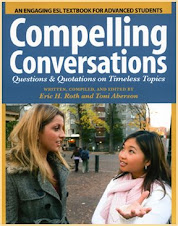
Partly as a result of these tutoring lessons over a few years, I wrote Compelling Conversations: Questions and Quotations on Timeless Topics. The conversation book includes 45 chapters with over 1400 questions, 500 quotations, and 450 targeted vocabulary words. The combination of poignant questions, vocabulary lists, proverbs, and witty quotations makes your job much easier. Each chapter is self-contained.
If you have a weaker student looking to improve their speaking skills, then I would advise using a picture dictionary. There are several fine choices. You might use the Oxford Picture Dictionary to open conversations, and I would be tempted to ask the client to bring in photographs and ads each week. Confession: I almost always referred weaker students to other English tutors who enjoyed working with lower level ESL students.
Naturally, you will need patience tutoring ESL clients on speaking skills. Be prepared to repeat words, listen very carefully, and remind students to pronounce word endings. Many students will want to work on their pronunciation. Recording your tutoring lessons can be quite helpful for students.
You can also ask/assign them listening activities on the web. I like Voice of America’s Special English programs for intermediate and advanced students. You will have to direct lower levels to websites to practice their listening and speaking skills with drills. They will love the work; you might go mad repeating vowel sounds and noting stress words.
Finally, the key to tutoring ESL students - or anyone else - remains respecting the student, meeting their needs, and providing a solid structure for your lessons. I have found that using a set text, developing a known routine, and combining conversation, vocabulary and some writing skills makes for a successful and satisfying experience.
As William Shakespeare noted four centuries ago, “All’s well that ends well”. Therefore, you should also have the grace to know when to end your lessons. Some clients will want to keep working with you. Yet you remain the tutor. Therefore, set a clear goal for your package of lessons, and conclude when the students have reached that goal. As the Hollywood cliché goes, “leave them wanting more.”
What are your plans and goals for tutoring English students this year?
Ask more. Know more. Share more.
Create Compelling Conversations.
Visit www.CompellingConversations.com today!
Are you tutoring English students on speaking skills? How do you effectively teach speaking skills to a private English language learner? What will you actually do for 60-120 minutes together? How will you make the conversation lessons meaningful enough that your client feels satisfied and wants to retain you for future lessons?
Speaking English means being able to actually holding clear, comfortable conversations. Yet holding a conversation in English remains a challenging task for many ESL and EFL students. (Personally, I blame an old-fashioned, grammar-obsessed curriculum coordinators and educational bureaucrats for creating the common situation where students can recite obscure grammar rules, but can’t discuss their weekend plans or talk about the movies.)
Yet here we are. University students and business professionals want to develop their speaking skills, but crowded English classes provide little opportunity for authentic conversations. Therefore, many English students hire English tutors to help them develop their conversation and speaking skills.
Teaching conversation skills sounds easy, but creating compelling conversation lessons can be a challenge. What does the student want to learn? What will you really teach? How will progress be measured? While sometimes younger students just want to talk and be heard, I have traditionally worked older, more serious students. Individualization remains the key.
I strongly suggest you establish clear expectations about both content and business matters. Some tutors even present a written contract outlining their rates, the location and times of meetings, and payment policies. One of my university colleagues makes students sign a form allowing her to videotape the entire tutoring session for her research. Another demands prepayment for packages of 10 sessions at a time. I’ve never been that formal, but I have also never been burned the way some tutors have been. In fact, I’ve had only very positive experiences with conversation clients.
Why? Perhaps luck; perhaps because I carefully screen potential clients. I only work with professionals, graduate students, and/or friends and spouses of friends with a solid foundation in English. Be explicit about what you want and don’t want to teach a client. Be prepared to provide options for potential clients that you reject.
I also set very clear expectations. This process eliminates potential confusion and establishes clear benchmarks. We will review X number of articles and discuss Y number of topics during the next month or semester. We will cover a significant amount of ground in a comfortable, relaxed manner.
For students who want to improve their conversation, I strongly suggest that you select the topic and materials in advance. You can use newspapers and/or magazines to find appropriate articles to begin the conversation. I used to assign the articles a week ahead and give English students my conversation worksheets.
Partly as a result of these tutoring lessons over a few years, I wrote Compelling Conversations: Questions and Quotations on Timeless Topics. The conversation book includes 45 chapters with over 1400 questions, 500 quotations, and 450 targeted vocabulary words. The combination of poignant questions, vocabulary lists, proverbs, and witty quotations makes your job much easier. Each chapter is self-contained.
If you have a weaker student looking to improve their speaking skills, then I would advise using a picture dictionary. There are several fine choices. You might use the Oxford Picture Dictionary to open conversations, and I would be tempted to ask the client to bring in photographs and ads each week. Confession: I almost always referred weaker students to other English tutors who enjoyed working with lower level ESL students.
Naturally, you will need patience tutoring ESL clients on speaking skills. Be prepared to repeat words, listen very carefully, and remind students to pronounce word endings. Many students will want to work on their pronunciation. Recording your tutoring lessons can be quite helpful for students.
You can also ask/assign them listening activities on the web. I like Voice of America’s Special English programs for intermediate and advanced students. You will have to direct lower levels to websites to practice their listening and speaking skills with drills. They will love the work; you might go mad repeating vowel sounds and noting stress words.
Finally, the key to tutoring ESL students - or anyone else - remains respecting the student, meeting their needs, and providing a solid structure for your lessons. I have found that using a set text, developing a known routine, and combining conversation, vocabulary and some writing skills makes for a successful and satisfying experience.
As William Shakespeare noted four centuries ago, “All’s well that ends well”. Therefore, you should also have the grace to know when to end your lessons. Some clients will want to keep working with you. Yet you remain the tutor. Therefore, set a clear goal for your package of lessons, and conclude when the students have reached that goal. As the Hollywood cliché goes, “leave them wanting more.”
What are your plans and goals for tutoring English students this year?
Ask more. Know more. Share more.
Create Compelling Conversations.
Visit www.CompellingConversations.com today!
Friday, December 12, 2008
Some Favorite ESL Textbooks
What ESL textbooks do you recommend? What are some of your favorite books to help English language learners develop their skills?
Two email requests in 40 hours require a decent response. Here's a quick, concise list of some ESL titles that I've enjoyed. It's by no means comprehensive, and just a starting list heavily influenced by the books in my eyesight.
The Creative Classroom: Teaching Language Outside the Box, by Hall Houston, contains dozens of bite-sized exercises to spark authentic language and creative discourse, This slim book, published by Lynx, should especially appeal to ESL students with a background or interest in engineering, science, and the arts.
Academic ESL/intensive English programs
Cambridge Vocabulary in Use series - An excellent supplemental text, especially for the more academically inclined. The self-contained two page format allows students, teachers, and tutors to pick and choose materials.
Cambridge Grammar in Use series - This series is the only grammar series that I've ever felt comfortable using in the classroom. Again, the accessible, clear format with self-contained lessons allows both self-study and effective use as a supplemental text.
English for Professionals series has become the gold standard for vocational students. The English for Health Sciences and English for Science and Engineering and English for Business all fill vital gaps. The rich collection of concise exercises, emphasizing and re-enforcing each other, make this a logical choice for workforce training programs.
Adult Education:
Side by Side - This classic series, now in its 3rd edition, particularly appeals to English language learners with limited literacy in their own best language. Given the appalling educational policies in some nearby poor countries, this textbook series has become extraordinarily popular in California and Texas.
Day by Day - Simple, clear communicative textbook for workplace instruction. Low intermediate- intermediate.
Oxford Picture Dictionary and workbook - excellent for beginning and intermediate English language learners.
Writing
Writing Academic English, by Alice Oshima and Ann Hogue, provides practical techniques for students planning to attend community college or university. I think the latest version is the fourth. I've used it in several programs with considerable success.
In Focus: Strategies for Academic Writers by Myra Ann Shulman, however, is my current choice for intermediate ESL students.
The clear, detailed exercises allow students to learn academic writing by actually writing short, focused pieces.
Finally, for advanced ESL students and international graduate students, I strongly recommend Academic Writing for Graduate Students, 2d ed.: Essential Tasks and Skills (Michigan Series in English for Academic & Professional Purposes) by John M. Swales and Christine A. Beer Feak. I teach two courses using this textbook at USC, and students make clear, significant progress by completing bite-sized writing exercises and analyzing short journal readings. The teacher's guide, called Commentary for, also deserves to be on your list.
Speaking Skills:
Giving Academic Presentations, by Susan Reinhart, stands heads and shoulders above the other ESL textbooks for public presentations. Students learn how to give clear, systematic oral presentations including problem-solution and process descriptions.
Communicating in Business by Simon Sweeney -Yet another outstanding Cambridge title, this Business English textbook includes helpful materials on negotiating and socializing as well as presenting.
Last, but not least, I naturally recommend Compelling Conversations: Questions and Quotations on Timeless Topics, by Toni Aberson and Eric Roth, as a supplemental text for advanced ESL classes, conversation clubs, and tutors.
Other special interest ESL books of quality.
Film is Content: A Study Guide for the Advanced ESL Classroom by Julia A. Williamson and Jill C. Vincent- This underappreciated University of Michigan textbook deserves a much wider audience. Although slightly dated, students learn critical thinking skills, academic vocabulary, and modern film.
Again, this list is just a starting list. What ESL books have your found effective in your teaching? Why?
Ask more. Know more. Share more.
Create Compelling Conversations.
Visit www.CompellingConversations.com
Two email requests in 40 hours require a decent response. Here's a quick, concise list of some ESL titles that I've enjoyed. It's by no means comprehensive, and just a starting list heavily influenced by the books in my eyesight.
The Creative Classroom: Teaching Language Outside the Box, by Hall Houston, contains dozens of bite-sized exercises to spark authentic language and creative discourse, This slim book, published by Lynx, should especially appeal to ESL students with a background or interest in engineering, science, and the arts.
Academic ESL/intensive English programs
Cambridge Vocabulary in Use series - An excellent supplemental text, especially for the more academically inclined. The self-contained two page format allows students, teachers, and tutors to pick and choose materials.
Cambridge Grammar in Use series - This series is the only grammar series that I've ever felt comfortable using in the classroom. Again, the accessible, clear format with self-contained lessons allows both self-study and effective use as a supplemental text.
English for Professionals series has become the gold standard for vocational students. The English for Health Sciences and English for Science and Engineering and English for Business all fill vital gaps. The rich collection of concise exercises, emphasizing and re-enforcing each other, make this a logical choice for workforce training programs.
Adult Education:
Side by Side - This classic series, now in its 3rd edition, particularly appeals to English language learners with limited literacy in their own best language. Given the appalling educational policies in some nearby poor countries, this textbook series has become extraordinarily popular in California and Texas.
Day by Day - Simple, clear communicative textbook for workplace instruction. Low intermediate- intermediate.
Oxford Picture Dictionary and workbook - excellent for beginning and intermediate English language learners.
Writing
Writing Academic English, by Alice Oshima and Ann Hogue, provides practical techniques for students planning to attend community college or university. I think the latest version is the fourth. I've used it in several programs with considerable success.
In Focus: Strategies for Academic Writers by Myra Ann Shulman, however, is my current choice for intermediate ESL students.
The clear, detailed exercises allow students to learn academic writing by actually writing short, focused pieces.
Finally, for advanced ESL students and international graduate students, I strongly recommend Academic Writing for Graduate Students, 2d ed.: Essential Tasks and Skills (Michigan Series in English for Academic & Professional Purposes) by John M. Swales and Christine A. Beer Feak. I teach two courses using this textbook at USC, and students make clear, significant progress by completing bite-sized writing exercises and analyzing short journal readings. The teacher's guide, called Commentary for, also deserves to be on your list.
Speaking Skills:
Giving Academic Presentations, by Susan Reinhart, stands heads and shoulders above the other ESL textbooks for public presentations. Students learn how to give clear, systematic oral presentations including problem-solution and process descriptions.
Communicating in Business by Simon Sweeney -Yet another outstanding Cambridge title, this Business English textbook includes helpful materials on negotiating and socializing as well as presenting.
Last, but not least, I naturally recommend Compelling Conversations: Questions and Quotations on Timeless Topics, by Toni Aberson and Eric Roth, as a supplemental text for advanced ESL classes, conversation clubs, and tutors.
Other special interest ESL books of quality.
Film is Content: A Study Guide for the Advanced ESL Classroom by Julia A. Williamson and Jill C. Vincent- This underappreciated University of Michigan textbook deserves a much wider audience. Although slightly dated, students learn critical thinking skills, academic vocabulary, and modern film.
Again, this list is just a starting list. What ESL books have your found effective in your teaching? Why?
Ask more. Know more. Share more.
Create Compelling Conversations.
Visit www.CompellingConversations.com
Subscribe to:
Posts (Atom)

 Posts
Posts