Cities attract the young, the strong, and the ambitious. Cities also provide housing, jobs, and hope for those fleeing boredom, economic crisis, and war. Our 21st century cities, like our English classrooms, reflect the diversity of the human experience.
Millions move from the countryside and across the globe to live in new cities every year. Cities provide employment, culture, and education. Cities are exciting. Yet, sometimes danger also lurks in cities. Many students struggle with economic pressures, culture shock, and criminal activity. Shouldn't we discuss these conflicting pressures in our ESL classrooms?
Teaching English in Los Angeles and Santa Monica I’ve found that students, who come from across the globe, eager to talk about cities. Some English students share stories about moving from rural areas and small towns to an international city; other students enjoy telling about their travel experiences. Discussions naturally touch on housing, employment, and lifestyle choices. English language learners – whether adult immigrants creating a new home or university students living abroad – can reflect on their experiences and share insights discussing urban life.
Are you a city person? Why?
How are cities different from small towns?
What cities have you visited? Lived in?
What attracted you to this city?
What do you find stressful about city life?
What do you find satisfying about living in a city?
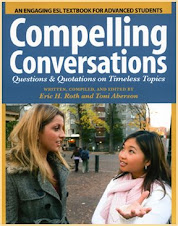
This month Exploring Cities, one of my favorite chapters, is highlighted as a free chapter on Compelling Conversations. Perhaps you will create some compelling conversations about cities in your classroom too. Check it out.
Ask more. Know more. Share more.
Create Compelling Conversations.
Visit www.CompellingConversations.com
Showing posts with label ESL conversations. Show all posts
Showing posts with label ESL conversations. Show all posts
Saturday, November 15, 2008


Tuesday, September 30, 2008
WWW. What Works and Why In Califoria's ESL Classrooms?
Los Angeles CATESOL Conference Highlights Practical ESL Teaching Techniques
Are you looking to share practical techniques with your fellow English teachers? What works in your ESL classroom? What tends to work in ESL classrooms? Why?
The Los Angeles Regional CATESOL conference, titled “WWW. What Works and Why” at Biola University on October 25 features over 60 workshops and panel discussions. The annual event is expected to attract over 500 ESL professions from K-12 classes, adult education, IEP, and community college and university programs.
Do you live in Southern California? Do you have plans for October 25th yet? Visit
http://www.lacatesol2008.org/ if you are interested. This regional conference is larger than many state conferences and reflects the importance of studying English to immigrants in Los Angeles – especially during economically difficult times.
By the way, I will be giving a 45-minute presentation titled “Technique for a More Democratic Classroom” and a joint presentation titled “Creating Win-Win Workplace English Programs That Work for Both Employers and Employees.”
In my solo presentation, I will review classroom practices like tailoring assignments for individual students, effective peer evaluations, and organizing students to create classroom materials. Some exercises come from Compelling Conversations. but most exercises are practices that I’ve developed over time in both writing and speaking courses.
The second presentation, with Troy Parr, comes out of a series of vocational ESL workshops that we designed for an important union for healthcare workers, the SEIU, in Los Angeles. (The director of their workplace educational programs read Compelling Conversations., and contacted me. I brought in Troy, who wrote his thesis on best practices in workplace ESL programs.) We emphasize the importance of creating practical, participant specific exercises that both introduce new workplace vocabulary and provide many opportunities to speak, write, and reflect on workplace issues – in English. These workshop exercise such as rewriting forms, writing memos, and giving presentations on safety tips also help students develop their language skills for beyond their immediate job.
Naturally, I hope you can make the LA Regional CATESOL conference. See you there?
For more information:
http://www.lacatesol2008.org/
http://catesol.org
Ask more. Know more. Share more.
Create Compelling Conversations.
Visit www.CompellingConversations.com
Are you looking to share practical techniques with your fellow English teachers? What works in your ESL classroom? What tends to work in ESL classrooms? Why?
The Los Angeles Regional CATESOL conference, titled “WWW. What Works and Why” at Biola University on October 25 features over 60 workshops and panel discussions. The annual event is expected to attract over 500 ESL professions from K-12 classes, adult education, IEP, and community college and university programs.
Do you live in Southern California? Do you have plans for October 25th yet? Visit
http://www.lacatesol2008.org/ if you are interested. This regional conference is larger than many state conferences and reflects the importance of studying English to immigrants in Los Angeles – especially during economically difficult times.
By the way, I will be giving a 45-minute presentation titled “Technique for a More Democratic Classroom” and a joint presentation titled “Creating Win-Win Workplace English Programs That Work for Both Employers and Employees.”
In my solo presentation, I will review classroom practices like tailoring assignments for individual students, effective peer evaluations, and organizing students to create classroom materials. Some exercises come from Compelling Conversations. but most exercises are practices that I’ve developed over time in both writing and speaking courses.
The second presentation, with Troy Parr, comes out of a series of vocational ESL workshops that we designed for an important union for healthcare workers, the SEIU, in Los Angeles. (The director of their workplace educational programs read Compelling Conversations., and contacted me. I brought in Troy, who wrote his thesis on best practices in workplace ESL programs.) We emphasize the importance of creating practical, participant specific exercises that both introduce new workplace vocabulary and provide many opportunities to speak, write, and reflect on workplace issues – in English. These workshop exercise such as rewriting forms, writing memos, and giving presentations on safety tips also help students develop their language skills for beyond their immediate job.
Naturally, I hope you can make the LA Regional CATESOL conference. See you there?
For more information:
http://www.lacatesol2008.org/
http://catesol.org
Ask more. Know more. Share more.
Create Compelling Conversations.
Visit www.CompellingConversations.com
Sunday, August 10, 2008
Conversation Tip #14: Ask a question, listen!
"Want to have a conversation? Ask a question, listen."
Robert Bly (1926- ), American poet and activist
Is that concise enough?
Ask more. Know more. Share more.
Create Compelling Conversations.
Visit www.CompellingConversations.com
Robert Bly (1926- ), American poet and activist
Is that concise enough?
Ask more. Know more. Share more.
Create Compelling Conversations.
Visit www.CompellingConversations.com
Saturday, July 19, 2008
What is the opposite of jealous? "Gratitude is Heaven itself."
A bright college student asked a simple vocabulary question that threw me this week. "What is the opposite of jealous"?
What is the opposite of jealous? Generous? Selfless? Confident? I found myself discussing various possibilities with students adding in situations. The simple vocabulary building exercise (create 25 pairs of opposite adjectives) took a more philosophical turn. We had a lively, if a bit wandering, class discussion. I apologized for my memory lapse, urged them to check a dictionary, and promised to get back to students with a better answer.
In the teacher's room, a fellow teacher noted "The world jealousy includes the word lousy." We shared a laugh. That's a good answer. How did he instantly come up with that? Why couldn't I do that?
I felt discontent, dissatisfied, and displeased with my weak classroom answers. Perhaps the opposite of "jealous" is content, satisfied, and pleased.
Stress comes naturally when driving in Los Angeles, and my commute back home fit the familiar pattern. Many words popped into my head that captured negative feelings, including jealous. Could I be jealous of bus riders? Really? I started to visualize a bus ride home from UCLA, sitting - no, probably standing up, for 40 minutes next to exhausted strangers. Memories of less pleasant commutes on subway rides in New York from 20 years ago returned. No, I didn't envy or feel jealous of the bus riders.
I eventually arrived home. Boomer, my dog, barked to announce my arrival and licked my face as I entered the front door. He's great. "Dogs are our link to paradise," wrote Milan Kundera. Absolutely.
Gratitude. That's the opposite of jealousy. Gratitude. Why didn't I think of that in class? Next time.
"Gratitude is heaven itself." Who said that? Blake? Yeah, William Blake. The great poet-painter-mystic man. Remember that quote the next time an English student asks, "what is the opposite of jealous?"
Teaching English, especially to bright international college students, helps keep me focused and clear. This week I learned the opposite of jealousy and rediscovered a favorite quotation. Consider me satisfied, content, and grateful.
Ask more. Know more. Share more.
Create Compelling Conversations.
Visit www.CompellingConversations.com
Thursday, May 22, 2008
ESL Classes Should Let Students Speak More!
Conversation remains a vital social skill for our English students. Naturally, immigrants and international students want to fully participate in their schools, their jobs, and their communities. Speaking clearly in English allows individuals to express their life experiences, insights, and perceptions in fluent conversations – both inside and outside classrooms. Limited English fluency, in contrast, often causes additional stress. "Speech is civilization itself," wrote Thomas Mann, the great 20th century German novelist."It is silence which isolates."
Therefore, conversation skills deserve far greater attention in English language classrooms for academic, social, and cultural reasons. Conversation skills also require practice, practice, and more practice. So let's give our students more chances to express themselves, share their experiences, and develop their discussion skills in our English language classrooms - especially our high intermediate and advanced students. Teachers need to create encouraging, yet rigorous, classroom atmospheres where students can learn by doing.
Speaking skills, I'd suggest, deserve at least as much attention as grammar in our classrooms. Do students who know grammar, but can't hold a conversation really speak English?
Conversation skills often matter more at work, at school, at parties, and at home. Whether ESL students seek better work opportunities, higher grades, or closer relations with native English speakers, our students also want to become fluent in English. So let's meet both our students needs and wishes, and add more conversation activities and time to our ESL classes.
"English saved my life."
Joseph Conrad (1857-1924), English novelist born in Poland
Ask more. Know more. Share more.
Create Compelling Conversations.
Visit www.CompellingConversations.com
Therefore, conversation skills deserve far greater attention in English language classrooms for academic, social, and cultural reasons. Conversation skills also require practice, practice, and more practice. So let's give our students more chances to express themselves, share their experiences, and develop their discussion skills in our English language classrooms - especially our high intermediate and advanced students. Teachers need to create encouraging, yet rigorous, classroom atmospheres where students can learn by doing.
Speaking skills, I'd suggest, deserve at least as much attention as grammar in our classrooms. Do students who know grammar, but can't hold a conversation really speak English?
Conversation skills often matter more at work, at school, at parties, and at home. Whether ESL students seek better work opportunities, higher grades, or closer relations with native English speakers, our students also want to become fluent in English. So let's meet both our students needs and wishes, and add more conversation activities and time to our ESL classes.
"English saved my life."
Joseph Conrad (1857-1924), English novelist born in Poland
Ask more. Know more. Share more.
Create Compelling Conversations.
Visit www.CompellingConversations.com
Wednesday, May 7, 2008
Fan Writes "Teachers and Tutors Should Know About Compelling Conversations."
Sometimes you just have to smile and feel good about your achievements!
Praise, especially from an experienced colleague living thousands of miles away, on a difficult project feels satisfying. In the last week, I’ve received three emails from Joan V., an ESL teacher and tutor, praising Compelling Conversations: Questions and Quotations on Timeless Topics – the book that I co-authored and self-published. Naturally, a smile crosses my face.
Imagine my surprise when a complete stranger emails me that "Teachers and tutors should know about Compelling Conversations... It's a marvelous book!"
Her experiences mirror my own experiences with the material, and validate the book’s premise: engaging students in sophisticated conversation helps build their vocabulary, leads to memorable conversations, and deepens relationships.
Here, in her own words, are excerpts from Joan’s strong recommendation.
-------------------------------------------------------------------------------------------------------
I am an English tutor working with Japanese adults in
I’ve always used questions as a conversation stimulus, and now I have this whole organized around topics book to use with my students! As you probably know, Many Japanese arrive in this country with a fair understanding of English grammar and quite a lot of vocabulary, but are initially unable to engage in conversation. This book is the perfect answer to this situation!
Thank you so much for putting this together!
Teachers and tutors should know about Compelling Conversations... I was a classroom ESL teacher for many years, went to conferences with book displays shopping for books, and was usually disappointed by the books I saw. There were a lot of boring books out there!
The book needs to on display at ESL conferences if they are still being held. ESL teachers and tutors working with intermediate and advanced level students would choose this book over almost anything else if they knew about it. Also many community colleges have ESL programs using traditional materials focused on grammar and repetition rather than real meaningful conversation which your book provides.
I happened on your book accidentally on the internet and looking at the sample lessons, I quickly knew that this book would work for my students.
I wanted to add one more thought regarding Compelling Conversations. It is saving me a lot of time! I have been tutoring Japanese adults (businessmen and their wives) for nine years after retiring from almost 30 years of teaching in public schools. I've spent so much time gathering materials from various sources--textbooks, my own materials, bilingual dictionaries, etc.
Now I'm finding that printing out a chapter of your book provides plenty of conversational focus for at least two hours or more of tutoring time. Even more important, our conversations are at a deeper level. For example, in chapter two there are some questions about childhood. A couple of weeks ago a student ordering on fluency was able to tell me about his childhood dreams and that now he is living that dream! I was thrilled!
Thanks.
Joan
----------------------------------------------------------------------------------
Wow!
Thank you, Joan! You made my week!
Check out sample Compelling Conversations lessons for yourself at:
http://www.compellingconversations.com/pdf/cc_sampler_esl.pdf
http://www.compellingconversations.com
Hopefully, you will have the same satisfying experiences that Joan and other satisfied teachers and tutors have had with Compelling Conversations. Enjoy!
Ask more. Know more. Share more.
Create Compelling Conversations.
Thursday, April 10, 2008
Excellent ESL Teaching resources at TESOL convention
Time flies. Or, as the Romans used to say, "tempus fugit."
Five days after the TESOl convention in New York City ended, I'm finally having a chance to sort through the numerous books, doublecheck website leads, and evaluate materials that I picked up. Sometimes "the eyes are too hungry", and I went a bit overboard in collecting ESL materials and resources for advanced English language learners. Of course, English teachers love books, new curriculum materials, and free ESL materials. I also have the excuse of working as a consultant for a workplace ESL program so I went hunting for some particular products for healthcare workers.
Here is a short list of promising materials:
VSOE ideas from TESOL convention
- software and textbook designed for foreign doctors and nurses
- great reviews from professional journals (medical, language)
- Effective Practices in Workplace Language Training (TESOL)
- Getting Ahead in the
- New Citizenship DVD for future naturalization tests. This free DVD, perfect for adult educators, confirms that the new citizenship test will only require a "high beginning" level of ESL to qualify for American citizenship. Personally, I consider this an absurdly low standard that implies new American citizens can speak worse English than at least a half a billion English speakers outside of the United States, the United Kingdom, Canada, and Australia.
Of course, low standards have many fans in the world of adult education and with many immigrant groups. More on this topic later. - The Center for Applied Linguistics www.cal.org continues to offer wider and deeper variety of resources for ESL teachers, especially for adult education.
- I had several fascinating conversations about various English competency tests and their possible use in the workplace. The TOEIC test, on its merits, seems the strongest by far. Unfortunately, this test - used by millions in the workplace worldwide - has become almost forbidden due to lawsuits claiming discrimination in the United States. What does this mean? Millions of applicants and employees in Japan, Korea, Taiwan, France, Germany, and other non-English speaking countries have taken this test of English skills. Why? Because English has become a global language and competency in English has become an essential workplace skill.
- But not in the United States! So-called labor and civil rights activists have promoted the concept that requiring English proficiency, as tested by the TOEIC, is discrimination unless the ad explicitly states "English skills required." This strange situation means that American workers can, and so often do , speak at a lower level than educated workers in Asia and Europe. What's wrong with this picture!!!
- Software programs continue to become stronger day by day, minute by minute. English language learners, international ESL students, and adult ESL educators have more choices than ever. I will spend a solid chunk of time researching these language programs during my summer break. So far, however, it's clear that www.openbookenglish.com and www.spokenskills.com offer great values for administrators, teachers, and students. ESL teachers will also find www.lessonwriter.com a wonderful, innovative, and time-saving site.
Ask more. Know more. Share more.
Create Compelling Conversations.
Visit www.CompellingConversations.com
Thursday, March 27, 2008
Going Beyond the ESL Classroom to Teach English
Why stay indoors on a beautiful sunny day? Do you want your class discussions to go beyond the predictable textbook lesson? How can ESL teachers use shopping malls, museums, and movies to help students develop a more practical vocabulary?
“The Outside World as an Extension of the EFL/ESL Classroom”, by Mark A. Pegrum, makes a compelling argument that ESL teachers should go way beyond dry textbooks to engage in the practical needs and broader cultural life. This exceptional article, written in proper academic style for elite educational audiences, clearly outlines the many reasons for engaging ESL students in the world around them. The article advocates field trips, conducting surveys, visiting museums, discussing movies, obtaining information from public offices, and summarizing television programs. Numerous activities, along with the suggested level and focus, are provided in this article/collection of lesson ideas for multiple levels. While I can’t bring myself to write in this style with all the appropriate footnotes to make commonsense sound so respectable in academic journals, I’m very glad that Pegrum wrote this outstanding article for ESL professionals. Good job!
These lessons work better for adult education and intensive English programs than community college or university level ESL classes. Many college ESL teachers, however, will also find excellent suggestions for supplemental intermediate and advanced activities. Check it out for lesson ideas to create authentic language and deepen practical life skills for your curious ESL students.
Ask more. Know more. Share more.
Create Compelling Conversations
Visit www.compellingconversations.com
Wednesday, March 12, 2008
Listening to Student Fears About Crime in ESL Classrooms
How often do English students fear being cheated, robbed, or even physically attacked? How many have been victims of crime? How often are student experiences and fears of crime acknowledged in our English classrooms?
Outraged by some exceptionally disturbing murders of students around Los Angeles, the United States, and the world, I’ve chosen the chapter “Crime and Punishment” as the conversation sample. We need to hear student fears, understand their experiences, give them a chance to reflect, and speak in our classrooms. Students have many stories and insights to share - and they often need the vocabulary to effectively communicate. Sometimes we share a sense of disappointment. Yet we often also can also share resources, provide additional information, and review safety tips.
Few topics engage students more than candid discussions and writings about crime. From bribery, scams, and kickbacks to stolen bikes, violent fights, and hit and run accidents, students have stories to share and classmates can learn from experiences. Ask students to suggest suggestions for safer schools, safer communities, and safer trips. You will hear a range of ideas from the practical and polite to wild, crazy, and rude. Lively classroom discussions can lead to poignant, personal problem-solution essays.
An experienced teacher should be able to hear the fear, acknowledge the threats, and help students confront a real problem facing far too many English language learners around the world.
Do international students sometimes have an exaggerated sense of danger in American cities? Sometimes. Are schools immune to the violence, crime, and chaos of surrounding areas? Certainly not. Will ignoring fears and crimes make them go away? Never.
Let’s provide English language learners, whether adult students or college students, both the place and time to reflect on laws, crimes, and the search for justice.
I hope that the conversation lesson called “Crime and Punishment” inspires compelling conversations in classrooms. Please visit www.compellingconversations.com , look over the material, and see if it works in your ESL classroom.
PS. Every school that I have taught in - from inner city high schools and urban adult schools to world famous community colleges and private universities - has had students attacked, robbed, and even murdered during my time teaching there. For worse or for better, this experience has influenced my sensitivity to student fears and concerns about crime in the United States.
Subscribe to:
Posts (Atom)

 Posts
Posts