Are you looking for more excellent videoclips for your English classes or private lessons?
As blog readers know, I'm a huge fan of encouraging students to find their own materials to summarize for homework on particular topics. For instance, students in my high intermediate oral skills found and reviewed videos offering advice on job interviews. Students emailed me their recommended clips with a short descriptive paragraph and a few sentences evaluating the video. Then I edited their writing, combined their reviews into a single document, and emailed the entire class the videoclips.
"Use or lose" was my comment. "Viewing these videoclips is an opportunity, not an obligation. Enjoy!" Almost every student chose to watch the videos and our 10-15 minute mock job interviews were quite strong. Allowing students to select their own materials lead to more authentic, student centered learning both in and out of the classroom.
Yet sometimes both students and teachers lack time. It's a real pleasure to have someone systematically collect and sort through potential video materials for class.
Hall Houston, the author of The Creative Classroom: Teaching Languages Outside the Box, recently posted about Jamie Keddie's excellent website TEFLclips.com on his blog:
Hall writes, "This website ( http://www.teflclips.com/ ) contains over 30 clever lesson plans for using video clips in the TEFL classroom. The lessons are well-written and contain teacher's notes and handouts. I am looking forward to using some of these lessons in my classes this year (2009)." As so often, I share Hall's tastes and concerns for creating a dynamic, creative classroom where students learn English and critical thinking skills.
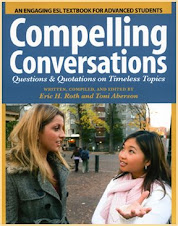
By the way, Hall recently wrote a long, very positive review of Compelling Conversations: Questions and Quotations on Timeless Topics for English Teaching Professional. (Here's a shout out to Hall. Thanks for the review and tip on videoclips!)
We live in a wonderful time to teach English. The technology allows us to gently cajole students to become autotelic, or self-directed, in their studies. Teaching with videoclips, both as homework and in class, adds visual information and builds rapport with our 21st century English students.
Use it or lose it. You choose. Will video work in your class?
Ask more. Know more. Share more.
Create Compelling Conversations.
Visit www.CompellingConversations.com
Showing posts with label autotelic. Show all posts
Showing posts with label autotelic. Show all posts
Friday, January 30, 2009


Friday, January 23, 2009
Cultivate Student Curiosity in ESL Classes - and Homework Assignments
Cultivate Student Curiosity in ESL Classes
“Curiosity is the best teacher,” goes the ancient proverb. Push your English language students to develop their own interests and passions. ESL students- adult, high school, or college - will remember the language they want and need to know to deepen their life experiences in English
Ironically, our job remains helping students become autotelic – or self-directed. Encouraging students to find and create their own vocabulary logs is just one useful, too seldom used technique in English language classrooms.
My standard homework assignment for English students remains having students find, summarize, and present newspaper articles on a topic (elections, housing, job interviews). The worksheet asks them to list core citation information, summarize the main idea, identify the best supporting evidence, etc. The worksheet also includes finding five new vocabulary words or phrases and writing new sentences. When the students complete their homework, they get together in groups of four and "present" their articles. I circulate around the room checking homework and having small chats. Students, meanwhile, build their own vocabulary logs from their own readings and discussions – and deepen their own interests.
Once students master the format, they choose both the subject and articles. In my high-intermediate writing course for international students, these homework readings provide the foundation for their research papers and final project. Students soon move beyond the worksheets and simply provide concise article summaries and evaluations.
Bottomline: We must find ways to gently cajole students to take responsibility for their own education – and become more self-directed.
Ask more. Know more. Share more.
Create Compelling Conversations.
Visit www.CompellingConversations.com
“Curiosity is the best teacher,” goes the ancient proverb. Push your English language students to develop their own interests and passions. ESL students- adult, high school, or college - will remember the language they want and need to know to deepen their life experiences in English
Ironically, our job remains helping students become autotelic – or self-directed. Encouraging students to find and create their own vocabulary logs is just one useful, too seldom used technique in English language classrooms.
My standard homework assignment for English students remains having students find, summarize, and present newspaper articles on a topic (elections, housing, job interviews). The worksheet asks them to list core citation information, summarize the main idea, identify the best supporting evidence, etc. The worksheet also includes finding five new vocabulary words or phrases and writing new sentences. When the students complete their homework, they get together in groups of four and "present" their articles. I circulate around the room checking homework and having small chats. Students, meanwhile, build their own vocabulary logs from their own readings and discussions – and deepen their own interests.
Once students master the format, they choose both the subject and articles. In my high-intermediate writing course for international students, these homework readings provide the foundation for their research papers and final project. Students soon move beyond the worksheets and simply provide concise article summaries and evaluations.
Bottomline: We must find ways to gently cajole students to take responsibility for their own education – and become more self-directed.
Ask more. Know more. Share more.
Create Compelling Conversations.
Visit www.CompellingConversations.com
Monday, October 27, 2008
How Democratic is Your English Classroom? How Democratic Do You Want it To Be?
Who gets to speak in class? Whose ideas count? Who chooses the assignments? How do students receive feedback? Do students have a chance to conference with their instructors? Can YouTube be a valuable source for homework assignment? Do you want your students to become self-directed - or autotelic - in their studies?
Here’s a quick checklist that ESL teachers that I created for a recent LA CATESOL regional conference workshop called “Techniques for a More Democratic Classroom."
My core assumption remains that giving students more opportunities to literally speak, write, and share their insights leads to a more engaging, dynamic, and valuable classroom experience. I will write more on this topic in a few days, but here are some questions to consider.
1. Who do you currently teach? How would you describe the students?
2. What are some of their personal interests?
3. How can student interests be better incorporated into the curriculum?
4. Which assignments do students currently choose? Which seems most successful? Why?
5. What are some benefits of greater student participation?
6. What are some risks of greater student participation?
7. Do you want to increase the number of choices students make?
8. What critical language skills can be taught by tapping into their interests?
9. How can you tweak current material to better individualize instruction?
10. What internet resources can you use to augment the current curriculum?
11. Which exercises or activities do you find most successful in your classroom?
12. What decisions do you keep as your prerogative as the instructor?
13. Will your students become self-directed learners?
14. How can you encourage that possibility?
15. How can you create a more democratic classroom?
16. What are some obstacles to a more democratic classroom?
17. How does technology encourage a more democratic classroom?
“Education is a kind of continuing dialogue and a dialogue assumes, in the nature of the case, different points of view.” Robert Hutchins (1899-1977), former President of University of Chicago and educational philosopher
Do you agree? Disagree? Why? Feel free to let me know.
I’ll post an article in a few days outlining some of my thoughts and sharing some materials.
Ask more. Know more. Share more.
Create Compelling Conversations.
Visit www.CompellingConversations.com
Here’s a quick checklist that ESL teachers that I created for a recent LA CATESOL regional conference workshop called “Techniques for a More Democratic Classroom."
My core assumption remains that giving students more opportunities to literally speak, write, and share their insights leads to a more engaging, dynamic, and valuable classroom experience. I will write more on this topic in a few days, but here are some questions to consider.
1. Who do you currently teach? How would you describe the students?
2. What are some of their personal interests?
3. How can student interests be better incorporated into the curriculum?
4. Which assignments do students currently choose? Which seems most successful? Why?
5. What are some benefits of greater student participation?
6. What are some risks of greater student participation?
7. Do you want to increase the number of choices students make?
8. What critical language skills can be taught by tapping into their interests?
9. How can you tweak current material to better individualize instruction?
10. What internet resources can you use to augment the current curriculum?
11. Which exercises or activities do you find most successful in your classroom?
12. What decisions do you keep as your prerogative as the instructor?
13. Will your students become self-directed learners?
14. How can you encourage that possibility?
15. How can you create a more democratic classroom?
16. What are some obstacles to a more democratic classroom?
17. How does technology encourage a more democratic classroom?
“Education is a kind of continuing dialogue and a dialogue assumes, in the nature of the case, different points of view.” Robert Hutchins (1899-1977), former President of University of Chicago and educational philosopher
Do you agree? Disagree? Why? Feel free to let me know.
I’ll post an article in a few days outlining some of my thoughts and sharing some materials.
Ask more. Know more. Share more.
Create Compelling Conversations.
Visit www.CompellingConversations.com
Subscribe to:
Posts (Atom)

 Posts
Posts