What ESL textbooks do you recommend? What are some of your favorite books to help English language learners develop their skills?
Two email requests in 40 hours require a decent response. Here's a quick, concise list of some ESL titles that I've enjoyed. It's by no means comprehensive, and just a starting list heavily influenced by the books in my eyesight.
The Creative Classroom: Teaching Language Outside the Box, by Hall Houston, contains dozens of bite-sized exercises to spark authentic language and creative discourse, This slim book, published by Lynx, should especially appeal to ESL students with a background or interest in engineering, science, and the arts.
Academic ESL/intensive English programs
Cambridge Vocabulary in Use series - An excellent supplemental text, especially for the more academically inclined. The self-contained two page format allows students, teachers, and tutors to pick and choose materials.
Cambridge Grammar in Use series - This series is the only grammar series that I've ever felt comfortable using in the classroom. Again, the accessible, clear format with self-contained lessons allows both self-study and effective use as a supplemental text.
English for Professionals series has become the gold standard for vocational students. The English for Health Sciences and English for Science and Engineering and English for Business all fill vital gaps. The rich collection of concise exercises, emphasizing and re-enforcing each other, make this a logical choice for workforce training programs.
Adult Education:
Side by Side - This classic series, now in its 3rd edition, particularly appeals to English language learners with limited literacy in their own best language. Given the appalling educational policies in some nearby poor countries, this textbook series has become extraordinarily popular in California and Texas.
Day by Day - Simple, clear communicative textbook for workplace instruction. Low intermediate- intermediate.
Oxford Picture Dictionary and workbook - excellent for beginning and intermediate English language learners.
Writing
Writing Academic English, by Alice Oshima and Ann Hogue, provides practical techniques for students planning to attend community college or university. I think the latest version is the fourth. I've used it in several programs with considerable success.
In Focus: Strategies for Academic Writers by Myra Ann Shulman, however, is my current choice for intermediate ESL students.
The clear, detailed exercises allow students to learn academic writing by actually writing short, focused pieces.
Finally, for advanced ESL students and international graduate students, I strongly recommend Academic Writing for Graduate Students, 2d ed.: Essential Tasks and Skills (Michigan Series in English for Academic & Professional Purposes) by John M. Swales and Christine A. Beer Feak. I teach two courses using this textbook at USC, and students make clear, significant progress by completing bite-sized writing exercises and analyzing short journal readings. The teacher's guide, called Commentary for, also deserves to be on your list.
Speaking Skills:
Giving Academic Presentations, by Susan Reinhart, stands heads and shoulders above the other ESL textbooks for public presentations. Students learn how to give clear, systematic oral presentations including problem-solution and process descriptions.
Communicating in Business by Simon Sweeney -Yet another outstanding Cambridge title, this Business English textbook includes helpful materials on negotiating and socializing as well as presenting.
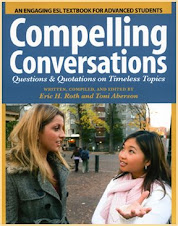
Last, but not least, I naturally recommend Compelling Conversations: Questions and Quotations on Timeless Topics, by Toni Aberson and Eric Roth, as a supplemental text for advanced ESL classes, conversation clubs, and tutors.
Other special interest ESL books of quality.
Film is Content: A Study Guide for the Advanced ESL Classroom by Julia A. Williamson and Jill C. Vincent- This underappreciated University of Michigan textbook deserves a much wider audience. Although slightly dated, students learn critical thinking skills, academic vocabulary, and modern film.
Again, this list is just a starting list. What ESL books have your found effective in your teaching? Why?
Ask more. Know more. Share more.
Create Compelling Conversations.
Visit www.CompellingConversations.com
Showing posts with label English language learners. Show all posts
Showing posts with label English language learners. Show all posts
Friday, December 12, 2008


Thursday, November 6, 2008
Who Makes the Rules? Who Chooses the Rulers? Obama Confirms Power of American Democracy!
Who makes the rules? Who chooses the rulers? Can citizens peacefully replace corrupt leaders?
In the United States of America, voters enjoy their opportunity to hire and fire the President. On Tuesday, American citizens voted, selected a new leader, and millions of people around the nation smiled, laughed, and felt hopeful again. Senator Obama, as so often, captured the power and beauty of the peaceful transfer of power in his eloquent victory speech.
"If there is anyone out there who still doubts that America is a place where all things are possible; who still wonders if the dream of our founders is alive in our time; who still questions the power of our democracy, tonight is your answer. "
Barack Hussein Obama (1961- ), President-elect of the United States
I, like so many Americans, feel very proud. We are coming back – to our ideals, our citizens, and our best traditions! The United States, the first nation explicitly created on enlightenment ideals, will become an inspiring 21st century nation.
This surprising election seems like a very teachable moment. Immigrants and international students can rest assured that they made the right decision to come to the United States. English language learners around the world should feel the enlarged possibilities that come with our strange tongue. European sceptics and Arab critics should candidly reassess their prejudices about Americans and the American government. After all, Obama – the son of an international African student and an adventurous Midwestern scholar – has just won the Presidency of the United States. Where else could that happen?
Let's talk about the power of elections and democratic values in our English classes. Let's discuss the possibilities for peaceful reform, voting, and the rights of citizens to choose their own leaders. ESL/Civics classes always discuss these questions, but English teachers should also celebrate this Anglo-American tradition in English language classes around the world. Let's start defending Western values in our classes- and even promoting western democratic principles. Human rights matter. Democracy matters. Freedom counts. The good society can face its problems, openly debate vital public policy issues, and peacefully elect new leaders.
Click here for a free advanced ESL conversation lesson on Voting from Compelling Conversations.
Ask more. Know more. Share more.
Create Compelling Conversations.
Visit www.CompellingConversations.com
In the United States of America, voters enjoy their opportunity to hire and fire the President. On Tuesday, American citizens voted, selected a new leader, and millions of people around the nation smiled, laughed, and felt hopeful again. Senator Obama, as so often, captured the power and beauty of the peaceful transfer of power in his eloquent victory speech.
"If there is anyone out there who still doubts that America is a place where all things are possible; who still wonders if the dream of our founders is alive in our time; who still questions the power of our democracy, tonight is your answer. "
Barack Hussein Obama (1961- ), President-elect of the United States
I, like so many Americans, feel very proud. We are coming back – to our ideals, our citizens, and our best traditions! The United States, the first nation explicitly created on enlightenment ideals, will become an inspiring 21st century nation.
This surprising election seems like a very teachable moment. Immigrants and international students can rest assured that they made the right decision to come to the United States. English language learners around the world should feel the enlarged possibilities that come with our strange tongue. European sceptics and Arab critics should candidly reassess their prejudices about Americans and the American government. After all, Obama – the son of an international African student and an adventurous Midwestern scholar – has just won the Presidency of the United States. Where else could that happen?
Let's talk about the power of elections and democratic values in our English classes. Let's discuss the possibilities for peaceful reform, voting, and the rights of citizens to choose their own leaders. ESL/Civics classes always discuss these questions, but English teachers should also celebrate this Anglo-American tradition in English language classes around the world. Let's start defending Western values in our classes- and even promoting western democratic principles. Human rights matter. Democracy matters. Freedom counts. The good society can face its problems, openly debate vital public policy issues, and peacefully elect new leaders.
Click here for a free advanced ESL conversation lesson on Voting from Compelling Conversations.
Ask more. Know more. Share more.
Create Compelling Conversations.
Visit www.CompellingConversations.com
Thursday, September 25, 2008
California Immigrants Are Learning English - and Want to Speak English Better!
Do American immigrants want to learn English? Are the children of Spanish-speaking adult immigrants learning English? What are the recent trends in California and Los Angeles?
A recently released Census Bureau report, based on the 2007 Census information, shows that – shock, shock – immigrants overwhelmingly want to improve their English skills. It also shows that a slight majority (51%) of immigrants in Los Angeles claim that they can speak English fluently – an increase from just a few years ago. The study also notes that 88% of immigrant children claim to speak English – and want to learn more.
Yesterday’s Los Angeles Times editorial “Speak English? Yes, more immigrants do “ provides a solid introduction to the heated debate over language and immigration in California. The editorial also argues that immigration reform should include a provision to keep families united so the American children of illegal immigrant parents are not separated from their parents. Finally, the editorial concludes that both the United States and the English language continue to evolve and Americans should embrace change.
The fine editorial, however, could and should have called for both expanding and improving the quality of public education programs so immigrants – including adult immigrants - can learn English quicker. A better Census report also would have included the legal status of immigrants and gone beyond self-reported data by immigrants with evolving language skills.
The editorial’s strong, humane conclusion is worth repeating verbatim:
“American culture grows and adapts as new immigrants redefine it over the generations, and the same can be said of the English language. We should embrace that evolution, not hold it at bay with false and alarmist arguments about the threat to American values.”
Los Angeles Times, September 24, 2008 editorial
Doesn’t that sound sane and civilized?
Ask more. Know more. Share more.
Create Compelling Conversations.
Visit www.CompellingConversations.com
A recently released Census Bureau report, based on the 2007 Census information, shows that – shock, shock – immigrants overwhelmingly want to improve their English skills. It also shows that a slight majority (51%) of immigrants in Los Angeles claim that they can speak English fluently – an increase from just a few years ago. The study also notes that 88% of immigrant children claim to speak English – and want to learn more.
Yesterday’s Los Angeles Times editorial “Speak English? Yes, more immigrants do “ provides a solid introduction to the heated debate over language and immigration in California. The editorial also argues that immigration reform should include a provision to keep families united so the American children of illegal immigrant parents are not separated from their parents. Finally, the editorial concludes that both the United States and the English language continue to evolve and Americans should embrace change.
The fine editorial, however, could and should have called for both expanding and improving the quality of public education programs so immigrants – including adult immigrants - can learn English quicker. A better Census report also would have included the legal status of immigrants and gone beyond self-reported data by immigrants with evolving language skills.
The editorial’s strong, humane conclusion is worth repeating verbatim:
“American culture grows and adapts as new immigrants redefine it over the generations, and the same can be said of the English language. We should embrace that evolution, not hold it at bay with false and alarmist arguments about the threat to American values.”
Los Angeles Times, September 24, 2008 editorial
Doesn’t that sound sane and civilized?
Ask more. Know more. Share more.
Create Compelling Conversations.
Visit www.CompellingConversations.com
Saturday, September 20, 2008
Who ranks ESL programs? How would you choose an English language school?
How would you choose an English language school? What if you lived in Korea, Spain, China, Brazil, Turkey, or Vietnam? What factors would influence your decision? How would you find out the school’s reputation? Who ranks ESL programs? What is their criteria?
Hundreds of thousands of students travel thousands of miles each semester to attend ESL schools. These intensive English language programs, often affiliated at universities, provide an opportunity to study English, live abroad, and prepare for the all-important TOEFL test. Given the importance of English to the business, scientific, and political events, the ability to read, write, and speak English often seems mandatory to ambitious 21st century students.
Yet, like any consumer product, the quality of the schools widely varies. How would a student make a rational choice?
This question emerged as I spoke with several dozen international students this week about their resumes, educational backgrounds, and training in English. While this elite group of mostly graduate students had succeeded in the academic game, several shared stories of unpleasant experiences at language schools. Sometimes students found a huge gap between their expectations and their actual American classroom experiences.
The apparent randomness of significant decisions often surprises me. Normally, I consult friends and established rankings as part of a decision making process. Yet a single thin piece of information, or casual conversation, can easily alter plans. Still I remember systematically searching through numerous guidebooks while selecting my college.
Where can students looking for a quality English language programs abroad find this sort of information? Does TESOL have some list of approved or sanctioned schools? Does somebody else – perhaps even local governments – track the effectiveness of schools? Further, what is their criteria? Where can individuals – students, teachers, parents – get that simple, yet vital bit of information? Is any of this information available in English, instead of the first language?
I would suspect, especially for international students of considerable income, that there would have to be somebody who attempts to grade, evaluate, and rank ESL schools. If I was going to travel to the United States, Australia, or the United Kingdom, I would certainly want to know the quality of the program and teachers. Even I was just going to a local English school or attending a public adult education center, I would still check on the school's reputation. Of course, recruiters provide some information too – often with a twist. Given the potential investment in money and time, I assume that guides must exist – and probably not in English.
The best English language source that I have found, so far, is a site called http://www.eslreview.org/ . It rates schools on a scale of 1-5 on teaching, location, housing services, price-quality relationship, and overall satisfaction. You can find basic information and read student reviews. You can also browse through the course catalog and contact the schools. This website review is a starting point, but not much more. The listings look like they could easily be gamed. They also don’t list school accreditations, average TOEFL scores, or hire staff to inspect the schools. Further, the list doesn’t include some prominent IEP schools in California. So it’s a valuable starting point to compare ESL schools, but it is hardly a Petersen’s Guide to IEP programs.
Does anybody know a better resource in English?
Ask more. Know more. Share more.
Create Compelling Conversations.
Visit www.CompellingConversations.com
Hundreds of thousands of students travel thousands of miles each semester to attend ESL schools. These intensive English language programs, often affiliated at universities, provide an opportunity to study English, live abroad, and prepare for the all-important TOEFL test. Given the importance of English to the business, scientific, and political events, the ability to read, write, and speak English often seems mandatory to ambitious 21st century students.
Yet, like any consumer product, the quality of the schools widely varies. How would a student make a rational choice?
This question emerged as I spoke with several dozen international students this week about their resumes, educational backgrounds, and training in English. While this elite group of mostly graduate students had succeeded in the academic game, several shared stories of unpleasant experiences at language schools. Sometimes students found a huge gap between their expectations and their actual American classroom experiences.
The apparent randomness of significant decisions often surprises me. Normally, I consult friends and established rankings as part of a decision making process. Yet a single thin piece of information, or casual conversation, can easily alter plans. Still I remember systematically searching through numerous guidebooks while selecting my college.
Where can students looking for a quality English language programs abroad find this sort of information? Does TESOL have some list of approved or sanctioned schools? Does somebody else – perhaps even local governments – track the effectiveness of schools? Further, what is their criteria? Where can individuals – students, teachers, parents – get that simple, yet vital bit of information? Is any of this information available in English, instead of the first language?
I would suspect, especially for international students of considerable income, that there would have to be somebody who attempts to grade, evaluate, and rank ESL schools. If I was going to travel to the United States, Australia, or the United Kingdom, I would certainly want to know the quality of the program and teachers. Even I was just going to a local English school or attending a public adult education center, I would still check on the school's reputation. Of course, recruiters provide some information too – often with a twist. Given the potential investment in money and time, I assume that guides must exist – and probably not in English.
The best English language source that I have found, so far, is a site called http://www.eslreview.org/ . It rates schools on a scale of 1-5 on teaching, location, housing services, price-quality relationship, and overall satisfaction. You can find basic information and read student reviews. You can also browse through the course catalog and contact the schools. This website review is a starting point, but not much more. The listings look like they could easily be gamed. They also don’t list school accreditations, average TOEFL scores, or hire staff to inspect the schools. Further, the list doesn’t include some prominent IEP schools in California. So it’s a valuable starting point to compare ESL schools, but it is hardly a Petersen’s Guide to IEP programs.
Does anybody know a better resource in English?
Ask more. Know more. Share more.
Create Compelling Conversations.
Visit www.CompellingConversations.com
Monday, July 21, 2008
So What Does Current Research Show About Teaching English in American Public Schools?
Do English language learners, or English as a Second language students, learn better in sheltered programs? Should students receive some instruction in their native language – and if so, for how long in American public schools? What does current research show about teaching English to children who speak another language at home? What language programs seem to work best? Which seem to produce the weakest results?
Teaching Language Learners: What the Research Does – and Does Not – Say , a 19- page article published in American Educator attempts to summarize current studies, detail the differences between studies, and introduce a more nuanced language to a very passionate debate. Claude Goldenberg, the author, writes in a clear, accessible style – and explains various bureaucratic jargon as he goes reviews the material. This article, written for American public education teachers in a union publication, deserves a large readership from English teachers, ESL teachers, ELL administrators, bilingual advocates, and journalists writing about language politics.
The article made numerous important points, including:
- the rapid growth of English Language Learners (ELL) students in public schools;
- a solid majority of ELL students are actually born in the United States (Why????);
- smaller class sizes matter;
- some intensive instruction in the primary language, for an unknown duration, helps improve target language abilities in writing;
- a huge debate continues over best practices over duration and purpose of primary language instruction;
- teaching English language learners from countries with low literacy than teaching students who bring strong academic skills in their native language (shock, shock!)
- written skills of ELLs remain far below national standards, especially in high school;
- oral skills often lack written skills in ESL/ELL students;
- students have difficulty moving from intermediate oral skills to achieving actual fluency;
- standard tests seldom test oral skills, leading to speaking skills being somewhat neglected in ESL/ELL classrooms.
Personally, I found the first two pages a bit annoying with its predictable complaints implying the impossibility of a second grader, particularly an ELL second grader, learning everything that is expected by state mandates. Yet when Goldenberg moved beyond the predictable “union” frame “our impossible job” and actually starting summarizing two major meta-studies of ELL practices, he provided a balanced, informative, and level-headed article filled with illuminating details.
As an adult educator, I also thought the article made a powerful argument for a huge expansion and deepening of adult education programs if a solid majority of ELL students are actually born in the United States. Why should millions of children born and raised in the United States be unable to speak English? If you believe that speaking English helps students live in the United States and language and culture are related, then this article provides a litany of troubling details about the state of ELL instruction and public education programs in general.
I strongly urge ELL and ESL instructors to read the long, ambitious, and satisfying article. It may become a seminal work in MA programs for ESL teachers, especially for people working in American public schools. http://www.aft.org/pubs-reports/american_educator/issues/summer08/goldenberg.pdf
This sometimes ugly debate over language policy will probably heat up as McCain and Obama attempt to make distinctions in their immigration and education policies. Perhaps this article will help clarify the complicated issues that go beyond bumpersticker solutions.
Ask more. Know more. Share more.Create Compelling Conversations.
Visit www.CompellingConversations.com
Friday, July 18, 2008
What is a lifequake? Is that a real word?
Earthquakes remain a concern for people living in many places, including Southern California. This awareness, and fear of sudden shaking and buildings falling, enters into many conversations.
I recently read a wonderful term and vocabulary word: lifequake. What does it mean? An event that suddenly changes your life – a car accident, being laid off, terrible illness, or getting divorced – in the same dramatic way that an earthquake might destroy a building.
Now I have a new way to ask friends to share more about awkward situations.
- How did you deal with that lifequake?
- What lifequakes have you survived?
- How will you manage that lifequake?
Is lifequake a real word? Can educated English speakers use it? Absolutely. New words and slang terms enter English dictionaries all the time, partly because our world continues to change and evolve. Lifequake clearly describes a common experience. It's pithy and practical. While I would might hesisitate about using the term on a TOEFL or TOEIC test, I plan to incorporate into my daily vocabulary with family, friends, and students.
A fellow ESL teacher and longtime California resident believes that “lifequake” was a widely used term in the 1970s among “young, hip people.” Perhaps. Whether old hipster slang or a new Californian term, lifequake conveys an understanding that sometimes life can shock and hurt. Lifequake is a fast way to communicate a harsh reality. Lifequakes happen.
Don't you agree?
Ask more. Know more. Share more.
Create Compelling Conversations.
Visit www.CompellingConversations.com
Sunday, July 6, 2008
Adding Classic Quotations Adds Depth, Diversity to ESL Classrooms
“If a nation expects to be ignorant and free…it expects what never was and never will be.”
Thomas Jefferson (1743-1826),
U.S. President and principal author of the Declaration of Independence
Classic quotations, like proverbs, brings in many insights from religious leaders and philosophers that go back even more than 2,000 years such as Buddha, Confucius, Aristotle, and the Biblical prophets in a compelling, succinct manner. These quotations remind us that some conversations have spanned centuries and cultures.
John Adams (1735-1826)
U.S. President and contributor to the Declaration of Independence
Create Compelling Conversations.
Visit www.CompellingConversations.com
Monday, June 9, 2008
Let's Encourage English Students to Make Good Mistakes"
One effective technique is encouraging English students, especially ESL students, to “make good mistakes” as they expand their vocabulary, experiment with new sentence structures, and use English more in their daily lives. A good mistake, as I explain on the first day of class, is a logical error that makes sense, but just happens to be wrong. For example, a young boy might think 2+2= 22. You can see the logic, but the answer is wrong. The student needs to know that 2+2=4. But you can also acknowledge that “22″ is a good mistake. Some teachers might consider this mistake a 'systems error' or 'category confusion.'
Far too many ESL students, especially in countries that still worship standardized exams, have created psychological barriers to experimenting in English. These English language learners often want to avoid making any mistakes, and prefer to remain silent in conversation class to expanding their verbal skills. The ESL teacher, therefore, has to directly confront this trend or learned behavior. You can’t learn to speak a new language without making mistakes.
So I encourage English students, in both conversation and writing classes, to make good mistakes. Take chances. Try something new. Stretch your learning muscles. And make good mistakes. A good mistake is also a mistake that we acknowledge and learn from and avoid repeating. A good mistake is not a good mistake if you’ve made it ten times before in a class or on previous papers. Students usually understand, relax a bit, and proceed to experiment a bit more in our crazy, confusing, and misspelled English language.
Our goal, I sometimes joke on that first day, is to make many good mistakes, learn from these good mistakes, and move forward to make new, different, and even better good mistakes.” We usually realize this goal in our English classes!
Ask more. Know more. Share more.Create Compelling Conversations.
Visit www.CompellingConversations.com
Tuesday, May 27, 2008
Do you ask questions on your attendance sheet in ESL class?
What makes you smile? Can you recommend a good movie? What's your favorite song? How do you prepare for a test? How do you relax? Do you have a favorite English word?
Create Compelling Conversations.
Visit www.CompellingConversations.com
Can you turn a bureaucratic requirement into a communication tool to express personal ideas and build classroom community? Absolutely.
Students appreciate the opportunity to express their ideas and perceptions, and learn more about their classmates. The questions also help build a better classroom atmosphere and provide ice-breakers for students to talk with each other during break. Finally, this extra line turns a boring procedure into an educational tool that works for administrators, teachers, and students.
I consider that a win-win-win situation. What's not to like?
Create Compelling Conversations.
Visit www.CompellingConversations.com
Thursday, May 22, 2008
ESL Classes Should Let Students Speak More!
Conversation remains a vital social skill for our English students. Naturally, immigrants and international students want to fully participate in their schools, their jobs, and their communities. Speaking clearly in English allows individuals to express their life experiences, insights, and perceptions in fluent conversations – both inside and outside classrooms. Limited English fluency, in contrast, often causes additional stress. "Speech is civilization itself," wrote Thomas Mann, the great 20th century German novelist."It is silence which isolates."
Therefore, conversation skills deserve far greater attention in English language classrooms for academic, social, and cultural reasons. Conversation skills also require practice, practice, and more practice. So let's give our students more chances to express themselves, share their experiences, and develop their discussion skills in our English language classrooms - especially our high intermediate and advanced students. Teachers need to create encouraging, yet rigorous, classroom atmospheres where students can learn by doing.
Speaking skills, I'd suggest, deserve at least as much attention as grammar in our classrooms. Do students who know grammar, but can't hold a conversation really speak English?
Conversation skills often matter more at work, at school, at parties, and at home. Whether ESL students seek better work opportunities, higher grades, or closer relations with native English speakers, our students also want to become fluent in English. So let's meet both our students needs and wishes, and add more conversation activities and time to our ESL classes.
"English saved my life."
Joseph Conrad (1857-1924), English novelist born in Poland
Ask more. Know more. Share more.
Create Compelling Conversations.
Visit www.CompellingConversations.com
Therefore, conversation skills deserve far greater attention in English language classrooms for academic, social, and cultural reasons. Conversation skills also require practice, practice, and more practice. So let's give our students more chances to express themselves, share their experiences, and develop their discussion skills in our English language classrooms - especially our high intermediate and advanced students. Teachers need to create encouraging, yet rigorous, classroom atmospheres where students can learn by doing.
Speaking skills, I'd suggest, deserve at least as much attention as grammar in our classrooms. Do students who know grammar, but can't hold a conversation really speak English?
Conversation skills often matter more at work, at school, at parties, and at home. Whether ESL students seek better work opportunities, higher grades, or closer relations with native English speakers, our students also want to become fluent in English. So let's meet both our students needs and wishes, and add more conversation activities and time to our ESL classes.
"English saved my life."
Joseph Conrad (1857-1924), English novelist born in Poland
Ask more. Know more. Share more.
Create Compelling Conversations.
Visit www.CompellingConversations.com
Tuesday, May 20, 2008
Do you teach the difference between "a" and "the" in conversation class?
Does teaching articles (a, an, the) make sense in a conversation class?
Context matters.
Conversation class should encourage English students to express their ideas, practice familiar words and syntax, and develop greater confidence in effectively communicating in English. Content remains king. Given how little most of our ESL students speak English outside of classes, we need to provide many speaking opportunities for them to develop greater fluency.
Starting from these assumptions, I generally prefer indirect correction of student errors during conversation class. I often circle around a class, listen in, join small discussion groups, and make a few notes. If I hear some grammatical error, I usually demonstrate correct language – but without explicitly or publicly correcting the student.
This indirect correction – modeling the correct syntax – seems especially important with adult students with limited academic backgrounds. I prefer encouraging these sometimes reluctant, shy and often insecure students to insisting on perfect grammar.
Yet article errors matter in English, and provide what native speakers consider significant information. Just as some languages divide nouns or adjectives into masculine and feminine, English highlights the difference between a definite (or known) member of a group and an indefinite (or unknown) member of a group. Article errors are also very common – even with immigrants who have lived in the
After collecting overheard student errors during conversation lessons, I tend to pick one “good mistake” and give several examples when the class comes back for a general discussion. It is here, more for college students and future college students, that I remind students of the differences between articles “a”, “an” and “the”. Because I teach in the
Create Compelling Conversations.
Visit www.CompellingConversations.com
Thursday, May 15, 2008
Conversation starter #10 - Can you recommend any good books to read?
- Can you recommend a good book?
- What’s the best book you’ve read this year?
English language learners can develop and deepen their conversation skills with classroom practice. As English students practice more, they also develop the confidence to start conversations with co-workers, fellow English students, fellow bus passengers, or strangers in line. Conversation skills can be practiced almost anywhere, but our English classrooms provide a safe, tolerant, and natural environment to develop and deepen speaking skills.
Ask more. Know more. Share more.
Create Compelling Conversations.
Visit www.CompellingConversations.com
Saturday, April 26, 2008
What should every ESL student know?
What should every ESL student know?
Beats me. One size fits all philosophies often seem a bit strange to me. Can anybody really answer this question for every international student and ESL college student in the United States? Really? Don't circumstances, needs, and desires differ?
On the other hand, administrators, teachers, future college students, and current international ESL students constantly face this common question. What should every ESL student know?
Fortunately, braver and more confident souls feel comfortable answering this reasonable question. That's why a small green and purple book, What Every ESL Student Should Know: A Guide to College and University Academic Success, caught my eyes at a recent English teachers' conference in California. Kathy Ochoa Flores, the author, has both more confidence and deeper insight into this essential, yet puzzling, question. In 119 pages, she displays considerable wit while dispensing practical advice to international students and immigrants preparing for college.
"My students always want to know what they should do to learn English," notes Flores in chapter 2. "I tell them to marry an American - one who is a native speaker and rich. That way, they can have someone to practice with every day, and they won't have to worry about working and studying at the same time. Unfortunately, this advice does not work for most of my students."
So Flores goes on to advocate, since many students are already married or too young to get married, to at least make some American friends. In bold print, she argues: "Native English speakers are everywhere. Use them. They are like free tutors." How? Take the bus, sit down next to some nice looking American, and start talking. Seek out the elderly since they tend to have both more free time and might be lonely. Talk to children, meet a school counselor, and ask many questions. "Talk to the telemarketers who call you during dinner time, and ask them lots of questions about their products." I completely agree.
This affordable book provides dozens of these imperative statements followed by detailed advice. Written in a clear manner, the concise format and friendly style make this book a wonderful book for newcomers. Easier to read, smaller in scope, and less than controversial than the popular book What's Up, America?, this book serves a slightly different purpose. Both titles help international students adjust to American college campuses, but What Every ESL Student Should Know focuses more on survival skills. International counselors, orientation coordinators, and even English language schools could provide a real service to their students by including this thin book in their orientation sessions and pre-college materials. The minimum cost will pay for itself by reducing ESL student stress.
Meanwhile, future international students should find it and buy it. This "one size fits all" work offers enough tips to satisfy any ESL student - and even a sceptical ESL university teacher!
Ask more. Know more. Share more.
Create Compelling Conversations.
Visit www.CompellingConversations.com
Beats me. One size fits all philosophies often seem a bit strange to me. Can anybody really answer this question for every international student and ESL college student in the United States? Really? Don't circumstances, needs, and desires differ?
On the other hand, administrators, teachers, future college students, and current international ESL students constantly face this common question. What should every ESL student know?
Fortunately, braver and more confident souls feel comfortable answering this reasonable question. That's why a small green and purple book, What Every ESL Student Should Know: A Guide to College and University Academic Success, caught my eyes at a recent English teachers' conference in California. Kathy Ochoa Flores, the author, has both more confidence and deeper insight into this essential, yet puzzling, question. In 119 pages, she displays considerable wit while dispensing practical advice to international students and immigrants preparing for college.
"My students always want to know what they should do to learn English," notes Flores in chapter 2. "I tell them to marry an American - one who is a native speaker and rich. That way, they can have someone to practice with every day, and they won't have to worry about working and studying at the same time. Unfortunately, this advice does not work for most of my students."
So Flores goes on to advocate, since many students are already married or too young to get married, to at least make some American friends. In bold print, she argues: "Native English speakers are everywhere. Use them. They are like free tutors." How? Take the bus, sit down next to some nice looking American, and start talking. Seek out the elderly since they tend to have both more free time and might be lonely. Talk to children, meet a school counselor, and ask many questions. "Talk to the telemarketers who call you during dinner time, and ask them lots of questions about their products." I completely agree.
This affordable book provides dozens of these imperative statements followed by detailed advice. Written in a clear manner, the concise format and friendly style make this book a wonderful book for newcomers. Easier to read, smaller in scope, and less than controversial than the popular book What's Up, America?, this book serves a slightly different purpose. Both titles help international students adjust to American college campuses, but What Every ESL Student Should Know focuses more on survival skills. International counselors, orientation coordinators, and even English language schools could provide a real service to their students by including this thin book in their orientation sessions and pre-college materials. The minimum cost will pay for itself by reducing ESL student stress.
Meanwhile, future international students should find it and buy it. This "one size fits all" work offers enough tips to satisfy any ESL student - and even a sceptical ESL university teacher!
Ask more. Know more. Share more.
Create Compelling Conversations.
Visit www.CompellingConversations.com
Thursday, April 24, 2008
Please speak a bit louder so I can hear you
Student conferences, especially with shy students worried about their grade or academic performance, can often be a bit awkward for both the professor and student. ESL students, sometimes insecure about their pronunciation or vocabulary, can feel particularly anxious. ESL teachers have to find ways to reduce student anxiety, provide a safe place for students to speak, provide feedback on student work, and uphold standards.
In general, I love student conferences because you get a chance to really work with a student on their writings and assignments. I often feel that I learn as much as I teach in these 20-30 minute conferences.
Sometimes, however, I have awkward conferences. If the student has plagiarized, then this can’t be avoided. Those moments, which I dread, can not be avoided. So it goes.
Yet sometimes, as occurred last semester, an ESL student is so shy, so timid, and so unsure that they speak so softly that I can’t even hear. Sometimes I lean forward and ask them to please speak a bit louder. If a student continues in the same low volume, I might apologize for my poor hearing and again request they speak up. What does one do on the third request?
“Please speak a bit louder so I can hear you.”
Was this too direct? I wanted to say, “If I can’t hear you, you will be misunderstood. I want to understand you. Speak up!!”
Patience, this time, paid off. The student raised her voice to an audible level, and replied, “okay.”
“Good to hear you,” I replied. We proceeded to have a productive end of semester conference.
Bottomline: students must speak up in conversations, conferences, and class discussions. Volume matters.
Ask more. Know more. Share more.
Create Compelling Conversations.
Visit www.CompellingConversations.com
Monday, April 21, 2008
Investing in quality ESL classes improves daily life
A good society helps its citizens flourish and visitors feel welcome.
A good society also invests in education, including teaching immigrants enough English that they can use their considerable intelligence, creativity, and skills in the workplace.
Unfortunately, low standards in public education have eroded support for government sponsored education programs. Worse, the few underfunded English as a Second Language programs usually provide the most basic English skills. Students learn to listen and read at about 4th grade level, and speak like a child with a very limited vocabulary.
From my perspective as an English instructor and former adult ESL teacher, the current adult ESL standards too often only teach immigrants passive skills like listening and some minimum reading. English language programs, whether designed for vocational skills or general language, must include speaking and writing. If people can’t hold a conversation in English, their job prospects remain rather limited!
A frontpage article in today’s Los Angeles Times points out the obvious problem.
When will the employers and voters decide to invest in real, serious, quality English languages for immigrants? And why are immigrants trained in English programs abroad so much stronger, better, and more effective than the adult ESL programs here? After all, immigrants have many more opportunities to speak English and learn outside of the classroom than students in
Again, the case for dramatically expanding and raising the standards of our English as a Second Language programs seems clear.
Unfortunately, reason and government policy do not always co-exist in the
Ask more. Know more. Share more.
Create Compelling Conversations.
Friday, April 18, 2008
Does Uncle Sam Want Immigrants to Learn English?
Learning to read, write, and speak English remains a legal requirement for legal immigrants to become citizens in the
Yet funding for English language classes, especially for adults, remains quite limited. Government programs only help students learn rather basic English, often around 1200 essential words. Students can "pass" all their ESL classes and learn enough English to hold low-level jobs. ESL students learn to listen more than speak, and read more than write. These low standards, by the way, also include a very, very low level definition of "can read, write, and speak" English for citizenship. (More on this subject in future posts.)
Many states, like
" Uncle Sam wants you to speak English" reads a popular bumper-sticker. Uncle Sam, the traditional symbol for the
I saw this bumper-sticker on the way back from an English teacher's conference again last week. I also wondered about the driver. Does he support helping immigrants learn English? Does he really think immigrants who don't speak English will understand his message? Would a Spanish speaking immigrant, for instance, know who Uncle Sam is? Or is the driver simply stating that immigrants - who might speak two, three, four, or more languages - should only speak English in the
Unfortunately, I never had a chance to talk with the gentleman who placed this provocative message on his car. I don't really know what he meant by his "Uncle Sam wants you to speak English" bumper-sticker. I hope, however, that he supports adding, not cutting, English language classes. We both would like more people to be able to speak to him and ask him questions in his best language too. How does the driver expect his wish to come true?
Perhaps if "Uncle Sam wants you to speak English", than he could find more ways to help immigrants and refugees learn English!
Create Compelling Conversations.
Visit www.compellingconversations.com .
Wednesday, April 16, 2008
Negative headlines and trendlines for ESL in California public schools
Yet the gap between "ought" and "is" remains very wide in Bush's America and in California's public schools.
The dollar continues to decline in value. The national budget, seldom balanced, has zoomed deep into mega-debt during the Bush II era with two expensive wars, a deepening recession, and record tax cuts for the wealthy. The
In
These abstract concerns about cutbacks took a very visible shape at the statewide California Teachers of English to Speakers of Other Languages convention last week. Total attendance was officially down by more than 25% since school districts had few available funds to send administrators, let alone teachers, to the conference. Yet I suspect the real numbers are far, far more dramatic than the reduction from 1600 t0 1200 attendees. Here are some signs of pervasive cutbacks:
- only a single school district recruited teachers
- the exhibition hall seemed like a ghost town
- publishers and vendors were eager to talk about the freezing of public education spending in many districts
- vendors expressed hope that teachers would buy even more supplies from their personal pockets
- many workshops collected rather sparse crowds
- the few job board postings were for summertime Intensive English Programs that attract private, international students
- the mood, despite many fantastic new educational resources and software programs, seemed very downbeat
Perhaps it's unfair to juxtapose a very hectic, chaotic international teachers' convention in
Teaching English, on a global level, continues to dramatically improve and expand. The development of new software for English language learners, better teaching techniques that respect students and encourage authentic communication, and the increase in international educational point to a better tomorrow. Meanwhile, the news from
Teaching at an elite private university in Los Angeles, I could pretend these cutbacks don't matter to me. Yet that's a dangerous illusion. The collapse of public education, especially for immigrants, will have both immediate and long-term consequences. The expanding gap between the wealthy who can afford a truly wonderful 21st century education and the expanding number of under-educated, over-stressed poor indicates a worsening future for too many Californians. As a stoic philosopher Epictetus noted so long ago, "only the educated are free."
As an American, a Californian, and an English teacher, I don't like the trendlines and headlines for American public education. Do you?
Ask more. Know more. Share more.
Create Compelling Conversations.
Visit www.compellingconversations.com
Wednesday, March 12, 2008
Listening to Student Fears About Crime in ESL Classrooms
How often do English students fear being cheated, robbed, or even physically attacked? How many have been victims of crime? How often are student experiences and fears of crime acknowledged in our English classrooms?
Outraged by some exceptionally disturbing murders of students around Los Angeles, the United States, and the world, I’ve chosen the chapter “Crime and Punishment” as the conversation sample. We need to hear student fears, understand their experiences, give them a chance to reflect, and speak in our classrooms. Students have many stories and insights to share - and they often need the vocabulary to effectively communicate. Sometimes we share a sense of disappointment. Yet we often also can also share resources, provide additional information, and review safety tips.
Few topics engage students more than candid discussions and writings about crime. From bribery, scams, and kickbacks to stolen bikes, violent fights, and hit and run accidents, students have stories to share and classmates can learn from experiences. Ask students to suggest suggestions for safer schools, safer communities, and safer trips. You will hear a range of ideas from the practical and polite to wild, crazy, and rude. Lively classroom discussions can lead to poignant, personal problem-solution essays.
An experienced teacher should be able to hear the fear, acknowledge the threats, and help students confront a real problem facing far too many English language learners around the world.
Do international students sometimes have an exaggerated sense of danger in American cities? Sometimes. Are schools immune to the violence, crime, and chaos of surrounding areas? Certainly not. Will ignoring fears and crimes make them go away? Never.
Let’s provide English language learners, whether adult students or college students, both the place and time to reflect on laws, crimes, and the search for justice.
I hope that the conversation lesson called “Crime and Punishment” inspires compelling conversations in classrooms. Please visit www.compellingconversations.com , look over the material, and see if it works in your ESL classroom.
PS. Every school that I have taught in - from inner city high schools and urban adult schools to world famous community colleges and private universities - has had students attacked, robbed, and even murdered during my time teaching there. For worse or for better, this experience has influenced my sensitivity to student fears and concerns about crime in the United States.
Tuesday, March 4, 2008
Raise the roof for adult English Language classrooms!
What do English language learners need to succeed at work, in college, and in life? That's a tough questions with few easy answers.
How many adult immigrants want to improve English language skills? How many adult immigrants need to improve their English? Do current adult education programs provide the language skills so students can enter and survive in community college classrooms? How can we improve the quality of English language classes in adult education programs?
OTAN opens new forum on the transition from adult education to community college.
The forum includes an outstanding collection of recent research studies looking at the numerous obstacles, program needs, and best teaching practices to help adult education – including ESL – student enter and succeed in mainstream college classes. Take a look!
Some of the clear conclusions include:
- - ESL students can and sometimes do succeed despite many obstacles.
- - A huge gap remains between students needs and current adult education programs
- - Only a small percentage of adults who would benefit from English language courses attend free adult education courses in
- - ESL students face exceptional barriers and require additional resources
- - adult education needs far more resources to meet its missions
- - English classes need to teach broader, deeper language skills
- - English teachers need far more support
- - Current funding formulas fail to adequate fund English language programs
- - adult schools should offer a wider range of courses at far more times
- - adult education needs to provide more fulltime teaching positions
- - funding shortages limit the ability of educators to meet student needs
- - Students need to write and speak better to realize their goals
- - English remains the passport to the American dream for immigrants
“California’s Commitment to Adult English Learners: Caught Between Funding and Need”, an excellent study written by Arturo Gonzalez for the Public Policy Institute of California (2007) also details these problems with considerable tact. Focusing on the outdated and inadequate funding structure, the report documents the conflict between large classes – needed for attendance – and quality language instruction. It also notes the tension between providing minimum educational services for
That’s very polite language for a tragic bottomline: our current adult ESL programs provide too little help to too few students for too short a time. The standards are too low, and the standardized tests only measure passive skills like listening and reading under the rubric of “life skills.” Far too many adult ESL programs currently fail to meet the student needs to master enough language to enter and succeed community college, earn enough money, or realize their American dreams. If current funding formulas don’t change, the huge gap between the official ambitions of adult education programs and the actual classroom realities will grow far worse.
Immigration, especially illegal immigration, remains a very hot and heated political issue – in
Let’s help adult immigrants take that huge step by expanding and deepening English language classes. English language learners win, English language teachers win, program administrators win, and
Let’s raise the roof on English language programs – in
Subscribe to:
Posts (Atom)

 Posts
Posts