"Next to money, English is the leading international language."
Evan Esar, American humorist
A new semester means more last minute orders of class sets of textbooks, including ESL books. I'm now seeing this situation as both an ESL instructor and a small publisher.
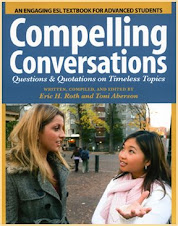
During the last week, several schools and English teachers have purchased class sets of Compelling Conversations: Questions and Quotations on Timeless. Naturally, that development pleases me for many reasons. English teachers using the book in Chile, Rwanda, Hungary, Russia, Canada, and Italy feeds my global soul.
Yet I’ve also been surprised at how many institutions have placed their orders on Amazon where they pay the full price of $24.50 . While ordering on Amazon puts more money in my book, it seems what I call a “good mistake” in my classes. Why?
Because schools, churches, and bookstores can place their orders with Booksurge directly, receive a 40% discount, and save money. Each book will cost $14.70 instead of $24.50. If the adult school or English language school sells the books to student, the institution can even make a nice profit. Schools that provide free ESL textbooks to their students should appreciate the savings because they can also provide more materials to English language learners.
• Bottomline: If you choose to buy Compelling Conversations for your oral skills class, conversation club, or advanced ESL class, save your school and yourself some money. Order your class set from Booksurge, the book’s publisher for wholesale orders.. Call customer service the BookSurge wholesale ordering hotline at 866-308-6235 and select option #6.
Of course, textbook prices do not matter equally to all. Some elite private schools, school administrators, and wealthy English language learners might even prefer to pay full price. Perhaps ordering class sets of hard to find quality ESL books directly on Amazon better fits their needs. Amazon also works better for individual English tutors and teachers.
Yet adult schools, public programs, churches, and smaller language schools ordering 10 or more copies should be - especially in these difficult economic times – more cost conscious. As the old proverb goes, a penny saved is a penny earned.
Thank you to everyone who has already brought Compelling Conversations into their classroom, and thank you to everyone considering Compelling Conversations . I hope that deepening the connections between individuals through smarter, better conversations will help create a better, more humane, and peaceful world.
"Conversation means being able to disagree and still continue the conversation."
Dwight McDonald (1906-1982), American editor
Ask more. Know more. Share more.
Create Compelling Conversations.
Visit www.CompellingConversations.com
Showing posts with label English class. Show all posts
Showing posts with label English class. Show all posts
Thursday, January 8, 2009


Tuesday, December 23, 2008
Consumer Product Reviews: Get Your ESL Students Talking About their Consumer Choices
Let ESL students give consumer product reviews in the New Year!
Do you let your students write and deliver product reviews? Consumer reviews help ESL students develop research skills, use critical thinking, and share their consumer choices.
The giving and receiving of gifts has become a central feature of Christmas, Hanukkah, winter solstice and New Year celebrations. We live – for worse or for better – in a consumer age. English language learners, around the world, share in this winter shopping spree. Product reviews allow them to talk about their gift selections and holiday gifts.
Many ESL students, especially young, hip, and wealthy teenagers and college students have also bought into - literally - the odd belief that "you are what you have". Therefore, these English language learners and experienced consumers often love to share their "insights" about consumer products. Product reviews speak to their lifestyles, passions, and curiosity.
As an ESL teacher, I use consumer product reviews to teach the difference between fact and opinion and identify critical thinking skills. The assignment lends itself to reviewing a few key concepts like “details matter” and “numbers add precision” while introducing hedging language. Of course, engaging student interests also leads to better classroom discussions and more use of authentic language.
You can also design a very simple presentation form so everyone can provide peer feedback. Result? The students receive written feedback on their product reviews from you (the teacher) and their classmates. Again, teenagers being teenagers, they love to read about themselves and the feedback. If possible, I also suggest videotaping the student reviews and posting them on a class website for both self and peer reviews.
Teaching high school students possess many challenges, beginning with capturing and holding their interest. Personally, I have found teaching slightly older undergraduate students far more satisfying - and far easier. But I have also had considerable success in short term IEP summer programs with that tough audience. Product reviews have always been a hit!
Here is both my short assignment sheet and a product review worksheet for ESL students.
----------------------------------------------------------------------------------------------------------
YOUR TURN: GIVING A PRODUCT REVIEW
You have probably bought thousands of items as a consumer. You have looked at and considered thousands more. You can’t buy everything; you have to pick and choose the products that fit you and your lifestyle.
Choose a single product and prepare to give a brief product review.
Your product review should include:
• a description of the product
• the way the product is used
• the cost of the product
• a comparison with other, similar products
• a recommendation to buy or not buy the product
• a reason for your recommendation
• a rating on a scale of 1-5
-----------------------------------------------------------------------------------------
PRODUCT REVIEW WORKSHEET
PRODUCT:
PURPOSE:
AUDIENCE:
USE:
COST:
COMPETITORS:
RECOMMENDATION:
REASON:
RATING:
_____________________________________________________________
As an old American cereal commercial used to say, “try it – you’ll like it!”
Ask more. Know more. Share more.
Create Compelling Conversations.
Visit www.CompellingConversations.com
Do you let your students write and deliver product reviews? Consumer reviews help ESL students develop research skills, use critical thinking, and share their consumer choices.
The giving and receiving of gifts has become a central feature of Christmas, Hanukkah, winter solstice and New Year celebrations. We live – for worse or for better – in a consumer age. English language learners, around the world, share in this winter shopping spree. Product reviews allow them to talk about their gift selections and holiday gifts.
Many ESL students, especially young, hip, and wealthy teenagers and college students have also bought into - literally - the odd belief that "you are what you have". Therefore, these English language learners and experienced consumers often love to share their "insights" about consumer products. Product reviews speak to their lifestyles, passions, and curiosity.
As an ESL teacher, I use consumer product reviews to teach the difference between fact and opinion and identify critical thinking skills. The assignment lends itself to reviewing a few key concepts like “details matter” and “numbers add precision” while introducing hedging language. Of course, engaging student interests also leads to better classroom discussions and more use of authentic language.
You can also design a very simple presentation form so everyone can provide peer feedback. Result? The students receive written feedback on their product reviews from you (the teacher) and their classmates. Again, teenagers being teenagers, they love to read about themselves and the feedback. If possible, I also suggest videotaping the student reviews and posting them on a class website for both self and peer reviews.
Teaching high school students possess many challenges, beginning with capturing and holding their interest. Personally, I have found teaching slightly older undergraduate students far more satisfying - and far easier. But I have also had considerable success in short term IEP summer programs with that tough audience. Product reviews have always been a hit!
Here is both my short assignment sheet and a product review worksheet for ESL students.
----------------------------------------------------------------------------------------------------------
YOUR TURN: GIVING A PRODUCT REVIEW
You have probably bought thousands of items as a consumer. You have looked at and considered thousands more. You can’t buy everything; you have to pick and choose the products that fit you and your lifestyle.
Choose a single product and prepare to give a brief product review.
Your product review should include:
• a description of the product
• the way the product is used
• the cost of the product
• a comparison with other, similar products
• a recommendation to buy or not buy the product
• a reason for your recommendation
• a rating on a scale of 1-5
-----------------------------------------------------------------------------------------
PRODUCT REVIEW WORKSHEET
PRODUCT:
PURPOSE:
AUDIENCE:
USE:
COST:
COMPETITORS:
RECOMMENDATION:
REASON:
RATING:
_____________________________________________________________
As an old American cereal commercial used to say, “try it – you’ll like it!”
Ask more. Know more. Share more.
Create Compelling Conversations.
Visit www.CompellingConversations.com
Saturday, November 15, 2008
Talking About Urban Pleasures, Perils in ESL Classrooms
Cities attract the young, the strong, and the ambitious. Cities also provide housing, jobs, and hope for those fleeing boredom, economic crisis, and war. Our 21st century cities, like our English classrooms, reflect the diversity of the human experience.
Millions move from the countryside and across the globe to live in new cities every year. Cities provide employment, culture, and education. Cities are exciting. Yet, sometimes danger also lurks in cities. Many students struggle with economic pressures, culture shock, and criminal activity. Shouldn't we discuss these conflicting pressures in our ESL classrooms?
Teaching English in Los Angeles and Santa Monica I’ve found that students, who come from across the globe, eager to talk about cities. Some English students share stories about moving from rural areas and small towns to an international city; other students enjoy telling about their travel experiences. Discussions naturally touch on housing, employment, and lifestyle choices. English language learners – whether adult immigrants creating a new home or university students living abroad – can reflect on their experiences and share insights discussing urban life.
Are you a city person? Why?
How are cities different from small towns?
What cities have you visited? Lived in?
What attracted you to this city?
What do you find stressful about city life?
What do you find satisfying about living in a city?
This month Exploring Cities, one of my favorite chapters, is highlighted as a free chapter on Compelling Conversations. Perhaps you will create some compelling conversations about cities in your classroom too. Check it out.
Ask more. Know more. Share more.
Create Compelling Conversations.
Visit www.CompellingConversations.com
Millions move from the countryside and across the globe to live in new cities every year. Cities provide employment, culture, and education. Cities are exciting. Yet, sometimes danger also lurks in cities. Many students struggle with economic pressures, culture shock, and criminal activity. Shouldn't we discuss these conflicting pressures in our ESL classrooms?
Teaching English in Los Angeles and Santa Monica I’ve found that students, who come from across the globe, eager to talk about cities. Some English students share stories about moving from rural areas and small towns to an international city; other students enjoy telling about their travel experiences. Discussions naturally touch on housing, employment, and lifestyle choices. English language learners – whether adult immigrants creating a new home or university students living abroad – can reflect on their experiences and share insights discussing urban life.
Are you a city person? Why?
How are cities different from small towns?
What cities have you visited? Lived in?
What attracted you to this city?
What do you find stressful about city life?
What do you find satisfying about living in a city?
This month Exploring Cities, one of my favorite chapters, is highlighted as a free chapter on Compelling Conversations. Perhaps you will create some compelling conversations about cities in your classroom too. Check it out.
Ask more. Know more. Share more.
Create Compelling Conversations.
Visit www.CompellingConversations.com
Subscribe to:
Posts (Atom)

 Posts
Posts