Have you seen Slumdog Millionaire yet? What about the Wrestler? Both of these outstanding films offer many poignant scenes, powerful performances, and excellent dialogue. Both movies should collect at least a few Oscars tonight.
Yet one often overlooked feature of both films remains their depiction of the allure and danger of crowds. A mob scene, fueled by religious hatred, leads to a brutal massacre in Slumdog Millionaire that haunts the main character. Unfortunately, as the recent televised terrorist attacks in Mumbai show, religious intolerance remains a huge problem both within India and between India and Pakistan.
Likewise, The Wrestler shows the pleasures for a star pe- whether as a wrestler or stripper - of a crowd's attention and brief affection. Yet the film also discloses both the fragility of the crowd's affection - and ugly underside that can emerge. Wresting crowds scream for righteous violence, pushing performers to both abuse their rivals and themselves to appease the calls for literal blood. How far have we really come since ancient Roman gladiators?
Further, both award-winning films show how individuals need to connect and overcome isolation. Authentic, private conversations offer a chance for characters to find solace, friendship, and love.
The Wrestler gives glimpses into the possibilities for a broken father-daughter relationship with seaside walks and talks. Yet it also painfully portrays the gap between vague intentions and actual commitment when a father fails to ask questions, listen to, and pay attention to his daughter.
In the film, the wrestler knows almost nothing about his daughter - and can only relate on a superficial role to role manner. Without giving away too much of the plot, the main character's inability to really talk to and care about females leads to dangerous dependence on worshiping crowds. He could relate to groups of people - and his profession encouraged relating based on stereotypes. This failure to engage with individuals instead of abstract types causes many painful mistakes - and helps push the Wrestler over the edge.
I recognize that creating space for authentic classroom conversations, especially in a second, third, or fourth language is difficult. Private English tutors often form a closer, more natural bond while teaching English than many adult education English teachers working with large classes. That's probably inevitable since numbers do matter. After all, tutors can tailor their private English lessons to their clients and allow natural conversations to evolve.
Yet caring, thoughtful English teachers can also carve out some space for students to express their thoughts and share their experience in both classroom discussions and private conversations. Conversation practice, however, makes English class far more student-centered and gives students a chance to learn by doing. In fact, I consider teaching conversation skills to be an essential skill for everyone - parents, children, immigrants, workers, wrestlers, policeman, and family members. Conversation allows us to learn about others, explore our own lives, and overcome loneliness. Just asking questions, listening to responses, and exchanging a few reflective words can deepen and improve relationships - inside a classroom and outside in the world.
Authentic conversations as the healthy counter to mindless violence of crazed crowds can be clearly seen in both Slumdog Millionaire and The Wrestler. Perhaps that message will reach some of the estimated 1 billion people watching the Oscar show later tonight on television and at parties. I hope so.
As Thomas Mann wrote, "Silence isolates... Conversation is civilization itself."
Ask more. Know more. Share more.
Create Compelling Conversations.
Visit www.CompellingConversations.com
Showing posts with label tutoring English. Show all posts
Showing posts with label tutoring English. Show all posts
Sunday, February 22, 2009


Thursday, January 22, 2009
Do You Tutor ESL Students? Set Clear Expectations - Especially in Speaking Skills!
Time is money, and money is precious these days. Tutoring English students, especially professional adults, requires setting clear, practical expectations.
Are you tutoring English students on speaking skills? How do you effectively teach speaking skills to a private English language learner? What will you actually do for 60-120 minutes together? How will you make the conversation lessons meaningful enough that your client feels satisfied and wants to retain you for future lessons?
Speaking English means being able to actually holding clear, comfortable conversations. Yet holding a conversation in English remains a challenging task for many ESL and EFL students. (Personally, I blame an old-fashioned, grammar-obsessed curriculum coordinators and educational bureaucrats for creating the common situation where students can recite obscure grammar rules, but can’t discuss their weekend plans or talk about the movies.)
Yet here we are. University students and business professionals want to develop their speaking skills, but crowded English classes provide little opportunity for authentic conversations. Therefore, many English students hire English tutors to help them develop their conversation and speaking skills.
Teaching conversation skills sounds easy, but creating compelling conversation lessons can be a challenge. What does the student want to learn? What will you really teach? How will progress be measured? While sometimes younger students just want to talk and be heard, I have traditionally worked older, more serious students. Individualization remains the key.
I strongly suggest you establish clear expectations about both content and business matters. Some tutors even present a written contract outlining their rates, the location and times of meetings, and payment policies. One of my university colleagues makes students sign a form allowing her to videotape the entire tutoring session for her research. Another demands prepayment for packages of 10 sessions at a time. I’ve never been that formal, but I have also never been burned the way some tutors have been. In fact, I’ve had only very positive experiences with conversation clients.
Why? Perhaps luck; perhaps because I carefully screen potential clients. I only work with professionals, graduate students, and/or friends and spouses of friends with a solid foundation in English. Be explicit about what you want and don’t want to teach a client. Be prepared to provide options for potential clients that you reject.
I also set very clear expectations. This process eliminates potential confusion and establishes clear benchmarks. We will review X number of articles and discuss Y number of topics during the next month or semester. We will cover a significant amount of ground in a comfortable, relaxed manner.
For students who want to improve their conversation, I strongly suggest that you select the topic and materials in advance. You can use newspapers and/or magazines to find appropriate articles to begin the conversation. I used to assign the articles a week ahead and give English students my conversation worksheets.
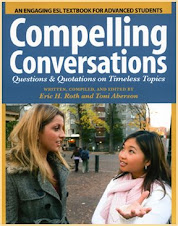
Partly as a result of these tutoring lessons over a few years, I wrote Compelling Conversations: Questions and Quotations on Timeless Topics. The conversation book includes 45 chapters with over 1400 questions, 500 quotations, and 450 targeted vocabulary words. The combination of poignant questions, vocabulary lists, proverbs, and witty quotations makes your job much easier. Each chapter is self-contained.
If you have a weaker student looking to improve their speaking skills, then I would advise using a picture dictionary. There are several fine choices. You might use the Oxford Picture Dictionary to open conversations, and I would be tempted to ask the client to bring in photographs and ads each week. Confession: I almost always referred weaker students to other English tutors who enjoyed working with lower level ESL students.
Naturally, you will need patience tutoring ESL clients on speaking skills. Be prepared to repeat words, listen very carefully, and remind students to pronounce word endings. Many students will want to work on their pronunciation. Recording your tutoring lessons can be quite helpful for students.
You can also ask/assign them listening activities on the web. I like Voice of America’s Special English programs for intermediate and advanced students. You will have to direct lower levels to websites to practice their listening and speaking skills with drills. They will love the work; you might go mad repeating vowel sounds and noting stress words.
Finally, the key to tutoring ESL students - or anyone else - remains respecting the student, meeting their needs, and providing a solid structure for your lessons. I have found that using a set text, developing a known routine, and combining conversation, vocabulary and some writing skills makes for a successful and satisfying experience.
As William Shakespeare noted four centuries ago, “All’s well that ends well”. Therefore, you should also have the grace to know when to end your lessons. Some clients will want to keep working with you. Yet you remain the tutor. Therefore, set a clear goal for your package of lessons, and conclude when the students have reached that goal. As the Hollywood cliché goes, “leave them wanting more.”
What are your plans and goals for tutoring English students this year?
Ask more. Know more. Share more.
Create Compelling Conversations.
Visit www.CompellingConversations.com today!
Are you tutoring English students on speaking skills? How do you effectively teach speaking skills to a private English language learner? What will you actually do for 60-120 minutes together? How will you make the conversation lessons meaningful enough that your client feels satisfied and wants to retain you for future lessons?
Speaking English means being able to actually holding clear, comfortable conversations. Yet holding a conversation in English remains a challenging task for many ESL and EFL students. (Personally, I blame an old-fashioned, grammar-obsessed curriculum coordinators and educational bureaucrats for creating the common situation where students can recite obscure grammar rules, but can’t discuss their weekend plans or talk about the movies.)
Yet here we are. University students and business professionals want to develop their speaking skills, but crowded English classes provide little opportunity for authentic conversations. Therefore, many English students hire English tutors to help them develop their conversation and speaking skills.
Teaching conversation skills sounds easy, but creating compelling conversation lessons can be a challenge. What does the student want to learn? What will you really teach? How will progress be measured? While sometimes younger students just want to talk and be heard, I have traditionally worked older, more serious students. Individualization remains the key.
I strongly suggest you establish clear expectations about both content and business matters. Some tutors even present a written contract outlining their rates, the location and times of meetings, and payment policies. One of my university colleagues makes students sign a form allowing her to videotape the entire tutoring session for her research. Another demands prepayment for packages of 10 sessions at a time. I’ve never been that formal, but I have also never been burned the way some tutors have been. In fact, I’ve had only very positive experiences with conversation clients.
Why? Perhaps luck; perhaps because I carefully screen potential clients. I only work with professionals, graduate students, and/or friends and spouses of friends with a solid foundation in English. Be explicit about what you want and don’t want to teach a client. Be prepared to provide options for potential clients that you reject.
I also set very clear expectations. This process eliminates potential confusion and establishes clear benchmarks. We will review X number of articles and discuss Y number of topics during the next month or semester. We will cover a significant amount of ground in a comfortable, relaxed manner.
For students who want to improve their conversation, I strongly suggest that you select the topic and materials in advance. You can use newspapers and/or magazines to find appropriate articles to begin the conversation. I used to assign the articles a week ahead and give English students my conversation worksheets.
Partly as a result of these tutoring lessons over a few years, I wrote Compelling Conversations: Questions and Quotations on Timeless Topics. The conversation book includes 45 chapters with over 1400 questions, 500 quotations, and 450 targeted vocabulary words. The combination of poignant questions, vocabulary lists, proverbs, and witty quotations makes your job much easier. Each chapter is self-contained.
If you have a weaker student looking to improve their speaking skills, then I would advise using a picture dictionary. There are several fine choices. You might use the Oxford Picture Dictionary to open conversations, and I would be tempted to ask the client to bring in photographs and ads each week. Confession: I almost always referred weaker students to other English tutors who enjoyed working with lower level ESL students.
Naturally, you will need patience tutoring ESL clients on speaking skills. Be prepared to repeat words, listen very carefully, and remind students to pronounce word endings. Many students will want to work on their pronunciation. Recording your tutoring lessons can be quite helpful for students.
You can also ask/assign them listening activities on the web. I like Voice of America’s Special English programs for intermediate and advanced students. You will have to direct lower levels to websites to practice their listening and speaking skills with drills. They will love the work; you might go mad repeating vowel sounds and noting stress words.
Finally, the key to tutoring ESL students - or anyone else - remains respecting the student, meeting their needs, and providing a solid structure for your lessons. I have found that using a set text, developing a known routine, and combining conversation, vocabulary and some writing skills makes for a successful and satisfying experience.
As William Shakespeare noted four centuries ago, “All’s well that ends well”. Therefore, you should also have the grace to know when to end your lessons. Some clients will want to keep working with you. Yet you remain the tutor. Therefore, set a clear goal for your package of lessons, and conclude when the students have reached that goal. As the Hollywood cliché goes, “leave them wanting more.”
What are your plans and goals for tutoring English students this year?
Ask more. Know more. Share more.
Create Compelling Conversations.
Visit www.CompellingConversations.com today!
Monday, May 12, 2008
Choosing to Speak English Opens Doors
Our students have chosen to speak English because it opens more doors. We should help them realize their ambitions, support their dreams, and avoid judging their motives.
For better or for worse, knowing English makes life easier and better. For instance, the ability to speak English allows individuals to communicate with millions of other people from around the world. Some globalization critics and ethnic nationalists, especially in smaller countries, have attacked English as subverting national and group identities. English speakers tend to be the more educated, more affluent, and more successful individuals in several developing countries. This fact apparently offends many people, including a surprisingly number of ESL teachers, who feel seeking worldly success, money, status, or an international spouse is elitist.
You will also find a rich literature on the use of English in advertisements in non-English speaking countries for the same reasons. Modern technological products and companies, such as LG, advertise inEurope in English their message that "Life is Good". The clear implication is that buying their LG product makes "Life Good" and as does speaking English since only English speakers can understand their ads. Hence, English has also become a symbol of modernism and stylish consumerism. LG is a Korean company!
Attacking the prevalence of English remains popular, and questioning the "morality" of choosing to speak English in some academic circles. This obsession seems misguided and ironic. As English teachers and tutors, we need to carefully assess the full range of aspirations and skills that our students as we choose and develop materials. But assessing does not mean judging them! A teacher should support the legal goals of their students.
If our students need a certain score on a standardized exam (TOEFL, TOEIC, citizenship), we need to choose appropriate materials to meet their immediate goals – including active skills like speaking and writing. The new TOEFL, by the way, is a huge improvement over the old, grammar-focused one used for decades. Speaking has been recognized as a vital life skill.
Yet we also need to help students develop authentic language skills that transcend immediate test scores. Many administrators, for understandable reasons, attempt to force all instruction toward standardized tests. Many English instructors feel that standardized test scores have displaced traditional educational goals. Professor Charles Talcott, for instance, has passionately argued against “The Tyranny of Standardized Testing in English Language Classrooms.”
How many times have you encountered ESL students who have collected impressive test scores yet struggled to express themselves in a simple conversation in English? Students need the chance to develop their conversation skills – in and out of the classroom. Listening and speaking remain essential skills so students can express themselves – even be themselves – in English.
For better or for worse, knowing English makes life easier and better. For instance, the ability to speak English allows individuals to communicate with millions of other people from around the world. Some globalization critics and ethnic nationalists, especially in smaller countries, have attacked English as subverting national and group identities. English speakers tend to be the more educated, more affluent, and more successful individuals in several developing countries. This fact apparently offends many people, including a surprisingly number of ESL teachers, who feel seeking worldly success, money, status, or an international spouse is elitist.
You will also find a rich literature on the use of English in advertisements in non-English speaking countries for the same reasons. Modern technological products and companies, such as LG, advertise in
Attacking the prevalence of English remains popular, and questioning the "morality" of choosing to speak English in some academic circles. This obsession seems misguided and ironic. As English teachers and tutors, we need to carefully assess the full range of aspirations and skills that our students as we choose and develop materials. But assessing does not mean judging them! A teacher should support the legal goals of their students.
If our students need a certain score on a standardized exam (TOEFL, TOEIC, citizenship), we need to choose appropriate materials to meet their immediate goals – including active skills like speaking and writing. The new TOEFL, by the way, is a huge improvement over the old, grammar-focused one used for decades. Speaking has been recognized as a vital life skill.
Yet we also need to help students develop authentic language skills that transcend immediate test scores. Many administrators, for understandable reasons, attempt to force all instruction toward standardized tests. Many English instructors feel that standardized test scores have displaced traditional educational goals. Professor Charles Talcott, for instance, has passionately argued against “The Tyranny of Standardized Testing in English Language Classrooms.”
How many times have you encountered ESL students who have collected impressive test scores yet struggled to express themselves in a simple conversation in English? Students need the chance to develop their conversation skills – in and out of the classroom. Listening and speaking remain essential skills so students can express themselves – even be themselves – in English.
English, an optional language for a majority of the globe, remains a smart choice for our students. They have chosen to be English language learners. Compelling Conversations: Questions and Quotations on Timeless Topics helps English language learners go from students to authentic speakers. Speaking English opens many doors. Can you think of a door you would like to open for your students?
Wednesday, May 7, 2008
Fan Writes "Teachers and Tutors Should Know About Compelling Conversations."
Sometimes you just have to smile and feel good about your achievements!
Praise, especially from an experienced colleague living thousands of miles away, on a difficult project feels satisfying. In the last week, I’ve received three emails from Joan V., an ESL teacher and tutor, praising Compelling Conversations: Questions and Quotations on Timeless Topics – the book that I co-authored and self-published. Naturally, a smile crosses my face.
Imagine my surprise when a complete stranger emails me that "Teachers and tutors should know about Compelling Conversations... It's a marvelous book!"
Her experiences mirror my own experiences with the material, and validate the book’s premise: engaging students in sophisticated conversation helps build their vocabulary, leads to memorable conversations, and deepens relationships.
Here, in her own words, are excerpts from Joan’s strong recommendation.
-------------------------------------------------------------------------------------------------------
I am an English tutor working with Japanese adults in
I’ve always used questions as a conversation stimulus, and now I have this whole organized around topics book to use with my students! As you probably know, Many Japanese arrive in this country with a fair understanding of English grammar and quite a lot of vocabulary, but are initially unable to engage in conversation. This book is the perfect answer to this situation!
Thank you so much for putting this together!
Teachers and tutors should know about Compelling Conversations... I was a classroom ESL teacher for many years, went to conferences with book displays shopping for books, and was usually disappointed by the books I saw. There were a lot of boring books out there!
The book needs to on display at ESL conferences if they are still being held. ESL teachers and tutors working with intermediate and advanced level students would choose this book over almost anything else if they knew about it. Also many community colleges have ESL programs using traditional materials focused on grammar and repetition rather than real meaningful conversation which your book provides.
I happened on your book accidentally on the internet and looking at the sample lessons, I quickly knew that this book would work for my students.
I wanted to add one more thought regarding Compelling Conversations. It is saving me a lot of time! I have been tutoring Japanese adults (businessmen and their wives) for nine years after retiring from almost 30 years of teaching in public schools. I've spent so much time gathering materials from various sources--textbooks, my own materials, bilingual dictionaries, etc.
Now I'm finding that printing out a chapter of your book provides plenty of conversational focus for at least two hours or more of tutoring time. Even more important, our conversations are at a deeper level. For example, in chapter two there are some questions about childhood. A couple of weeks ago a student ordering on fluency was able to tell me about his childhood dreams and that now he is living that dream! I was thrilled!
Thanks.
Joan
----------------------------------------------------------------------------------
Wow!
Thank you, Joan! You made my week!
Check out sample Compelling Conversations lessons for yourself at:
http://www.compellingconversations.com/pdf/cc_sampler_esl.pdf
http://www.compellingconversations.com
Hopefully, you will have the same satisfying experiences that Joan and other satisfied teachers and tutors have had with Compelling Conversations. Enjoy!
Ask more. Know more. Share more.
Create Compelling Conversations.
Subscribe to:
Posts (Atom)

 Posts
Posts