Ask more. Know more. Share more. Speak more.
Create Compelling Classroom Conversations.
That's the core educational philosophy behind this blog by an experienced English as a Second Language teacher working in Los Angeles. The evolving blog shares educational resources, sparks conversations between ESL teachers and English language learners, and discusses effective teaching techniques.
Although "well-begun is half done," the blog will continue to develop and deepen over time.
Welcome to Compelling Conversations! Volume 1: Issue 1
This issue has been long overdue, and for our first 2009 issue, we would like to personally thank you for subscribing to our newsletter for English teachers. We appreciate your visit to our website and, for this reason, we have good news:
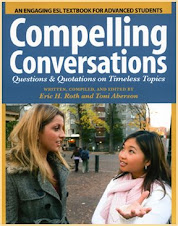
A discount coupon for our book! If you've haven't had the opportunity to get a copy of our book, we have lowered the price for our subscribers: you can get $5 off the regular price for Compelling Conversations: Questions and Quotations on Timeless Topics (for ESL learners and teachers)! Click here to get your copy for $15 (instead of $20).
Or just download our free Compelling Conversations chapters on Change and on Job Interviews.
Don't forget to check out our special thank you offer again at the end of this newsletter.
In This Issue Articles of Interest
The Compelling Conversations Blog recently had a post on World Englishes, which linked to a review on a book by the same name. In this newsletter you will find an intro to Eric Roth's review (to the right), and for the sake of providing different perspectives on the subject matter, here are a few articles that have caught our attention.
UsingEnglish.com provides a short article on how native English speakers are not always considered the best choice for foreign businesses. Perhaps the debate for International English should focus on the listening audience.
This is an extensive article on English as a global language for business, which was written by Jeanette Gilsdorf, a Professor in the Department of Information Systems at the College of Business Administration at California State University – Long Beach.
The radio program This I Believe was also reviewed on the Compelling Conversations Blog. We offer an assignment/worksheet on the post, and you will find an intro and direct link on the right.
World Englishes Review by Eric Roth
Do the English in England speak the same English as the Americans, the Jamaicans, the South Africans, the Australians, the Irish, and the Indians? Do they even speak the same English as they did 100 years ago before radio, television, and the internet? Should there be a global standard for all English speakers? Linguist Andy Kirkpatrick raises these and many other provocative questions in his exceptionally documented book “World Englishes: Implications for International Communication and English Language Teaching” published by Cambridge University Press.
What are your core beliefs? More importantly, what are your students’ core beliefs? How can you help English language learners improve their listening skills while exploring their own personal philosophy? Do you use radio podcasts in your English classrooms or ask students to write personal essays? If so, you might want to visit www.ThisIBelieve.org for excellent, fascinating authentic listening materials.
Are you (or will you be) teaching an ESL class? Here are a few articles that relate to our trademark phrase "Ask more. Know more. Share more." on conversations in the ESL classroom, along with other articles about teaching abroad:
This is a useful article by Mario Rinvolucri, which provides example questions and things you can do to check your students for understanding (before asking them directly).
Memoirs of a Teacher This article gives the perspective of an ESL teacher who followed in his mother's footsteps after an experience in Korea. He debated about going, but the experience proved fruitful.
Improving Teacher-Student Interaction This report on an action research project provides insights on how to effectively get your students to participate in class. Having active students isn't just about asking compelling questions, but rather how they are asked!
Teaching English in Vietnam This article goes over the requirements, available positions, what living there means, and the general expectations you should keep in mind on what it takes to teach ESL in Vietnam.
Vietnam Embraces English Classes - and Looks for Communicative English Teachers Thursday, April 2nd, 2009
My recent trip to Vietnam to meet English teachers and lead a professional development seminar at the American-Pacific University, Vietnam lead to many wonderful moments and a few surprising conversations.
Teaching English in developing countries always poses challenges, and Vietnam falls into that category. Let me share a few selective details to provide a brief introduction to the education atmosphere for English teachers who prefer a communicative approach to grammar drill and kill tasks. Consider the gap between a traditional teacher-centered education philosophy and modern student-centered approaches for teaching English.
By the way, the Compelling Conversations Blog will be getting a make-over! Yes, we'll soon be incorporating more digital media, changing our theme, and we'll be making it easier for you to get a copy of our class worksheets. We want to move beyond mere text and incorporate more pictures and sound to create a livelier, more 21st century look.
Again, as a newsletter subscriber, you qualify for a $5 discount on our downloadable ESL ebook that makes teaching conversation in English class a simple joy. Why not buy your copy today?
Do you match? How do you know? Where does kissing come from?
Are you romantically involved? Do you match your partner? How do you know? Who will you choose to share your life with? Are you considering marriage? Are you already married? Use these questions as a springboard to reflect on your options, choices, and desires on this Valentine’s Day.
Here is chapter #33 from Compelling Conversations that many friends have told me is better for native speakers than English language learners or ESL classrooms. Perhaps they are right. On the other hand, I’ve had great conversations in my adult ESL and college ESL classes using this chapter too.
As both a happily married man of 14 years and the child of divorced parents, these questions seem like smart questions to ask - even for romantics on Valentine’s Day. Perhaps especially on Valentine’s Day when the official propaganda of “love will conquer all” seems so pervasive. So whether English teachers ask themselves, their partner, or their students these questions, I’d like to share this list on my blog tonight.
I’m also including a short videoclip from Discovery News that I found quite interesting on the origins of kissing and how that satisfying activity is believed to have spread around the globe. Enjoy!
The Skinny on Smooching from Discovery News
1. Why do (did) you want to get married? 2. Do (did) you have a checklist of qualities for a potential spouse? 3. What are the three main qualifications on your checklist? Partner? Provider? Lover? Friend? 4. When did you fall in love? Did one person fall first? Who? 5. How did you know your lover was the one? How did your thinking evolve? 6. Did you ever have moments of doubt? How did your thinking evolve? 7. Do you think people should live together before they get married? Why? Can you share some examples? 8. Are sex, love and marriage linked in your mind, or is each separate? How are they different? 9. What are some endearing qualities of your companion? 10. Do you like your partner’s friends? Do you respect them? Why? 11. What advice have your parents and close friends given you? Your extended family? How important is their opinion in your decision? Why? 12. Do you think you are marrying only an individual or are you also marrying your spouse’s family? How would you describe your potential in-laws? 13. What does your partner do that annoys you? 14. Do you expect to be the pilot, co-pilot, or passenger in the marriage? Why? 15. What, if anything, would definitely cause you to divorce? Why?
Q U E S T I O N S A N D Q U OTAT I O N S O N T I M E L E S S TO P I C S • 1 0 5 V O C A B U L A R Y Review these words and expressions. Circle the words that you know. potential ………………………………………………………………………………………. neat freak …………………………………………………………………………………….. spouse ………………………………………………………………………………………….. nupital …………………………………………………………………………………………. conflicts ……………………………………………………………………………………….. checklist ……………………………………………………………………………………….. resolve …………………………………………………………………………………………. pre-nuptial …………………………………………………………………………………… compatible …………………………………………………………………………………… pack rat ……………………………………………………………………………………….. justify …………………………………………………………………………………………… evolve …………………………………………………………………………………………..
P R O V E R B S What do these proverbs mean? Can you share some other proverbs? The needle is always accompanied by the thread.—Korean Strange is the affinity that binds two in marriage.—Japanese Whoever marries only for beauty will live in misery.—Russian
T H E C O N V E R S A T I O N C O N T I N U E S … 1. Thinking about personal preferences, do you like to stay up late or get up early? Do you have compatible sleeping habits? 2. Do you have similar media habits? What about tastes in TV shows and movies? 3. Where do you prefer to live? Country? City? Farm? Apartment? House? 4. Are you a pack rat? Are you a neat freak? Are your styles compatible? 5. Will you still love your partner when he or she is 64? Will your partner love you with wrinkles? 6. Do you know an older couple that might be a model for a good partnership? Who are they? 7. What activities do you enjoy in your leisure time? Will your spouse join you? 8. Do you and your lover share spending philosophies? Do you shop together? 9. Do you expect to live with older generations? Who? Why? Where? When? 10. What is your approach to settling conflicts? How often do you have conflicts? 11. Do you want children? How many? N O T E S & Q U E S T I O N S . . . . . . . . . . . . . . . . . . . . . . . . . . . . . . . . . . . . . . . . . . . . . . . . . . . . . . . . . . . . . . . . . . . . . . . . . . . . . . . . . . . . . . . . . . . . . . . . . . . . . . . . . . . . . . . . . . . . . . . . . . . . . . . . . . . . . . . . . . . . . . . . . . . . . . . . . . . . . . . . . . . . . . . . . . . . . . . . . . . . . . . . . . . . . . . . . . . . . . . . . . . . . . . . . . . . . . . . . . . . . . . . . . . . . . . . . . . . . . . . . . . . . . . . . . . . . . . . . . . . . . . . . . . . . . . . . . . . . . . . . . . . . . . . . . . . . . . . . . . . . . . . . . . . . . . . 1 0 6 • w w w. c o m p e l l i n g c o n v e r s a t i o n s . c o m
12. Do you believe in birth control? Why? 13. How do you think your baby would look like? Why? 14. What kind of parent do you expect your spouse to become? Why? 15. Would you want your sons to be like the man you’re marrying? Would you want your daughters to be like the woman you’re marrying? 16. Do you expect to follow family or religious traditions? Which ones? Why? 17. If disagreements arise about children, how do you expect to resolve them? 18. Do you think all money should be shared or should each spouse have separate bank accounts? Why? How do you expect to manage household expenses? 19. What were the best gifts that you’ve given or received in the relationship? 20. What passions do you share? What unites you as a couple? 21. Do you have a favorite photograph of you as a couple? Can you describe it? 22. Where do you want to travel together? What do you want to see together? 23. What are you looking forward to doing together as a married couple? 24. How do you expect your life to change once you are married? What are some advantages of being married? 25. Do you have any tips or suggestions on how to create and preserve a happy marriage?
Q U O T A T I O N S Which two quotations come closest to your attitudes? 1. “By all means marry; if you get a good wife, you’ll become happy; if you get a bad one, you’ll become a philosopher.” —Socrates (470-339 BC), Greek philosopher 2. “Man’s best possession is a sympathetic wife.” —Euripides (480-406 BC), playwright 3. “I’m so gullible. I’m so damn gullible. And I am so sick of being gullible.” —Lana Turner (1921-1995), Hollywood star married seven times 4. “Love is the ideal thing, marriage a real thing; a confusion of the real with the ideal never goes unpunished.” —Goethe (1749-1832), German poet, novelist, and scientist 5. “Marriage is a great institution, but I’m not ready for an institution.” —Mae West (1892-1980), American actress 7. “Love means never having to say you’re sorry.” —Ali McGraw in Love Story (1970)
“Love is the ideal thing, marriage a real thing; a confusion of the real with the ideal never goes unpunished.” Goethe (1749-1832), German poet, novelist, and scientist
Q U E S T I O N S A N D Q U OTAT I O N S O N T I M E L E S S TO P I C S • 1 0 7
8. “Marriage: A word that should be pronounced ‘mirage.’” —Herbert Spencer (1820-1903), English philosopher 9. “No matter who you get married to, you wake up married to somebody else.” —Marlon Brando in Guys and Dolls (1955) 10. “Second marriage: the triumph of hope over experience.” —Dr. Samuel Johnson (1709-1784), English writer 11. “Marriage is a very good thing, but I think it’s a mistake to make a habit of it.” —W. Somerset Maugham (1874-1965), English novelist 12. “A happy marriage is a long conversation that always seems too short.” —Andre Maurois (1885-1967), French author 13. “A successful marriage is not a gift; it is an achievement.” —Ann Landers (1918-2002), American advice columnist ★ O N Y O U R O W N With your class partner, list three celebrity marriages that have ended in divorce. For each couple who divorced, list two reasons you think their marriage did not last. Then, list three marriages of well known people that have lasted more than 20 years. For each couple, list two reasons why you think their marriage lasted. Share with the class. 1. …………………………………………………………………………………………………… • . ………………………………………………………………………………………………. • . ………………………………………………………………………………………………. 2. ……………………………………………………………………………………………………. • . ………………………………………………………………………………………………. • . ………………………………………………………………………………………………. 3. ……………………………………………………………………………………………………. • . ………………………………………………………………………………………………. • . ………………………………………………………………………………………………. 1. …………………………………………………………………………………………………… • . ………………………………………………………………………………………………. • . ………………………………………………………………………………………………. 2. ……………………………………………………………………………………………………. • . ………………………………………………………………………………………………. • . ………………………………………………………………………………………………. 3. ……………………………………………………………………………………………………. • . ………………………………………………………………………………………………. • . ………………………………………………………………………………………………. 1 0 8 • w w w. c o m p e l l i n g c o n v e r s a t i o n s . c o m
"Next to money, English is the leading international language." Evan Esar, American humorist
A new semester means more last minute orders of class sets of textbooks, including ESL books. I'm now seeing this situation as both an ESL instructor and a small publisher.
During the last week, several schools and English teachers have purchased class sets of Compelling Conversations: Questions and Quotations on Timeless. Naturally, that development pleases me for many reasons. English teachers using the book in Chile, Rwanda, Hungary, Russia, Canada, and Italy feeds my global soul.
Yet I’ve also been surprised at how many institutions have placed their orders on Amazon where they pay the full price of $24.50 . While ordering on Amazon puts more money in my book, it seems what I call a “good mistake” in my classes. Why?
Because schools, churches, and bookstores can place their orders with Booksurge directly, receive a 40% discount, and save money. Each book will cost $14.70 instead of $24.50. If the adult school or English language school sells the books to student, the institution can even make a nice profit. Schools that provide free ESL textbooks to their students should appreciate the savings because they can also provide more materials to English language learners. • Bottomline: If you choose to buy Compelling Conversations for your oral skills class, conversation club, or advanced ESL class, save your school and yourself some money. Order your class set from Booksurge, the book’s publisher for wholesale orders.. Call customer service the BookSurge wholesale ordering hotline at 866-308-6235 and select option #6.
Of course, textbook prices do not matter equally to all. Some elite private schools, school administrators, and wealthy English language learners might even prefer to pay full price. Perhaps ordering class sets of hard to find quality ESL books directly on Amazon better fits their needs. Amazon also works better for individual English tutors and teachers.
Yet adult schools, public programs, churches, and smaller language schools ordering 10 or more copies should be - especially in these difficult economic times – more cost conscious. As the old proverb goes, a penny saved is a penny earned.
Thank you to everyone who has already brought Compelling Conversations into their classroom, and thank you to everyone considering Compelling Conversations . I hope that deepening the connections between individuals through smarter, better conversations will help create a better, more humane, and peaceful world.
"Conversation means being able to disagree and still continue the conversation." Dwight McDonald (1906-1982), American editor
Ask more. Know more. Share more. Create Compelling Conversations. Visit www.CompellingConversations.com
As we welcome the new year, we can anticipate some familiar pleasures and puzzles. For English language teachers, establishing reasonable standards for oral communication remains a complicated, difficult challenge. Students must be able to clearly communicate their ideas with adequate pronunciation, but we must allow for a rich variety of accents too. Some ESL teachers also find themselves placed in the role of both gatekeeper - upholding standards of admission to university courses - and coach. Some tension between these roles occurs when evaluating a student's oral skills for mandatory courses. English teachers, especially ESL and ESOL working with adult English language learners, can build on the experience of international organizations working with refugees and immigrants. Check out this practical chart with ten categories for listening comprehension and speaking skills developed by the United States Office of Refugee Resettlement and revised by the Spring Institute for Intercultural Learning. Where did I find it? As so often, I went to the Center for Applied Linguistics website. What are reasonable standards for listening comprehension and speaking skills for adult English language learners? That’s a difficult question, and context matters. This chart, however, seems quite sensible. SPL stands for Student Performance Level here. The descriptors for listening comprehension and oral communication are intended to establish a standard that government agencies, educational institutions, and non-profits can all use to share evaluations. Despite the bureaucratic title, the chart itself contains excellent descriptions that English teachers and testers can use for adult English language learners. After having been in several long faculty discussions over standards for oral skills, I appreciate the explicit standards combined with some flexibility. This chart, developed for adult refugees, resembles other charts, yet includes more details and an explicit acknowledgment of economics. I like that awareness even if this factor can sometimes be misused to justify low standards in adult education programs. (After all, illiterate peasants move to the United States, Canada, England, and Australia in hopes of improving their economic and social status.) Our job as educators is to provide our students with the language skills to live fuller, more satisfying lives – in English – wherever they choose to live and work. Student Performance Level (SPL) Descriptors for Listening Comprehension and Oral Communication SPL General Language Ability Listening Comprehension Oral Communication
0 No ability whatsoever No ability whatsoever No ability whatsoever
1 Functions minimally, if at all, in English. Can handle only very routine entry-level jobs that do not require oral communication, and in which all tasks can be easily demonstrated. A native speaker used to dealing with limited English speakers can rarely communicate with a person at this level except through gestures. Understands only a few isolated words, and extremely simple learned phrases. Vocabulary limited to a few isolated words. No control of grammar.
2 Functions in a very limited way in situations related to immediate needs. Can handle only routine entry-level jobs that do not require oral communication, and in which all tasks can be easily demonstrated. A native English speaker used to dealing with limited English speakers will have great difficulty communicating with a person at this level. Understands a limited number of very simple learned phrases, spoken slowly with frequent repetitions. Expresses a limited number of immediate survival needs using very simple learned phrases.
3 Functions with some difficulty in situations related to immediate needs. Can han¬dle routine entry-level jobs that involve only the most basic oral communication, and in which all tasks can be demonstrated. A native English speaker used to dealing with limited English speakers will have great difficulty communicating with a person at this level. Understands simple learned phrases, spoken slowly with frequent repetitions. Expresses immediate survival needs using simple learned phrases.
4 Can satisfy basic survival needs and a few very routine social demands. Can handle entry-level jobs that involve some simple oral communication, but in which tasks can be easily demonstrated. A native English speaker used to dealing with limited English speakers will have difficulty communicating with a person at this level. Understands simple learned phrases easily, and some simple new phrases containing familiar vocabulary, spoken slowly with frequent repetitions. Expresses basic survival needs including asking and responding to related questions, using both learned and a limited number of new phrases. Participates in basic conversations in a few very routine social situations. Speaks with hesitation and frequent pauses. Some control of basic grammar. 5 Can satisfy basic survival needs and some limited social demands. Can handle jobs and job training that involve following simple oral instructions but in which most tasks can also be demonstrated. A native English speaker used to dealing with limited English speakers will have some difficulty communicating with a person at this level. Understands learned phrases easily and short new phrases containing familiar vocabulary spoken slowly with repetition. Has limited ability to understand on the telephone. Functions independently in most face-to-face basic survival situations but needs some help. Asks and responds to direct questions on familiar and some unfamiliar subjects. Still relies on learned phrases but also uses new phrases (i.e., speaks with some creativity) but with hesitation and pauses. Communicates on the phone to express a limited number of survival needs, but with some difficulty. Participates in basic conversations in a limited number of social situations. Can occasionally clarify general meaning. 6 Can satisfy most survival needs and limited social demands. Can handle jobs and job training that involve following simple oral and written instructions and diagrams. A native English speaker not used to dealing with limited English speak¬ers will be able to communicate with a person at this level on familiar topics, but with difficulty and some effort. Understands conversations containing some unfamiliar vocabulary on many every¬day subjects, with a need for repetition, rewording or slower speech. Has some ability to understand without face-to-face contact (e.g. on the telephone, TV). Functions independently in most survival situations, but needs some help. Relies less on learned phrases; speaks with creativity, but with hesitation. Communicates on the phone on familiar subjects but with some difficulty. Participates with some confidence in social situations when addressed directly. Can sometimes clarify general meaning by rewording. Control of basic grammar evident, but inconsistent; may attempt to use more difficult grammar but with almost no control. 7 Can satisfy survival needs and routine work and social demands. Can handle work that involves following oral and simple written instructions in familiar and some unfamiliar situations. A native English speaker not used to dealing with limited English speakers can generally communicate with a person at this level on familiar topics. Understands conversations on most everyday subjects at normal speed when addressed directly; may need repetition, rewording, or slower speech. Understands routine work-related conversations. Increasing ability to understand without face-to-face contact (telephone, TV, radio). Has difficulty following conversation between native speakers. Functions independently in survival and many social and work situations, but may need help occasion¬ally. Communicates on the phone on familiar subjects. Expands on basic ideas in conversation, but still speaks with hesitation while searching for appropriate vocabulary and grammar. Clarifies general meaning easily, and can sometimes convey exact meaning. Controls basic grammar, but not more difficult grammar. 8 Can participate effectively in social and familiar work situations. A native English speaker not used to dealing with limited English speakers can communicate with a person at this level on almost all topics. Understands general conversation and conversation on technical subjects in own field. Understands without face-to-face contact (telephone, TV, radio); may have difficulty following rapid or colloquial speech. Understands most conversations between native speakers; may miss details if speech is very rapid or colloquial or if subject is unfamiliar. Participates effectively in practical and social conversation and in technical discussions in own field. Speaks fluently in both familiar and unfamiliar situations; can handle problem situations. Conveys and explains exact meaning of complex ideas. Good control of grammar.
9 Can participate fluently and accurately in practical, social, and work situations. A native English speaker not used to dealing with limited English speakers can communicate easily with a person at this level. Understands almost all speech in any context. Occasionally confused by highly colloquial or regional speech. Approximates a native speaker’s fluency and ability to convey own ideas precisely, even in unfamiliar situations. Speaks without effort. Excellent control of grammar with no apparent patterns of weakness. 10 Ability equal to that of a native speaker of the same socioeconomic level. Equal to that of a native speaker of the same socioeconomic level. Equal to that of a native speaker of the same socioeconomic level.
Original chart from http://www.cal.org/caela/esl_resources/slspls.html These standards, of course, remain more relevant for adult educators and workplace programs than more academic programs. English teachers should, however, create classroom activities where students can engage in extended conversations in English on a wide variety of topics. The higher levels of this chart (SPL 9-10) articulate an excellent standard for all English language learners, including academic English and Business English students.
Ask more. Know more. Share more. Create Compelling Conversations. Visit www.CompellingConversations.com
What ESL textbooks do you recommend? What are some of your favorite books to help English language learners develop their skills?
Two email requests in 40 hours require a decent response. Here's a quick, concise list of some ESL titles that I've enjoyed. It's by no means comprehensive, and just a starting list heavily influenced by the books in my eyesight.
The Creative Classroom: Teaching Language Outside the Box, by Hall Houston, contains dozens of bite-sized exercises to spark authentic language and creative discourse, This slim book, published by Lynx, should especially appeal to ESL students with a background or interest in engineering, science, and the arts.
Academic ESL/intensive English programs Cambridge Vocabulary in Use series - An excellent supplemental text, especially for the more academically inclined. The self-contained two page format allows students, teachers, and tutors to pick and choose materials.
Cambridge Grammar in Use series - This series is the only grammar series that I've ever felt comfortable using in the classroom. Again, the accessible, clear format with self-contained lessons allows both self-study and effective use as a supplemental text.
English for Professionals series has become the gold standard for vocational students. The English for Health Sciences and English for Science and Engineering and English for Business all fill vital gaps. The rich collection of concise exercises, emphasizing and re-enforcing each other, make this a logical choice for workforce training programs.
Adult Education: Side by Side - This classic series, now in its 3rd edition, particularly appeals to English language learners with limited literacy in their own best language. Given the appalling educational policies in some nearby poor countries, this textbook series has become extraordinarily popular in California and Texas. Day by Day - Simple, clear communicative textbook for workplace instruction. Low intermediate- intermediate. Oxford Picture Dictionary and workbook - excellent for beginning and intermediate English language learners.
Writing
Writing Academic English, by Alice Oshima and Ann Hogue, provides practical techniques for students planning to attend community college or university. I think the latest version is the fourth. I've used it in several programs with considerable success.
In Focus: Strategies for Academic Writers by Myra Ann Shulman, however, is my current choice for intermediate ESL students. The clear, detailed exercises allow students to learn academic writing by actually writing short, focused pieces.
Finally, for advanced ESL students and international graduate students, I strongly recommend Academic Writing for Graduate Students, 2d ed.: Essential Tasks and Skills (Michigan Series in English for Academic & Professional Purposes) by John M. Swales and Christine A. Beer Feak. I teach two courses using this textbook at USC, and students make clear, significant progress by completing bite-sized writing exercises and analyzing short journal readings. The teacher's guide, called Commentary for, also deserves to be on your list.
Speaking Skills: Giving Academic Presentations, by Susan Reinhart, stands heads and shoulders above the other ESL textbooks for public presentations. Students learn how to give clear, systematic oral presentations including problem-solution and process descriptions.
Communicating in Business by Simon Sweeney -Yet another outstanding Cambridge title, this Business English textbook includes helpful materials on negotiating and socializing as well as presenting.
Last, but not least, I naturally recommend Compelling Conversations: Questions and Quotations on Timeless Topics, by Toni Aberson and Eric Roth, as a supplemental text for advanced ESL classes, conversation clubs, and tutors.
Other special interest ESL books of quality. Film is Content: A Study Guide for the Advanced ESL Classroom by Julia A. Williamson and Jill C. Vincent- This underappreciated University of Michigan textbook deserves a much wider audience. Although slightly dated, students learn critical thinking skills, academic vocabulary, and modern film.
Again, this list is just a starting list. What ESL books have your found effective in your teaching? Why?
Ask more. Know more. Share more. Create Compelling Conversations. Visit www.CompellingConversations.com


 Posts
Posts