Los Angeles CATESOL Conference Highlights Practical ESL Teaching Techniques
Are you looking to share practical techniques with your fellow English teachers? What works in your ESL classroom? What tends to work in ESL classrooms? Why?
The Los Angeles Regional CATESOL conference, titled “WWW. What Works and Why” at Biola University on October 25 features over 60 workshops and panel discussions. The annual event is expected to attract over 500 ESL professions from K-12 classes, adult education, IEP, and community college and university programs.
Do you live in Southern California? Do you have plans for October 25th yet? Visit
http://www.lacatesol2008.org/ if you are interested. This regional conference is larger than many state conferences and reflects the importance of studying English to immigrants in Los Angeles – especially during economically difficult times.
By the way, I will be giving a 45-minute presentation titled “Technique for a More Democratic Classroom” and a joint presentation titled “Creating Win-Win Workplace English Programs That Work for Both Employers and Employees.”
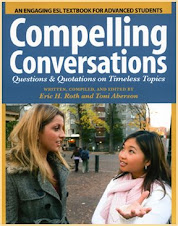
In my solo presentation, I will review classroom practices like tailoring assignments for individual students, effective peer evaluations, and organizing students to create classroom materials. Some exercises come from Compelling Conversations. but most exercises are practices that I’ve developed over time in both writing and speaking courses.
The second presentation, with Troy Parr, comes out of a series of vocational ESL workshops that we designed for an important union for healthcare workers, the SEIU, in Los Angeles. (The director of their workplace educational programs read Compelling Conversations., and contacted me. I brought in Troy, who wrote his thesis on best practices in workplace ESL programs.) We emphasize the importance of creating practical, participant specific exercises that both introduce new workplace vocabulary and provide many opportunities to speak, write, and reflect on workplace issues – in English. These workshop exercise such as rewriting forms, writing memos, and giving presentations on safety tips also help students develop their language skills for beyond their immediate job.
Naturally, I hope you can make the LA Regional CATESOL conference. See you there?
For more information:
http://www.lacatesol2008.org/
http://catesol.org
Ask more. Know more. Share more.
Create Compelling Conversations.
Visit www.CompellingConversations.com
Showing posts with label workplace ESL programs. Show all posts
Showing posts with label workplace ESL programs. Show all posts
Tuesday, September 30, 2008


Saturday, August 23, 2008
Conversation Tip #15: Seek First to Understand - ESL Worksheet
Seek to Understand
Have you ever seen two emotional people talk past each other? Both talk and neither listen. Both want to tell the other, and don’t want to hear – or understand – what the other person is saying. This happens too often in stressful workplaces.
Stephen Covey, author of the international bestseller called “Seven Habits of Highly Effective People, advises people “to seek first to understand, then to be understood.” Following this traditional wisdom can improve workplace relationships and communication.
What are some techniques that can help understand other people? Here are some tips:
• Listen first and avoid interrupting.
• Pause before speaking.
• Look people in the eye.
• Be curious.
• Ask “what” and “how” questions to get more information.
• Keep the voice down. Stay calm. Talk slow.
• Repeat or rephrase what people say to avoid misunderstandings.
What are some other tips to avoid misunderstandings or conflicts at work?
1.
2.
3.
4.
What are some advantages of staying calm at work?
1.
2.
3.
Ask more. Know more. Share more.
Create Compelling Conversations.
Visit www.CompellingConversations.com
Have you ever seen two emotional people talk past each other? Both talk and neither listen. Both want to tell the other, and don’t want to hear – or understand – what the other person is saying. This happens too often in stressful workplaces.
Stephen Covey, author of the international bestseller called “Seven Habits of Highly Effective People, advises people “to seek first to understand, then to be understood.” Following this traditional wisdom can improve workplace relationships and communication.
What are some techniques that can help understand other people? Here are some tips:
• Listen first and avoid interrupting.
• Pause before speaking.
• Look people in the eye.
• Be curious.
• Ask “what” and “how” questions to get more information.
• Keep the voice down. Stay calm. Talk slow.
• Repeat or rephrase what people say to avoid misunderstandings.
What are some other tips to avoid misunderstandings or conflicts at work?
1.
2.
3.
4.
What are some advantages of staying calm at work?
1.
2.
3.
Ask more. Know more. Share more.
Create Compelling Conversations.
Visit www.CompellingConversations.com
Monday, August 4, 2008
Workplace Conversation tip: Tone, Volumen, and Context Matter!
Style matters – especially when we talk with our co-workers, consumers, patients, and supervisors. English language learners, recent immigrants, and far too many other people who work in English sometimes seem to forget this!
Consider the difference in how these requests sound.
Shut off the TV!
Please turn off the TV?
Could you turn off the TV?
Would you please turn off the TV?
Close the door!
Close the door; it’s noisy out there.
Shut the damn door!
Would you please close the door; it’s noisy out there.
Could you get the door?
Can you close the door?
Sometimes, especially in an emergency, it is appropriate to warn other people with a short command.
Call the police!
Help!
Shut the door!
We recognize it is an emergency because of the way the request is made. It’s an order.
I. When would it be appropriate to give a warning on your job? Please give 3 examples.
1.
2.
3.
But, usually, we also make our requests that are not emergencies. We can – and should- give suggestions in a kinder, gentler way.
We can use many words to make requests and suggestions:
May Can Could Would Should Might
II. Please write a request that you might give or hear at work with these words.
1. Can ______________________________________________?
2. May ______________________________________________?
3. Could _____________________________________________?
4. Would_____________________________________________?
5. Should_____________________________________________?
6. Might _____________________________________________?
Adding the word “please” makes your requests and suggestions sound nicer too!
Ask more. Know more. Share more.
Create Compelling Conversations.
Visit www.CompellingConversations.com
Consider the difference in how these requests sound.
Shut off the TV!
Please turn off the TV?
Could you turn off the TV?
Would you please turn off the TV?
Close the door!
Close the door; it’s noisy out there.
Shut the damn door!
Would you please close the door; it’s noisy out there.
Could you get the door?
Can you close the door?
Sometimes, especially in an emergency, it is appropriate to warn other people with a short command.
Call the police!
Help!
Shut the door!
We recognize it is an emergency because of the way the request is made. It’s an order.
I. When would it be appropriate to give a warning on your job? Please give 3 examples.
1.
2.
3.
But, usually, we also make our requests that are not emergencies. We can – and should- give suggestions in a kinder, gentler way.
We can use many words to make requests and suggestions:
May Can Could Would Should Might
II. Please write a request that you might give or hear at work with these words.
1. Can ______________________________________________?
2. May ______________________________________________?
3. Could _____________________________________________?
4. Would_____________________________________________?
5. Should_____________________________________________?
6. Might _____________________________________________?
Adding the word “please” makes your requests and suggestions sound nicer too!
Ask more. Know more. Share more.
Create Compelling Conversations.
Visit www.CompellingConversations.com
Monday, April 21, 2008
Investing in quality ESL classes improves daily life
A good society helps its citizens flourish and visitors feel welcome.
A good society also invests in education, including teaching immigrants enough English that they can use their considerable intelligence, creativity, and skills in the workplace.
Unfortunately, low standards in public education have eroded support for government sponsored education programs. Worse, the few underfunded English as a Second Language programs usually provide the most basic English skills. Students learn to listen and read at about 4th grade level, and speak like a child with a very limited vocabulary.
From my perspective as an English instructor and former adult ESL teacher, the current adult ESL standards too often only teach immigrants passive skills like listening and some minimum reading. English language programs, whether designed for vocational skills or general language, must include speaking and writing. If people can’t hold a conversation in English, their job prospects remain rather limited!
A frontpage article in today’s Los Angeles Times points out the obvious problem.
When will the employers and voters decide to invest in real, serious, quality English languages for immigrants? And why are immigrants trained in English programs abroad so much stronger, better, and more effective than the adult ESL programs here? After all, immigrants have many more opportunities to speak English and learn outside of the classroom than students in
Again, the case for dramatically expanding and raising the standards of our English as a Second Language programs seems clear.
Unfortunately, reason and government policy do not always co-exist in the
Ask more. Know more. Share more.
Create Compelling Conversations.
Subscribe to:
Posts (Atom)

 Posts
Posts