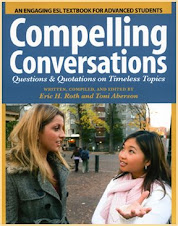
Almost everyone agrees that adult ESL teachers should help their English students develop their job skills and practice mock job interviews in our English classes.
During these difficult economic times, however, I would suggest that ESL and even EFL instructors working with college and university students also should focus on practical employment skills. Videotaping practice interviews – and longer is better – remains an invaluable tool.
Yet ESL teachers can also help ESL/EFL students conduct research for possible jobs with information interviews. A common practice in the United States, informational interviews allow job seekers to meet working professionals in their field, collect detailed information on working lives, and expand their network of valuable contacts. Sometimes it also leads to job leads, internships, and even jobs.
More About Informational Interviews on the Web
Vanderbilt University, an elite private university in Tennessee, has compiled an impressive list of 60 informational interviews from a wide variety of disciplines and professions. (Peabody is a leading school of Education within Vanderbilt University). These provide illuminating examples of real-life informational interviews. Note: some speakers have a strong southern accent.
http://streams.peabody.vanderbilt.edu/hod1210/sort_field.htm
Here’s a solid collection of typical informational interview questions from About.com, a fairly reliable New York Times-owned website. Questions are divided into Occupational and Functional categories.
http://jobsearch.about.com/od/infointerviews/a/infointervquest.htm
Here’s a basic video, perhaps targeted for adult education and community college students, that reviews the fundamentals of conducting an informational interview.
http://education-portal.com/videos/Conducting_an_Informational_Interview_Video.html
Naturally, many students hope to find job leads from their informational interviews. ESL students can always use more practice job interviews. This chapter of potential job interview questions and quotations comes from Compelling Conversations that I have used with community college, adult education, and university students.
http://www.compellingconversations.com/pdf/practicing_job_interview.pdf
From my perspective, holding both long mock job interviews and hearing trip reports of information interviews are practical, effective uses of precious classroom time.
Ask more. Know more. Share more.
Create Compelling Conversations.
Visit www.CompellingConversations.com
Showing posts with label Teaching ESL. Show all posts
Showing posts with label Teaching ESL. Show all posts
Sunday, September 27, 2009


Monday, March 2, 2009
What Does the English Teacher Do While ESL Students Converse?
What do you do while students are having conversations or talking in pairs? Do you have a “formula” for taking notes? Do you focus more on fluency or accuracy in conversation activities?
Many English teachers, especially novice ESL instructors, talk more than ideal - and allow their English students to talk too little. Ironically, many ESL instructors make this “good mistake” because they are so dedicated. What, after all, are English teachers supposed to do while students exchange ideas and practice their speaking skills?
Listen. Take notes. Politely, and indirectly, correct by modeling better speech. Sometimes, for brief periods, join in the student conversations. Listen. Ask questions. Take notes. Repeat.
When I taught an advanced ESL conversation class to immigrants and international students from many different countries at Santa Monica Community College, I developed a little routine for the popular two-hour class.
First, I introduced conversation topics with a quotation or proverb and briefly introduce the day’s topic. Then I distribute worksheets (which became chapters in Compelling Conversations) with 30 or so questions, 10 or 12 key vocabulary words, and a few selected quotations or proverbs. Then students would be paired up to interview each other and share experiences for 20-30 minutes.
What did I do? I simply circled around the room, briefly joining in conversations, taking notes, and indirectly correcting students by modeling a better way to ask or respond to questions. I also jotted down key comments and “good mistakes” - both grammar and pronunciation - that I would later share with the entire class. Further, I focused on the content of student comments so fluency and meaning was more important than accuracy. Ideas and perceptions mattered more than perfect grammar.
These notes, however, helped me guide the classroom discussion because it closely echoed their previous conversations. It also lead to dynamic discussions because several perspectives were acknowledged and considered. Discussions were usually for another 20-30 minutes.
Taking notes also gave me a chance to emphasize certain sound groups or related word forms. While the students were talking to each other, I was playing reporter and taking notes. This group activity would often take another 10-15 minutes. Class ended with everyone asking a question on that same topic so they could continue the discussions outside of the classroom.
Here is a reproducible worksheet that captures that process of monitoring conversations and leading discussions. Although designed to be used with Compelling Conversations: Questions and Quotations on Timeless Topics, it can be used for any ESL classroom discussing almost any topic.
—————————————————–
Compelling Conversation Classroom Worksheet for Teachers
Topic:
Pages:
Date:
# of participants:
# of groups:
Class:
Opening Quote:
Opening comments to class:
Starting time for conversations:
Conversation content:
- What did you hear the students say? Summarize.
Follow-up class discussion questions:
Review Vocabulary:
Pronunciation tips:
Grammar issues:
Other comments/observations:
———————————————————
Is this a lesson plan? Sort of, but it's completely responsive to your students' comments, questions, and conversations. You take the "good mistakes" from that day's actual events. Whether you consider this a worksheet or lessonplan, this document has helped me teach and lead many satisfying ESL classes.
As an old American cereal commercial used to say, "try it - you'll like it."
Ask more. Know more. Share more.
Create Compelling Conversations.
Visit www.CompellingConversations.com
Many English teachers, especially novice ESL instructors, talk more than ideal - and allow their English students to talk too little. Ironically, many ESL instructors make this “good mistake” because they are so dedicated. What, after all, are English teachers supposed to do while students exchange ideas and practice their speaking skills?
Listen. Take notes. Politely, and indirectly, correct by modeling better speech. Sometimes, for brief periods, join in the student conversations. Listen. Ask questions. Take notes. Repeat.
When I taught an advanced ESL conversation class to immigrants and international students from many different countries at Santa Monica Community College, I developed a little routine for the popular two-hour class.
First, I introduced conversation topics with a quotation or proverb and briefly introduce the day’s topic. Then I distribute worksheets (which became chapters in Compelling Conversations) with 30 or so questions, 10 or 12 key vocabulary words, and a few selected quotations or proverbs. Then students would be paired up to interview each other and share experiences for 20-30 minutes.
What did I do? I simply circled around the room, briefly joining in conversations, taking notes, and indirectly correcting students by modeling a better way to ask or respond to questions. I also jotted down key comments and “good mistakes” - both grammar and pronunciation - that I would later share with the entire class. Further, I focused on the content of student comments so fluency and meaning was more important than accuracy. Ideas and perceptions mattered more than perfect grammar.
These notes, however, helped me guide the classroom discussion because it closely echoed their previous conversations. It also lead to dynamic discussions because several perspectives were acknowledged and considered. Discussions were usually for another 20-30 minutes.
Taking notes also gave me a chance to emphasize certain sound groups or related word forms. While the students were talking to each other, I was playing reporter and taking notes. This group activity would often take another 10-15 minutes. Class ended with everyone asking a question on that same topic so they could continue the discussions outside of the classroom.
Here is a reproducible worksheet that captures that process of monitoring conversations and leading discussions. Although designed to be used with Compelling Conversations: Questions and Quotations on Timeless Topics, it can be used for any ESL classroom discussing almost any topic.
—————————————————–
Compelling Conversation Classroom Worksheet for Teachers
Topic:
Pages:
Date:
# of participants:
# of groups:
Class:
Opening Quote:
Opening comments to class:
Starting time for conversations:
Conversation content:
- What did you hear the students say? Summarize.
Follow-up class discussion questions:
Review Vocabulary:
Pronunciation tips:
Grammar issues:
Other comments/observations:
———————————————————
Is this a lesson plan? Sort of, but it's completely responsive to your students' comments, questions, and conversations. You take the "good mistakes" from that day's actual events. Whether you consider this a worksheet or lessonplan, this document has helped me teach and lead many satisfying ESL classes.
As an old American cereal commercial used to say, "try it - you'll like it."
Ask more. Know more. Share more.
Create Compelling Conversations.
Visit www.CompellingConversations.com
Sunday, February 22, 2009
Slumdog Millionaire, The Wrestler Show Danger of Crowds, Need for Real Conversations
Have you seen Slumdog Millionaire yet? What about the Wrestler? Both of these outstanding films offer many poignant scenes, powerful performances, and excellent dialogue. Both movies should collect at least a few Oscars tonight.
Yet one often overlooked feature of both films remains their depiction of the allure and danger of crowds. A mob scene, fueled by religious hatred, leads to a brutal massacre in Slumdog Millionaire that haunts the main character. Unfortunately, as the recent televised terrorist attacks in Mumbai show, religious intolerance remains a huge problem both within India and between India and Pakistan.
Likewise, The Wrestler shows the pleasures for a star pe- whether as a wrestler or stripper - of a crowd's attention and brief affection. Yet the film also discloses both the fragility of the crowd's affection - and ugly underside that can emerge. Wresting crowds scream for righteous violence, pushing performers to both abuse their rivals and themselves to appease the calls for literal blood. How far have we really come since ancient Roman gladiators?
Further, both award-winning films show how individuals need to connect and overcome isolation. Authentic, private conversations offer a chance for characters to find solace, friendship, and love.
The Wrestler gives glimpses into the possibilities for a broken father-daughter relationship with seaside walks and talks. Yet it also painfully portrays the gap between vague intentions and actual commitment when a father fails to ask questions, listen to, and pay attention to his daughter.
In the film, the wrestler knows almost nothing about his daughter - and can only relate on a superficial role to role manner. Without giving away too much of the plot, the main character's inability to really talk to and care about females leads to dangerous dependence on worshiping crowds. He could relate to groups of people - and his profession encouraged relating based on stereotypes. This failure to engage with individuals instead of abstract types causes many painful mistakes - and helps push the Wrestler over the edge.
I recognize that creating space for authentic classroom conversations, especially in a second, third, or fourth language is difficult. Private English tutors often form a closer, more natural bond while teaching English than many adult education English teachers working with large classes. That's probably inevitable since numbers do matter. After all, tutors can tailor their private English lessons to their clients and allow natural conversations to evolve.
Yet caring, thoughtful English teachers can also carve out some space for students to express their thoughts and share their experience in both classroom discussions and private conversations. Conversation practice, however, makes English class far more student-centered and gives students a chance to learn by doing. In fact, I consider teaching conversation skills to be an essential skill for everyone - parents, children, immigrants, workers, wrestlers, policeman, and family members. Conversation allows us to learn about others, explore our own lives, and overcome loneliness. Just asking questions, listening to responses, and exchanging a few reflective words can deepen and improve relationships - inside a classroom and outside in the world.
Authentic conversations as the healthy counter to mindless violence of crazed crowds can be clearly seen in both Slumdog Millionaire and The Wrestler. Perhaps that message will reach some of the estimated 1 billion people watching the Oscar show later tonight on television and at parties. I hope so.
As Thomas Mann wrote, "Silence isolates... Conversation is civilization itself."
Ask more. Know more. Share more.
Create Compelling Conversations.
Visit www.CompellingConversations.com
Yet one often overlooked feature of both films remains their depiction of the allure and danger of crowds. A mob scene, fueled by religious hatred, leads to a brutal massacre in Slumdog Millionaire that haunts the main character. Unfortunately, as the recent televised terrorist attacks in Mumbai show, religious intolerance remains a huge problem both within India and between India and Pakistan.
Likewise, The Wrestler shows the pleasures for a star pe- whether as a wrestler or stripper - of a crowd's attention and brief affection. Yet the film also discloses both the fragility of the crowd's affection - and ugly underside that can emerge. Wresting crowds scream for righteous violence, pushing performers to both abuse their rivals and themselves to appease the calls for literal blood. How far have we really come since ancient Roman gladiators?
Further, both award-winning films show how individuals need to connect and overcome isolation. Authentic, private conversations offer a chance for characters to find solace, friendship, and love.
The Wrestler gives glimpses into the possibilities for a broken father-daughter relationship with seaside walks and talks. Yet it also painfully portrays the gap between vague intentions and actual commitment when a father fails to ask questions, listen to, and pay attention to his daughter.
In the film, the wrestler knows almost nothing about his daughter - and can only relate on a superficial role to role manner. Without giving away too much of the plot, the main character's inability to really talk to and care about females leads to dangerous dependence on worshiping crowds. He could relate to groups of people - and his profession encouraged relating based on stereotypes. This failure to engage with individuals instead of abstract types causes many painful mistakes - and helps push the Wrestler over the edge.
I recognize that creating space for authentic classroom conversations, especially in a second, third, or fourth language is difficult. Private English tutors often form a closer, more natural bond while teaching English than many adult education English teachers working with large classes. That's probably inevitable since numbers do matter. After all, tutors can tailor their private English lessons to their clients and allow natural conversations to evolve.
Yet caring, thoughtful English teachers can also carve out some space for students to express their thoughts and share their experience in both classroom discussions and private conversations. Conversation practice, however, makes English class far more student-centered and gives students a chance to learn by doing. In fact, I consider teaching conversation skills to be an essential skill for everyone - parents, children, immigrants, workers, wrestlers, policeman, and family members. Conversation allows us to learn about others, explore our own lives, and overcome loneliness. Just asking questions, listening to responses, and exchanging a few reflective words can deepen and improve relationships - inside a classroom and outside in the world.
Authentic conversations as the healthy counter to mindless violence of crazed crowds can be clearly seen in both Slumdog Millionaire and The Wrestler. Perhaps that message will reach some of the estimated 1 billion people watching the Oscar show later tonight on television and at parties. I hope so.
As Thomas Mann wrote, "Silence isolates... Conversation is civilization itself."
Ask more. Know more. Share more.
Create Compelling Conversations.
Visit www.CompellingConversations.com
Saturday, July 26, 2008
Make Change Your Friend: Lesson for ESL class
How do you close an excellent ESL summer class that has shared experiences, insights, and laughs for a short month?
Create Compelling Conversations.
Visit www.CompellingConversations.com
Class bookends, both beginnings and endings, deserve special attention. This teaching proverb becomes more important in short term summer English programs where ESL students have traveled thousands of miles to study English.
As so often, I tend to learn by stumbling. Yet, over the years, I’ve developed a rather effective last class ESL lecture around a simple theme: Make Change Your Friend.
Working in an Intensive English Program (IEP) during the summer provides many satisfactions., but sometimes it feels like the course ends just when you have finally begun to really know your students. The students, often college age and less focused on grades than regular university students, come to study English, but also to enjoy themselves in Southern California. The classes tend to more relaxed, looser, and casual than my usual teaching situations, but more goal-focused and academic than adult education classes filled with working immigrants. The students, often unused to choosing their own readings and talking with an interested instructor, appreciate the personal feedback. Many students are also on their first trip to California and the United States, and have had rather disappointing experiences with rigid educational institutions back in their native countries.Therefore, many students enter their last class feeling rather down. Vacation is almost over. Few exude excitement about returning home. How do you change that atmosphere to emphasize the positive and provide an exceptional last ESL class?
What are you looking forward to? That's the question I ask on the attendance sheet.
Next, the lesson begins with a review of changes in their own lives over the last 10 years, and small personal chit-chats with each student. I tend to focus, just a bit, on the present perfect as they write 5 questions to ask their conversation partner and classmates. Most students are in college, but a few are working professionals a bit older. Studying - and living in -
By zooming out a bit more, we shift the conversation to changes - social, economic, or cultural - in our native countries over the last 10 years. The students usually provide a wide range of examples. Sometimes we also indicate how we would like our countries and cultures to change.
We soon shift to technological changes - and students share their experiences with different technologies. Of course, technology continues to improve - providing an optimistic twist. Computers are faster, video editing easier, and cell phones better. The evidence for material progress seems overwhelming.
Taking this theme a bit further, I note how the many uses of medical technology. People can live longer, new hearts installed, even limbs restored. From implants to cosmetic surgery, medical devices are changing our experience as humans. Are humans changing too? We live in fantastic times - unlike any previous generation.
I proceed to review themes from previous class readings and discussions from healthy relationships and elections to changes in human reproduction and evolving definitions of marriage. With a nod toward the great science fiction film Blade Runner, I ask “what makes humans human?” Let’s be humane as long as we human, as a Roman stoic philosopher advised.
Finally, quoting former President Clinton, I urge them to embrace change. “Make change your friend,” advised
Then, students write down three ways they can make change their friend. It’s a positive, look forward conclusion to a short English program. Soon class ends, students snap pictures with digital cameras, and exchange emails.
We make change our friend - even if the change is ending a wonderful, educational vacation. Students say goodbye to their
The journey of life continues. Make change your friend.
What do you on your last lesson?
Create Compelling Conversations.
Visit www.CompellingConversations.com
Subscribe to:
Posts (Atom)

 Posts
Posts