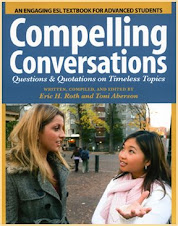
Sometimes people appreciate our ideas. Sometimes we find an educational site that shares our goals, perceptions, and priorities. Sometimes our efforts draw praise. April 13, 2010 provided a pleasant surprise as ESL teacher.
Under the title "Great Tips", a small, but influential American librarian's blog called eslconversationclubs.blogspot.com shared some ideas from Compelling Conversations. Naturally, I am quite pleased to both be recommended - and to discover an entire community of like-minded educators.
Here's the link to today's blog post to ESL educators, librarians, and conversation club coordinators:
http://eslconversationclubs.blogspot.com/2010/04/great-tips.html
After reading the article, I spent a satisfying hour exploring the deep resources on the blog that dates back several years. Among the excellent resources is a short two page document called ESL Conversation Clubs Best Practices by Jean Kaleda of webjunction.com that deserves a wider audience. Check it out here:
http://eslconversationclubs.blogspot.com/search/label/bestpractices
Enough said. Today provided some surprising validation that conversation clubs fill a vital, often overlooked, need for many American immigrants, ESL students, and other English language learners. And many experts find my little niche, self-published book a valuable, accessible resource. Consider me satisfied!
Ask more. Know more. Share more.
Create Compelling Conversations.
Visit www.CompellingConversations.com
Showing posts with label Adult Education. Show all posts
Showing posts with label Adult Education. Show all posts
Tuesday, April 13, 2010


Monday, March 23, 2009
More Practical Tips to Help English Students Ace the Job Interview
During these difficult economic times, English teachers should take every possible opportunity to focus on job interview skills. As blog readers know, I'm a big fan of both videotaping practice interviews and having ESL/EFL students conduct research for possible jobs with information interviews.
Here is an excellent, concise list of simple practical steps for English language learners to take when preparing for a job interview - and a few post-interview suggestions worth noting. The fine article comes from the Q Blog for English language learners. It's a fine resource. Check it out.
Official Q Blog: How to Succeed in an Interview
Ask more. Know more. Share more.
Create Compelling Conversations.
Visit www.CompellingConversations.com
Here is an excellent, concise list of simple practical steps for English language learners to take when preparing for a job interview - and a few post-interview suggestions worth noting. The fine article comes from the Q Blog for English language learners. It's a fine resource. Check it out.
Official Q Blog: How to Succeed in an Interview
Ask more. Know more. Share more.
Create Compelling Conversations.
Visit www.CompellingConversations.com
Sunday, February 15, 2009
Finding Interview Tips, Insights on YouTube for English Language Learners
How can English teachers encourage adult and university students to expand their language skills and improve their employment opportunities in a difficult economic climate?
Personally, I've slightly modified my oral skills course this semester to provide greater emphasis on interviewing skills. Students interviewed each other for 10-15 minute videotaped mock job interviews for their first assignment.
The use of videotaping students in class has gained far more acceptance in the last few years, partly due to the technological advances. OTAN, the adult education website established by the California Department of Education, even created an entire section devoted to using videotapes and videocameras in the adult ESL classes.
Another factor has been the increasing popularity of YouTube videoclips by students seeking practical information. I've combined those two trends by requiring students to find and review YouTube clips on vital employment skills and speaking skills. Students found and reviewed videoclips, and emailed them in as homework. Afterwards, I combined all the student evaluations into a single email that I sent to the entire class with a few editorial comments and minor editing.
Here is the homework sheet for that assignment. As with the reviews, "use or lose."
----------------------------------------------------------------------------------
Getting Job Interview Advice from YouTube!
Student Name:
Class:
Teacher:
School:
Date:
Please find an YouTube videoclip that helps people successfully interview for jobs – in English - that you would like to share with your classmates. Watch the video, take notes, and review it for your classmates.
Video title:
Web address:
Length:
Creator:
Please describe the video.
What interview tips did the video provide?
Where do you think the video was produced? Why?
How practical did you find the advice? Why?
What was the strongest part? Why?
What was the weakest part? Why?
Who do think is the target audience for this video?
Why did you choose this video?
How would you rate this video 1-5 stars? Why?
------------------------------------------------------------------------------------
This simple worksheet combines research, critical thinking, and language skills. As English teachers, we can use simple technology to help English language learners develop their language skills, especially when they are motivated to learn and search out new sources. Instead of dismissing YouTube searching as a waste of time, let's turn their interests into productive learning opportunities and share insights. After all, employment interviews often serve as a real-world language tests for our ESL students.
Let's make sure we give them the tools to pass those crucial tests.
Ask more. Know more. Share more.
Create Compelling Conversations.
Visit www.CompellingConversations.com
Personally, I've slightly modified my oral skills course this semester to provide greater emphasis on interviewing skills. Students interviewed each other for 10-15 minute videotaped mock job interviews for their first assignment.
The use of videotaping students in class has gained far more acceptance in the last few years, partly due to the technological advances. OTAN, the adult education website established by the California Department of Education, even created an entire section devoted to using videotapes and videocameras in the adult ESL classes.
Another factor has been the increasing popularity of YouTube videoclips by students seeking practical information. I've combined those two trends by requiring students to find and review YouTube clips on vital employment skills and speaking skills. Students found and reviewed videoclips, and emailed them in as homework. Afterwards, I combined all the student evaluations into a single email that I sent to the entire class with a few editorial comments and minor editing.
Here is the homework sheet for that assignment. As with the reviews, "use or lose."
----------------------------------------------------------------------------------
Getting Job Interview Advice from YouTube!
Student Name:
Class:
Teacher:
School:
Date:
Please find an YouTube videoclip that helps people successfully interview for jobs – in English - that you would like to share with your classmates. Watch the video, take notes, and review it for your classmates.
Video title:
Web address:
Length:
Creator:
Please describe the video.
What interview tips did the video provide?
Where do you think the video was produced? Why?
How practical did you find the advice? Why?
What was the strongest part? Why?
What was the weakest part? Why?
Who do think is the target audience for this video?
Why did you choose this video?
How would you rate this video 1-5 stars? Why?
------------------------------------------------------------------------------------
This simple worksheet combines research, critical thinking, and language skills. As English teachers, we can use simple technology to help English language learners develop their language skills, especially when they are motivated to learn and search out new sources. Instead of dismissing YouTube searching as a waste of time, let's turn their interests into productive learning opportunities and share insights. After all, employment interviews often serve as a real-world language tests for our ESL students.
Let's make sure we give them the tools to pass those crucial tests.
Ask more. Know more. Share more.
Create Compelling Conversations.
Visit www.CompellingConversations.com
Saturday, January 10, 2009
How Many American Adults Can't Read this Blog? Literally Can't Read This Blog!
How Many American Adults Can’t Read this Blog?
How many American adults can’t read a simple newspaper article, understand warning labels, or write an effective complaint letter? Take a guess. Five million adults? Ten million adults? Twelve million adults?
According to a new federal study, an estimated 35 million American adults remain functionally illiterate in 2009.
Greg Toppo told part of the depressing story yesterday in an excellent, concise USA TODAY frontpage article. Title? Literacy Study: 1 in 7 U.S. adults are unable to read this story. “A long-awaited federal study finds that an estimated 32 million adults in the USA — about one in seven — are saddled with such low literacy skills that it would be tough for them to read anything more challenging than a children's picture book.”
Is the situation improving? NO! “From 1992 to 2003, it shows, the USA added about 23 million adults to its population; in that period, an estimated 3.6 million more joined the ranks of adults with low literacy skills.” A U.S. Education Department expert explains. “"They really cannot read … paragraphs (or) sentences that are connected,"
USA TODAY deserves credit for bringing more attention than usual to this avoidable tragedy. President John F. Kennedy famously noted that “a child miseducated is a child lost.” Those "lost children" have become adults!
So how can we explain these shocking (yet very familiar to experts) findings? How is this possible? Why is this awful situation tolerated? Please don’t tell me that there is a lack of money because the federal government just gave away – without conditions or even pretense of accountability - $350 BILLION dollars to wealthy banks and mega international corporations.
The American public education system is failing on multiple levels. Adult education remains the stepchild of public education. Underfunded, often overlooked, and seldom appreciated, adult education plays a vital role in teaching essential life skills – including reading and writing – to thousands. Thousands of adult educators work long hours in stressful jobs, often part-time without fulltime benefits, to help high school dropouts prepare for a GED and new immigrants learn English. Yet the gap between the objective educational needs and funding to provide a real first world education to these struggling Americans remains huge.
Will President Obama address this widespread, documented crisis in public education? Perhaps.
Consider me, as so often, a sceptic.
Ask more. Know more. Share more.
Create Compelling Conversations.
Visit www.CompellingConversations.com
How many American adults can’t read a simple newspaper article, understand warning labels, or write an effective complaint letter? Take a guess. Five million adults? Ten million adults? Twelve million adults?
According to a new federal study, an estimated 35 million American adults remain functionally illiterate in 2009.
Greg Toppo told part of the depressing story yesterday in an excellent, concise USA TODAY frontpage article. Title? Literacy Study: 1 in 7 U.S. adults are unable to read this story. “A long-awaited federal study finds that an estimated 32 million adults in the USA — about one in seven — are saddled with such low literacy skills that it would be tough for them to read anything more challenging than a children's picture book.”
Is the situation improving? NO! “From 1992 to 2003, it shows, the USA added about 23 million adults to its population; in that period, an estimated 3.6 million more joined the ranks of adults with low literacy skills.” A U.S. Education Department expert explains. “"They really cannot read … paragraphs (or) sentences that are connected,"
USA TODAY deserves credit for bringing more attention than usual to this avoidable tragedy. President John F. Kennedy famously noted that “a child miseducated is a child lost.” Those "lost children" have become adults!
So how can we explain these shocking (yet very familiar to experts) findings? How is this possible? Why is this awful situation tolerated? Please don’t tell me that there is a lack of money because the federal government just gave away – without conditions or even pretense of accountability - $350 BILLION dollars to wealthy banks and mega international corporations.
The American public education system is failing on multiple levels. Adult education remains the stepchild of public education. Underfunded, often overlooked, and seldom appreciated, adult education plays a vital role in teaching essential life skills – including reading and writing – to thousands. Thousands of adult educators work long hours in stressful jobs, often part-time without fulltime benefits, to help high school dropouts prepare for a GED and new immigrants learn English. Yet the gap between the objective educational needs and funding to provide a real first world education to these struggling Americans remains huge.
Will President Obama address this widespread, documented crisis in public education? Perhaps.
Consider me, as so often, a sceptic.
Ask more. Know more. Share more.
Create Compelling Conversations.
Visit www.CompellingConversations.com
Tuesday, December 23, 2008
Consumer Product Reviews: Get Your ESL Students Talking About their Consumer Choices
Let ESL students give consumer product reviews in the New Year!
Do you let your students write and deliver product reviews? Consumer reviews help ESL students develop research skills, use critical thinking, and share their consumer choices.
The giving and receiving of gifts has become a central feature of Christmas, Hanukkah, winter solstice and New Year celebrations. We live – for worse or for better – in a consumer age. English language learners, around the world, share in this winter shopping spree. Product reviews allow them to talk about their gift selections and holiday gifts.
Many ESL students, especially young, hip, and wealthy teenagers and college students have also bought into - literally - the odd belief that "you are what you have". Therefore, these English language learners and experienced consumers often love to share their "insights" about consumer products. Product reviews speak to their lifestyles, passions, and curiosity.
As an ESL teacher, I use consumer product reviews to teach the difference between fact and opinion and identify critical thinking skills. The assignment lends itself to reviewing a few key concepts like “details matter” and “numbers add precision” while introducing hedging language. Of course, engaging student interests also leads to better classroom discussions and more use of authentic language.
You can also design a very simple presentation form so everyone can provide peer feedback. Result? The students receive written feedback on their product reviews from you (the teacher) and their classmates. Again, teenagers being teenagers, they love to read about themselves and the feedback. If possible, I also suggest videotaping the student reviews and posting them on a class website for both self and peer reviews.
Teaching high school students possess many challenges, beginning with capturing and holding their interest. Personally, I have found teaching slightly older undergraduate students far more satisfying - and far easier. But I have also had considerable success in short term IEP summer programs with that tough audience. Product reviews have always been a hit!
Here is both my short assignment sheet and a product review worksheet for ESL students.
----------------------------------------------------------------------------------------------------------
YOUR TURN: GIVING A PRODUCT REVIEW
You have probably bought thousands of items as a consumer. You have looked at and considered thousands more. You can’t buy everything; you have to pick and choose the products that fit you and your lifestyle.
Choose a single product and prepare to give a brief product review.
Your product review should include:
• a description of the product
• the way the product is used
• the cost of the product
• a comparison with other, similar products
• a recommendation to buy or not buy the product
• a reason for your recommendation
• a rating on a scale of 1-5
-----------------------------------------------------------------------------------------
PRODUCT REVIEW WORKSHEET
PRODUCT:
PURPOSE:
AUDIENCE:
USE:
COST:
COMPETITORS:
RECOMMENDATION:
REASON:
RATING:
_____________________________________________________________
As an old American cereal commercial used to say, “try it – you’ll like it!”
Ask more. Know more. Share more.
Create Compelling Conversations.
Visit www.CompellingConversations.com
Do you let your students write and deliver product reviews? Consumer reviews help ESL students develop research skills, use critical thinking, and share their consumer choices.
The giving and receiving of gifts has become a central feature of Christmas, Hanukkah, winter solstice and New Year celebrations. We live – for worse or for better – in a consumer age. English language learners, around the world, share in this winter shopping spree. Product reviews allow them to talk about their gift selections and holiday gifts.
Many ESL students, especially young, hip, and wealthy teenagers and college students have also bought into - literally - the odd belief that "you are what you have". Therefore, these English language learners and experienced consumers often love to share their "insights" about consumer products. Product reviews speak to their lifestyles, passions, and curiosity.
As an ESL teacher, I use consumer product reviews to teach the difference between fact and opinion and identify critical thinking skills. The assignment lends itself to reviewing a few key concepts like “details matter” and “numbers add precision” while introducing hedging language. Of course, engaging student interests also leads to better classroom discussions and more use of authentic language.
You can also design a very simple presentation form so everyone can provide peer feedback. Result? The students receive written feedback on their product reviews from you (the teacher) and their classmates. Again, teenagers being teenagers, they love to read about themselves and the feedback. If possible, I also suggest videotaping the student reviews and posting them on a class website for both self and peer reviews.
Teaching high school students possess many challenges, beginning with capturing and holding their interest. Personally, I have found teaching slightly older undergraduate students far more satisfying - and far easier. But I have also had considerable success in short term IEP summer programs with that tough audience. Product reviews have always been a hit!
Here is both my short assignment sheet and a product review worksheet for ESL students.
----------------------------------------------------------------------------------------------------------
YOUR TURN: GIVING A PRODUCT REVIEW
You have probably bought thousands of items as a consumer. You have looked at and considered thousands more. You can’t buy everything; you have to pick and choose the products that fit you and your lifestyle.
Choose a single product and prepare to give a brief product review.
Your product review should include:
• a description of the product
• the way the product is used
• the cost of the product
• a comparison with other, similar products
• a recommendation to buy or not buy the product
• a reason for your recommendation
• a rating on a scale of 1-5
-----------------------------------------------------------------------------------------
PRODUCT REVIEW WORKSHEET
PRODUCT:
PURPOSE:
AUDIENCE:
USE:
COST:
COMPETITORS:
RECOMMENDATION:
REASON:
RATING:
_____________________________________________________________
As an old American cereal commercial used to say, “try it – you’ll like it!”
Ask more. Know more. Share more.
Create Compelling Conversations.
Visit www.CompellingConversations.com
Tuesday, December 9, 2008
Another Five Star Review for Compelling Conversations on Amazon
Allow me to brag for a moment. Another five-star review for Compelling Conversations: Questions and Quotations on Timeless Topics showed up on Amazon. Consider me pleased!
Here's the entire Amazon review:
5.0 out of 5 stars A wholesome learning resource!, December 4, 2008
By Erika Villafane "Erika" (Miami, Florida USA) - See all my reviews
When compelling conversations got into my hands I couldn't help but to think: I wish I had this book when I was learning English!
As English as a second language speaker, I can really tell the difference that compelling conversations has with other ESL text books: topics richness that takes learning at a higher level.
Not only you will feel motivated to improve your language skills, but you will have a rich-provoking theme about life to discuss and share with your tutor or classmates. That in turn makes you grow personally and you certainly will remember the discussed matter here when need it to apply into a situation out of the classroom. You will appreciate American culture as well as other's point of view.
The book is very well structured into four sections totaling 45 chapters. Each one of them is organized into conversations starters followed by vocabulary, proverbs and the indispensable quotations. One that really caught my attention was the Arab proverb "he who has health has hope and he who has hope has everything"
I recommend it to anyone who wants to learn while enjoying the process.
Erika Villafane
------------------------------
This makes 14 positive Amazon
reviews - all four and five stars - that various ESL teachers, writers, English language learners, and other fine folks have written. Not bad for a self-published book!
Three other bits of positive news about Compelling Conversations. A private language school in Chile made a large order, another community college in California adopted the conversation book as the course textbook, and Compelling Conversations has been added to an adult education center in Rwanda for advanced English class. Whether due to changes in the TOEFL test that require test-takers to actually speak, a strong word-of-mouth campaign, or just the belief that conversations should go beneath the surface, sales of Compelling Conversations have gone up. These successes may seem small, but they all make me smile!
Ask more. Know more. Share more.
Create Compelling Conversations.
Visit www.CompellingConversations.com
Here's the entire Amazon review:
5.0 out of 5 stars A wholesome learning resource!, December 4, 2008
By Erika Villafane "Erika" (Miami, Florida USA) - See all my reviews
When compelling conversations got into my hands I couldn't help but to think: I wish I had this book when I was learning English!
As English as a second language speaker, I can really tell the difference that compelling conversations has with other ESL text books: topics richness that takes learning at a higher level.
Not only you will feel motivated to improve your language skills, but you will have a rich-provoking theme about life to discuss and share with your tutor or classmates. That in turn makes you grow personally and you certainly will remember the discussed matter here when need it to apply into a situation out of the classroom. You will appreciate American culture as well as other's point of view.
The book is very well structured into four sections totaling 45 chapters. Each one of them is organized into conversations starters followed by vocabulary, proverbs and the indispensable quotations. One that really caught my attention was the Arab proverb "he who has health has hope and he who has hope has everything"
I recommend it to anyone who wants to learn while enjoying the process.
Erika Villafane
------------------------------
This makes 14 positive Amazon
reviews - all four and five stars - that various ESL teachers, writers, English language learners, and other fine folks have written. Not bad for a self-published book!
Three other bits of positive news about Compelling Conversations. A private language school in Chile made a large order, another community college in California adopted the conversation book as the course textbook, and Compelling Conversations has been added to an adult education center in Rwanda for advanced English class. Whether due to changes in the TOEFL test that require test-takers to actually speak, a strong word-of-mouth campaign, or just the belief that conversations should go beneath the surface, sales of Compelling Conversations have gone up. These successes may seem small, but they all make me smile!
Ask more. Know more. Share more.
Create Compelling Conversations.
Visit www.CompellingConversations.com
Thursday, September 25, 2008
California Immigrants Are Learning English - and Want to Speak English Better!
Do American immigrants want to learn English? Are the children of Spanish-speaking adult immigrants learning English? What are the recent trends in California and Los Angeles?
A recently released Census Bureau report, based on the 2007 Census information, shows that – shock, shock – immigrants overwhelmingly want to improve their English skills. It also shows that a slight majority (51%) of immigrants in Los Angeles claim that they can speak English fluently – an increase from just a few years ago. The study also notes that 88% of immigrant children claim to speak English – and want to learn more.
Yesterday’s Los Angeles Times editorial “Speak English? Yes, more immigrants do “ provides a solid introduction to the heated debate over language and immigration in California. The editorial also argues that immigration reform should include a provision to keep families united so the American children of illegal immigrant parents are not separated from their parents. Finally, the editorial concludes that both the United States and the English language continue to evolve and Americans should embrace change.
The fine editorial, however, could and should have called for both expanding and improving the quality of public education programs so immigrants – including adult immigrants - can learn English quicker. A better Census report also would have included the legal status of immigrants and gone beyond self-reported data by immigrants with evolving language skills.
The editorial’s strong, humane conclusion is worth repeating verbatim:
“American culture grows and adapts as new immigrants redefine it over the generations, and the same can be said of the English language. We should embrace that evolution, not hold it at bay with false and alarmist arguments about the threat to American values.”
Los Angeles Times, September 24, 2008 editorial
Doesn’t that sound sane and civilized?
Ask more. Know more. Share more.
Create Compelling Conversations.
Visit www.CompellingConversations.com
A recently released Census Bureau report, based on the 2007 Census information, shows that – shock, shock – immigrants overwhelmingly want to improve their English skills. It also shows that a slight majority (51%) of immigrants in Los Angeles claim that they can speak English fluently – an increase from just a few years ago. The study also notes that 88% of immigrant children claim to speak English – and want to learn more.
Yesterday’s Los Angeles Times editorial “Speak English? Yes, more immigrants do “ provides a solid introduction to the heated debate over language and immigration in California. The editorial also argues that immigration reform should include a provision to keep families united so the American children of illegal immigrant parents are not separated from their parents. Finally, the editorial concludes that both the United States and the English language continue to evolve and Americans should embrace change.
The fine editorial, however, could and should have called for both expanding and improving the quality of public education programs so immigrants – including adult immigrants - can learn English quicker. A better Census report also would have included the legal status of immigrants and gone beyond self-reported data by immigrants with evolving language skills.
The editorial’s strong, humane conclusion is worth repeating verbatim:
“American culture grows and adapts as new immigrants redefine it over the generations, and the same can be said of the English language. We should embrace that evolution, not hold it at bay with false and alarmist arguments about the threat to American values.”
Los Angeles Times, September 24, 2008 editorial
Doesn’t that sound sane and civilized?
Ask more. Know more. Share more.
Create Compelling Conversations.
Visit www.CompellingConversations.com
Thursday, September 11, 2008
Revising the ESL Curriculum and Finding Solace with Quotes
“Do what you can, with what you have, where you are,” advised President Theodore (Teddy) Roosevelt. These words of solace often comfort me when I stress myself out trying to cram too much material into lessons.
How can I cover everything that I want in a single semester? It’s just impossible. For every new activity, I must let an old one go. If I add a Youtube homework assignment, than I should eliminate another homework assignment to maintain the balance. For instance, I asked every student to find and review a YouTube video on interview skills so I had to cut the assignment where students found and summarize an article on job hunting skills.
By the way, the international graduate English students found and reviewed a wonderful collection of smart, informative, current, and funny videos. Then I combined into a single email for the entire class with one of my own selections. On their own time and initiative, students watched many of the videos leading to the best mock job interviews that I’ve seen at the intermediate speaking skill level yet. Again, a democratic classroom atmosphere often creates a far more interesting and effective classroom.
As I continue to plan, adjust, and readjust assignments, I once again find solace in these words. Yet these continual curriculum revisions remain voluntary tasks in pursuit of excellence. “A problem,” noted Duke Ellington, “is a chance for you to do your best.”
Ask more. Know more. Share more.
Create Compelling Conversations.
Visit www.CompellingConversations.com
How can I cover everything that I want in a single semester? It’s just impossible. For every new activity, I must let an old one go. If I add a Youtube homework assignment, than I should eliminate another homework assignment to maintain the balance. For instance, I asked every student to find and review a YouTube video on interview skills so I had to cut the assignment where students found and summarize an article on job hunting skills.
By the way, the international graduate English students found and reviewed a wonderful collection of smart, informative, current, and funny videos. Then I combined into a single email for the entire class with one of my own selections. On their own time and initiative, students watched many of the videos leading to the best mock job interviews that I’ve seen at the intermediate speaking skill level yet. Again, a democratic classroom atmosphere often creates a far more interesting and effective classroom.
As I continue to plan, adjust, and readjust assignments, I once again find solace in these words. Yet these continual curriculum revisions remain voluntary tasks in pursuit of excellence. “A problem,” noted Duke Ellington, “is a chance for you to do your best.”
Ask more. Know more. Share more.
Create Compelling Conversations.
Visit www.CompellingConversations.com
Saturday, September 6, 2008
Why do school boards so often make problematic decisions?
"God made the idiot for practice. Then he made school boards."
Mark Twain (1835-1910), American novelist and humorist
As the quality of American public schools continues to decline and more classes and program get cutback, this quip remains painfully current.
Ask more. Know more. Share more.
Create Compelling Conversations.
Visit www.CompellingConversations.com
Mark Twain (1835-1910), American novelist and humorist
As the quality of American public schools continues to decline and more classes and program get cutback, this quip remains painfully current.
Ask more. Know more. Share more.
Create Compelling Conversations.
Visit www.CompellingConversations.com
Thursday, August 14, 2008
Do your EL/Civics students know about the electoral college?
How could George W. Bush be elected President of the United States? Really.
Let me be more precise. How could Al Gore win the popular vote and still lose the 2000 U.S. Presidential election to the second George Bush? The short, unpleasant answer is that the popular vote doesn’t count – and the only vote that matters in electing presidents in the United States is the electoral college.
What is the electoral college? How many votes does your state have in the real United States presidential election? If you teach U.S. history, EL/Civics, or just vote in U.S. elections, you already know these answers – and your students and friends should too!
Check out the easy to use electoral college map hosted by the Los Angeles Times.
Among the many interesting features is that the default setting, based on the 2004 U.S. Presidential election, shows Senator McCain with a clear electoral college advantage over Senator Obama. Amidst the daily national polls, it’s easy for U.S. citizens – let alone adult immigrants and citizenship students – to forget this vital fact. You can also go to the fine Wikipedia article on the peculiar history and strange institution called the United_States_Electoral_College.
By the way, I’m one of those folks that wants to abolish the electoral college as a sad legacy of both aristocratic ideals and slave-era logic. Direct elections work just fine. Since abolishing the electoral college seems very, very difficult, we should – it seems to me – at least switch from a winner take all system for each state to a fairer system where each congressional district chooses its own electors. Adopting this more transparent, honest “tiered” system would quickly reveal the huge divide between urban and rural America across the country. If Senator Obama wins the popular vote and still loses the electoral college, I expect more Democrats to rediscover their discomfort with the very undemocratic electoral college. Let’s hope that doesn’t happen!
Ask more. Know more. Share more.
Create Compelling Conversations.
Visit www.CompellingConversations.com
Let me be more precise. How could Al Gore win the popular vote and still lose the 2000 U.S. Presidential election to the second George Bush? The short, unpleasant answer is that the popular vote doesn’t count – and the only vote that matters in electing presidents in the United States is the electoral college.
What is the electoral college? How many votes does your state have in the real United States presidential election? If you teach U.S. history, EL/Civics, or just vote in U.S. elections, you already know these answers – and your students and friends should too!
Check out the easy to use electoral college map hosted by the Los Angeles Times.
Among the many interesting features is that the default setting, based on the 2004 U.S. Presidential election, shows Senator McCain with a clear electoral college advantage over Senator Obama. Amidst the daily national polls, it’s easy for U.S. citizens – let alone adult immigrants and citizenship students – to forget this vital fact. You can also go to the fine Wikipedia article on the peculiar history and strange institution called the United_States_Electoral_College.
By the way, I’m one of those folks that wants to abolish the electoral college as a sad legacy of both aristocratic ideals and slave-era logic. Direct elections work just fine. Since abolishing the electoral college seems very, very difficult, we should – it seems to me – at least switch from a winner take all system for each state to a fairer system where each congressional district chooses its own electors. Adopting this more transparent, honest “tiered” system would quickly reveal the huge divide between urban and rural America across the country. If Senator Obama wins the popular vote and still loses the electoral college, I expect more Democrats to rediscover their discomfort with the very undemocratic electoral college. Let’s hope that doesn’t happen!
Ask more. Know more. Share more.
Create Compelling Conversations.
Visit www.CompellingConversations.com
Sunday, August 3, 2008
Solzhenitsyn, Free Speech, and Teaching English
“Own only what you can always carry with you; know languages, know countries, know people. Let your memory be your travel bag.”
Alexander Solzhenitsyn (1918-2008), Russian writer and Nobel Prize winner
Alexander Solzhenitsyn, an exceptional writer of rare courage, died today. English teachers, lovers of literature, and people conscience will find his long obituary in the International Herald Tribune worth reading.
While far too many western leftists preferred to close their eyes to the nature and brutality of the Soviet slave labor system, Solzhenitsyn wrote novels that detailed the misery and repression created by the communists. His writings also made it impossible for even the most naïve leftist intellectuals to deny Stalin’s gulags – and how millions looked away. He won the Nobel Prize for Literature in 1970, but the Soviet authorities naturally prevented him from accepting his award. He spent 20 years in prison camps for his writings.
Do you have English language students from Russia? Do you know immigrants and refugees who spent their youth under the Soviet system? How did living under a communist dictatorship distort human relationships? Solzhenitsyn’s writings, once censored, may help you better understand some of the historical and cultural factors that have influenced your students and their worldviews.
Personally, I found working with Russian refugees and immigrants a very eye-opening experience. The more you learn about the old Soviet system, the more you appreciate the American tradition of individual rights and political freedom. Solzhenitsyn wrote in his 1967 novel, The Cancer Ward, about the consequences of silent conformity with Stalin’s crimes. "Suddenly all the professors and engineers turned out to be saboteurs — and they believed it? ... Or all of Lenin's old guard were vile renegades — and they believed it? Suddenly all their friends and acquaintances were enemies of the people — and they believed it?" Everyone, as in Nazi Germany, knew and didn’t want to know.
Free speech and free press remain under siege – in the United States, often from self-righteous idealists. Solzhenitsyn’s writings serve as a powerful rebuke to coercive utopians, and illuminate the power of personal choices under the most severe stress.
ESL teachers, especially EL/Civics teachers in adult education, need to emphasize the beauty, rarity, and wisdom of the first amendment guaranteeing free speech and a free press. Educators and librarians need to resist the pressure, and the temptation, to censor themselves "for the children." Classrooms must remain rare zones where ideas are openly discussed.
I chose Solzhenitsyn’s quote for the dedication page of Compelling Conversations: Questions and Quotations on Timeless Topics to remind myself – and others – to look beyond material possessions. We need to stay awake and remain sane – even if our society begins to sprout social cancers and asking simple questions becomes dangerous.
Solzhenitsyn provides a model of resistance to tyranny.
Ask more. Know more. Share more.
Create Compelling Conversations.
Visit www.CompellingConversations.com
Alexander Solzhenitsyn (1918-2008), Russian writer and Nobel Prize winner
Alexander Solzhenitsyn, an exceptional writer of rare courage, died today. English teachers, lovers of literature, and people conscience will find his long obituary in the International Herald Tribune worth reading.
While far too many western leftists preferred to close their eyes to the nature and brutality of the Soviet slave labor system, Solzhenitsyn wrote novels that detailed the misery and repression created by the communists. His writings also made it impossible for even the most naïve leftist intellectuals to deny Stalin’s gulags – and how millions looked away. He won the Nobel Prize for Literature in 1970, but the Soviet authorities naturally prevented him from accepting his award. He spent 20 years in prison camps for his writings.
Do you have English language students from Russia? Do you know immigrants and refugees who spent their youth under the Soviet system? How did living under a communist dictatorship distort human relationships? Solzhenitsyn’s writings, once censored, may help you better understand some of the historical and cultural factors that have influenced your students and their worldviews.
Personally, I found working with Russian refugees and immigrants a very eye-opening experience. The more you learn about the old Soviet system, the more you appreciate the American tradition of individual rights and political freedom. Solzhenitsyn wrote in his 1967 novel, The Cancer Ward, about the consequences of silent conformity with Stalin’s crimes. "Suddenly all the professors and engineers turned out to be saboteurs — and they believed it? ... Or all of Lenin's old guard were vile renegades — and they believed it? Suddenly all their friends and acquaintances were enemies of the people — and they believed it?" Everyone, as in Nazi Germany, knew and didn’t want to know.
Free speech and free press remain under siege – in the United States, often from self-righteous idealists. Solzhenitsyn’s writings serve as a powerful rebuke to coercive utopians, and illuminate the power of personal choices under the most severe stress.
ESL teachers, especially EL/Civics teachers in adult education, need to emphasize the beauty, rarity, and wisdom of the first amendment guaranteeing free speech and a free press. Educators and librarians need to resist the pressure, and the temptation, to censor themselves "for the children." Classrooms must remain rare zones where ideas are openly discussed.
I chose Solzhenitsyn’s quote for the dedication page of Compelling Conversations: Questions and Quotations on Timeless Topics to remind myself – and others – to look beyond material possessions. We need to stay awake and remain sane – even if our society begins to sprout social cancers and asking simple questions becomes dangerous.
Solzhenitsyn provides a model of resistance to tyranny.
Ask more. Know more. Share more.
Create Compelling Conversations.
Visit www.CompellingConversations.com
Sunday, July 27, 2008
Conversation Starter - Make a Sincere Comment About a Car
Sometimes a simple comment leads to a delightful conversation.
Today I noticed a very, very old truck parked on the street while walking my dog.
"She's as old as I am," replied the owner from his frontyard. He soon came to the sidewalk. "Made in 1931."
Although I'm hardly a car guy, we proceeded to have a rather detailed and informative conversation about Ford, Model AA, and vocational education. That ancient truck, donated to a local veterans group, still runs. The local adult education high school will help train mechanics on it - and restore it. Cool.
I have an old 1981 Volvo with 249,000 - and the antique truck owner, Deano, has several Toyotas with over 300,000. We both find something wonderful with quality cars built to last - unlike so many models today. Car companies could - and still can - make quality cars that last decades.
Deano, by the way, is a former high school teacher who volunteers at the local Veterans Administration (VA) hospital. You can't help but respect a man who helps soldiers and veterans recover from war wounds - visible and invisible.
Friendly and folksy, I instantly felt comfortable with him and traded a few teachers' tales. We shared a few frustrations with standardized tests too. We will, I suspect, have other fine conversations in the future.
A casual comment, "nice truck", lead to a satisfying exchange. with a neighbor. That's my conversation tip #12: make a sincere comment about a situation and be curious about your neighbors. You never know what you will learn or who you will meet - even in your own neighborhood!
Ask more. Know more. Share more.
Create Compelling Conversations.
Visit www.CompellingConversations.com
Today I noticed a very, very old truck parked on the street while walking my dog.
"She's as old as I am," replied the owner from his frontyard. He soon came to the sidewalk. "Made in 1931."
Although I'm hardly a car guy, we proceeded to have a rather detailed and informative conversation about Ford, Model AA, and vocational education. That ancient truck, donated to a local veterans group, still runs. The local adult education high school will help train mechanics on it - and restore it. Cool.
I have an old 1981 Volvo with 249,000 - and the antique truck owner, Deano, has several Toyotas with over 300,000. We both find something wonderful with quality cars built to last - unlike so many models today. Car companies could - and still can - make quality cars that last decades.
Deano, by the way, is a former high school teacher who volunteers at the local Veterans Administration (VA) hospital. You can't help but respect a man who helps soldiers and veterans recover from war wounds - visible and invisible.
Friendly and folksy, I instantly felt comfortable with him and traded a few teachers' tales. We shared a few frustrations with standardized tests too. We will, I suspect, have other fine conversations in the future.
A casual comment, "nice truck", lead to a satisfying exchange. with a neighbor. That's my conversation tip #12: make a sincere comment about a situation and be curious about your neighbors. You never know what you will learn or who you will meet - even in your own neighborhood!
Ask more. Know more. Share more.
Create Compelling Conversations.
Visit www.CompellingConversations.com
Sunday, July 6, 2008
Adding Classic Quotations Adds Depth, Diversity to ESL Classrooms
“If a nation expects to be ignorant and free…it expects what never was and never will be.”
Thomas Jefferson (1743-1826),
U.S. President and principal author of the Declaration of Independence
Classic quotations, like proverbs, brings in many insights from religious leaders and philosophers that go back even more than 2,000 years such as Buddha, Confucius, Aristotle, and the Biblical prophets in a compelling, succinct manner. These quotations remind us that some conversations have spanned centuries and cultures.
John Adams (1735-1826)
U.S. President and contributor to the Declaration of Independence
Create Compelling Conversations.
Visit www.CompellingConversations.com
Wednesday, July 2, 2008
A New Issue of Easy English Times Makes Me Smile!
The “Summer Fun” issue of Easy English Times arrived yesterday, and it made me smile. It’s another wonderful issue of ESL student essays, teaching tips, and classroom exercises for English language learners.
The Easy English Times (EET) editors also generously added seven photographs to the monthly “instant activity: conversation” column written by Toni Aberson and myself. This month’s topic is Enjoying the Beach. The beautifully illustrated excerpt from Compelling Conversations, modified for beginning and intermediate ESL student readers should be popular. The column also inspired me to take a long walk on
The summer issue also lead me to revisit the Easy English Times website. Unfortunately, the EET website doesn’t include the entire current and past issues so the conversation column isn’t online. The clean website, although in need of an update, includes several valuable chunks of information for ESL educators and people teaching in adult literacy and prisons.
The section titled Immigration Issues features first person essays from immigrants and refugees and an evocative photo essay by Betty Malmgren that documents the intense passions and political symbols used at immigration protest marches. Malmgren deserves credit for showing both sides of this heated and very American debate in a fair, nuanced manner. I’m also fond of the section titled internet resources which includes archived columns from Andrea Uram for teachers of beginning ESL students and Susan Gaer’s columns on using the internet in ESL classrooms.
Yet my favorite part of the Easy English Times website remains student writing where you can read first person stories from immigrants and refugees who have created new lives in the
Website visitors can request a free copy of Easy English Times newspaper, and subscribers can access the entire adult education newspaper online for $15. It’s a good buy, especially for American ESL teachers working with beginning and intermediate adult ESL students. In a far better world, there would be fewer refugees from wars, famines, and persecution – and more than enough money to buy class sets of this ESL newspaper for more adult schools.
Ask more. Know more. Share more.Create Compelling Conversations.
Visit www.CompellingConversations.com
Tuesday, June 3, 2008
Creating Top Ten Tip Lists for Advanced ESL Classes
Sometimes, however, students will simply create a list and avoid providing clear reasons. In order to emphasize the need to share information and exchange insights, I often ask for a "top ten tips" to doing something. This twist also invites a wider range of topics from the practical to more philosophical.
You can ask students for their top ten tips for:
choosing a school?
saving money?
staying healthy and happy?
making and keeping friends?
avoiding boredom and finding satisfaction?
getting good grades?
learning English?
traveling to a new city/country?
Break students into groups of 3-4. Give them 20 minutes to come up their top ten tips on a given topic. Ask them to provide at least one reason and/or example for each answer.
Pass out different colors of chalk for each group. Have students write their answers on the board.The instructor goes through the list, asking questions - both soft and hard, and engages student groups.
Create Compelling Conversations.
Visit www.CompellingConversations.com
Wednesday, May 7, 2008
Fan Writes "Teachers and Tutors Should Know About Compelling Conversations."
Sometimes you just have to smile and feel good about your achievements!
Praise, especially from an experienced colleague living thousands of miles away, on a difficult project feels satisfying. In the last week, I’ve received three emails from Joan V., an ESL teacher and tutor, praising Compelling Conversations: Questions and Quotations on Timeless Topics – the book that I co-authored and self-published. Naturally, a smile crosses my face.
Imagine my surprise when a complete stranger emails me that "Teachers and tutors should know about Compelling Conversations... It's a marvelous book!"
Her experiences mirror my own experiences with the material, and validate the book’s premise: engaging students in sophisticated conversation helps build their vocabulary, leads to memorable conversations, and deepens relationships.
Here, in her own words, are excerpts from Joan’s strong recommendation.
-------------------------------------------------------------------------------------------------------
I am an English tutor working with Japanese adults in
I’ve always used questions as a conversation stimulus, and now I have this whole organized around topics book to use with my students! As you probably know, Many Japanese arrive in this country with a fair understanding of English grammar and quite a lot of vocabulary, but are initially unable to engage in conversation. This book is the perfect answer to this situation!
Thank you so much for putting this together!
Teachers and tutors should know about Compelling Conversations... I was a classroom ESL teacher for many years, went to conferences with book displays shopping for books, and was usually disappointed by the books I saw. There were a lot of boring books out there!
The book needs to on display at ESL conferences if they are still being held. ESL teachers and tutors working with intermediate and advanced level students would choose this book over almost anything else if they knew about it. Also many community colleges have ESL programs using traditional materials focused on grammar and repetition rather than real meaningful conversation which your book provides.
I happened on your book accidentally on the internet and looking at the sample lessons, I quickly knew that this book would work for my students.
I wanted to add one more thought regarding Compelling Conversations. It is saving me a lot of time! I have been tutoring Japanese adults (businessmen and their wives) for nine years after retiring from almost 30 years of teaching in public schools. I've spent so much time gathering materials from various sources--textbooks, my own materials, bilingual dictionaries, etc.
Now I'm finding that printing out a chapter of your book provides plenty of conversational focus for at least two hours or more of tutoring time. Even more important, our conversations are at a deeper level. For example, in chapter two there are some questions about childhood. A couple of weeks ago a student ordering on fluency was able to tell me about his childhood dreams and that now he is living that dream! I was thrilled!
Thanks.
Joan
----------------------------------------------------------------------------------
Wow!
Thank you, Joan! You made my week!
Check out sample Compelling Conversations lessons for yourself at:
http://www.compellingconversations.com/pdf/cc_sampler_esl.pdf
http://www.compellingconversations.com
Hopefully, you will have the same satisfying experiences that Joan and other satisfied teachers and tutors have had with Compelling Conversations. Enjoy!
Ask more. Know more. Share more.
Create Compelling Conversations.
Monday, April 21, 2008
Investing in quality ESL classes improves daily life
A good society helps its citizens flourish and visitors feel welcome.
A good society also invests in education, including teaching immigrants enough English that they can use their considerable intelligence, creativity, and skills in the workplace.
Unfortunately, low standards in public education have eroded support for government sponsored education programs. Worse, the few underfunded English as a Second Language programs usually provide the most basic English skills. Students learn to listen and read at about 4th grade level, and speak like a child with a very limited vocabulary.
From my perspective as an English instructor and former adult ESL teacher, the current adult ESL standards too often only teach immigrants passive skills like listening and some minimum reading. English language programs, whether designed for vocational skills or general language, must include speaking and writing. If people can’t hold a conversation in English, their job prospects remain rather limited!
A frontpage article in today’s Los Angeles Times points out the obvious problem.
When will the employers and voters decide to invest in real, serious, quality English languages for immigrants? And why are immigrants trained in English programs abroad so much stronger, better, and more effective than the adult ESL programs here? After all, immigrants have many more opportunities to speak English and learn outside of the classroom than students in
Again, the case for dramatically expanding and raising the standards of our English as a Second Language programs seems clear.
Unfortunately, reason and government policy do not always co-exist in the
Ask more. Know more. Share more.
Create Compelling Conversations.
Friday, April 18, 2008
Does Uncle Sam Want Immigrants to Learn English?
Learning to read, write, and speak English remains a legal requirement for legal immigrants to become citizens in the
Yet funding for English language classes, especially for adults, remains quite limited. Government programs only help students learn rather basic English, often around 1200 essential words. Students can "pass" all their ESL classes and learn enough English to hold low-level jobs. ESL students learn to listen more than speak, and read more than write. These low standards, by the way, also include a very, very low level definition of "can read, write, and speak" English for citizenship. (More on this subject in future posts.)
Many states, like
" Uncle Sam wants you to speak English" reads a popular bumper-sticker. Uncle Sam, the traditional symbol for the
I saw this bumper-sticker on the way back from an English teacher's conference again last week. I also wondered about the driver. Does he support helping immigrants learn English? Does he really think immigrants who don't speak English will understand his message? Would a Spanish speaking immigrant, for instance, know who Uncle Sam is? Or is the driver simply stating that immigrants - who might speak two, three, four, or more languages - should only speak English in the
Unfortunately, I never had a chance to talk with the gentleman who placed this provocative message on his car. I don't really know what he meant by his "Uncle Sam wants you to speak English" bumper-sticker. I hope, however, that he supports adding, not cutting, English language classes. We both would like more people to be able to speak to him and ask him questions in his best language too. How does the driver expect his wish to come true?
Perhaps if "Uncle Sam wants you to speak English", than he could find more ways to help immigrants and refugees learn English!
Create Compelling Conversations.
Visit www.compellingconversations.com .
Wednesday, April 16, 2008
Negative headlines and trendlines for ESL in California public schools
Yet the gap between "ought" and "is" remains very wide in Bush's America and in California's public schools.
The dollar continues to decline in value. The national budget, seldom balanced, has zoomed deep into mega-debt during the Bush II era with two expensive wars, a deepening recession, and record tax cuts for the wealthy. The
In
These abstract concerns about cutbacks took a very visible shape at the statewide California Teachers of English to Speakers of Other Languages convention last week. Total attendance was officially down by more than 25% since school districts had few available funds to send administrators, let alone teachers, to the conference. Yet I suspect the real numbers are far, far more dramatic than the reduction from 1600 t0 1200 attendees. Here are some signs of pervasive cutbacks:
- only a single school district recruited teachers
- the exhibition hall seemed like a ghost town
- publishers and vendors were eager to talk about the freezing of public education spending in many districts
- vendors expressed hope that teachers would buy even more supplies from their personal pockets
- many workshops collected rather sparse crowds
- the few job board postings were for summertime Intensive English Programs that attract private, international students
- the mood, despite many fantastic new educational resources and software programs, seemed very downbeat
Perhaps it's unfair to juxtapose a very hectic, chaotic international teachers' convention in
Teaching English, on a global level, continues to dramatically improve and expand. The development of new software for English language learners, better teaching techniques that respect students and encourage authentic communication, and the increase in international educational point to a better tomorrow. Meanwhile, the news from
Teaching at an elite private university in Los Angeles, I could pretend these cutbacks don't matter to me. Yet that's a dangerous illusion. The collapse of public education, especially for immigrants, will have both immediate and long-term consequences. The expanding gap between the wealthy who can afford a truly wonderful 21st century education and the expanding number of under-educated, over-stressed poor indicates a worsening future for too many Californians. As a stoic philosopher Epictetus noted so long ago, "only the educated are free."
As an American, a Californian, and an English teacher, I don't like the trendlines and headlines for American public education. Do you?
Ask more. Know more. Share more.
Create Compelling Conversations.
Visit www.compellingconversations.com
Sunday, March 30, 2008
The Center for Applied Linguistics Suggests Workshops at TESOL
How do you choose which of the many tempting ESL workshops at an international convention of ESL teachers and researchers?
As part of my preparation for the TESOL convention, I checked the
a list of recommended workshops by CAL researchers. As ever, the Center for Applied Linguistics website provides some practical suggestions.
“World of TESOL, Worlds of Refugees”, “Strategies for Serving High Advanced Adult ESL Students”, and “Building Academic Language Through Scaffolded Instructional Conversations”, and “Analyzing Oral Proficiency to Guide Instruction” sound like sensible, smart choices. “Applying Teacher Input to Improve Assessment” also sounds like an excellent idea. Two other workshops that caught my eye, “Interested in Working as as ESOL Consultant” and “Connecting Culture and Language in ELL Instruction”, but I’m not going to any workshops that start at 7:30 AM or 7:30 PM while visiting New York City.
Please visit www.CompellingConversations.com .
Subscribe to:
Posts (Atom)

 Posts
Posts