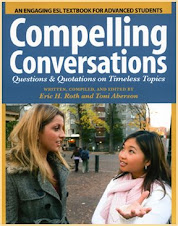
How can English teachers encourage adult and university students to expand their language skills and improve their employment opportunities in a difficult economic climate?
Personally, I've slightly modified my oral skills course this semester to provide greater emphasis on interviewing skills. Students interviewed each other for 10-15 minute videotaped mock job interviews for their first assignment.
The use of videotaping students in class has gained far more acceptance in the last few years, partly due to the technological advances. OTAN, the adult education website established by the California Department of Education, even created an entire section devoted to using videotapes and videocameras in the adult ESL classes.
Another factor has been the increasing popularity of YouTube videoclips by students seeking practical information. I've combined those two trends by requiring students to find and review YouTube clips on vital employment skills and speaking skills. Students found and reviewed videoclips, and emailed them in as homework. Afterwards, I combined all the student evaluations into a single email that I sent to the entire class with a few editorial comments and minor editing.
Here is the homework sheet for that assignment. As with the reviews, "use or lose."
----------------------------------------------------------------------------------
Getting Job Interview Advice from YouTube!
Student Name:
Class:
Teacher:
School:
Date:
Please find an YouTube videoclip that helps people successfully interview for jobs – in English - that you would like to share with your classmates. Watch the video, take notes, and review it for your classmates.
Video title:
Web address:
Length:
Creator:
Please describe the video.
What interview tips did the video provide?
Where do you think the video was produced? Why?
How practical did you find the advice? Why?
What was the strongest part? Why?
What was the weakest part? Why?
Who do think is the target audience for this video?
Why did you choose this video?
How would you rate this video 1-5 stars? Why?
------------------------------------------------------------------------------------
This simple worksheet combines research, critical thinking, and language skills. As English teachers, we can use simple technology to help English language learners develop their language skills, especially when they are motivated to learn and search out new sources. Instead of dismissing YouTube searching as a waste of time, let's turn their interests into productive learning opportunities and share insights. After all, employment interviews often serve as a real-world language tests for our ESL students.
Let's make sure we give them the tools to pass those crucial tests.
Ask more. Know more. Share more.
Create Compelling Conversations.
Visit www.CompellingConversations.com
Showing posts with label workplace conversation. Show all posts
Showing posts with label workplace conversation. Show all posts
Sunday, February 15, 2009


Monday, August 4, 2008
Workplace Conversation tip: Tone, Volumen, and Context Matter!
Style matters – especially when we talk with our co-workers, consumers, patients, and supervisors. English language learners, recent immigrants, and far too many other people who work in English sometimes seem to forget this!
Consider the difference in how these requests sound.
Shut off the TV!
Please turn off the TV?
Could you turn off the TV?
Would you please turn off the TV?
Close the door!
Close the door; it’s noisy out there.
Shut the damn door!
Would you please close the door; it’s noisy out there.
Could you get the door?
Can you close the door?
Sometimes, especially in an emergency, it is appropriate to warn other people with a short command.
Call the police!
Help!
Shut the door!
We recognize it is an emergency because of the way the request is made. It’s an order.
I. When would it be appropriate to give a warning on your job? Please give 3 examples.
1.
2.
3.
But, usually, we also make our requests that are not emergencies. We can – and should- give suggestions in a kinder, gentler way.
We can use many words to make requests and suggestions:
May Can Could Would Should Might
II. Please write a request that you might give or hear at work with these words.
1. Can ______________________________________________?
2. May ______________________________________________?
3. Could _____________________________________________?
4. Would_____________________________________________?
5. Should_____________________________________________?
6. Might _____________________________________________?
Adding the word “please” makes your requests and suggestions sound nicer too!
Ask more. Know more. Share more.
Create Compelling Conversations.
Visit www.CompellingConversations.com
Consider the difference in how these requests sound.
Shut off the TV!
Please turn off the TV?
Could you turn off the TV?
Would you please turn off the TV?
Close the door!
Close the door; it’s noisy out there.
Shut the damn door!
Would you please close the door; it’s noisy out there.
Could you get the door?
Can you close the door?
Sometimes, especially in an emergency, it is appropriate to warn other people with a short command.
Call the police!
Help!
Shut the door!
We recognize it is an emergency because of the way the request is made. It’s an order.
I. When would it be appropriate to give a warning on your job? Please give 3 examples.
1.
2.
3.
But, usually, we also make our requests that are not emergencies. We can – and should- give suggestions in a kinder, gentler way.
We can use many words to make requests and suggestions:
May Can Could Would Should Might
II. Please write a request that you might give or hear at work with these words.
1. Can ______________________________________________?
2. May ______________________________________________?
3. Could _____________________________________________?
4. Would_____________________________________________?
5. Should_____________________________________________?
6. Might _____________________________________________?
Adding the word “please” makes your requests and suggestions sound nicer too!
Ask more. Know more. Share more.
Create Compelling Conversations.
Visit www.CompellingConversations.com
Subscribe to:
Posts (Atom)

 Posts
Posts