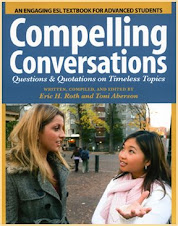
Cities attract the young, the strong, and the ambitious. Cities also provide housing, jobs, and hope for those fleeing boredom, economic crisis, and war. Our 21st century cities, like our English classrooms, reflect the diversity of the human experience.
Millions move from the countryside and across the globe to live in new cities every year. Cities provide employment, culture, and education. Cities are exciting. Yet, sometimes danger also lurks in cities. Many students struggle with economic pressures, culture shock, and criminal activity. Shouldn't we discuss these conflicting pressures in our ESL classrooms?
Teaching English in Los Angeles and Santa Monica I’ve found that students, who come from across the globe, eager to talk about cities. Some English students share stories about moving from rural areas and small towns to an international city; other students enjoy telling about their travel experiences. Discussions naturally touch on housing, employment, and lifestyle choices. English language learners – whether adult immigrants creating a new home or university students living abroad – can reflect on their experiences and share insights discussing urban life.
Are you a city person? Why?
How are cities different from small towns?
What cities have you visited? Lived in?
What attracted you to this city?
What do you find stressful about city life?
What do you find satisfying about living in a city?
This month Exploring Cities, one of my favorite chapters, is highlighted as a free chapter on Compelling Conversations. Perhaps you will create some compelling conversations about cities in your classroom too. Check it out.
Ask more. Know more. Share more.
Create Compelling Conversations.
Visit www.CompellingConversations.com
Showing posts with label ESL students. Show all posts
Showing posts with label ESL students. Show all posts
Saturday, November 15, 2008


Monday, October 27, 2008
How Democratic is Your English Classroom? How Democratic Do You Want it To Be?
Who gets to speak in class? Whose ideas count? Who chooses the assignments? How do students receive feedback? Do students have a chance to conference with their instructors? Can YouTube be a valuable source for homework assignment? Do you want your students to become self-directed - or autotelic - in their studies?
Here’s a quick checklist that ESL teachers that I created for a recent LA CATESOL regional conference workshop called “Techniques for a More Democratic Classroom."
My core assumption remains that giving students more opportunities to literally speak, write, and share their insights leads to a more engaging, dynamic, and valuable classroom experience. I will write more on this topic in a few days, but here are some questions to consider.
1. Who do you currently teach? How would you describe the students?
2. What are some of their personal interests?
3. How can student interests be better incorporated into the curriculum?
4. Which assignments do students currently choose? Which seems most successful? Why?
5. What are some benefits of greater student participation?
6. What are some risks of greater student participation?
7. Do you want to increase the number of choices students make?
8. What critical language skills can be taught by tapping into their interests?
9. How can you tweak current material to better individualize instruction?
10. What internet resources can you use to augment the current curriculum?
11. Which exercises or activities do you find most successful in your classroom?
12. What decisions do you keep as your prerogative as the instructor?
13. Will your students become self-directed learners?
14. How can you encourage that possibility?
15. How can you create a more democratic classroom?
16. What are some obstacles to a more democratic classroom?
17. How does technology encourage a more democratic classroom?
“Education is a kind of continuing dialogue and a dialogue assumes, in the nature of the case, different points of view.” Robert Hutchins (1899-1977), former President of University of Chicago and educational philosopher
Do you agree? Disagree? Why? Feel free to let me know.
I’ll post an article in a few days outlining some of my thoughts and sharing some materials.
Ask more. Know more. Share more.
Create Compelling Conversations.
Visit www.CompellingConversations.com
Here’s a quick checklist that ESL teachers that I created for a recent LA CATESOL regional conference workshop called “Techniques for a More Democratic Classroom."
My core assumption remains that giving students more opportunities to literally speak, write, and share their insights leads to a more engaging, dynamic, and valuable classroom experience. I will write more on this topic in a few days, but here are some questions to consider.
1. Who do you currently teach? How would you describe the students?
2. What are some of their personal interests?
3. How can student interests be better incorporated into the curriculum?
4. Which assignments do students currently choose? Which seems most successful? Why?
5. What are some benefits of greater student participation?
6. What are some risks of greater student participation?
7. Do you want to increase the number of choices students make?
8. What critical language skills can be taught by tapping into their interests?
9. How can you tweak current material to better individualize instruction?
10. What internet resources can you use to augment the current curriculum?
11. Which exercises or activities do you find most successful in your classroom?
12. What decisions do you keep as your prerogative as the instructor?
13. Will your students become self-directed learners?
14. How can you encourage that possibility?
15. How can you create a more democratic classroom?
16. What are some obstacles to a more democratic classroom?
17. How does technology encourage a more democratic classroom?
“Education is a kind of continuing dialogue and a dialogue assumes, in the nature of the case, different points of view.” Robert Hutchins (1899-1977), former President of University of Chicago and educational philosopher
Do you agree? Disagree? Why? Feel free to let me know.
I’ll post an article in a few days outlining some of my thoughts and sharing some materials.
Ask more. Know more. Share more.
Create Compelling Conversations.
Visit www.CompellingConversations.com
Sunday, July 20, 2008
Volume Matters
Speaking too loud can be annoying and push people away. Speaking too softly, however, can be an even larger obstacle to simple communication and a satisfying conversation.
During classroom discussions in English class, some students to will boldly speak their mind. Other students tend to hold back, offer only the safest comments, and other share their wit. One overlooked, essential quality to speech in class, however, is volume. Students must speak loud enough that their fellow students can hear them - whether seated in the front or back row.
One can, however, sympathize with the timid English students who speak softer than ideal in a large classroom.
Being inaudible, however, in personal conversations remains a far more serious problem - especially for English as a Second Language (ESL) students.
Ask more. Know more. Share more.
Create Compelling Conversations.
Visit www.CompellingConversations.com
During classroom discussions in English class, some students to will boldly speak their mind. Other students tend to hold back, offer only the safest comments, and other share their wit. One overlooked, essential quality to speech in class, however, is volume. Students must speak loud enough that their fellow students can hear them - whether seated in the front or back row.
One can, however, sympathize with the timid English students who speak softer than ideal in a large classroom.
Being inaudible, however, in personal conversations remains a far more serious problem - especially for English as a Second Language (ESL) students.
Student conferences, especially with shy students worried about their grade or academic performance, can often be a bit awkward for both the professor and student. ESL (English as a Second Language) students, sometimes insecure about their pronunciation or vocabulary, can feel particularly anxious. ESL and other English teachers have to find ways to reduce student anxiety, provide a safe place for English students to speak, provide feedback on student work, and uphold academic standards. (Adult education, by the way, would be greatly improved if ESL teachers had more opportunities for student conferences.)
In general, I find student conferences very productive and satisfying because you get a chance to really work with a college student on their writings and assignments. I often feel that I learn as much as I teach in these 20-30 minute student conferences.
Sometimes, however, I have awkward conferences. If the student has plagiarized, then this can’t be avoided. Those moments, which I dread, can not be avoided. So it goes.
Yet sometimes, as occurred last semester, an ESL (English as a Second Language) student is so shy, so timid, and so unsure that they speak so softly that I can’t even hear. Sometimes I lean forward and ask them to please speak a bit louder. If a student continues in the same low volume, I might apologize for my poor hearing and again request they speak up. What does one do on the third request?
“Please speak a bit louder so I can hear you.”
Was this too direct? I wanted to say, “If I can’t hear you, you will be misunderstood. I want to understand you. Speak up!!”
Patience, this time, paid off. The student raised her voice to an audible level, and replied, “okay.”
“Good to hear you,” I replied. We proceeded to have a productive end of semester conference.
English and ESL teachers at all levels, from elementary school and high school to adult school and university, need to emphasize the importance of student speech being comprehensible. That includes speaking loud enough that conversation partners, classmates, and instructors can hear.
Bottomline: students must speak up in conversations, conferences, and class discussions. Volume matters.Ask more. Know more. Share more.
Create Compelling Conversations.
Visit www.CompellingConversations.com
Thursday, May 1, 2008
What are the 1000 most common words in English? Should you care?
Wiktionary, an offshoot of the wonderful Wikipedia, offers this answer . Looks, sounds, and feels right to me.
Do I recommend memorizing this list? No. Language is to be used, discovered, and enjoyed. Memorizing long lists of vocabulary words in English, while sometimes effective for standardized tests, seldom helps create compelling conversations.
Vocabulary lists, however, can provide a sense of satisfaction and order.
Should you care? Do you have to care? Sometimes lists like this can also help us review and trigger new connections. You probably want to know these words if you are planning to study in English at a university, college, or community college - but I wouldn't stress. Learning English takes time, and you will find the words that you need when you need them.
Yet exploring a personal interest in English will help you generate a more personal, authentic, and meaningful vocabulary in English. So what interests you today? What do you want to learn more about? Where can you find two quality articles on that topic? Why not create your own vocabulary list to match you and your interests? After all, shouldn't your vocabulary journal reflect you?
Rudyard Kipling (1865-1936), British author and Nobel Prize winner in Literature
Ask more. Know more. Share more.
Create Compelling Conversations.
Visit www.CompellingConversations.com
Saturday, April 26, 2008
What should every ESL student know?
What should every ESL student know?
Beats me. One size fits all philosophies often seem a bit strange to me. Can anybody really answer this question for every international student and ESL college student in the United States? Really? Don't circumstances, needs, and desires differ?
On the other hand, administrators, teachers, future college students, and current international ESL students constantly face this common question. What should every ESL student know?
Fortunately, braver and more confident souls feel comfortable answering this reasonable question. That's why a small green and purple book, What Every ESL Student Should Know: A Guide to College and University Academic Success, caught my eyes at a recent English teachers' conference in California. Kathy Ochoa Flores, the author, has both more confidence and deeper insight into this essential, yet puzzling, question. In 119 pages, she displays considerable wit while dispensing practical advice to international students and immigrants preparing for college.
"My students always want to know what they should do to learn English," notes Flores in chapter 2. "I tell them to marry an American - one who is a native speaker and rich. That way, they can have someone to practice with every day, and they won't have to worry about working and studying at the same time. Unfortunately, this advice does not work for most of my students."
So Flores goes on to advocate, since many students are already married or too young to get married, to at least make some American friends. In bold print, she argues: "Native English speakers are everywhere. Use them. They are like free tutors." How? Take the bus, sit down next to some nice looking American, and start talking. Seek out the elderly since they tend to have both more free time and might be lonely. Talk to children, meet a school counselor, and ask many questions. "Talk to the telemarketers who call you during dinner time, and ask them lots of questions about their products." I completely agree.
This affordable book provides dozens of these imperative statements followed by detailed advice. Written in a clear manner, the concise format and friendly style make this book a wonderful book for newcomers. Easier to read, smaller in scope, and less than controversial than the popular book What's Up, America?, this book serves a slightly different purpose. Both titles help international students adjust to American college campuses, but What Every ESL Student Should Know focuses more on survival skills. International counselors, orientation coordinators, and even English language schools could provide a real service to their students by including this thin book in their orientation sessions and pre-college materials. The minimum cost will pay for itself by reducing ESL student stress.
Meanwhile, future international students should find it and buy it. This "one size fits all" work offers enough tips to satisfy any ESL student - and even a sceptical ESL university teacher!
Ask more. Know more. Share more.
Create Compelling Conversations.
Visit www.CompellingConversations.com
Beats me. One size fits all philosophies often seem a bit strange to me. Can anybody really answer this question for every international student and ESL college student in the United States? Really? Don't circumstances, needs, and desires differ?
On the other hand, administrators, teachers, future college students, and current international ESL students constantly face this common question. What should every ESL student know?
Fortunately, braver and more confident souls feel comfortable answering this reasonable question. That's why a small green and purple book, What Every ESL Student Should Know: A Guide to College and University Academic Success, caught my eyes at a recent English teachers' conference in California. Kathy Ochoa Flores, the author, has both more confidence and deeper insight into this essential, yet puzzling, question. In 119 pages, she displays considerable wit while dispensing practical advice to international students and immigrants preparing for college.
"My students always want to know what they should do to learn English," notes Flores in chapter 2. "I tell them to marry an American - one who is a native speaker and rich. That way, they can have someone to practice with every day, and they won't have to worry about working and studying at the same time. Unfortunately, this advice does not work for most of my students."
So Flores goes on to advocate, since many students are already married or too young to get married, to at least make some American friends. In bold print, she argues: "Native English speakers are everywhere. Use them. They are like free tutors." How? Take the bus, sit down next to some nice looking American, and start talking. Seek out the elderly since they tend to have both more free time and might be lonely. Talk to children, meet a school counselor, and ask many questions. "Talk to the telemarketers who call you during dinner time, and ask them lots of questions about their products." I completely agree.
This affordable book provides dozens of these imperative statements followed by detailed advice. Written in a clear manner, the concise format and friendly style make this book a wonderful book for newcomers. Easier to read, smaller in scope, and less than controversial than the popular book What's Up, America?, this book serves a slightly different purpose. Both titles help international students adjust to American college campuses, but What Every ESL Student Should Know focuses more on survival skills. International counselors, orientation coordinators, and even English language schools could provide a real service to their students by including this thin book in their orientation sessions and pre-college materials. The minimum cost will pay for itself by reducing ESL student stress.
Meanwhile, future international students should find it and buy it. This "one size fits all" work offers enough tips to satisfy any ESL student - and even a sceptical ESL university teacher!
Ask more. Know more. Share more.
Create Compelling Conversations.
Visit www.CompellingConversations.com
Thursday, April 24, 2008
Please speak a bit louder so I can hear you
Student conferences, especially with shy students worried about their grade or academic performance, can often be a bit awkward for both the professor and student. ESL students, sometimes insecure about their pronunciation or vocabulary, can feel particularly anxious. ESL teachers have to find ways to reduce student anxiety, provide a safe place for students to speak, provide feedback on student work, and uphold standards.
In general, I love student conferences because you get a chance to really work with a student on their writings and assignments. I often feel that I learn as much as I teach in these 20-30 minute conferences.
Sometimes, however, I have awkward conferences. If the student has plagiarized, then this can’t be avoided. Those moments, which I dread, can not be avoided. So it goes.
Yet sometimes, as occurred last semester, an ESL student is so shy, so timid, and so unsure that they speak so softly that I can’t even hear. Sometimes I lean forward and ask them to please speak a bit louder. If a student continues in the same low volume, I might apologize for my poor hearing and again request they speak up. What does one do on the third request?
“Please speak a bit louder so I can hear you.”
Was this too direct? I wanted to say, “If I can’t hear you, you will be misunderstood. I want to understand you. Speak up!!”
Patience, this time, paid off. The student raised her voice to an audible level, and replied, “okay.”
“Good to hear you,” I replied. We proceeded to have a productive end of semester conference.
Bottomline: students must speak up in conversations, conferences, and class discussions. Volume matters.
Ask more. Know more. Share more.
Create Compelling Conversations.
Visit www.CompellingConversations.com
Subscribe to:
Posts (Atom)

 Posts
Posts