Almost everyone agrees that adult ESL teachers should help their English students develop their job skills and practice mock job interviews in our English classes.
During these difficult economic times, however, I would suggest that ESL and even EFL instructors working with college and university students also should focus on practical employment skills. Videotaping practice interviews – and longer is better – remains an invaluable tool.
Yet ESL teachers can also help ESL/EFL students conduct research for possible jobs with information interviews. A common practice in the United States, informational interviews allow job seekers to meet working professionals in their field, collect detailed information on working lives, and expand their network of valuable contacts. Sometimes it also leads to job leads, internships, and even jobs.
More About Informational Interviews on the Web
Vanderbilt University, an elite private university in Tennessee, has compiled an impressive list of 60 informational interviews from a wide variety of disciplines and professions. (Peabody is a leading school of Education within Vanderbilt University). These provide illuminating examples of real-life informational interviews. Note: some speakers have a strong southern accent.
http://streams.peabody.vanderbilt.edu/hod1210/sort_field.htm
Here’s a solid collection of typical informational interview questions from About.com, a fairly reliable New York Times-owned website. Questions are divided into Occupational and Functional categories.
http://jobsearch.about.com/od/infointerviews/a/infointervquest.htm
Here’s a basic video, perhaps targeted for adult education and community college students, that reviews the fundamentals of conducting an informational interview.
http://education-portal.com/videos/Conducting_an_Informational_Interview_Video.html
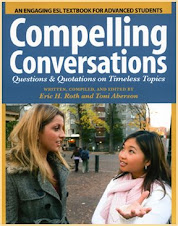
Naturally, many students hope to find job leads from their informational interviews. ESL students can always use more practice job interviews. This chapter of potential job interview questions and quotations comes from Compelling Conversations that I have used with community college, adult education, and university students.
http://www.compellingconversations.com/pdf/practicing_job_interview.pdf
From my perspective, holding both long mock job interviews and hearing trip reports of information interviews are practical, effective uses of precious classroom time.
Ask more. Know more. Share more.
Create Compelling Conversations.
Visit www.CompellingConversations.com
Showing posts with label ESL activities. Show all posts
Showing posts with label ESL activities. Show all posts
Sunday, September 27, 2009


Monday, March 23, 2009
More Practical Tips to Help English Students Ace the Job Interview
During these difficult economic times, English teachers should take every possible opportunity to focus on job interview skills. As blog readers know, I'm a big fan of both videotaping practice interviews and having ESL/EFL students conduct research for possible jobs with information interviews.
Here is an excellent, concise list of simple practical steps for English language learners to take when preparing for a job interview - and a few post-interview suggestions worth noting. The fine article comes from the Q Blog for English language learners. It's a fine resource. Check it out.
Official Q Blog: How to Succeed in an Interview
Ask more. Know more. Share more.
Create Compelling Conversations.
Visit www.CompellingConversations.com
Here is an excellent, concise list of simple practical steps for English language learners to take when preparing for a job interview - and a few post-interview suggestions worth noting. The fine article comes from the Q Blog for English language learners. It's a fine resource. Check it out.
Official Q Blog: How to Succeed in an Interview
Ask more. Know more. Share more.
Create Compelling Conversations.
Visit www.CompellingConversations.com
Friday, January 30, 2009
More Ideas for Using Videoclips in English Lessons
Are you looking for more excellent videoclips for your English classes or private lessons?
As blog readers know, I'm a huge fan of encouraging students to find their own materials to summarize for homework on particular topics. For instance, students in my high intermediate oral skills found and reviewed videos offering advice on job interviews. Students emailed me their recommended clips with a short descriptive paragraph and a few sentences evaluating the video. Then I edited their writing, combined their reviews into a single document, and emailed the entire class the videoclips.
"Use or lose" was my comment. "Viewing these videoclips is an opportunity, not an obligation. Enjoy!" Almost every student chose to watch the videos and our 10-15 minute mock job interviews were quite strong. Allowing students to select their own materials lead to more authentic, student centered learning both in and out of the classroom.
Yet sometimes both students and teachers lack time. It's a real pleasure to have someone systematically collect and sort through potential video materials for class.
Hall Houston, the author of The Creative Classroom: Teaching Languages Outside the Box, recently posted about Jamie Keddie's excellent website TEFLclips.com on his blog:
Hall writes, "This website ( http://www.teflclips.com/ ) contains over 30 clever lesson plans for using video clips in the TEFL classroom. The lessons are well-written and contain teacher's notes and handouts. I am looking forward to using some of these lessons in my classes this year (2009)." As so often, I share Hall's tastes and concerns for creating a dynamic, creative classroom where students learn English and critical thinking skills.
By the way, Hall recently wrote a long, very positive review of Compelling Conversations: Questions and Quotations on Timeless Topics for English Teaching Professional. (Here's a shout out to Hall. Thanks for the review and tip on videoclips!)
We live in a wonderful time to teach English. The technology allows us to gently cajole students to become autotelic, or self-directed, in their studies. Teaching with videoclips, both as homework and in class, adds visual information and builds rapport with our 21st century English students.
Use it or lose it. You choose. Will video work in your class?
Ask more. Know more. Share more.
Create Compelling Conversations.
Visit www.CompellingConversations.com
As blog readers know, I'm a huge fan of encouraging students to find their own materials to summarize for homework on particular topics. For instance, students in my high intermediate oral skills found and reviewed videos offering advice on job interviews. Students emailed me their recommended clips with a short descriptive paragraph and a few sentences evaluating the video. Then I edited their writing, combined their reviews into a single document, and emailed the entire class the videoclips.
"Use or lose" was my comment. "Viewing these videoclips is an opportunity, not an obligation. Enjoy!" Almost every student chose to watch the videos and our 10-15 minute mock job interviews were quite strong. Allowing students to select their own materials lead to more authentic, student centered learning both in and out of the classroom.
Yet sometimes both students and teachers lack time. It's a real pleasure to have someone systematically collect and sort through potential video materials for class.
Hall Houston, the author of The Creative Classroom: Teaching Languages Outside the Box, recently posted about Jamie Keddie's excellent website TEFLclips.com on his blog:
Hall writes, "This website ( http://www.teflclips.com/ ) contains over 30 clever lesson plans for using video clips in the TEFL classroom. The lessons are well-written and contain teacher's notes and handouts. I am looking forward to using some of these lessons in my classes this year (2009)." As so often, I share Hall's tastes and concerns for creating a dynamic, creative classroom where students learn English and critical thinking skills.
By the way, Hall recently wrote a long, very positive review of Compelling Conversations: Questions and Quotations on Timeless Topics for English Teaching Professional. (Here's a shout out to Hall. Thanks for the review and tip on videoclips!)
We live in a wonderful time to teach English. The technology allows us to gently cajole students to become autotelic, or self-directed, in their studies. Teaching with videoclips, both as homework and in class, adds visual information and builds rapport with our 21st century English students.
Use it or lose it. You choose. Will video work in your class?
Ask more. Know more. Share more.
Create Compelling Conversations.
Visit www.CompellingConversations.com
Friday, January 23, 2009
Cultivate Student Curiosity in ESL Classes - and Homework Assignments
Cultivate Student Curiosity in ESL Classes
“Curiosity is the best teacher,” goes the ancient proverb. Push your English language students to develop their own interests and passions. ESL students- adult, high school, or college - will remember the language they want and need to know to deepen their life experiences in English
Ironically, our job remains helping students become autotelic – or self-directed. Encouraging students to find and create their own vocabulary logs is just one useful, too seldom used technique in English language classrooms.
My standard homework assignment for English students remains having students find, summarize, and present newspaper articles on a topic (elections, housing, job interviews). The worksheet asks them to list core citation information, summarize the main idea, identify the best supporting evidence, etc. The worksheet also includes finding five new vocabulary words or phrases and writing new sentences. When the students complete their homework, they get together in groups of four and "present" their articles. I circulate around the room checking homework and having small chats. Students, meanwhile, build their own vocabulary logs from their own readings and discussions – and deepen their own interests.
Once students master the format, they choose both the subject and articles. In my high-intermediate writing course for international students, these homework readings provide the foundation for their research papers and final project. Students soon move beyond the worksheets and simply provide concise article summaries and evaluations.
Bottomline: We must find ways to gently cajole students to take responsibility for their own education – and become more self-directed.
Ask more. Know more. Share more.
Create Compelling Conversations.
Visit www.CompellingConversations.com
“Curiosity is the best teacher,” goes the ancient proverb. Push your English language students to develop their own interests and passions. ESL students- adult, high school, or college - will remember the language they want and need to know to deepen their life experiences in English
Ironically, our job remains helping students become autotelic – or self-directed. Encouraging students to find and create their own vocabulary logs is just one useful, too seldom used technique in English language classrooms.
My standard homework assignment for English students remains having students find, summarize, and present newspaper articles on a topic (elections, housing, job interviews). The worksheet asks them to list core citation information, summarize the main idea, identify the best supporting evidence, etc. The worksheet also includes finding five new vocabulary words or phrases and writing new sentences. When the students complete their homework, they get together in groups of four and "present" their articles. I circulate around the room checking homework and having small chats. Students, meanwhile, build their own vocabulary logs from their own readings and discussions – and deepen their own interests.
Once students master the format, they choose both the subject and articles. In my high-intermediate writing course for international students, these homework readings provide the foundation for their research papers and final project. Students soon move beyond the worksheets and simply provide concise article summaries and evaluations.
Bottomline: We must find ways to gently cajole students to take responsibility for their own education – and become more self-directed.
Ask more. Know more. Share more.
Create Compelling Conversations.
Visit www.CompellingConversations.com
Tuesday, December 23, 2008
Consumer Product Reviews: Get Your ESL Students Talking About their Consumer Choices
Let ESL students give consumer product reviews in the New Year!
Do you let your students write and deliver product reviews? Consumer reviews help ESL students develop research skills, use critical thinking, and share their consumer choices.
The giving and receiving of gifts has become a central feature of Christmas, Hanukkah, winter solstice and New Year celebrations. We live – for worse or for better – in a consumer age. English language learners, around the world, share in this winter shopping spree. Product reviews allow them to talk about their gift selections and holiday gifts.
Many ESL students, especially young, hip, and wealthy teenagers and college students have also bought into - literally - the odd belief that "you are what you have". Therefore, these English language learners and experienced consumers often love to share their "insights" about consumer products. Product reviews speak to their lifestyles, passions, and curiosity.
As an ESL teacher, I use consumer product reviews to teach the difference between fact and opinion and identify critical thinking skills. The assignment lends itself to reviewing a few key concepts like “details matter” and “numbers add precision” while introducing hedging language. Of course, engaging student interests also leads to better classroom discussions and more use of authentic language.
You can also design a very simple presentation form so everyone can provide peer feedback. Result? The students receive written feedback on their product reviews from you (the teacher) and their classmates. Again, teenagers being teenagers, they love to read about themselves and the feedback. If possible, I also suggest videotaping the student reviews and posting them on a class website for both self and peer reviews.
Teaching high school students possess many challenges, beginning with capturing and holding their interest. Personally, I have found teaching slightly older undergraduate students far more satisfying - and far easier. But I have also had considerable success in short term IEP summer programs with that tough audience. Product reviews have always been a hit!
Here is both my short assignment sheet and a product review worksheet for ESL students.
----------------------------------------------------------------------------------------------------------
YOUR TURN: GIVING A PRODUCT REVIEW
You have probably bought thousands of items as a consumer. You have looked at and considered thousands more. You can’t buy everything; you have to pick and choose the products that fit you and your lifestyle.
Choose a single product and prepare to give a brief product review.
Your product review should include:
• a description of the product
• the way the product is used
• the cost of the product
• a comparison with other, similar products
• a recommendation to buy or not buy the product
• a reason for your recommendation
• a rating on a scale of 1-5
-----------------------------------------------------------------------------------------
PRODUCT REVIEW WORKSHEET
PRODUCT:
PURPOSE:
AUDIENCE:
USE:
COST:
COMPETITORS:
RECOMMENDATION:
REASON:
RATING:
_____________________________________________________________
As an old American cereal commercial used to say, “try it – you’ll like it!”
Ask more. Know more. Share more.
Create Compelling Conversations.
Visit www.CompellingConversations.com
Do you let your students write and deliver product reviews? Consumer reviews help ESL students develop research skills, use critical thinking, and share their consumer choices.
The giving and receiving of gifts has become a central feature of Christmas, Hanukkah, winter solstice and New Year celebrations. We live – for worse or for better – in a consumer age. English language learners, around the world, share in this winter shopping spree. Product reviews allow them to talk about their gift selections and holiday gifts.
Many ESL students, especially young, hip, and wealthy teenagers and college students have also bought into - literally - the odd belief that "you are what you have". Therefore, these English language learners and experienced consumers often love to share their "insights" about consumer products. Product reviews speak to their lifestyles, passions, and curiosity.
As an ESL teacher, I use consumer product reviews to teach the difference between fact and opinion and identify critical thinking skills. The assignment lends itself to reviewing a few key concepts like “details matter” and “numbers add precision” while introducing hedging language. Of course, engaging student interests also leads to better classroom discussions and more use of authentic language.
You can also design a very simple presentation form so everyone can provide peer feedback. Result? The students receive written feedback on their product reviews from you (the teacher) and their classmates. Again, teenagers being teenagers, they love to read about themselves and the feedback. If possible, I also suggest videotaping the student reviews and posting them on a class website for both self and peer reviews.
Teaching high school students possess many challenges, beginning with capturing and holding their interest. Personally, I have found teaching slightly older undergraduate students far more satisfying - and far easier. But I have also had considerable success in short term IEP summer programs with that tough audience. Product reviews have always been a hit!
Here is both my short assignment sheet and a product review worksheet for ESL students.
----------------------------------------------------------------------------------------------------------
YOUR TURN: GIVING A PRODUCT REVIEW
You have probably bought thousands of items as a consumer. You have looked at and considered thousands more. You can’t buy everything; you have to pick and choose the products that fit you and your lifestyle.
Choose a single product and prepare to give a brief product review.
Your product review should include:
• a description of the product
• the way the product is used
• the cost of the product
• a comparison with other, similar products
• a recommendation to buy or not buy the product
• a reason for your recommendation
• a rating on a scale of 1-5
-----------------------------------------------------------------------------------------
PRODUCT REVIEW WORKSHEET
PRODUCT:
PURPOSE:
AUDIENCE:
USE:
COST:
COMPETITORS:
RECOMMENDATION:
REASON:
RATING:
_____________________________________________________________
As an old American cereal commercial used to say, “try it – you’ll like it!”
Ask more. Know more. Share more.
Create Compelling Conversations.
Visit www.CompellingConversations.com
Subscribe to:
Posts (Atom)

 Posts
Posts