What do you do while students are having conversations or talking in pairs? Do you have a “formula” for taking notes? Do you focus more on fluency or accuracy in conversation activities?
Many English teachers, especially novice ESL instructors, talk more than ideal - and allow their English students to talk too little. Ironically, many ESL instructors make this “good mistake” because they are so dedicated. What, after all, are English teachers supposed to do while students exchange ideas and practice their speaking skills?
Listen. Take notes. Politely, and indirectly, correct by modeling better speech. Sometimes, for brief periods, join in the student conversations. Listen. Ask questions. Take notes. Repeat.
When I taught an advanced ESL conversation class to immigrants and international students from many different countries at Santa Monica Community College, I developed a little routine for the popular two-hour class.
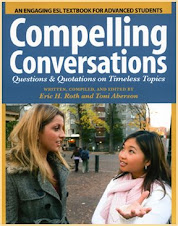
First, I introduced conversation topics with a quotation or proverb and briefly introduce the day’s topic. Then I distribute worksheets (which became chapters in Compelling Conversations) with 30 or so questions, 10 or 12 key vocabulary words, and a few selected quotations or proverbs. Then students would be paired up to interview each other and share experiences for 20-30 minutes.
What did I do? I simply circled around the room, briefly joining in conversations, taking notes, and indirectly correcting students by modeling a better way to ask or respond to questions. I also jotted down key comments and “good mistakes” - both grammar and pronunciation - that I would later share with the entire class. Further, I focused on the content of student comments so fluency and meaning was more important than accuracy. Ideas and perceptions mattered more than perfect grammar.
These notes, however, helped me guide the classroom discussion because it closely echoed their previous conversations. It also lead to dynamic discussions because several perspectives were acknowledged and considered. Discussions were usually for another 20-30 minutes.
Taking notes also gave me a chance to emphasize certain sound groups or related word forms. While the students were talking to each other, I was playing reporter and taking notes. This group activity would often take another 10-15 minutes. Class ended with everyone asking a question on that same topic so they could continue the discussions outside of the classroom.
Here is a reproducible worksheet that captures that process of monitoring conversations and leading discussions. Although designed to be used with Compelling Conversations: Questions and Quotations on Timeless Topics, it can be used for any ESL classroom discussing almost any topic.
—————————————————–
Compelling Conversation Classroom Worksheet for Teachers
Topic:
Pages:
Date:
# of participants:
# of groups:
Class:
Opening Quote:
Opening comments to class:
Starting time for conversations:
Conversation content:
- What did you hear the students say? Summarize.
Follow-up class discussion questions:
Review Vocabulary:
Pronunciation tips:
Grammar issues:
Other comments/observations:
———————————————————
Is this a lesson plan? Sort of, but it's completely responsive to your students' comments, questions, and conversations. You take the "good mistakes" from that day's actual events. Whether you consider this a worksheet or lessonplan, this document has helped me teach and lead many satisfying ESL classes.
As an old American cereal commercial used to say, "try it - you'll like it."
Ask more. Know more. Share more.
Create Compelling Conversations.
Visit www.CompellingConversations.com
Showing posts with label conversation class. Show all posts
Showing posts with label conversation class. Show all posts
Monday, March 2, 2009


Tuesday, December 9, 2008
Another Five Star Review for Compelling Conversations on Amazon
Allow me to brag for a moment. Another five-star review for Compelling Conversations: Questions and Quotations on Timeless Topics showed up on Amazon. Consider me pleased!
Here's the entire Amazon review:
5.0 out of 5 stars A wholesome learning resource!, December 4, 2008
By Erika Villafane "Erika" (Miami, Florida USA) - See all my reviews
When compelling conversations got into my hands I couldn't help but to think: I wish I had this book when I was learning English!
As English as a second language speaker, I can really tell the difference that compelling conversations has with other ESL text books: topics richness that takes learning at a higher level.
Not only you will feel motivated to improve your language skills, but you will have a rich-provoking theme about life to discuss and share with your tutor or classmates. That in turn makes you grow personally and you certainly will remember the discussed matter here when need it to apply into a situation out of the classroom. You will appreciate American culture as well as other's point of view.
The book is very well structured into four sections totaling 45 chapters. Each one of them is organized into conversations starters followed by vocabulary, proverbs and the indispensable quotations. One that really caught my attention was the Arab proverb "he who has health has hope and he who has hope has everything"
I recommend it to anyone who wants to learn while enjoying the process.
Erika Villafane
------------------------------
This makes 14 positive Amazon
reviews - all four and five stars - that various ESL teachers, writers, English language learners, and other fine folks have written. Not bad for a self-published book!
Three other bits of positive news about Compelling Conversations. A private language school in Chile made a large order, another community college in California adopted the conversation book as the course textbook, and Compelling Conversations has been added to an adult education center in Rwanda for advanced English class. Whether due to changes in the TOEFL test that require test-takers to actually speak, a strong word-of-mouth campaign, or just the belief that conversations should go beneath the surface, sales of Compelling Conversations have gone up. These successes may seem small, but they all make me smile!
Ask more. Know more. Share more.
Create Compelling Conversations.
Visit www.CompellingConversations.com
Here's the entire Amazon review:
5.0 out of 5 stars A wholesome learning resource!, December 4, 2008
By Erika Villafane "Erika" (Miami, Florida USA) - See all my reviews
When compelling conversations got into my hands I couldn't help but to think: I wish I had this book when I was learning English!
As English as a second language speaker, I can really tell the difference that compelling conversations has with other ESL text books: topics richness that takes learning at a higher level.
Not only you will feel motivated to improve your language skills, but you will have a rich-provoking theme about life to discuss and share with your tutor or classmates. That in turn makes you grow personally and you certainly will remember the discussed matter here when need it to apply into a situation out of the classroom. You will appreciate American culture as well as other's point of view.
The book is very well structured into four sections totaling 45 chapters. Each one of them is organized into conversations starters followed by vocabulary, proverbs and the indispensable quotations. One that really caught my attention was the Arab proverb "he who has health has hope and he who has hope has everything"
I recommend it to anyone who wants to learn while enjoying the process.
Erika Villafane
------------------------------
This makes 14 positive Amazon
reviews - all four and five stars - that various ESL teachers, writers, English language learners, and other fine folks have written. Not bad for a self-published book!
Three other bits of positive news about Compelling Conversations. A private language school in Chile made a large order, another community college in California adopted the conversation book as the course textbook, and Compelling Conversations has been added to an adult education center in Rwanda for advanced English class. Whether due to changes in the TOEFL test that require test-takers to actually speak, a strong word-of-mouth campaign, or just the belief that conversations should go beneath the surface, sales of Compelling Conversations have gone up. These successes may seem small, but they all make me smile!
Ask more. Know more. Share more.
Create Compelling Conversations.
Visit www.CompellingConversations.com
Sunday, May 25, 2008
Paraphrasing matters in conversation too!
Paraphrasing remains a critical skill in academic classrooms and in the larger world.
The ability to re-phrase and re-state, usually called paraphrasing, allows students to confirm information, accurately convey information, and avoid plagiarism problems in writing papers. Paraphrasing, usually quite emphasized in ESL and EFL writing classes, deserves some attention in conversation class too.
Students should learn to confirm information by asking clarification questions. Some useful phrases for a listener to ask include:
Are you saying…?
Do you mean?
What are you getting at?
If I understand you correctly, you are saying …
Did I get that right?
Speakers can also check to see if their group members understand their directions.
Can you understand me?
Do you follow?
Is that clear?
Should I repeat the directions?
Do you want me to repeat that?
Asking advanced students to repeat directions, in different words, can be an effective group activity. Student A tells a story, and Student B retells it to Student C. It also helps build vocabulary.
Another technique that I’ve found useful is asking students to paraphrase proverbs and quotations. This exercise, done in groups of two, is often followed by asking if students agree or disagree with the proverb or quotation. Of course, students have to give a reason and/or an example. ESL tutors and lucky teachers with small classes can further elaborate this technique to match student interests.
If students can accurately paraphrase a reading, a radio segment, or a verbal statement, they can actively participate in common conversations and classroom discussions. Many English teachers underestimate the importance of this skill, ansd assume students understand more than they might. Verbal paraphrasing activities allow both students and teachers to assess a listening comprehension in a natural, authentic manner.
Verbal paraphrasing, therefore, deserves more attention in speaking activities - especially in high intermediate and advanced levels!
Create Compelling Conversations.
Visit www.CompellingConversations.com
Tuesday, May 20, 2008
Do you teach the difference between "a" and "the" in conversation class?
Does teaching articles (a, an, the) make sense in a conversation class?
Context matters.
Conversation class should encourage English students to express their ideas, practice familiar words and syntax, and develop greater confidence in effectively communicating in English. Content remains king. Given how little most of our ESL students speak English outside of classes, we need to provide many speaking opportunities for them to develop greater fluency.
Starting from these assumptions, I generally prefer indirect correction of student errors during conversation class. I often circle around a class, listen in, join small discussion groups, and make a few notes. If I hear some grammatical error, I usually demonstrate correct language – but without explicitly or publicly correcting the student.
This indirect correction – modeling the correct syntax – seems especially important with adult students with limited academic backgrounds. I prefer encouraging these sometimes reluctant, shy and often insecure students to insisting on perfect grammar.
Yet article errors matter in English, and provide what native speakers consider significant information. Just as some languages divide nouns or adjectives into masculine and feminine, English highlights the difference between a definite (or known) member of a group and an indefinite (or unknown) member of a group. Article errors are also very common – even with immigrants who have lived in the
After collecting overheard student errors during conversation lessons, I tend to pick one “good mistake” and give several examples when the class comes back for a general discussion. It is here, more for college students and future college students, that I remind students of the differences between articles “a”, “an” and “the”. Because I teach in the
Create Compelling Conversations.
Visit www.CompellingConversations.com
Subscribe to:
Posts (Atom)

 Posts
Posts