Who makes the rules? Who chooses the rulers? Can citizens peacefully replace corrupt leaders?
In the United States of America, voters enjoy their opportunity to hire and fire the President. On Tuesday, American citizens voted, selected a new leader, and millions of people around the nation smiled, laughed, and felt hopeful again. Senator Obama, as so often, captured the power and beauty of the peaceful transfer of power in his eloquent victory speech.
"If there is anyone out there who still doubts that America is a place where all things are possible; who still wonders if the dream of our founders is alive in our time; who still questions the power of our democracy, tonight is your answer. "
Barack Hussein Obama (1961- ), President-elect of the United States
I, like so many Americans, feel very proud. We are coming back – to our ideals, our citizens, and our best traditions! The United States, the first nation explicitly created on enlightenment ideals, will become an inspiring 21st century nation.
This surprising election seems like a very teachable moment. Immigrants and international students can rest assured that they made the right decision to come to the United States. English language learners around the world should feel the enlarged possibilities that come with our strange tongue. European sceptics and Arab critics should candidly reassess their prejudices about Americans and the American government. After all, Obama – the son of an international African student and an adventurous Midwestern scholar – has just won the Presidency of the United States. Where else could that happen?
Let's talk about the power of elections and democratic values in our English classes. Let's discuss the possibilities for peaceful reform, voting, and the rights of citizens to choose their own leaders. ESL/Civics classes always discuss these questions, but English teachers should also celebrate this Anglo-American tradition in English language classes around the world. Let's start defending Western values in our classes- and even promoting western democratic principles. Human rights matter. Democracy matters. Freedom counts. The good society can face its problems, openly debate vital public policy issues, and peacefully elect new leaders.
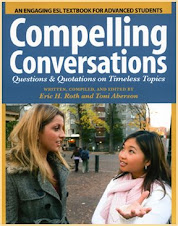
Click here for a free advanced ESL conversation lesson on Voting from Compelling Conversations.
Ask more. Know more. Share more.
Create Compelling Conversations.
Visit www.CompellingConversations.com
Showing posts with label democratic classroom. Show all posts
Showing posts with label democratic classroom. Show all posts
Thursday, November 6, 2008


Monday, October 27, 2008
How Democratic is Your English Classroom? How Democratic Do You Want it To Be?
Who gets to speak in class? Whose ideas count? Who chooses the assignments? How do students receive feedback? Do students have a chance to conference with their instructors? Can YouTube be a valuable source for homework assignment? Do you want your students to become self-directed - or autotelic - in their studies?
Here’s a quick checklist that ESL teachers that I created for a recent LA CATESOL regional conference workshop called “Techniques for a More Democratic Classroom."
My core assumption remains that giving students more opportunities to literally speak, write, and share their insights leads to a more engaging, dynamic, and valuable classroom experience. I will write more on this topic in a few days, but here are some questions to consider.
1. Who do you currently teach? How would you describe the students?
2. What are some of their personal interests?
3. How can student interests be better incorporated into the curriculum?
4. Which assignments do students currently choose? Which seems most successful? Why?
5. What are some benefits of greater student participation?
6. What are some risks of greater student participation?
7. Do you want to increase the number of choices students make?
8. What critical language skills can be taught by tapping into their interests?
9. How can you tweak current material to better individualize instruction?
10. What internet resources can you use to augment the current curriculum?
11. Which exercises or activities do you find most successful in your classroom?
12. What decisions do you keep as your prerogative as the instructor?
13. Will your students become self-directed learners?
14. How can you encourage that possibility?
15. How can you create a more democratic classroom?
16. What are some obstacles to a more democratic classroom?
17. How does technology encourage a more democratic classroom?
“Education is a kind of continuing dialogue and a dialogue assumes, in the nature of the case, different points of view.” Robert Hutchins (1899-1977), former President of University of Chicago and educational philosopher
Do you agree? Disagree? Why? Feel free to let me know.
I’ll post an article in a few days outlining some of my thoughts and sharing some materials.
Ask more. Know more. Share more.
Create Compelling Conversations.
Visit www.CompellingConversations.com
Here’s a quick checklist that ESL teachers that I created for a recent LA CATESOL regional conference workshop called “Techniques for a More Democratic Classroom."
My core assumption remains that giving students more opportunities to literally speak, write, and share their insights leads to a more engaging, dynamic, and valuable classroom experience. I will write more on this topic in a few days, but here are some questions to consider.
1. Who do you currently teach? How would you describe the students?
2. What are some of their personal interests?
3. How can student interests be better incorporated into the curriculum?
4. Which assignments do students currently choose? Which seems most successful? Why?
5. What are some benefits of greater student participation?
6. What are some risks of greater student participation?
7. Do you want to increase the number of choices students make?
8. What critical language skills can be taught by tapping into their interests?
9. How can you tweak current material to better individualize instruction?
10. What internet resources can you use to augment the current curriculum?
11. Which exercises or activities do you find most successful in your classroom?
12. What decisions do you keep as your prerogative as the instructor?
13. Will your students become self-directed learners?
14. How can you encourage that possibility?
15. How can you create a more democratic classroom?
16. What are some obstacles to a more democratic classroom?
17. How does technology encourage a more democratic classroom?
“Education is a kind of continuing dialogue and a dialogue assumes, in the nature of the case, different points of view.” Robert Hutchins (1899-1977), former President of University of Chicago and educational philosopher
Do you agree? Disagree? Why? Feel free to let me know.
I’ll post an article in a few days outlining some of my thoughts and sharing some materials.
Ask more. Know more. Share more.
Create Compelling Conversations.
Visit www.CompellingConversations.com
Subscribe to:
Posts (Atom)

 Posts
Posts