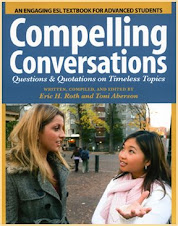
Cultivate Student Curiosity in ESL Classes
“Curiosity is the best teacher,” goes the ancient proverb. Push your English language students to develop their own interests and passions. ESL students- adult, high school, or college - will remember the language they want and need to know to deepen their life experiences in English
Ironically, our job remains helping students become autotelic – or self-directed. Encouraging students to find and create their own vocabulary logs is just one useful, too seldom used technique in English language classrooms.
My standard homework assignment for English students remains having students find, summarize, and present newspaper articles on a topic (elections, housing, job interviews). The worksheet asks them to list core citation information, summarize the main idea, identify the best supporting evidence, etc. The worksheet also includes finding five new vocabulary words or phrases and writing new sentences. When the students complete their homework, they get together in groups of four and "present" their articles. I circulate around the room checking homework and having small chats. Students, meanwhile, build their own vocabulary logs from their own readings and discussions – and deepen their own interests.
Once students master the format, they choose both the subject and articles. In my high-intermediate writing course for international students, these homework readings provide the foundation for their research papers and final project. Students soon move beyond the worksheets and simply provide concise article summaries and evaluations.
Bottomline: We must find ways to gently cajole students to take responsibility for their own education – and become more self-directed.
Ask more. Know more. Share more.
Create Compelling Conversations.
Visit www.CompellingConversations.com
Showing posts with label vocabulary. Show all posts
Showing posts with label vocabulary. Show all posts
Friday, January 23, 2009


Saturday, July 19, 2008
What is the opposite of jealous? "Gratitude is Heaven itself."
A bright college student asked a simple vocabulary question that threw me this week. "What is the opposite of jealous"?
What is the opposite of jealous? Generous? Selfless? Confident? I found myself discussing various possibilities with students adding in situations. The simple vocabulary building exercise (create 25 pairs of opposite adjectives) took a more philosophical turn. We had a lively, if a bit wandering, class discussion. I apologized for my memory lapse, urged them to check a dictionary, and promised to get back to students with a better answer.
In the teacher's room, a fellow teacher noted "The world jealousy includes the word lousy." We shared a laugh. That's a good answer. How did he instantly come up with that? Why couldn't I do that?
I felt discontent, dissatisfied, and displeased with my weak classroom answers. Perhaps the opposite of "jealous" is content, satisfied, and pleased.
Stress comes naturally when driving in Los Angeles, and my commute back home fit the familiar pattern. Many words popped into my head that captured negative feelings, including jealous. Could I be jealous of bus riders? Really? I started to visualize a bus ride home from UCLA, sitting - no, probably standing up, for 40 minutes next to exhausted strangers. Memories of less pleasant commutes on subway rides in New York from 20 years ago returned. No, I didn't envy or feel jealous of the bus riders.
I eventually arrived home. Boomer, my dog, barked to announce my arrival and licked my face as I entered the front door. He's great. "Dogs are our link to paradise," wrote Milan Kundera. Absolutely.
Gratitude. That's the opposite of jealousy. Gratitude. Why didn't I think of that in class? Next time.
"Gratitude is heaven itself." Who said that? Blake? Yeah, William Blake. The great poet-painter-mystic man. Remember that quote the next time an English student asks, "what is the opposite of jealous?"
Teaching English, especially to bright international college students, helps keep me focused and clear. This week I learned the opposite of jealousy and rediscovered a favorite quotation. Consider me satisfied, content, and grateful.
Ask more. Know more. Share more.
Create Compelling Conversations.
Visit www.CompellingConversations.com
Friday, July 18, 2008
What is a lifequake? Is that a real word?
Earthquakes remain a concern for people living in many places, including Southern California. This awareness, and fear of sudden shaking and buildings falling, enters into many conversations.
I recently read a wonderful term and vocabulary word: lifequake. What does it mean? An event that suddenly changes your life – a car accident, being laid off, terrible illness, or getting divorced – in the same dramatic way that an earthquake might destroy a building.
Now I have a new way to ask friends to share more about awkward situations.
- How did you deal with that lifequake?
- What lifequakes have you survived?
- How will you manage that lifequake?
Is lifequake a real word? Can educated English speakers use it? Absolutely. New words and slang terms enter English dictionaries all the time, partly because our world continues to change and evolve. Lifequake clearly describes a common experience. It's pithy and practical. While I would might hesisitate about using the term on a TOEFL or TOEIC test, I plan to incorporate into my daily vocabulary with family, friends, and students.
A fellow ESL teacher and longtime California resident believes that “lifequake” was a widely used term in the 1970s among “young, hip people.” Perhaps. Whether old hipster slang or a new Californian term, lifequake conveys an understanding that sometimes life can shock and hurt. Lifequake is a fast way to communicate a harsh reality. Lifequakes happen.
Don't you agree?
Ask more. Know more. Share more.
Create Compelling Conversations.
Visit www.CompellingConversations.com
Thursday, May 1, 2008
What are the 1000 most common words in English? Should you care?
Wiktionary, an offshoot of the wonderful Wikipedia, offers this answer . Looks, sounds, and feels right to me.
Do I recommend memorizing this list? No. Language is to be used, discovered, and enjoyed. Memorizing long lists of vocabulary words in English, while sometimes effective for standardized tests, seldom helps create compelling conversations.
Vocabulary lists, however, can provide a sense of satisfaction and order.
Should you care? Do you have to care? Sometimes lists like this can also help us review and trigger new connections. You probably want to know these words if you are planning to study in English at a university, college, or community college - but I wouldn't stress. Learning English takes time, and you will find the words that you need when you need them.
Yet exploring a personal interest in English will help you generate a more personal, authentic, and meaningful vocabulary in English. So what interests you today? What do you want to learn more about? Where can you find two quality articles on that topic? Why not create your own vocabulary list to match you and your interests? After all, shouldn't your vocabulary journal reflect you?
Rudyard Kipling (1865-1936), British author and Nobel Prize winner in Literature
Ask more. Know more. Share more.
Create Compelling Conversations.
Visit www.CompellingConversations.com
Subscribe to:
Posts (Atom)

 Posts
Posts