Showing posts with label international students. Show all posts

Sunday, July 20, 2008

Volume Matters

Speaking too loud can be annoying and push people away. Speaking too softly, however, can be an even larger obstacle to simple communication and a satisfying conversation.

During classroom discussions in English class, some students to will boldly speak their mind. Other students tend to hold back, offer only the safest comments, and other share their wit. One overlooked, essential quality to speech in class, however, is volume. Students must speak loud enough that their fellow students can hear them - whether seated in the front or back row.
One can, however, sympathize with the timid English students who speak softer than ideal in a large classroom.

Being inaudible, however, in personal conversations remains a far more serious problem - especially for English as a Second Language (ESL) students.

Student conferences, especially with shy students worried about their grade or academic performance, can often be a bit awkward for both the professor and student. ESL (English as a Second Language) students, sometimes insecure about their pronunciation or vocabulary, can feel particularly anxious. ESL and other English teachers have to find ways to reduce student anxiety, provide a safe place for English students to speak, provide feedback on student work, and uphold academic standards. (Adult education, by the way, would be greatly improved if ESL teachers had more opportunities for student conferences.)

In general, I find student conferences very productive and satisfying because you get a chance to really work with a college student on their writings and assignments. I often feel that I learn as much as I teach in these 20-30 minute student conferences.

Sometimes, however, I have awkward conferences. If the student has plagiarized, then this can’t be avoided. Those moments, which I dread, can not be avoided. So it goes.

Yet sometimes, as occurred last semester, an ESL (English as a Second Language) student is so shy, so timid, and so unsure that they speak so softly that I can’t even hear. Sometimes I lean forward and ask them to please speak a bit louder. If a student continues in the same low volume, I might apologize for my poor hearing and again request they speak up. What does one do on the third request?

“Please speak a bit louder so I can hear you.”

Was this too direct? I wanted to say, “If I can’t hear you, you will be misunderstood. I want to understand you. Speak up!!”

Patience, this time, paid off. The student raised her voice to an audible level, and replied, “okay.”

“Good to hear you,” I replied. We proceeded to have a productive end of semester conference.

English and ESL teachers at all levels, from elementary school and high school to adult school and university, need to emphasize the importance of student speech being comprehensible. That includes speaking loud enough that conversation partners, classmates, and instructors can hear.

Bottomline: students must speak up in conversations, conferences, and class discussions. Volume matters.


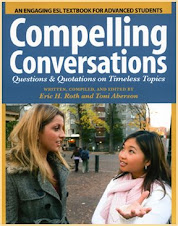
Ask more. Know more. Share more.
Create Compelling Conversations.
Visit www.CompellingConversations.com

Saturday, April 26, 2008

What should every ESL student know?

What should every ESL student know?

Beats me. One size fits all philosophies often seem a bit strange to me. Can anybody really answer this question for every international student and ESL college student in the United States? Really? Don't circumstances, needs, and desires differ?

On the other hand, administrators, teachers, future college students, and current international ESL students constantly face this common question. What should every ESL student know?

Fortunately, braver and more confident souls feel comfortable answering this reasonable question. That's why a small green and purple book, What Every ESL Student Should Know: A Guide to College and University Academic Success, caught my eyes at a recent English teachers' conference in California. Kathy Ochoa Flores, the author, has both more confidence and deeper insight into this essential, yet puzzling, question. In 119 pages, she displays considerable wit while dispensing practical advice to international students and immigrants preparing for college.

"My students always want to know what they should do to learn English," notes Flores in chapter 2. "I tell them to marry an American - one who is a native speaker and rich. That way, they can have someone to practice with every day, and they won't have to worry about working and studying at the same time. Unfortunately, this advice does not work for most of my students."

So Flores goes on to advocate, since many students are already married or too young to get married, to at least make some American friends. In bold print, she argues: "Native English speakers are everywhere. Use them. They are like free tutors." How? Take the bus, sit down next to some nice looking American, and start talking. Seek out the elderly since they tend to have both more free time and might be lonely. Talk to children, meet a school counselor, and ask many questions. "Talk to the telemarketers who call you during dinner time, and ask them lots of questions about their products." I completely agree.

This affordable book provides dozens of these imperative statements followed by detailed advice. Written in a clear manner, the concise format and friendly style make this book a wonderful book for newcomers. Easier to read, smaller in scope, and less than controversial than the popular book What's Up, America?, this book serves a slightly different purpose. Both titles help international students adjust to American college campuses, but What Every ESL Student Should Know focuses more on survival skills. International counselors, orientation coordinators, and even English language schools could provide a real service to their students by including this thin book in their orientation sessions and pre-college materials. The minimum cost will pay for itself by reducing ESL student stress.

Meanwhile, future international students should find it and buy it. This "one size fits all" work offers enough tips to satisfy any ESL student - and even a sceptical ESL university teacher!

Ask more. Know more. Share more.
Create Compelling Conversations.
Visit www.CompellingConversations.com