A Way With Words: Another Resource for English Teachers and Word Mavens
Do you have a way with words? Are you a lover of word trivia and origins? Are you an English teacher? If so, consider listening to the celebrated public radio show!
Forget forcing students to memorize boring vocabulary lists. Get your English students engaged in the story of English words, their origins, and multiple uses.
A Way with Words, another outstanding public radio show, is co-hosted by Martha Barnette and Grant Barrett (who writes an annual buzzwords of the year survey for the New York Times.) The hour long program examines the English language as the hosts answer listeners' questions about intriguing aspects of the English language, including grammar, vocabulary, idioms, slang, dialects, speaking, and writing. The friendly format also demonstrates excellent discussion skills. Web visitors can also listen to episodes online, down MP3s, and subscribe to podcasts for free.
While the show is better for English teachers and writers than most English language learners or adult ESL students, listeners will gain a greater appreciation for and knowledge of our strange, fascinating language.
Features:
• Free downloads
• Thematic episodes accompanied by a reading text
• Discussion points
• All past episodes are archived chronologically for easy browsing
• Free subscriptions
Site URL: http://www.waywordradio.org/
Check it out!
Word mavens might also be interested in New York Times column on buzzwords:
http://ideas.blogs.nytimes.com/2008/12/22/whats-your-buzzword-of-2008/#comment-2671
As you might suspect, I recommended "lifequake" as a buzzword for 2008 because so many lives suffered sudden changes, like in earthquakes.
Ask more. Know more. Share more.
Create Compelling Conversations.
Visit www.CompellingConversations.com
Showing posts with label free teaching resources. Show all posts
Showing posts with label free teaching resources. Show all posts
Friday, December 26, 2008


Saturday, November 15, 2008
Talking About Urban Pleasures, Perils in ESL Classrooms
Cities attract the young, the strong, and the ambitious. Cities also provide housing, jobs, and hope for those fleeing boredom, economic crisis, and war. Our 21st century cities, like our English classrooms, reflect the diversity of the human experience.
Millions move from the countryside and across the globe to live in new cities every year. Cities provide employment, culture, and education. Cities are exciting. Yet, sometimes danger also lurks in cities. Many students struggle with economic pressures, culture shock, and criminal activity. Shouldn't we discuss these conflicting pressures in our ESL classrooms?
Teaching English in Los Angeles and Santa Monica I’ve found that students, who come from across the globe, eager to talk about cities. Some English students share stories about moving from rural areas and small towns to an international city; other students enjoy telling about their travel experiences. Discussions naturally touch on housing, employment, and lifestyle choices. English language learners – whether adult immigrants creating a new home or university students living abroad – can reflect on their experiences and share insights discussing urban life.
Are you a city person? Why?
How are cities different from small towns?
What cities have you visited? Lived in?
What attracted you to this city?
What do you find stressful about city life?
What do you find satisfying about living in a city?
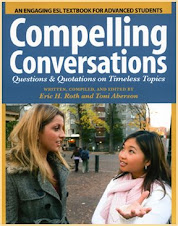
This month Exploring Cities, one of my favorite chapters, is highlighted as a free chapter on Compelling Conversations. Perhaps you will create some compelling conversations about cities in your classroom too. Check it out.
Ask more. Know more. Share more.
Create Compelling Conversations.
Visit www.CompellingConversations.com
Millions move from the countryside and across the globe to live in new cities every year. Cities provide employment, culture, and education. Cities are exciting. Yet, sometimes danger also lurks in cities. Many students struggle with economic pressures, culture shock, and criminal activity. Shouldn't we discuss these conflicting pressures in our ESL classrooms?
Teaching English in Los Angeles and Santa Monica I’ve found that students, who come from across the globe, eager to talk about cities. Some English students share stories about moving from rural areas and small towns to an international city; other students enjoy telling about their travel experiences. Discussions naturally touch on housing, employment, and lifestyle choices. English language learners – whether adult immigrants creating a new home or university students living abroad – can reflect on their experiences and share insights discussing urban life.
Are you a city person? Why?
How are cities different from small towns?
What cities have you visited? Lived in?
What attracted you to this city?
What do you find stressful about city life?
What do you find satisfying about living in a city?
This month Exploring Cities, one of my favorite chapters, is highlighted as a free chapter on Compelling Conversations. Perhaps you will create some compelling conversations about cities in your classroom too. Check it out.
Ask more. Know more. Share more.
Create Compelling Conversations.
Visit www.CompellingConversations.com
Subscribe to:
Posts (Atom)

 Posts
Posts