What makes a great English teacher? Children and Adults apparently disagree.
Marisa Constantinides, a prominent EFL teacher and blogger, wrote a fascinating article that explores this issue in a fascinating post. Here it is.
http://marisaconstantinides.edublogs.org/2010/02/14/what-kind-of-teacher-are-you-are-you-in-your-students-hall-of-fame/comment-page-1/
While I have no experience teaching young child, the survey confirms my perceptions about the educational desires of adult students. Many adult students work and struggle in boring, stressful positions so they seek more creativity and passion in their English classes – and English teachers. Further, given the time pressures, instructors who both efficiently manage their classes and display patience are appreciated.
I would be curious, however, to know if there is a difference between various types of adult learners. For instance, many Business English classes in an EFL context include many middle-class professionals while many more working class adults attend ESL classes in English speaking classes. I also wonder if different ages of adults would provide different responses. Would younger working adults look for the same qualities as seniors taking an English class? Would creativity and passion still top the list of desired characteristics for English teachers?
The bottomline remains the same: our English students invest considerable time, energy, and often money into their studies. It behooves us to create compelling English lessons, exude energy, and patiently, clearly their "good mistakes".
“I cannot teach anybody anything, I can only make them think.”
Socrates (BC 469-BC 399) Greek philosopher of Athens
Ask more. Know more. Share more.
Create Compelling Conversations.
Visit www.CompellingConversations.com
Showing posts with label adult education ESL. Show all posts
Showing posts with label adult education ESL. Show all posts
Sunday, February 14, 2010


Friday, September 18, 2009
What Do Your ESL Students Believe? Find Out!
Why Bring ‘This I Believe’ Essays and Podcasts Into Your English Classroom?
What are your core beliefs? More importantly, what are the core beliefs of your English students? How do you know? Do you like listening to quality radio essays to improve listening skills and critical thinking skills? Are you looking for a friendly way to gently nudge your EFL students into reflecting on their experiences and expressing their ideas?
If so, you might want to consider adding This I Believe radio essays to your curriculum. This I Believe, originally a radio program hosted by legendary journalist Edward R. Murrow in the 1950s, has been resurrected by National Public Radio as a weekly feature.
While the 1950s version sought out short personal essays by leading intellectuals, artists, and prominent personalities, the 21st century version is far more democratic. Anybody can submit an essay – and thousands and thousands of individuals around the world – have.
English teachers and global travelers might appreciate the sample podcast This I Believe: Inviting the World to Dinner by travel writer and Parisian resident Jim Haynes. Students might also appreciate the open spirit and generosity, but if not, they can choose from over 200 other radio essays. In short, The This I Believe website includes a tremendous amount of free resources for teachers and students. Teachers can sign up for the free mailing list and download an exceptional discussion guide. Amazon also sells several collections of This I Believe essays from both the modern version (with audio) and the original collections from over 50 years ago.
Why don’t you try it in your English class? Here is a simple reproducible homework worksheet that allows English students to find, summarize, and share their own favorite podcasts. I usually have students “introduce” their choice in both small groups and before the entire class. After students have listened to several “this I believe” radio essays, they feel more comfortable writing their essay and presenting it before the class for a final project.
So far, my intermediate and advanced students have both enjoyed the assignment and produced original, reflective work. The flexible format also means that English teachers can modify it to meet student or course requirements. Writing instructors can ask for essays; speech instructors can require a speech. Yet students get an often rare chance to hear intelligent voices reveal their personal philosophies in an engaging manner. Further, our students get to speak their minds and share their insights in our strange, wonderful language. I believe that makes a compelling English class too!
As Mr. Murrow would say, “good night and good luck.”
-------------------------------------------------------------------------------
This I Believe Homework Worksheet
Links: This I Believe
http://www.npr.org/templates/story/story.php?storyId=4538138
Please select one radio segment, based on a personal essay, and read by writers. Find a story that resonates with you. Listen carefully. Take notes. Fill out the worksheet below. You will be asked to share your selection with classmates in both a small group and the entire class.
Student:
This I Believe Title:
Author/Reader:
Length:
Who is the author?
What’s the main idea?
Why did you choose this podcast?
Did you hear any new words or phrases?
1.
2.
3.
Who do you imagine is the audience for this podcast? Why?
What is your reaction? Why?
-------------------------------------------------------------------------------------
Ask more. Know more. Share more.
Create Compelling Conversations.
Visit www.CompellingConversations.com
What are your core beliefs? More importantly, what are the core beliefs of your English students? How do you know? Do you like listening to quality radio essays to improve listening skills and critical thinking skills? Are you looking for a friendly way to gently nudge your EFL students into reflecting on their experiences and expressing their ideas?
If so, you might want to consider adding This I Believe radio essays to your curriculum. This I Believe, originally a radio program hosted by legendary journalist Edward R. Murrow in the 1950s, has been resurrected by National Public Radio as a weekly feature.
While the 1950s version sought out short personal essays by leading intellectuals, artists, and prominent personalities, the 21st century version is far more democratic. Anybody can submit an essay – and thousands and thousands of individuals around the world – have.
English teachers and global travelers might appreciate the sample podcast This I Believe: Inviting the World to Dinner by travel writer and Parisian resident Jim Haynes. Students might also appreciate the open spirit and generosity, but if not, they can choose from over 200 other radio essays. In short, The This I Believe website includes a tremendous amount of free resources for teachers and students. Teachers can sign up for the free mailing list and download an exceptional discussion guide. Amazon also sells several collections of This I Believe essays from both the modern version (with audio) and the original collections from over 50 years ago.
Why don’t you try it in your English class? Here is a simple reproducible homework worksheet that allows English students to find, summarize, and share their own favorite podcasts. I usually have students “introduce” their choice in both small groups and before the entire class. After students have listened to several “this I believe” radio essays, they feel more comfortable writing their essay and presenting it before the class for a final project.
So far, my intermediate and advanced students have both enjoyed the assignment and produced original, reflective work. The flexible format also means that English teachers can modify it to meet student or course requirements. Writing instructors can ask for essays; speech instructors can require a speech. Yet students get an often rare chance to hear intelligent voices reveal their personal philosophies in an engaging manner. Further, our students get to speak their minds and share their insights in our strange, wonderful language. I believe that makes a compelling English class too!
As Mr. Murrow would say, “good night and good luck.”
-------------------------------------------------------------------------------
This I Believe Homework Worksheet
Links: This I Believe
http://www.npr.org/templates/story/story.php?storyId=4538138
Please select one radio segment, based on a personal essay, and read by writers. Find a story that resonates with you. Listen carefully. Take notes. Fill out the worksheet below. You will be asked to share your selection with classmates in both a small group and the entire class.
Student:
This I Believe Title:
Author/Reader:
Length:
Who is the author?
What’s the main idea?
Why did you choose this podcast?
Did you hear any new words or phrases?
1.
2.
3.
Who do you imagine is the audience for this podcast? Why?
What is your reaction? Why?
-------------------------------------------------------------------------------------
Ask more. Know more. Share more.
Create Compelling Conversations.
Visit www.CompellingConversations.com
Saturday, April 18, 2009
Welcome To Compelling Conversations for ESL/EFL Teachers
Welcome to Compelling Conversations!
Volume 1: Issue 1
This is a monthly newsletter from CompellingConversations.com.
Ask more. Know more. Share more.
Create Compelling Conversations.
Visit www.CompellingConversations.com
Volume 1: Issue 1
This issue has been long overdue, and for our first 2009 issue, we would like to personally thank you for subscribing to our newsletter for English teachers. We appreciate your visit to our website and, for this reason, we have good news:
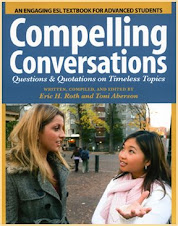
A discount coupon for our book! If you've haven't had the opportunity to get a copy of our book, we have lowered the price for our subscribers: you can get $5 off the regular price for Compelling Conversations: Questions and Quotations on Timeless Topics (for ESL learners and teachers)! Click here to get your copy for $15 (instead of $20).
Or just download our free Compelling Conversations chapters on Change and on Job Interviews.
Don't forget to check out our special thank you offer again at the end of this newsletter.
| In This Issue Articles of Interest The Compelling Conversations Blog recently had a post on World Englishes, which linked to a review on a book by the same name. In this newsletter you will find an intro to Eric Roth's review (to the right), and for the sake of providing different perspectives on the subject matter, here are a few articles that have caught our attention.
The radio program This I Believe was also reviewed on the Compelling Conversations Blog. We offer an assignment/worksheet on the post, and you will find an intro and direct link on the right. | World Englishes Review by Eric Roth Do the English in England speak the same English as the Americans, the Jamaicans, the South Africans, the Australians, the Irish, and the Indians? Do they even speak the same English as they did 100 years ago before radio, television, and the internet? Should there be a global standard for all English speakers? Linguist Andy Kirkpatrick raises these and many other provocative questions in his exceptionally documented book “World Englishes: Implications for International Communication and English Language Teaching” published by Cambridge University Press. Read more » This I Believe Tuesday, March 24, 2009 What are your core beliefs? More importantly, what are your students’ core beliefs? How can you help English language learners improve their listening skills while exploring their own personal philosophy? Do you use radio podcasts in your English classrooms or ask students to write personal essays? If so, you might want to visit www.ThisIBelieve.org for excellent, fascinating authentic listening materials. Read more » |
Speaking of radio programs, do you like podcasts? VOA News makes Special English podcasts; check out Baseball Terms: This Is a Whole New Ballgame!
Vietnam Embraces English Classes - and Looks for Communicative English Teachers By the way, the Compelling Conversations Blog will be getting a make-over! Yes, we'll soon be incorporating more digital media, changing our theme, and we'll be making it easier for you to get a copy of our class worksheets. We want to move beyond mere text and incorporate more pictures and sound to create a livelier, more 21st century look. Again, as a newsletter subscriber, you qualify for a $5 discount on our downloadable ESL ebook that makes teaching conversation in English class a simple joy. Why not buy your copy today? Click here for your copy of Compelling Conversations: Questions and Quotations on Timeless Topics (for ESL learners and teachers) for $15 (instead of $20)! |
Ask more. Know more. Share more.
Create Compelling Conversations.
Visit www.CompellingConversations.com
Sunday, February 15, 2009
Finding Interview Tips, Insights on YouTube for English Language Learners
How can English teachers encourage adult and university students to expand their language skills and improve their employment opportunities in a difficult economic climate?
Personally, I've slightly modified my oral skills course this semester to provide greater emphasis on interviewing skills. Students interviewed each other for 10-15 minute videotaped mock job interviews for their first assignment.
The use of videotaping students in class has gained far more acceptance in the last few years, partly due to the technological advances. OTAN, the adult education website established by the California Department of Education, even created an entire section devoted to using videotapes and videocameras in the adult ESL classes.
Another factor has been the increasing popularity of YouTube videoclips by students seeking practical information. I've combined those two trends by requiring students to find and review YouTube clips on vital employment skills and speaking skills. Students found and reviewed videoclips, and emailed them in as homework. Afterwards, I combined all the student evaluations into a single email that I sent to the entire class with a few editorial comments and minor editing.
Here is the homework sheet for that assignment. As with the reviews, "use or lose."
----------------------------------------------------------------------------------
Getting Job Interview Advice from YouTube!
Student Name:
Class:
Teacher:
School:
Date:
Please find an YouTube videoclip that helps people successfully interview for jobs – in English - that you would like to share with your classmates. Watch the video, take notes, and review it for your classmates.
Video title:
Web address:
Length:
Creator:
Please describe the video.
What interview tips did the video provide?
Where do you think the video was produced? Why?
How practical did you find the advice? Why?
What was the strongest part? Why?
What was the weakest part? Why?
Who do think is the target audience for this video?
Why did you choose this video?
How would you rate this video 1-5 stars? Why?
------------------------------------------------------------------------------------
This simple worksheet combines research, critical thinking, and language skills. As English teachers, we can use simple technology to help English language learners develop their language skills, especially when they are motivated to learn and search out new sources. Instead of dismissing YouTube searching as a waste of time, let's turn their interests into productive learning opportunities and share insights. After all, employment interviews often serve as a real-world language tests for our ESL students.
Let's make sure we give them the tools to pass those crucial tests.
Ask more. Know more. Share more.
Create Compelling Conversations.
Visit www.CompellingConversations.com
Personally, I've slightly modified my oral skills course this semester to provide greater emphasis on interviewing skills. Students interviewed each other for 10-15 minute videotaped mock job interviews for their first assignment.
The use of videotaping students in class has gained far more acceptance in the last few years, partly due to the technological advances. OTAN, the adult education website established by the California Department of Education, even created an entire section devoted to using videotapes and videocameras in the adult ESL classes.
Another factor has been the increasing popularity of YouTube videoclips by students seeking practical information. I've combined those two trends by requiring students to find and review YouTube clips on vital employment skills and speaking skills. Students found and reviewed videoclips, and emailed them in as homework. Afterwards, I combined all the student evaluations into a single email that I sent to the entire class with a few editorial comments and minor editing.
Here is the homework sheet for that assignment. As with the reviews, "use or lose."
----------------------------------------------------------------------------------
Getting Job Interview Advice from YouTube!
Student Name:
Class:
Teacher:
School:
Date:
Please find an YouTube videoclip that helps people successfully interview for jobs – in English - that you would like to share with your classmates. Watch the video, take notes, and review it for your classmates.
Video title:
Web address:
Length:
Creator:
Please describe the video.
What interview tips did the video provide?
Where do you think the video was produced? Why?
How practical did you find the advice? Why?
What was the strongest part? Why?
What was the weakest part? Why?
Who do think is the target audience for this video?
Why did you choose this video?
How would you rate this video 1-5 stars? Why?
------------------------------------------------------------------------------------
This simple worksheet combines research, critical thinking, and language skills. As English teachers, we can use simple technology to help English language learners develop their language skills, especially when they are motivated to learn and search out new sources. Instead of dismissing YouTube searching as a waste of time, let's turn their interests into productive learning opportunities and share insights. After all, employment interviews often serve as a real-world language tests for our ESL students.
Let's make sure we give them the tools to pass those crucial tests.
Ask more. Know more. Share more.
Create Compelling Conversations.
Visit www.CompellingConversations.com
Saturday, February 14, 2009
Going Beyond the Romantic Hype: Relationship Questionships for Adults
Do you match? How do you know? Where does kissing come from?
Are you romantically involved? Do you match your partner? How do you know? Who will you choose to share your life with? Are you considering marriage? Are you already married? Use these questions as a springboard to reflect on your options, choices, and desires on this Valentine’s Day.
Here is chapter #33 from Compelling Conversations that many friends have told me is better for native speakers than English language learners or ESL classrooms. Perhaps they are right. On the other hand, I’ve had great conversations in my adult ESL and college ESL classes using this chapter too.
As both a happily married man of 14 years and the child of divorced parents, these questions seem like smart questions to ask - even for romantics on Valentine’s Day. Perhaps especially on Valentine’s Day when the official propaganda of “love will conquer all” seems so pervasive. So whether English teachers ask themselves, their partner, or their students these questions, I’d like to share this list on my blog tonight.
I’m also including a short videoclip from Discovery News that I found quite interesting on the origins of kissing and how that satisfying activity is believed to have spread around the globe. Enjoy!
The Skinny on Smooching from Discovery News
1. Why do (did) you want to get married?
2. Do (did) you have a checklist of qualities for a potential spouse?
3. What are the three main qualifications on your checklist? Partner?
Provider? Lover? Friend?
4. When did you fall in love? Did one person fall first? Who?
5. How did you know your lover was the one? How did your thinking
evolve?
6. Did you ever have moments of doubt? How did your thinking evolve?
7. Do you think people should live together before they get married?
Why? Can you share some examples?
8. Are sex, love and marriage linked in your mind, or is each separate?
How are they different?
9. What are some endearing qualities of your companion?
10. Do you like your partner’s friends? Do you respect them? Why?
11. What advice have your parents and close friends given you? Your
extended family? How important is their opinion in your decision? Why?
12. Do you think you are marrying only an individual or are you also
marrying your spouse’s family? How would you describe your
potential in-laws?
13. What does your partner do that annoys you?
14. Do you expect to be the pilot, co-pilot, or passenger in the
marriage? Why?
15. What, if anything, would definitely cause you to divorce? Why?
Q U E S T I O N S A N D Q U OTAT I O N S O N T I M E L E S S TO P I C S • 1 0 5
V O C A B U L A R Y
Review these words and expressions. Circle the words that you know.
potential ……………………………………………………………………………………….
neat freak ……………………………………………………………………………………..
spouse …………………………………………………………………………………………..
nupital ………………………………………………………………………………………….
conflicts ………………………………………………………………………………………..
checklist ………………………………………………………………………………………..
resolve ………………………………………………………………………………………….
pre-nuptial ……………………………………………………………………………………
compatible ……………………………………………………………………………………
pack rat ………………………………………………………………………………………..
justify ……………………………………………………………………………………………
evolve …………………………………………………………………………………………..
P R O V E R B S
What do these proverbs mean? Can you share some other proverbs?
The needle is always accompanied by the thread.—Korean
Strange is the affinity that binds two in marriage.—Japanese
Whoever marries only for beauty will live in misery.—Russian
T H E C O N V E R S A T I O N C O N T I N U E S …
1. Thinking about personal preferences, do you like to stay up late or
get up early? Do you have compatible sleeping habits?
2. Do you have similar media habits? What about tastes in TV shows
and movies?
3. Where do you prefer to live? Country? City? Farm? Apartment?
House?
4. Are you a pack rat? Are you a neat freak? Are your styles
compatible?
5. Will you still love your partner when he or she is 64? Will your
partner love you with wrinkles?
6. Do you know an older couple that might be a model for a good
partnership? Who are they?
7. What activities do you enjoy in your leisure time? Will your spouse
join you?
8. Do you and your lover share spending philosophies? Do you shop
together?
9. Do you expect to live with older generations? Who? Why? Where?
When?
10. What is your approach to settling conflicts? How often do you have
conflicts?
11. Do you want children? How many?
N O T E S & Q U E S T I O N S
. . . . . . . . . . . . . . . . . . . . . . . . . . . . . . . . . . . . . . .
. . . . . . . . . . . . . . . . . . . . . . . . . . . . . . . . . . . . . . .
. . . . . . . . . . . . . . . . . . . . . . . . . . . . . . . . . . . . . . .
. . . . . . . . . . . . . . . . . . . . . . . . . . . . . . . . . . . . . . .
. . . . . . . . . . . . . . . . . . . . . . . . . . . . . . . . . . . . . . .
. . . . . . . . . . . . . . . . . . . . . . . . . . . . . . . . . . . . . . .
. . . . . . . . . . . . . . . . . . . . . . . . . . . . . . . . . . . . . . .
. . . . . . . . . . . . . . . . . . . . . . . . . . . . . . . . . . . . . . .
1 0 6 • w w w. c o m p e l l i n g c o n v e r s a t i o n s . c o m
12. Do you believe in birth control? Why?
13. How do you think your baby would look like? Why?
14. What kind of parent do you expect your spouse to become? Why?
15. Would you want your sons to be like the man you’re marrying?
Would you want your daughters to be like the woman you’re
marrying?
16. Do you expect to follow family or religious traditions? Which ones?
Why?
17. If disagreements arise about children, how do you expect to
resolve them?
18. Do you think all money should be shared or should each spouse
have separate bank accounts? Why? How do you expect to
manage household expenses?
19. What were the best gifts that you’ve given or received in the
relationship?
20. What passions do you share? What unites you as a couple?
21. Do you have a favorite photograph of you as a couple? Can you
describe it?
22. Where do you want to travel together? What do you want to see
together?
23. What are you looking forward to doing together as a married
couple?
24. How do you expect your life to change once you are married?
What are some advantages of being married?
25. Do you have any tips or suggestions on how to create and preserve
a happy marriage?
Q U O T A T I O N S
Which two quotations come closest to your attitudes?
1. “By all means marry; if you get a good wife, you’ll become happy;
if you get a bad one, you’ll become a philosopher.”
—Socrates (470-339 BC), Greek philosopher
2. “Man’s best possession is a sympathetic wife.”
—Euripides (480-406 BC), playwright
3. “I’m so gullible. I’m so damn gullible. And I am so sick of being
gullible.”
—Lana Turner (1921-1995), Hollywood star married seven times
4. “Love is the ideal thing, marriage a real thing; a confusion of the
real with the ideal never goes unpunished.”
—Goethe (1749-1832), German poet, novelist, and scientist
5. “Marriage is a great institution, but I’m not ready for an
institution.”
—Mae West (1892-1980), American actress
7. “Love means never having to say you’re sorry.”
—Ali McGraw in Love Story (1970)
“Love is the ideal thing, marriage a real
thing; a confusion of the real with the ideal
never goes unpunished.”
Goethe (1749-1832),
German poet, novelist, and scientist
Q U E S T I O N S A N D Q U OTAT I O N S O N T I M E L E S S TO P I C S • 1 0 7
8. “Marriage: A word that should be pronounced ‘mirage.’”
—Herbert Spencer (1820-1903), English philosopher
9. “No matter who you get married to, you wake up married to
somebody else.”
—Marlon Brando in Guys and Dolls (1955)
10. “Second marriage: the triumph of hope over experience.”
—Dr. Samuel Johnson (1709-1784), English writer
11. “Marriage is a very good thing, but I think it’s a mistake to make a
habit of it.”
—W. Somerset Maugham (1874-1965), English novelist
12. “A happy marriage is a long conversation that always seems too
short.”
—Andre Maurois (1885-1967), French author
13. “A successful marriage is not a gift; it is an achievement.”
—Ann Landers (1918-2002), American advice columnist
★
O N Y O U R O W N
With your class partner, list three celebrity marriages that have ended in divorce. For each couple who divorced, list two reasons you think their marriage did not last.
Then, list three marriages of well known people that have lasted
more than 20 years. For each couple, list two reasons why you
think their marriage lasted. Share with the class.
1. ……………………………………………………………………………………………………
• . ……………………………………………………………………………………………….
• . ……………………………………………………………………………………………….
2. …………………………………………………………………………………………………….
• . ……………………………………………………………………………………………….
• . ……………………………………………………………………………………………….
3. …………………………………………………………………………………………………….
• . ……………………………………………………………………………………………….
• . ……………………………………………………………………………………………….
1. ……………………………………………………………………………………………………
• . ……………………………………………………………………………………………….
• . ……………………………………………………………………………………………….
2. …………………………………………………………………………………………………….
• . ……………………………………………………………………………………………….
• . ……………………………………………………………………………………………….
3. …………………………………………………………………………………………………….
• . ……………………………………………………………………………………………….
• . ……………………………………………………………………………………………….
1 0 8 • w w w. c o m p e l l i n g c o n v e r s a t i o n s . c o m
Ask more. Know more. Share more.
Create Compelling Conversations.
Visit www.CompellingConversations.com
Are you romantically involved? Do you match your partner? How do you know? Who will you choose to share your life with? Are you considering marriage? Are you already married? Use these questions as a springboard to reflect on your options, choices, and desires on this Valentine’s Day.
Here is chapter #33 from Compelling Conversations that many friends have told me is better for native speakers than English language learners or ESL classrooms. Perhaps they are right. On the other hand, I’ve had great conversations in my adult ESL and college ESL classes using this chapter too.
As both a happily married man of 14 years and the child of divorced parents, these questions seem like smart questions to ask - even for romantics on Valentine’s Day. Perhaps especially on Valentine’s Day when the official propaganda of “love will conquer all” seems so pervasive. So whether English teachers ask themselves, their partner, or their students these questions, I’d like to share this list on my blog tonight.
I’m also including a short videoclip from Discovery News that I found quite interesting on the origins of kissing and how that satisfying activity is believed to have spread around the globe. Enjoy!
The Skinny on Smooching from Discovery News
1. Why do (did) you want to get married?
2. Do (did) you have a checklist of qualities for a potential spouse?
3. What are the three main qualifications on your checklist? Partner?
Provider? Lover? Friend?
4. When did you fall in love? Did one person fall first? Who?
5. How did you know your lover was the one? How did your thinking
evolve?
6. Did you ever have moments of doubt? How did your thinking evolve?
7. Do you think people should live together before they get married?
Why? Can you share some examples?
8. Are sex, love and marriage linked in your mind, or is each separate?
How are they different?
9. What are some endearing qualities of your companion?
10. Do you like your partner’s friends? Do you respect them? Why?
11. What advice have your parents and close friends given you? Your
extended family? How important is their opinion in your decision? Why?
12. Do you think you are marrying only an individual or are you also
marrying your spouse’s family? How would you describe your
potential in-laws?
13. What does your partner do that annoys you?
14. Do you expect to be the pilot, co-pilot, or passenger in the
marriage? Why?
15. What, if anything, would definitely cause you to divorce? Why?
Q U E S T I O N S A N D Q U OTAT I O N S O N T I M E L E S S TO P I C S • 1 0 5
V O C A B U L A R Y
Review these words and expressions. Circle the words that you know.
potential ……………………………………………………………………………………….
neat freak ……………………………………………………………………………………..
spouse …………………………………………………………………………………………..
nupital ………………………………………………………………………………………….
conflicts ………………………………………………………………………………………..
checklist ………………………………………………………………………………………..
resolve ………………………………………………………………………………………….
pre-nuptial ……………………………………………………………………………………
compatible ……………………………………………………………………………………
pack rat ………………………………………………………………………………………..
justify ……………………………………………………………………………………………
evolve …………………………………………………………………………………………..
P R O V E R B S
What do these proverbs mean? Can you share some other proverbs?
The needle is always accompanied by the thread.—Korean
Strange is the affinity that binds two in marriage.—Japanese
Whoever marries only for beauty will live in misery.—Russian
T H E C O N V E R S A T I O N C O N T I N U E S …
1. Thinking about personal preferences, do you like to stay up late or
get up early? Do you have compatible sleeping habits?
2. Do you have similar media habits? What about tastes in TV shows
and movies?
3. Where do you prefer to live? Country? City? Farm? Apartment?
House?
4. Are you a pack rat? Are you a neat freak? Are your styles
compatible?
5. Will you still love your partner when he or she is 64? Will your
partner love you with wrinkles?
6. Do you know an older couple that might be a model for a good
partnership? Who are they?
7. What activities do you enjoy in your leisure time? Will your spouse
join you?
8. Do you and your lover share spending philosophies? Do you shop
together?
9. Do you expect to live with older generations? Who? Why? Where?
When?
10. What is your approach to settling conflicts? How often do you have
conflicts?
11. Do you want children? How many?
N O T E S & Q U E S T I O N S
. . . . . . . . . . . . . . . . . . . . . . . . . . . . . . . . . . . . . . .
. . . . . . . . . . . . . . . . . . . . . . . . . . . . . . . . . . . . . . .
. . . . . . . . . . . . . . . . . . . . . . . . . . . . . . . . . . . . . . .
. . . . . . . . . . . . . . . . . . . . . . . . . . . . . . . . . . . . . . .
. . . . . . . . . . . . . . . . . . . . . . . . . . . . . . . . . . . . . . .
. . . . . . . . . . . . . . . . . . . . . . . . . . . . . . . . . . . . . . .
. . . . . . . . . . . . . . . . . . . . . . . . . . . . . . . . . . . . . . .
. . . . . . . . . . . . . . . . . . . . . . . . . . . . . . . . . . . . . . .
1 0 6 • w w w. c o m p e l l i n g c o n v e r s a t i o n s . c o m
12. Do you believe in birth control? Why?
13. How do you think your baby would look like? Why?
14. What kind of parent do you expect your spouse to become? Why?
15. Would you want your sons to be like the man you’re marrying?
Would you want your daughters to be like the woman you’re
marrying?
16. Do you expect to follow family or religious traditions? Which ones?
Why?
17. If disagreements arise about children, how do you expect to
resolve them?
18. Do you think all money should be shared or should each spouse
have separate bank accounts? Why? How do you expect to
manage household expenses?
19. What were the best gifts that you’ve given or received in the
relationship?
20. What passions do you share? What unites you as a couple?
21. Do you have a favorite photograph of you as a couple? Can you
describe it?
22. Where do you want to travel together? What do you want to see
together?
23. What are you looking forward to doing together as a married
couple?
24. How do you expect your life to change once you are married?
What are some advantages of being married?
25. Do you have any tips or suggestions on how to create and preserve
a happy marriage?
Q U O T A T I O N S
Which two quotations come closest to your attitudes?
1. “By all means marry; if you get a good wife, you’ll become happy;
if you get a bad one, you’ll become a philosopher.”
—Socrates (470-339 BC), Greek philosopher
2. “Man’s best possession is a sympathetic wife.”
—Euripides (480-406 BC), playwright
3. “I’m so gullible. I’m so damn gullible. And I am so sick of being
gullible.”
—Lana Turner (1921-1995), Hollywood star married seven times
4. “Love is the ideal thing, marriage a real thing; a confusion of the
real with the ideal never goes unpunished.”
—Goethe (1749-1832), German poet, novelist, and scientist
5. “Marriage is a great institution, but I’m not ready for an
institution.”
—Mae West (1892-1980), American actress
7. “Love means never having to say you’re sorry.”
—Ali McGraw in Love Story (1970)
“Love is the ideal thing, marriage a real
thing; a confusion of the real with the ideal
never goes unpunished.”
Goethe (1749-1832),
German poet, novelist, and scientist
Q U E S T I O N S A N D Q U OTAT I O N S O N T I M E L E S S TO P I C S • 1 0 7
8. “Marriage: A word that should be pronounced ‘mirage.’”
—Herbert Spencer (1820-1903), English philosopher
9. “No matter who you get married to, you wake up married to
somebody else.”
—Marlon Brando in Guys and Dolls (1955)
10. “Second marriage: the triumph of hope over experience.”
—Dr. Samuel Johnson (1709-1784), English writer
11. “Marriage is a very good thing, but I think it’s a mistake to make a
habit of it.”
—W. Somerset Maugham (1874-1965), English novelist
12. “A happy marriage is a long conversation that always seems too
short.”
—Andre Maurois (1885-1967), French author
13. “A successful marriage is not a gift; it is an achievement.”
—Ann Landers (1918-2002), American advice columnist
★
O N Y O U R O W N
With your class partner, list three celebrity marriages that have ended in divorce. For each couple who divorced, list two reasons you think their marriage did not last.
Then, list three marriages of well known people that have lasted
more than 20 years. For each couple, list two reasons why you
think their marriage lasted. Share with the class.
1. ……………………………………………………………………………………………………
• . ……………………………………………………………………………………………….
• . ……………………………………………………………………………………………….
2. …………………………………………………………………………………………………….
• . ……………………………………………………………………………………………….
• . ……………………………………………………………………………………………….
3. …………………………………………………………………………………………………….
• . ……………………………………………………………………………………………….
• . ……………………………………………………………………………………………….
1. ……………………………………………………………………………………………………
• . ……………………………………………………………………………………………….
• . ……………………………………………………………………………………………….
2. …………………………………………………………………………………………………….
• . ……………………………………………………………………………………………….
• . ……………………………………………………………………………………………….
3. …………………………………………………………………………………………………….
• . ……………………………………………………………………………………………….
• . ……………………………………………………………………………………………….
1 0 8 • w w w. c o m p e l l i n g c o n v e r s a t i o n s . c o m
Ask more. Know more. Share more.
Create Compelling Conversations.
Visit www.CompellingConversations.com
Friday, January 23, 2009
Cultivate Student Curiosity in ESL Classes - and Homework Assignments
Cultivate Student Curiosity in ESL Classes
“Curiosity is the best teacher,” goes the ancient proverb. Push your English language students to develop their own interests and passions. ESL students- adult, high school, or college - will remember the language they want and need to know to deepen their life experiences in English
Ironically, our job remains helping students become autotelic – or self-directed. Encouraging students to find and create their own vocabulary logs is just one useful, too seldom used technique in English language classrooms.
My standard homework assignment for English students remains having students find, summarize, and present newspaper articles on a topic (elections, housing, job interviews). The worksheet asks them to list core citation information, summarize the main idea, identify the best supporting evidence, etc. The worksheet also includes finding five new vocabulary words or phrases and writing new sentences. When the students complete their homework, they get together in groups of four and "present" their articles. I circulate around the room checking homework and having small chats. Students, meanwhile, build their own vocabulary logs from their own readings and discussions – and deepen their own interests.
Once students master the format, they choose both the subject and articles. In my high-intermediate writing course for international students, these homework readings provide the foundation for their research papers and final project. Students soon move beyond the worksheets and simply provide concise article summaries and evaluations.
Bottomline: We must find ways to gently cajole students to take responsibility for their own education – and become more self-directed.
Ask more. Know more. Share more.
Create Compelling Conversations.
Visit www.CompellingConversations.com
“Curiosity is the best teacher,” goes the ancient proverb. Push your English language students to develop their own interests and passions. ESL students- adult, high school, or college - will remember the language they want and need to know to deepen their life experiences in English
Ironically, our job remains helping students become autotelic – or self-directed. Encouraging students to find and create their own vocabulary logs is just one useful, too seldom used technique in English language classrooms.
My standard homework assignment for English students remains having students find, summarize, and present newspaper articles on a topic (elections, housing, job interviews). The worksheet asks them to list core citation information, summarize the main idea, identify the best supporting evidence, etc. The worksheet also includes finding five new vocabulary words or phrases and writing new sentences. When the students complete their homework, they get together in groups of four and "present" their articles. I circulate around the room checking homework and having small chats. Students, meanwhile, build their own vocabulary logs from their own readings and discussions – and deepen their own interests.
Once students master the format, they choose both the subject and articles. In my high-intermediate writing course for international students, these homework readings provide the foundation for their research papers and final project. Students soon move beyond the worksheets and simply provide concise article summaries and evaluations.
Bottomline: We must find ways to gently cajole students to take responsibility for their own education – and become more self-directed.
Ask more. Know more. Share more.
Create Compelling Conversations.
Visit www.CompellingConversations.com
Thursday, January 8, 2009
Surprise Bulk Orders of Compelling Conversations From Amazon
"Next to money, English is the leading international language."
Evan Esar, American humorist
A new semester means more last minute orders of class sets of textbooks, including ESL books. I'm now seeing this situation as both an ESL instructor and a small publisher.
During the last week, several schools and English teachers have purchased class sets of Compelling Conversations: Questions and Quotations on Timeless. Naturally, that development pleases me for many reasons. English teachers using the book in Chile, Rwanda, Hungary, Russia, Canada, and Italy feeds my global soul.
Yet I’ve also been surprised at how many institutions have placed their orders on Amazon where they pay the full price of $24.50 . While ordering on Amazon puts more money in my book, it seems what I call a “good mistake” in my classes. Why?
Because schools, churches, and bookstores can place their orders with Booksurge directly, receive a 40% discount, and save money. Each book will cost $14.70 instead of $24.50. If the adult school or English language school sells the books to student, the institution can even make a nice profit. Schools that provide free ESL textbooks to their students should appreciate the savings because they can also provide more materials to English language learners.
• Bottomline: If you choose to buy Compelling Conversations for your oral skills class, conversation club, or advanced ESL class, save your school and yourself some money. Order your class set from Booksurge, the book’s publisher for wholesale orders.. Call customer service the BookSurge wholesale ordering hotline at 866-308-6235 and select option #6.
Of course, textbook prices do not matter equally to all. Some elite private schools, school administrators, and wealthy English language learners might even prefer to pay full price. Perhaps ordering class sets of hard to find quality ESL books directly on Amazon better fits their needs. Amazon also works better for individual English tutors and teachers.
Yet adult schools, public programs, churches, and smaller language schools ordering 10 or more copies should be - especially in these difficult economic times – more cost conscious. As the old proverb goes, a penny saved is a penny earned.
Thank you to everyone who has already brought Compelling Conversations into their classroom, and thank you to everyone considering Compelling Conversations . I hope that deepening the connections between individuals through smarter, better conversations will help create a better, more humane, and peaceful world.
"Conversation means being able to disagree and still continue the conversation."
Dwight McDonald (1906-1982), American editor
Ask more. Know more. Share more.
Create Compelling Conversations.
Visit www.CompellingConversations.com
Evan Esar, American humorist
A new semester means more last minute orders of class sets of textbooks, including ESL books. I'm now seeing this situation as both an ESL instructor and a small publisher.
During the last week, several schools and English teachers have purchased class sets of Compelling Conversations: Questions and Quotations on Timeless. Naturally, that development pleases me for many reasons. English teachers using the book in Chile, Rwanda, Hungary, Russia, Canada, and Italy feeds my global soul.
Yet I’ve also been surprised at how many institutions have placed their orders on Amazon where they pay the full price of $24.50 . While ordering on Amazon puts more money in my book, it seems what I call a “good mistake” in my classes. Why?
Because schools, churches, and bookstores can place their orders with Booksurge directly, receive a 40% discount, and save money. Each book will cost $14.70 instead of $24.50. If the adult school or English language school sells the books to student, the institution can even make a nice profit. Schools that provide free ESL textbooks to their students should appreciate the savings because they can also provide more materials to English language learners.
• Bottomline: If you choose to buy Compelling Conversations for your oral skills class, conversation club, or advanced ESL class, save your school and yourself some money. Order your class set from Booksurge, the book’s publisher for wholesale orders.. Call customer service the BookSurge wholesale ordering hotline at 866-308-6235 and select option #6.
Of course, textbook prices do not matter equally to all. Some elite private schools, school administrators, and wealthy English language learners might even prefer to pay full price. Perhaps ordering class sets of hard to find quality ESL books directly on Amazon better fits their needs. Amazon also works better for individual English tutors and teachers.
Yet adult schools, public programs, churches, and smaller language schools ordering 10 or more copies should be - especially in these difficult economic times – more cost conscious. As the old proverb goes, a penny saved is a penny earned.
Thank you to everyone who has already brought Compelling Conversations into their classroom, and thank you to everyone considering Compelling Conversations . I hope that deepening the connections between individuals through smarter, better conversations will help create a better, more humane, and peaceful world.
"Conversation means being able to disagree and still continue the conversation."
Dwight McDonald (1906-1982), American editor
Ask more. Know more. Share more.
Create Compelling Conversations.
Visit www.CompellingConversations.com
Sunday, January 4, 2009
How Rich Do You Feel Today? How Rich Are You - on a Global Scale?
How rich are you?
How rich are you on a strictly material level? Where do you stand from a global scale? For Americans and English teachers feeling rather blue about our declining home values, vanishing retirement accounts, and questionable job security, this chart provides some useful perspective.
http://www.globalrichlist.com/
Of course, commonsense and a growing body of psychological and sociological research has documented the very, very loose correlation between material wealth and happiness – once the basic necessities of life are met. Satisfying personal relationships, long conversations with relatives and friends, and meaningful work remain vital essential for a truly rich life.
Let’s make sure we find ways to create healthier, saner, and more satisfying lives and English classrooms in 2009 than 2008.
Ask more. Know more. Share more.
Create Compelling Conversations.
Visit www.CompellingConversations.com
How rich are you on a strictly material level? Where do you stand from a global scale? For Americans and English teachers feeling rather blue about our declining home values, vanishing retirement accounts, and questionable job security, this chart provides some useful perspective.
http://www.globalrichlist.com/
Of course, commonsense and a growing body of psychological and sociological research has documented the very, very loose correlation between material wealth and happiness – once the basic necessities of life are met. Satisfying personal relationships, long conversations with relatives and friends, and meaningful work remain vital essential for a truly rich life.
Let’s make sure we find ways to create healthier, saner, and more satisfying lives and English classrooms in 2009 than 2008.
Ask more. Know more. Share more.
Create Compelling Conversations.
Visit www.CompellingConversations.com
Wednesday, December 31, 2008
New Year: Old Dilemmas for Assessing Listening and Speaking Skills for English Language Learners
As we welcome the new year, we can anticipate some familiar pleasures and puzzles.
For English language teachers, establishing reasonable standards for oral communication remains a complicated, difficult challenge. Students must be able to clearly communicate their ideas with adequate pronunciation, but we must allow for a rich variety of accents too. Some ESL teachers also find themselves placed in the role of both gatekeeper - upholding standards of admission to university courses - and coach. Some tension between these roles occurs when evaluating a student's oral skills for mandatory courses.
English teachers, especially ESL and ESOL working with adult English language learners, can build on the experience of international organizations working with refugees and immigrants.
Check out this practical chart with ten categories for listening comprehension and speaking skills developed by the United States Office of Refugee Resettlement and revised by the Spring Institute for Intercultural Learning. Where did I find it? As so often, I went to the Center for Applied Linguistics website.
What are reasonable standards for listening comprehension and speaking skills for adult English language learners? That’s a difficult question, and context matters. This chart, however, seems quite sensible.
SPL stands for Student Performance Level here. The descriptors for listening comprehension and oral communication are intended to establish a standard that government agencies, educational institutions, and non-profits can all use to share evaluations. Despite the bureaucratic title, the chart itself contains excellent descriptions that English teachers and testers can use for adult English language learners.
After having been in several long faculty discussions over standards for oral skills, I appreciate the explicit standards combined with some flexibility.
This chart, developed for adult refugees, resembles other charts, yet includes more details and an explicit acknowledgment of economics. I like that awareness even if this factor can sometimes be misused to justify low standards in adult education programs. (After all, illiterate peasants move to the United States, Canada, England, and Australia in hopes of improving their economic and social status.)
Our job as educators is to provide our students with the language skills to live fuller, more satisfying lives – in English – wherever they choose to live and work.
Student Performance Level (SPL) Descriptors for Listening Comprehension and Oral Communication
SPL General Language Ability
Listening Comprehension Oral
Communication
0
No ability whatsoever
No ability whatsoever
No ability whatsoever
1
Functions minimally, if at all, in English. Can handle only very routine entry-level jobs that do not require oral communication, and in which all tasks can be easily demonstrated. A native speaker used to dealing with limited English speakers can rarely communicate with a person at this level except through gestures.
Understands only a few isolated words, and extremely simple learned phrases.
Vocabulary limited to a few isolated words. No control of grammar.
2
Functions in a very limited way in situations related to immediate needs. Can handle only routine entry-level jobs that do not require oral communication, and in which all tasks can be easily demonstrated. A native English speaker used to dealing with limited English speakers will have great difficulty communicating with a person at this level.
Understands a limited number of very simple learned phrases, spoken slowly with frequent repetitions.
Expresses a limited number of immediate survival needs using very simple learned phrases.
3 Functions with some difficulty in situations related to immediate needs. Can han¬dle routine entry-level jobs that involve only the most basic oral communication, and in which all tasks can be demonstrated. A native English speaker used to dealing with limited English speakers will have great difficulty communicating with a person at this level.
Understands simple learned phrases, spoken slowly with frequent repetitions.
Expresses immediate survival needs using simple learned phrases.
4 Can satisfy basic survival needs and a few very routine social demands. Can handle entry-level jobs that involve some simple oral communication, but in which tasks can be easily demonstrated. A native English speaker used to dealing with limited English speakers will have difficulty communicating with a person at this level.
Understands simple learned phrases easily, and some simple new phrases containing familiar vocabulary, spoken slowly with frequent repetitions.
Expresses basic survival needs including asking and responding to related questions, using both learned and a limited number of new phrases. Participates in basic conversations in a few very routine social situations. Speaks with hesitation and frequent pauses. Some control of basic grammar.
5 Can satisfy basic survival needs and some limited social demands. Can handle jobs and job training that involve following simple oral instructions but in which most tasks can also be demonstrated. A native English speaker used to dealing with limited English speakers will have some difficulty communicating with a person at this level.
Understands learned phrases easily and short new phrases containing familiar vocabulary spoken slowly with repetition. Has limited ability to understand on the telephone.
Functions independently in most face-to-face basic survival situations but needs some help. Asks and responds to direct questions on familiar and some unfamiliar subjects. Still relies on learned phrases but also uses new phrases (i.e., speaks with some creativity) but with hesitation and pauses. Communicates on the phone to express a limited number of survival needs, but with some difficulty. Participates in basic conversations in a limited number of social situations. Can occasionally clarify general meaning.
6
Can satisfy most survival needs and limited social demands. Can handle jobs and job training that involve following simple oral and written instructions and diagrams. A native English speaker not used to dealing with limited English speak¬ers will be able to communicate with a person at this level on familiar topics, but with difficulty and some effort.
Understands conversations containing some unfamiliar vocabulary on many every¬day subjects, with a need for repetition, rewording or slower speech. Has some ability to understand without face-to-face contact (e.g. on the telephone, TV).
Functions independently in most survival situations, but needs some help. Relies less on learned phrases; speaks with creativity, but with hesitation. Communicates on the phone on familiar subjects but with some difficulty. Participates with some confidence in social situations when addressed directly. Can sometimes clarify general meaning by rewording. Control of basic grammar evident, but inconsistent; may attempt to use more difficult grammar but with almost no control.
7
Can satisfy survival needs and routine work and social demands. Can handle work that involves following oral and simple written instructions in familiar and some unfamiliar situations. A native English speaker not used to dealing with limited English speakers can generally communicate with a person at this level on familiar topics.
Understands conversations on most everyday subjects at normal speed when addressed directly; may need repetition, rewording, or slower speech. Understands routine work-related conversations. Increasing ability to understand without face-to-face contact (telephone, TV, radio). Has difficulty following conversation between native speakers.
Functions independently in survival and many social and work situations, but may need help occasion¬ally. Communicates on the phone on familiar subjects. Expands on basic ideas in conversation, but still speaks with hesitation while searching for appropriate vocabulary and grammar. Clarifies general meaning easily, and can sometimes convey exact meaning. Controls basic grammar, but not more difficult grammar.
8 Can participate effectively in social and familiar work situations. A native English speaker not used to dealing with limited English speakers can communicate with a person at this level on almost all topics.
Understands general conversation and conversation on technical subjects in own field. Understands without face-to-face contact (telephone, TV, radio); may have difficulty following rapid or colloquial speech. Understands most conversations between native speakers; may miss details if speech is very rapid or colloquial or if subject is unfamiliar. Participates effectively in practical and social conversation and in technical discussions in own field. Speaks fluently in both familiar and unfamiliar situations; can handle problem situations. Conveys and explains exact meaning of complex ideas. Good control of grammar.
9 Can participate fluently and accurately in practical, social, and work situations. A native English speaker not used to dealing with limited English speakers can communicate easily with a person at this level.
Understands almost all speech in any context. Occasionally confused by highly colloquial or regional speech.
Approximates a native speaker’s fluency and ability to convey own ideas precisely, even in unfamiliar situations. Speaks without effort. Excellent control of grammar with no apparent patterns of weakness.
10
Ability equal to that of a native speaker of the same socioeconomic level.
Equal to that of a native speaker of the same socioeconomic level. Equal to that of a native speaker of the same socioeconomic level.
Original chart from http://www.cal.org/caela/esl_resources/slspls.html
These standards, of course, remain more relevant for adult educators and workplace programs than more academic programs. English teachers should, however, create classroom activities where students can engage in extended conversations in English on a wide variety of topics. The higher levels of this chart (SPL 9-10) articulate an excellent standard for all English language learners, including academic English and Business English students.
Ask more. Know more. Share more.
Create Compelling Conversations.
Visit www.CompellingConversations.com
For English language teachers, establishing reasonable standards for oral communication remains a complicated, difficult challenge. Students must be able to clearly communicate their ideas with adequate pronunciation, but we must allow for a rich variety of accents too. Some ESL teachers also find themselves placed in the role of both gatekeeper - upholding standards of admission to university courses - and coach. Some tension between these roles occurs when evaluating a student's oral skills for mandatory courses.
English teachers, especially ESL and ESOL working with adult English language learners, can build on the experience of international organizations working with refugees and immigrants.
Check out this practical chart with ten categories for listening comprehension and speaking skills developed by the United States Office of Refugee Resettlement and revised by the Spring Institute for Intercultural Learning. Where did I find it? As so often, I went to the Center for Applied Linguistics website.
What are reasonable standards for listening comprehension and speaking skills for adult English language learners? That’s a difficult question, and context matters. This chart, however, seems quite sensible.
SPL stands for Student Performance Level here. The descriptors for listening comprehension and oral communication are intended to establish a standard that government agencies, educational institutions, and non-profits can all use to share evaluations. Despite the bureaucratic title, the chart itself contains excellent descriptions that English teachers and testers can use for adult English language learners.
After having been in several long faculty discussions over standards for oral skills, I appreciate the explicit standards combined with some flexibility.
This chart, developed for adult refugees, resembles other charts, yet includes more details and an explicit acknowledgment of economics. I like that awareness even if this factor can sometimes be misused to justify low standards in adult education programs. (After all, illiterate peasants move to the United States, Canada, England, and Australia in hopes of improving their economic and social status.)
Our job as educators is to provide our students with the language skills to live fuller, more satisfying lives – in English – wherever they choose to live and work.
Student Performance Level (SPL) Descriptors for Listening Comprehension and Oral Communication
SPL General Language Ability
Listening Comprehension Oral
Communication
0
No ability whatsoever
No ability whatsoever
No ability whatsoever
1
Functions minimally, if at all, in English. Can handle only very routine entry-level jobs that do not require oral communication, and in which all tasks can be easily demonstrated. A native speaker used to dealing with limited English speakers can rarely communicate with a person at this level except through gestures.
Understands only a few isolated words, and extremely simple learned phrases.
Vocabulary limited to a few isolated words. No control of grammar.
2
Functions in a very limited way in situations related to immediate needs. Can handle only routine entry-level jobs that do not require oral communication, and in which all tasks can be easily demonstrated. A native English speaker used to dealing with limited English speakers will have great difficulty communicating with a person at this level.
Understands a limited number of very simple learned phrases, spoken slowly with frequent repetitions.
Expresses a limited number of immediate survival needs using very simple learned phrases.
3 Functions with some difficulty in situations related to immediate needs. Can han¬dle routine entry-level jobs that involve only the most basic oral communication, and in which all tasks can be demonstrated. A native English speaker used to dealing with limited English speakers will have great difficulty communicating with a person at this level.
Understands simple learned phrases, spoken slowly with frequent repetitions.
Expresses immediate survival needs using simple learned phrases.
4 Can satisfy basic survival needs and a few very routine social demands. Can handle entry-level jobs that involve some simple oral communication, but in which tasks can be easily demonstrated. A native English speaker used to dealing with limited English speakers will have difficulty communicating with a person at this level.
Understands simple learned phrases easily, and some simple new phrases containing familiar vocabulary, spoken slowly with frequent repetitions.
Expresses basic survival needs including asking and responding to related questions, using both learned and a limited number of new phrases. Participates in basic conversations in a few very routine social situations. Speaks with hesitation and frequent pauses. Some control of basic grammar.
5 Can satisfy basic survival needs and some limited social demands. Can handle jobs and job training that involve following simple oral instructions but in which most tasks can also be demonstrated. A native English speaker used to dealing with limited English speakers will have some difficulty communicating with a person at this level.
Understands learned phrases easily and short new phrases containing familiar vocabulary spoken slowly with repetition. Has limited ability to understand on the telephone.
Functions independently in most face-to-face basic survival situations but needs some help. Asks and responds to direct questions on familiar and some unfamiliar subjects. Still relies on learned phrases but also uses new phrases (i.e., speaks with some creativity) but with hesitation and pauses. Communicates on the phone to express a limited number of survival needs, but with some difficulty. Participates in basic conversations in a limited number of social situations. Can occasionally clarify general meaning.
6
Can satisfy most survival needs and limited social demands. Can handle jobs and job training that involve following simple oral and written instructions and diagrams. A native English speaker not used to dealing with limited English speak¬ers will be able to communicate with a person at this level on familiar topics, but with difficulty and some effort.
Understands conversations containing some unfamiliar vocabulary on many every¬day subjects, with a need for repetition, rewording or slower speech. Has some ability to understand without face-to-face contact (e.g. on the telephone, TV).
Functions independently in most survival situations, but needs some help. Relies less on learned phrases; speaks with creativity, but with hesitation. Communicates on the phone on familiar subjects but with some difficulty. Participates with some confidence in social situations when addressed directly. Can sometimes clarify general meaning by rewording. Control of basic grammar evident, but inconsistent; may attempt to use more difficult grammar but with almost no control.
7
Can satisfy survival needs and routine work and social demands. Can handle work that involves following oral and simple written instructions in familiar and some unfamiliar situations. A native English speaker not used to dealing with limited English speakers can generally communicate with a person at this level on familiar topics.
Understands conversations on most everyday subjects at normal speed when addressed directly; may need repetition, rewording, or slower speech. Understands routine work-related conversations. Increasing ability to understand without face-to-face contact (telephone, TV, radio). Has difficulty following conversation between native speakers.
Functions independently in survival and many social and work situations, but may need help occasion¬ally. Communicates on the phone on familiar subjects. Expands on basic ideas in conversation, but still speaks with hesitation while searching for appropriate vocabulary and grammar. Clarifies general meaning easily, and can sometimes convey exact meaning. Controls basic grammar, but not more difficult grammar.
8 Can participate effectively in social and familiar work situations. A native English speaker not used to dealing with limited English speakers can communicate with a person at this level on almost all topics.
Understands general conversation and conversation on technical subjects in own field. Understands without face-to-face contact (telephone, TV, radio); may have difficulty following rapid or colloquial speech. Understands most conversations between native speakers; may miss details if speech is very rapid or colloquial or if subject is unfamiliar. Participates effectively in practical and social conversation and in technical discussions in own field. Speaks fluently in both familiar and unfamiliar situations; can handle problem situations. Conveys and explains exact meaning of complex ideas. Good control of grammar.
9 Can participate fluently and accurately in practical, social, and work situations. A native English speaker not used to dealing with limited English speakers can communicate easily with a person at this level.
Understands almost all speech in any context. Occasionally confused by highly colloquial or regional speech.
Approximates a native speaker’s fluency and ability to convey own ideas precisely, even in unfamiliar situations. Speaks without effort. Excellent control of grammar with no apparent patterns of weakness.
10
Ability equal to that of a native speaker of the same socioeconomic level.
Equal to that of a native speaker of the same socioeconomic level. Equal to that of a native speaker of the same socioeconomic level.
Original chart from http://www.cal.org/caela/esl_resources/slspls.html
These standards, of course, remain more relevant for adult educators and workplace programs than more academic programs. English teachers should, however, create classroom activities where students can engage in extended conversations in English on a wide variety of topics. The higher levels of this chart (SPL 9-10) articulate an excellent standard for all English language learners, including academic English and Business English students.
Ask more. Know more. Share more.
Create Compelling Conversations.
Visit www.CompellingConversations.com
Wednesday, November 12, 2008
Easy English Times Publishes "Reading Pleasures" as Conversation Activity
Easy English Times, an adult education newspaper for English language learners published in California, adapts a chapter from Compelling Conversations each month. The editors selected "Reading Pleasures", one of my favorite chapters, to run in their November-December issue. Since Easy English Times focuses on the needs of beginning and intermediate ESL students, the editor selects the most accessible sections and adds dictionary definitions, creating a satisfying instant conversation activity.
Here is the Easy English Times Instant Activity for November-December.
Instant activity: Conversation
-----------------------------------------------------------------------------------
Reading pleasures and tastes
The activities below come from a book for English as a second language learners by Eric Roth and Toni Aberson. The title is "Compelling Conversations: Questions and Quotations on Timeless Topics." (See ad on this page.)
Exchanging views: Reading is a solitary* activity, yet it can bring people together in conversation. Interview your partner and exchange reading experiences.
1. What are some books that you have read and enjoyed?
2. Have you ever re-read a book? Which? Why? How many times?
3. Do you have a library card? Do you like to browse* in bookstores?
4. Have you ever been in a book club? What kinds of books do/did you read in the book club?
5. Did your mother or other family member read to you as a child? Did you have a favorite story? What was it?
6. Where did you first learn to read? At home? At school?
7. What were your favorite books as a child? Who was your favorite author? Why?
8. As a teenager, did you have any favorite books, comics, or magazines? Can you describe them?
9. Which magazines or newspapers do you scan now*? Why?
10. Who are some famous writers from your country?
11. Can you think of some movies that are adapted from novels?
12. Do you prefer reading fiction or non-fiction? Why?
13. Do you have a favorite writer or poet? Who?
14. Did you have to memorize any poems in school? Which?
15. Have your read any good biographies? Memoirs*? Self-help books?
16. Are you reading a book now? What is it? Can you describe it?
17. Do you think books and magazines make good gifts? Why?
18. What book are you planning to read in the near future?
Quotations: Memorize your favorite quotation and author's name. Share it with someone.
1. "Reading is to the mind, what exercise is to the body." --Richard Steele (1672-1729), Irish writer
2. "No entertainment is so cheap as reading, nor any pleasure so lasting*." --Lady Mary Wortley Montagu (1689-1762), British author/critic
3. "The pleasure of all reading is doubled* when one lives with another who shares the same books." --Katherine Mansfield (1888-1923), short story writer and poet
4. "However many holy words you read, however many you speak, what good will they do you if you do not act upon them?" --Buddha (563-483 BC), founder of Buddhism
5. "Read the best books first, or you may not have a chance to read them all." --Henry David Thoreau (1817-1862), essayist
6. "I would rather be poor in a cottage* full of books than a king without the desire to read." --Thomas B. Macaulay (1800-1859), historian
7. "A book should serve as the ax* for the frozen sea within us." --Franz Kafka (1883-1924), novelist
8. "Any book that helps a child to form the habit of reading, to make reading one of his deep and continuing needs, is good for him." --Maya Angelou (1928-), American poet
9. "A truly great book should be read in youth*, again in maturity and once more in old age, as a fine building should be seen by morning light, at noon and by moonlight." --Robertson Davies (1913-1995), Canadian novelist
On your own: Bring in a book which is important to you. Show the book to the class. Tell them the author, the title, and the reason why this book is important to you.
VOCABULARY HELP*
ax - An ax is a tool for cutting wood.
browse - If you browse in a store, you look at things in a casual way, in the hope that you might find something you like.
cottage - A cottage is a small house, usually in the country.
doubled - When something doubles or when you doubled it, it becomes twice as great in number, amount, or size.
essays - Essays are short pieces of writing on a particular subject.
lasting - You can use lasting to describe a situation, result, or agreement that continues to exist or have an effect for a very long time.
memoirs - A person's memoirs are a written account of the people who they have known and events that they remember.
scan - When you scan written material, you look through it quickly in order to find important or interesting information.
solitary - A solitary activity is one that you do alone.
youth - Someone's youth is the period of their life during which they are a child, before they are a fully mature adult.
*Definitions from the Collins COBUILD Intermediate Dictionary of American English, published by Heinle, a part of Cengage Learning © 2008 and the Newbury House Dictionary of American English 4th edition, by Rideout. © 2004 Monroe Allen Publishers. Heinle, a part of Cengage Learning enjoys an exclusive license with respect to the copyright and all the exclusive rights comprised in the copyright in the work and all revisions thereof.
--------------------------------------------------------------------------------
I love these monthly columns because they keep me connected to adult education and my decade of teaching immigrants and refugees in Los Angeles and Santa Monica. The atmosphere in those classrooms, where everyone volunteered and no one worried about grades, is something quite special. We were just adults sharing our experiences, insights, and languages.
Ask more. Know more. Share more.
Create Compelling Conversations.
Visit www.CompellingConversations.com
Here is the Easy English Times Instant Activity for November-December.
Instant activity: Conversation
-----------------------------------------------------------------------------------
Reading pleasures and tastes
The activities below come from a book for English as a second language learners by Eric Roth and Toni Aberson. The title is "Compelling Conversations: Questions and Quotations on Timeless Topics." (See ad on this page.)
Exchanging views: Reading is a solitary* activity, yet it can bring people together in conversation. Interview your partner and exchange reading experiences.
1. What are some books that you have read and enjoyed?
2. Have you ever re-read a book? Which? Why? How many times?
3. Do you have a library card? Do you like to browse* in bookstores?
4. Have you ever been in a book club? What kinds of books do/did you read in the book club?
5. Did your mother or other family member read to you as a child? Did you have a favorite story? What was it?
6. Where did you first learn to read? At home? At school?
7. What were your favorite books as a child? Who was your favorite author? Why?
8. As a teenager, did you have any favorite books, comics, or magazines? Can you describe them?
9. Which magazines or newspapers do you scan now*? Why?
10. Who are some famous writers from your country?
11. Can you think of some movies that are adapted from novels?
12. Do you prefer reading fiction or non-fiction? Why?
13. Do you have a favorite writer or poet? Who?
14. Did you have to memorize any poems in school? Which?
15. Have your read any good biographies? Memoirs*? Self-help books?
16. Are you reading a book now? What is it? Can you describe it?
17. Do you think books and magazines make good gifts? Why?
18. What book are you planning to read in the near future?
Quotations: Memorize your favorite quotation and author's name. Share it with someone.
1. "Reading is to the mind, what exercise is to the body." --Richard Steele (1672-1729), Irish writer
2. "No entertainment is so cheap as reading, nor any pleasure so lasting*." --Lady Mary Wortley Montagu (1689-1762), British author/critic
3. "The pleasure of all reading is doubled* when one lives with another who shares the same books." --Katherine Mansfield (1888-1923), short story writer and poet
4. "However many holy words you read, however many you speak, what good will they do you if you do not act upon them?" --Buddha (563-483 BC), founder of Buddhism
5. "Read the best books first, or you may not have a chance to read them all." --Henry David Thoreau (1817-1862), essayist
6. "I would rather be poor in a cottage* full of books than a king without the desire to read." --Thomas B. Macaulay (1800-1859), historian
7. "A book should serve as the ax* for the frozen sea within us." --Franz Kafka (1883-1924), novelist
8. "Any book that helps a child to form the habit of reading, to make reading one of his deep and continuing needs, is good for him." --Maya Angelou (1928-), American poet
9. "A truly great book should be read in youth*, again in maturity and once more in old age, as a fine building should be seen by morning light, at noon and by moonlight." --Robertson Davies (1913-1995), Canadian novelist
On your own: Bring in a book which is important to you. Show the book to the class. Tell them the author, the title, and the reason why this book is important to you.
VOCABULARY HELP*
ax - An ax is a tool for cutting wood.
browse - If you browse in a store, you look at things in a casual way, in the hope that you might find something you like.
cottage - A cottage is a small house, usually in the country.
doubled - When something doubles or when you doubled it, it becomes twice as great in number, amount, or size.
essays - Essays are short pieces of writing on a particular subject.
lasting - You can use lasting to describe a situation, result, or agreement that continues to exist or have an effect for a very long time.
memoirs - A person's memoirs are a written account of the people who they have known and events that they remember.
scan - When you scan written material, you look through it quickly in order to find important or interesting information.
solitary - A solitary activity is one that you do alone.
youth - Someone's youth is the period of their life during which they are a child, before they are a fully mature adult.
*Definitions from the Collins COBUILD Intermediate Dictionary of American English, published by Heinle, a part of Cengage Learning © 2008 and the Newbury House Dictionary of American English 4th edition, by Rideout. © 2004 Monroe Allen Publishers. Heinle, a part of Cengage Learning enjoys an exclusive license with respect to the copyright and all the exclusive rights comprised in the copyright in the work and all revisions thereof.
--------------------------------------------------------------------------------
I love these monthly columns because they keep me connected to adult education and my decade of teaching immigrants and refugees in Los Angeles and Santa Monica. The atmosphere in those classrooms, where everyone volunteered and no one worried about grades, is something quite special. We were just adults sharing our experiences, insights, and languages.
Ask more. Know more. Share more.
Create Compelling Conversations.
Visit www.CompellingConversations.com
Thursday, November 6, 2008
Who Makes the Rules? Who Chooses the Rulers? Obama Confirms Power of American Democracy!
Who makes the rules? Who chooses the rulers? Can citizens peacefully replace corrupt leaders?
In the United States of America, voters enjoy their opportunity to hire and fire the President. On Tuesday, American citizens voted, selected a new leader, and millions of people around the nation smiled, laughed, and felt hopeful again. Senator Obama, as so often, captured the power and beauty of the peaceful transfer of power in his eloquent victory speech.
"If there is anyone out there who still doubts that America is a place where all things are possible; who still wonders if the dream of our founders is alive in our time; who still questions the power of our democracy, tonight is your answer. "
Barack Hussein Obama (1961- ), President-elect of the United States
I, like so many Americans, feel very proud. We are coming back – to our ideals, our citizens, and our best traditions! The United States, the first nation explicitly created on enlightenment ideals, will become an inspiring 21st century nation.
This surprising election seems like a very teachable moment. Immigrants and international students can rest assured that they made the right decision to come to the United States. English language learners around the world should feel the enlarged possibilities that come with our strange tongue. European sceptics and Arab critics should candidly reassess their prejudices about Americans and the American government. After all, Obama – the son of an international African student and an adventurous Midwestern scholar – has just won the Presidency of the United States. Where else could that happen?
Let's talk about the power of elections and democratic values in our English classes. Let's discuss the possibilities for peaceful reform, voting, and the rights of citizens to choose their own leaders. ESL/Civics classes always discuss these questions, but English teachers should also celebrate this Anglo-American tradition in English language classes around the world. Let's start defending Western values in our classes- and even promoting western democratic principles. Human rights matter. Democracy matters. Freedom counts. The good society can face its problems, openly debate vital public policy issues, and peacefully elect new leaders.
Click here for a free advanced ESL conversation lesson on Voting from Compelling Conversations.
Ask more. Know more. Share more.
Create Compelling Conversations.
Visit www.CompellingConversations.com
In the United States of America, voters enjoy their opportunity to hire and fire the President. On Tuesday, American citizens voted, selected a new leader, and millions of people around the nation smiled, laughed, and felt hopeful again. Senator Obama, as so often, captured the power and beauty of the peaceful transfer of power in his eloquent victory speech.
"If there is anyone out there who still doubts that America is a place where all things are possible; who still wonders if the dream of our founders is alive in our time; who still questions the power of our democracy, tonight is your answer. "
Barack Hussein Obama (1961- ), President-elect of the United States
I, like so many Americans, feel very proud. We are coming back – to our ideals, our citizens, and our best traditions! The United States, the first nation explicitly created on enlightenment ideals, will become an inspiring 21st century nation.
This surprising election seems like a very teachable moment. Immigrants and international students can rest assured that they made the right decision to come to the United States. English language learners around the world should feel the enlarged possibilities that come with our strange tongue. European sceptics and Arab critics should candidly reassess their prejudices about Americans and the American government. After all, Obama – the son of an international African student and an adventurous Midwestern scholar – has just won the Presidency of the United States. Where else could that happen?
Let's talk about the power of elections and democratic values in our English classes. Let's discuss the possibilities for peaceful reform, voting, and the rights of citizens to choose their own leaders. ESL/Civics classes always discuss these questions, but English teachers should also celebrate this Anglo-American tradition in English language classes around the world. Let's start defending Western values in our classes- and even promoting western democratic principles. Human rights matter. Democracy matters. Freedom counts. The good society can face its problems, openly debate vital public policy issues, and peacefully elect new leaders.
Click here for a free advanced ESL conversation lesson on Voting from Compelling Conversations.
Ask more. Know more. Share more.
Create Compelling Conversations.
Visit www.CompellingConversations.com
Monday, October 27, 2008
How Democratic is Your English Classroom? How Democratic Do You Want it To Be?
Who gets to speak in class? Whose ideas count? Who chooses the assignments? How do students receive feedback? Do students have a chance to conference with their instructors? Can YouTube be a valuable source for homework assignment? Do you want your students to become self-directed - or autotelic - in their studies?
Here’s a quick checklist that ESL teachers that I created for a recent LA CATESOL regional conference workshop called “Techniques for a More Democratic Classroom."
My core assumption remains that giving students more opportunities to literally speak, write, and share their insights leads to a more engaging, dynamic, and valuable classroom experience. I will write more on this topic in a few days, but here are some questions to consider.
1. Who do you currently teach? How would you describe the students?
2. What are some of their personal interests?
3. How can student interests be better incorporated into the curriculum?
4. Which assignments do students currently choose? Which seems most successful? Why?
5. What are some benefits of greater student participation?
6. What are some risks of greater student participation?
7. Do you want to increase the number of choices students make?
8. What critical language skills can be taught by tapping into their interests?
9. How can you tweak current material to better individualize instruction?
10. What internet resources can you use to augment the current curriculum?
11. Which exercises or activities do you find most successful in your classroom?
12. What decisions do you keep as your prerogative as the instructor?
13. Will your students become self-directed learners?
14. How can you encourage that possibility?
15. How can you create a more democratic classroom?
16. What are some obstacles to a more democratic classroom?
17. How does technology encourage a more democratic classroom?
“Education is a kind of continuing dialogue and a dialogue assumes, in the nature of the case, different points of view.” Robert Hutchins (1899-1977), former President of University of Chicago and educational philosopher
Do you agree? Disagree? Why? Feel free to let me know.
I’ll post an article in a few days outlining some of my thoughts and sharing some materials.
Ask more. Know more. Share more.
Create Compelling Conversations.
Visit www.CompellingConversations.com
Here’s a quick checklist that ESL teachers that I created for a recent LA CATESOL regional conference workshop called “Techniques for a More Democratic Classroom."
My core assumption remains that giving students more opportunities to literally speak, write, and share their insights leads to a more engaging, dynamic, and valuable classroom experience. I will write more on this topic in a few days, but here are some questions to consider.
1. Who do you currently teach? How would you describe the students?
2. What are some of their personal interests?
3. How can student interests be better incorporated into the curriculum?
4. Which assignments do students currently choose? Which seems most successful? Why?
5. What are some benefits of greater student participation?
6. What are some risks of greater student participation?
7. Do you want to increase the number of choices students make?
8. What critical language skills can be taught by tapping into their interests?
9. How can you tweak current material to better individualize instruction?
10. What internet resources can you use to augment the current curriculum?
11. Which exercises or activities do you find most successful in your classroom?
12. What decisions do you keep as your prerogative as the instructor?
13. Will your students become self-directed learners?
14. How can you encourage that possibility?
15. How can you create a more democratic classroom?
16. What are some obstacles to a more democratic classroom?
17. How does technology encourage a more democratic classroom?
“Education is a kind of continuing dialogue and a dialogue assumes, in the nature of the case, different points of view.” Robert Hutchins (1899-1977), former President of University of Chicago and educational philosopher
Do you agree? Disagree? Why? Feel free to let me know.
I’ll post an article in a few days outlining some of my thoughts and sharing some materials.
Ask more. Know more. Share more.
Create Compelling Conversations.
Visit www.CompellingConversations.com
Saturday, September 27, 2008
Amazon Rates Compelling Conversations #3 in Adult and Continuing Education
Let me enjoy this brief moment of personal satisfaction.
Amazon lists over 5 million books on its website – and continues to overlook many fine self-published books. Naturally, as a self-publisher, Amazon represents an important outlet for my ESL conversation textbook, Compelling Conversations: Questions and Quotations on Timeless Topics. Besides, numbers add precision and ratings can become addictive.
Today Amazon has Compelling Conversations listed at 6,198! That’s my highest overall rating yet – and far better than my usual top 35,000 rating. The book is also rated #3 in the category “adult and continuing education”. Consider me satisfied and surprised.
For a small self-published author, selling a book around the world – and collecting favorable reviews from customers in Australia, Japan, and Spain is a simple pleasure. Amazon’s customer reviews have certainly helped promote the unusual conversation book aimed at sophisticated adults who want to bring their insights, wit and humor into more and deeper English language conversations. Besides my website, www.CompellingConversations.com that offers free sample chapters, Amazon remains my principal promotional tool. So the Amazon ratings and category rankings provide a way to measure success.
Of course, I remain curious about Compelling Conversations finding more success in adult education ESL programs than the flexible private language programs, university programs, and conversation clubs. Private schools, focusing on student desires and needs, usually provide smaller classes with more speaking opportunities. Further, the academic vocabulary appeals more to university bound or university trained adults. Compelling Conversations usually ranks higher in categories like “English as a Second Language”, “English as a Foreign Language”, “Teaching Methods”, “TOEIC”, and even “Quotes” than “Adult and Continuing Education.”
The increasing popularity of Compelling Conversations also reflects a growing awareness that adult education students want and need more speaking opportunities. Adult education programs, sometimes narrowly focused on a so-called life skills curriculum and preparing students for fill-in the blank mandated tests, offer few conversation classes. Why? Mostly because of the funding structure which doesn’t encourage specialized language classes. The large class sizes also limit the chances to speak – even in intermediate and advanced classes. Creative, dedicated adult education teachers have to make exceptional efforts to provide students with speaking skills – and many do so. Compelling Conversations helps busy adult education teachers supplement life skills lessons with energetic conversation activities.
Amazon updates their numbers every hour, and no doubt Compelling Conversations
will soon return to its usual ranking. Reaching the top 10,000 on Amazon may not sound like much to people who reduce all experiences to dollar signs. I made more money teaching Thursday than on my exceptionally successful Friday as a publisher. Yet I’m counting this milestone as a personal victory, counting my blessings, and smiling.
Ask more. Know more. Share more.
Create Compelling Conversations.
Visit www.CompellingConversations.com
Amazon lists over 5 million books on its website – and continues to overlook many fine self-published books. Naturally, as a self-publisher, Amazon represents an important outlet for my ESL conversation textbook, Compelling Conversations: Questions and Quotations on Timeless Topics. Besides, numbers add precision and ratings can become addictive.
Today Amazon has Compelling Conversations listed at 6,198! That’s my highest overall rating yet – and far better than my usual top 35,000 rating. The book is also rated #3 in the category “adult and continuing education”. Consider me satisfied and surprised.
For a small self-published author, selling a book around the world – and collecting favorable reviews from customers in Australia, Japan, and Spain is a simple pleasure. Amazon’s customer reviews have certainly helped promote the unusual conversation book aimed at sophisticated adults who want to bring their insights, wit and humor into more and deeper English language conversations. Besides my website, www.CompellingConversations.com that offers free sample chapters, Amazon remains my principal promotional tool. So the Amazon ratings and category rankings provide a way to measure success.
Of course, I remain curious about Compelling Conversations finding more success in adult education ESL programs than the flexible private language programs, university programs, and conversation clubs. Private schools, focusing on student desires and needs, usually provide smaller classes with more speaking opportunities. Further, the academic vocabulary appeals more to university bound or university trained adults. Compelling Conversations usually ranks higher in categories like “English as a Second Language”, “English as a Foreign Language”, “Teaching Methods”, “TOEIC”, and even “Quotes” than “Adult and Continuing Education.”
The increasing popularity of Compelling Conversations also reflects a growing awareness that adult education students want and need more speaking opportunities. Adult education programs, sometimes narrowly focused on a so-called life skills curriculum and preparing students for fill-in the blank mandated tests, offer few conversation classes. Why? Mostly because of the funding structure which doesn’t encourage specialized language classes. The large class sizes also limit the chances to speak – even in intermediate and advanced classes. Creative, dedicated adult education teachers have to make exceptional efforts to provide students with speaking skills – and many do so. Compelling Conversations helps busy adult education teachers supplement life skills lessons with energetic conversation activities.
Amazon updates their numbers every hour, and no doubt Compelling Conversations
will soon return to its usual ranking. Reaching the top 10,000 on Amazon may not sound like much to people who reduce all experiences to dollar signs. I made more money teaching Thursday than on my exceptionally successful Friday as a publisher. Yet I’m counting this milestone as a personal victory, counting my blessings, and smiling.
Ask more. Know more. Share more.
Create Compelling Conversations.
Visit www.CompellingConversations.com
Subscribe to:
Posts (Atom)

 Posts
Posts