Showing posts with label studying in American colleges. Show all posts

Monday, June 9, 2008

Let's Encourage English Students to Make Good Mistakes"

How can English language teachers create a rigorous, tolerant, and focused classroom atmosphere?

One effective technique is encouraging English students, especially ESL students, to “make good mistakes” as they expand their vocabulary, experiment with new sentence structures, and use English more in their daily lives. A good mistake, as I explain on the first day of class, is a logical error that makes sense, but just happens to be wrong. For example, a young boy might think 2+2= 22. You can see the logic, but the answer is wrong. The student needs to know that 2+2=4. But you can also acknowledge that “22″ is a good mistake. Some teachers might consider this mistake a 'systems error' or 'category confusion.'

Far too many ESL students, especially in countries that still worship standardized exams, have created psychological barriers to experimenting in English. These English language learners often want to avoid making any mistakes, and prefer to remain silent in conversation class to expanding their verbal skills. The ESL teacher, therefore, has to directly confront this trend or learned behavior. You can’t learn to speak a new language without making mistakes.

So I encourage English students, in both conversation and writing classes, to make good mistakes. Take chances. Try something new. Stretch your learning muscles. And make good mistakes. A good mistake is also a mistake that we acknowledge and learn from and avoid repeating. A good mistake is not a good mistake if you’ve made it ten times before in a class or on previous papers. Students usually understand, relax a bit, and proceed to experiment a bit more in our crazy, confusing, and misspelled English language.

Our goal, I sometimes joke on that first day, is to make many good mistakes, learn from these good mistakes, and move forward to make new, different, and even better good mistakes.” We usually realize this goal in our English classes!

Ask more. Know more. Share more.
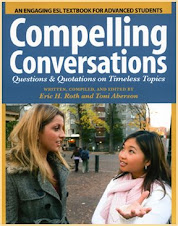
Create Compelling Conversations.
Visit www.CompellingConversations.com

Saturday, April 26, 2008

What should every ESL student know?

What should every ESL student know?

Beats me. One size fits all philosophies often seem a bit strange to me. Can anybody really answer this question for every international student and ESL college student in the United States? Really? Don't circumstances, needs, and desires differ?

On the other hand, administrators, teachers, future college students, and current international ESL students constantly face this common question. What should every ESL student know?

Fortunately, braver and more confident souls feel comfortable answering this reasonable question. That's why a small green and purple book, What Every ESL Student Should Know: A Guide to College and University Academic Success, caught my eyes at a recent English teachers' conference in California. Kathy Ochoa Flores, the author, has both more confidence and deeper insight into this essential, yet puzzling, question. In 119 pages, she displays considerable wit while dispensing practical advice to international students and immigrants preparing for college.

"My students always want to know what they should do to learn English," notes Flores in chapter 2. "I tell them to marry an American - one who is a native speaker and rich. That way, they can have someone to practice with every day, and they won't have to worry about working and studying at the same time. Unfortunately, this advice does not work for most of my students."

So Flores goes on to advocate, since many students are already married or too young to get married, to at least make some American friends. In bold print, she argues: "Native English speakers are everywhere. Use them. They are like free tutors." How? Take the bus, sit down next to some nice looking American, and start talking. Seek out the elderly since they tend to have both more free time and might be lonely. Talk to children, meet a school counselor, and ask many questions. "Talk to the telemarketers who call you during dinner time, and ask them lots of questions about their products." I completely agree.

This affordable book provides dozens of these imperative statements followed by detailed advice. Written in a clear manner, the concise format and friendly style make this book a wonderful book for newcomers. Easier to read, smaller in scope, and less than controversial than the popular book What's Up, America?, this book serves a slightly different purpose. Both titles help international students adjust to American college campuses, but What Every ESL Student Should Know focuses more on survival skills. International counselors, orientation coordinators, and even English language schools could provide a real service to their students by including this thin book in their orientation sessions and pre-college materials. The minimum cost will pay for itself by reducing ESL student stress.

Meanwhile, future international students should find it and buy it. This "one size fits all" work offers enough tips to satisfy any ESL student - and even a sceptical ESL university teacher!

Ask more. Know more. Share more.
Create Compelling Conversations.
Visit www.CompellingConversations.com