Showing posts with label Speech. Show all posts

Sunday, July 20, 2008

Volume Matters

Speaking too loud can be annoying and push people away. Speaking too softly, however, can be an even larger obstacle to simple communication and a satisfying conversation.

During classroom discussions in English class, some students to will boldly speak their mind. Other students tend to hold back, offer only the safest comments, and other share their wit. One overlooked, essential quality to speech in class, however, is volume. Students must speak loud enough that their fellow students can hear them - whether seated in the front or back row.
One can, however, sympathize with the timid English students who speak softer than ideal in a large classroom.

Being inaudible, however, in personal conversations remains a far more serious problem - especially for English as a Second Language (ESL) students.

Student conferences, especially with shy students worried about their grade or academic performance, can often be a bit awkward for both the professor and student. ESL (English as a Second Language) students, sometimes insecure about their pronunciation or vocabulary, can feel particularly anxious. ESL and other English teachers have to find ways to reduce student anxiety, provide a safe place for English students to speak, provide feedback on student work, and uphold academic standards. (Adult education, by the way, would be greatly improved if ESL teachers had more opportunities for student conferences.)

In general, I find student conferences very productive and satisfying because you get a chance to really work with a college student on their writings and assignments. I often feel that I learn as much as I teach in these 20-30 minute student conferences.

Sometimes, however, I have awkward conferences. If the student has plagiarized, then this can’t be avoided. Those moments, which I dread, can not be avoided. So it goes.

Yet sometimes, as occurred last semester, an ESL (English as a Second Language) student is so shy, so timid, and so unsure that they speak so softly that I can’t even hear. Sometimes I lean forward and ask them to please speak a bit louder. If a student continues in the same low volume, I might apologize for my poor hearing and again request they speak up. What does one do on the third request?

“Please speak a bit louder so I can hear you.”

Was this too direct? I wanted to say, “If I can’t hear you, you will be misunderstood. I want to understand you. Speak up!!”

Patience, this time, paid off. The student raised her voice to an audible level, and replied, “okay.”

“Good to hear you,” I replied. We proceeded to have a productive end of semester conference.

English and ESL teachers at all levels, from elementary school and high school to adult school and university, need to emphasize the importance of student speech being comprehensible. That includes speaking loud enough that conversation partners, classmates, and instructors can hear.

Bottomline: students must speak up in conversations, conferences, and class discussions. Volume matters.


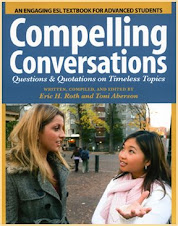
Ask more. Know more. Share more.
Create Compelling Conversations.
Visit www.CompellingConversations.com

Thursday, April 10, 2008

Excellent ESL Teaching resources at TESOL convention

Time flies. Or, as the Romans used to say, "tempus fugit."

Five days after the TESOl convention in New York City ended, I'm finally having a chance to sort through the numerous books, doublecheck website leads, and evaluate materials that I picked up. Sometimes "the eyes are too hungry", and I went a bit overboard in collecting ESL materials and resources for advanced English language learners. Of course, English teachers love books, new curriculum materials, and free ESL materials. I also have the excuse of working as a consultant for a workplace ESL program so I went hunting for some particular products for healthcare workers.

Here is a short list of promising materials:

VSOE ideas from TESOL convention

American Speech Sounds program for Healthcare workers. Also www.eslrules.com has powerful training materials for focused workshops for non-native English speakers working in hospital, clinics, and across the medical field.

- software and textbook designed for foreign doctors and nurses

- great reviews from professional journals (medical, language)

  1. Effective Practices in Workplace Language Training (TESOL)
  2. Getting Ahead in the US (Living Language) – videotape/textbook series
  3. New Citizenship DVD for future naturalization tests. This free DVD, perfect for adult educators, confirms that the new citizenship test will only require a "high beginning" level of ESL to qualify for American citizenship. Personally, I consider this an absurdly low standard that implies new American citizens can speak worse English than at least a half a billion English speakers outside of the United States, the United Kingdom, Canada, and Australia.
    Of course, low standards have many fans in the world of adult education and with many immigrant groups. More on this topic later.
  4. The Center for Applied Linguistics www.cal.org continues to offer wider and deeper variety of resources for ESL teachers, especially for adult education.
  5. I had several fascinating conversations about various English competency tests and their possible use in the workplace. The TOEIC test, on its merits, seems the strongest by far. Unfortunately, this test - used by millions in the workplace worldwide - has become almost forbidden due to lawsuits claiming discrimination in the United States. What does this mean? Millions of applicants and employees in Japan, Korea, Taiwan, France, Germany, and other non-English speaking countries have taken this test of English skills. Why? Because English has become a global language and competency in English has become an essential workplace skill.
  6. But not in the United States! So-called labor and civil rights activists have promoted the concept that requiring English proficiency, as tested by the TOEIC, is discrimination unless the ad explicitly states "English skills required." This strange situation means that American workers can, and so often do , speak at a lower level than educated workers in Asia and Europe. What's wrong with this picture!!!
  7. Software programs continue to become stronger day by day, minute by minute. English language learners, international ESL students, and adult ESL educators have more choices than ever. I will spend a solid chunk of time researching these language programs during my summer break. So far, however, it's clear that www.openbookenglish.com and www.spokenskills.com offer great values for administrators, teachers, and students. ESL teachers will also find www.lessonwriter.com a wonderful, innovative, and time-saving site.
More later, but I must return to a large pile of research reports that need grading!

Ask more. Know more. Share more.
Create Compelling Conversations.
Visit www.CompellingConversations.com

Thursday, March 20, 2008

Obama Shows How to Give a Great Speech!

Obama shows how to discuss race in a calm, rational manner

Do you use current events in your ESL class? Do you teach American history, citizenship, speech, or political science? Have you found a way to candidly discuss the pervasive and destructive role of race in American history in a calm, rational manner?

Hopefully, you have already had a chance to hear Senator Obama’s eloquent, reflective speech on race and American culture. Faced with a political crisis of his own making, Obama tried to both distance himself from his fiery pastor’s sermons, condemn their ignorant accusations, and explain the source of his pastor’s anger and bitterness. It’s a masterpiece of modern oratory.

Can Americans unite to solve serious national problems such as collapsing schools, collapsing bridges, and the collapsing dollar? Will Americans find a way to develop to honestly discuss the role of racial categories in our history, acknowledge the pain caused by racism and violence, and avoid name-calling to affirm a common destiny? Can Blacks, Whites, Hispanics, Asian, and Native Americans move beyond skin pigment and group complaints to renew our nation? Is there a way to calmly, rationally discuss deep emotional gaps and economic divisions that still plague the nation’s diverse racial groups?

Senator Obama’s speech yesterday deserves to be seen, heard, and read and reflected upon. Tracing the tragic role that race has played in the United States from the sanctioning of slavery in the Constitution to economic anxieties today, Obama provided personal and collective examples with maturity, understanding, and respect. He also listed the sources of “white resentment” such as affirmative action programs, busing, and violent crime in urban areas.

Obama’s “A More Perfect Union” speech,seems destined to become a classic. I consider it a 21st century version of Dr. King’s 1963 “I Have A Dream” speech. It deserves to be added to curriculum on many levels:

  1. Classic rhetoric built around a solid structure.
  2. Exceptionally vivid examples and memorable phrases
  3. A clear, compelling review of the nation’s history – and noble ambitions
  4. A poised delivery style, with exceptional eye contact, and clear pronunciation.
  5. An outstanding vocabulary supporting a focused message for multiple audiences
  6. A mature review of the enduring legacy of racism for multiple audience
  7. An affirmation of our common destiny and founding ideals as Americans in a changing world.

English language learners, immigrants, and international students will also gain vocabulary, history, and insights from hearing, watching, and reading the speech.

Click on the link below to read or hear the speech.

http://www.iht.com/articles/2008/03/18/america/18obamaspeech.php