Cities attract the young, the strong, and the ambitious. Cities also provide housing, jobs, and hope for those fleeing boredom, economic crisis, and war. Our 21st century cities, like our English classrooms, reflect the diversity of the human experience.
Millions move from the countryside and across the globe to live in new cities every year. Cities provide employment, culture, and education. Cities are exciting. Yet, sometimes danger also lurks in cities. Many students struggle with economic pressures, culture shock, and criminal activity. Shouldn't we discuss these conflicting pressures in our ESL classrooms?
Teaching English in Los Angeles and Santa Monica I’ve found that students, who come from across the globe, eager to talk about cities. Some English students share stories about moving from rural areas and small towns to an international city; other students enjoy telling about their travel experiences. Discussions naturally touch on housing, employment, and lifestyle choices. English language learners – whether adult immigrants creating a new home or university students living abroad – can reflect on their experiences and share insights discussing urban life.
Are you a city person? Why?
How are cities different from small towns?
What cities have you visited? Lived in?
What attracted you to this city?
What do you find stressful about city life?
What do you find satisfying about living in a city?
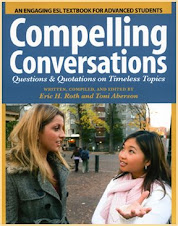
This month Exploring Cities, one of my favorite chapters, is highlighted as a free chapter on Compelling Conversations. Perhaps you will create some compelling conversations about cities in your classroom too. Check it out.
Ask more. Know more. Share more.
Create Compelling Conversations.
Visit www.CompellingConversations.com
Showing posts with label ELL lessons. Show all posts
Showing posts with label ELL lessons. Show all posts
Saturday, November 15, 2008


Tuesday, June 3, 2008
Creating Top Ten Tip Lists for Advanced ESL Classes
Sometimes, however, students will simply create a list and avoid providing clear reasons. In order to emphasize the need to share information and exchange insights, I often ask for a "top ten tips" to doing something. This twist also invites a wider range of topics from the practical to more philosophical.
You can ask students for their top ten tips for:
choosing a school?
saving money?
staying healthy and happy?
making and keeping friends?
avoiding boredom and finding satisfaction?
getting good grades?
learning English?
traveling to a new city/country?
Break students into groups of 3-4. Give them 20 minutes to come up their top ten tips on a given topic. Ask them to provide at least one reason and/or example for each answer.
Pass out different colors of chalk for each group. Have students write their answers on the board.The instructor goes through the list, asking questions - both soft and hard, and engages student groups.
Create Compelling Conversations.
Visit www.CompellingConversations.com
Subscribe to:
Posts (Atom)

 Posts
Posts