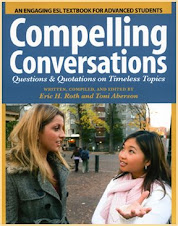
What should every ESL student know?
Beats me. One size fits all philosophies often seem a bit strange to me. Can anybody really answer this question for every international student and ESL college student in the United States? Really? Don't circumstances, needs, and desires differ?
On the other hand, administrators, teachers, future college students, and current international ESL students constantly face this common question. What should every ESL student know?
Fortunately, braver and more confident souls feel comfortable answering this reasonable question. That's why a small green and purple book, What Every ESL Student Should Know: A Guide to College and University Academic Success, caught my eyes at a recent English teachers' conference in California. Kathy Ochoa Flores, the author, has both more confidence and deeper insight into this essential, yet puzzling, question. In 119 pages, she displays considerable wit while dispensing practical advice to international students and immigrants preparing for college.
"My students always want to know what they should do to learn English," notes Flores in chapter 2. "I tell them to marry an American - one who is a native speaker and rich. That way, they can have someone to practice with every day, and they won't have to worry about working and studying at the same time. Unfortunately, this advice does not work for most of my students."
So Flores goes on to advocate, since many students are already married or too young to get married, to at least make some American friends. In bold print, she argues: "Native English speakers are everywhere. Use them. They are like free tutors." How? Take the bus, sit down next to some nice looking American, and start talking. Seek out the elderly since they tend to have both more free time and might be lonely. Talk to children, meet a school counselor, and ask many questions. "Talk to the telemarketers who call you during dinner time, and ask them lots of questions about their products." I completely agree.
This affordable book provides dozens of these imperative statements followed by detailed advice. Written in a clear manner, the concise format and friendly style make this book a wonderful book for newcomers. Easier to read, smaller in scope, and less than controversial than the popular book What's Up, America?, this book serves a slightly different purpose. Both titles help international students adjust to American college campuses, but What Every ESL Student Should Know focuses more on survival skills. International counselors, orientation coordinators, and even English language schools could provide a real service to their students by including this thin book in their orientation sessions and pre-college materials. The minimum cost will pay for itself by reducing ESL student stress.
Meanwhile, future international students should find it and buy it. This "one size fits all" work offers enough tips to satisfy any ESL student - and even a sceptical ESL university teacher!
Ask more. Know more. Share more.
Create Compelling Conversations.
Visit www.CompellingConversations.com
Saturday, April 26, 2008


Thursday, April 24, 2008
Please speak a bit louder so I can hear you
Student conferences, especially with shy students worried about their grade or academic performance, can often be a bit awkward for both the professor and student. ESL students, sometimes insecure about their pronunciation or vocabulary, can feel particularly anxious. ESL teachers have to find ways to reduce student anxiety, provide a safe place for students to speak, provide feedback on student work, and uphold standards.
In general, I love student conferences because you get a chance to really work with a student on their writings and assignments. I often feel that I learn as much as I teach in these 20-30 minute conferences.
Sometimes, however, I have awkward conferences. If the student has plagiarized, then this can’t be avoided. Those moments, which I dread, can not be avoided. So it goes.
Yet sometimes, as occurred last semester, an ESL student is so shy, so timid, and so unsure that they speak so softly that I can’t even hear. Sometimes I lean forward and ask them to please speak a bit louder. If a student continues in the same low volume, I might apologize for my poor hearing and again request they speak up. What does one do on the third request?
“Please speak a bit louder so I can hear you.”
Was this too direct? I wanted to say, “If I can’t hear you, you will be misunderstood. I want to understand you. Speak up!!”
Patience, this time, paid off. The student raised her voice to an audible level, and replied, “okay.”
“Good to hear you,” I replied. We proceeded to have a productive end of semester conference.
Bottomline: students must speak up in conversations, conferences, and class discussions. Volume matters.
Ask more. Know more. Share more.
Create Compelling Conversations.
Visit www.CompellingConversations.com
Monday, April 21, 2008
Investing in quality ESL classes improves daily life
A good society helps its citizens flourish and visitors feel welcome.
A good society also invests in education, including teaching immigrants enough English that they can use their considerable intelligence, creativity, and skills in the workplace.
Unfortunately, low standards in public education have eroded support for government sponsored education programs. Worse, the few underfunded English as a Second Language programs usually provide the most basic English skills. Students learn to listen and read at about 4th grade level, and speak like a child with a very limited vocabulary.
From my perspective as an English instructor and former adult ESL teacher, the current adult ESL standards too often only teach immigrants passive skills like listening and some minimum reading. English language programs, whether designed for vocational skills or general language, must include speaking and writing. If people can’t hold a conversation in English, their job prospects remain rather limited!
A frontpage article in today’s Los Angeles Times points out the obvious problem.
When will the employers and voters decide to invest in real, serious, quality English languages for immigrants? And why are immigrants trained in English programs abroad so much stronger, better, and more effective than the adult ESL programs here? After all, immigrants have many more opportunities to speak English and learn outside of the classroom than students in
Again, the case for dramatically expanding and raising the standards of our English as a Second Language programs seems clear.
Unfortunately, reason and government policy do not always co-exist in the
Ask more. Know more. Share more.
Create Compelling Conversations.
Friday, April 18, 2008
Does Uncle Sam Want Immigrants to Learn English?
Learning to read, write, and speak English remains a legal requirement for legal immigrants to become citizens in the
Yet funding for English language classes, especially for adults, remains quite limited. Government programs only help students learn rather basic English, often around 1200 essential words. Students can "pass" all their ESL classes and learn enough English to hold low-level jobs. ESL students learn to listen more than speak, and read more than write. These low standards, by the way, also include a very, very low level definition of "can read, write, and speak" English for citizenship. (More on this subject in future posts.)
Many states, like
" Uncle Sam wants you to speak English" reads a popular bumper-sticker. Uncle Sam, the traditional symbol for the
I saw this bumper-sticker on the way back from an English teacher's conference again last week. I also wondered about the driver. Does he support helping immigrants learn English? Does he really think immigrants who don't speak English will understand his message? Would a Spanish speaking immigrant, for instance, know who Uncle Sam is? Or is the driver simply stating that immigrants - who might speak two, three, four, or more languages - should only speak English in the
Unfortunately, I never had a chance to talk with the gentleman who placed this provocative message on his car. I don't really know what he meant by his "Uncle Sam wants you to speak English" bumper-sticker. I hope, however, that he supports adding, not cutting, English language classes. We both would like more people to be able to speak to him and ask him questions in his best language too. How does the driver expect his wish to come true?
Perhaps if "Uncle Sam wants you to speak English", than he could find more ways to help immigrants and refugees learn English!
Create Compelling Conversations.
Visit www.compellingconversations.com .
Wednesday, April 16, 2008
Negative headlines and trendlines for ESL in California public schools
Yet the gap between "ought" and "is" remains very wide in Bush's America and in California's public schools.
The dollar continues to decline in value. The national budget, seldom balanced, has zoomed deep into mega-debt during the Bush II era with two expensive wars, a deepening recession, and record tax cuts for the wealthy. The
In
These abstract concerns about cutbacks took a very visible shape at the statewide California Teachers of English to Speakers of Other Languages convention last week. Total attendance was officially down by more than 25% since school districts had few available funds to send administrators, let alone teachers, to the conference. Yet I suspect the real numbers are far, far more dramatic than the reduction from 1600 t0 1200 attendees. Here are some signs of pervasive cutbacks:
- only a single school district recruited teachers
- the exhibition hall seemed like a ghost town
- publishers and vendors were eager to talk about the freezing of public education spending in many districts
- vendors expressed hope that teachers would buy even more supplies from their personal pockets
- many workshops collected rather sparse crowds
- the few job board postings were for summertime Intensive English Programs that attract private, international students
- the mood, despite many fantastic new educational resources and software programs, seemed very downbeat
Perhaps it's unfair to juxtapose a very hectic, chaotic international teachers' convention in
Teaching English, on a global level, continues to dramatically improve and expand. The development of new software for English language learners, better teaching techniques that respect students and encourage authentic communication, and the increase in international educational point to a better tomorrow. Meanwhile, the news from
Teaching at an elite private university in Los Angeles, I could pretend these cutbacks don't matter to me. Yet that's a dangerous illusion. The collapse of public education, especially for immigrants, will have both immediate and long-term consequences. The expanding gap between the wealthy who can afford a truly wonderful 21st century education and the expanding number of under-educated, over-stressed poor indicates a worsening future for too many Californians. As a stoic philosopher Epictetus noted so long ago, "only the educated are free."
As an American, a Californian, and an English teacher, I don't like the trendlines and headlines for American public education. Do you?
Ask more. Know more. Share more.
Create Compelling Conversations.
Visit www.compellingconversations.com
Thursday, April 10, 2008
Excellent ESL Teaching resources at TESOL convention
Time flies. Or, as the Romans used to say, "tempus fugit."
Five days after the TESOl convention in New York City ended, I'm finally having a chance to sort through the numerous books, doublecheck website leads, and evaluate materials that I picked up. Sometimes "the eyes are too hungry", and I went a bit overboard in collecting ESL materials and resources for advanced English language learners. Of course, English teachers love books, new curriculum materials, and free ESL materials. I also have the excuse of working as a consultant for a workplace ESL program so I went hunting for some particular products for healthcare workers.
Here is a short list of promising materials:
VSOE ideas from TESOL convention
- software and textbook designed for foreign doctors and nurses
- great reviews from professional journals (medical, language)
- Effective Practices in Workplace Language Training (TESOL)
- Getting Ahead in the
- New Citizenship DVD for future naturalization tests. This free DVD, perfect for adult educators, confirms that the new citizenship test will only require a "high beginning" level of ESL to qualify for American citizenship. Personally, I consider this an absurdly low standard that implies new American citizens can speak worse English than at least a half a billion English speakers outside of the United States, the United Kingdom, Canada, and Australia.
Of course, low standards have many fans in the world of adult education and with many immigrant groups. More on this topic later. - The Center for Applied Linguistics www.cal.org continues to offer wider and deeper variety of resources for ESL teachers, especially for adult education.
- I had several fascinating conversations about various English competency tests and their possible use in the workplace. The TOEIC test, on its merits, seems the strongest by far. Unfortunately, this test - used by millions in the workplace worldwide - has become almost forbidden due to lawsuits claiming discrimination in the United States. What does this mean? Millions of applicants and employees in Japan, Korea, Taiwan, France, Germany, and other non-English speaking countries have taken this test of English skills. Why? Because English has become a global language and competency in English has become an essential workplace skill.
- But not in the United States! So-called labor and civil rights activists have promoted the concept that requiring English proficiency, as tested by the TOEIC, is discrimination unless the ad explicitly states "English skills required." This strange situation means that American workers can, and so often do , speak at a lower level than educated workers in Asia and Europe. What's wrong with this picture!!!
- Software programs continue to become stronger day by day, minute by minute. English language learners, international ESL students, and adult ESL educators have more choices than ever. I will spend a solid chunk of time researching these language programs during my summer break. So far, however, it's clear that www.openbookenglish.com and www.spokenskills.com offer great values for administrators, teachers, and students. ESL teachers will also find www.lessonwriter.com a wonderful, innovative, and time-saving site.
Ask more. Know more. Share more.
Create Compelling Conversations.
Visit www.CompellingConversations.com
Sunday, March 30, 2008
The Center for Applied Linguistics Suggests Workshops at TESOL
How do you choose which of the many tempting ESL workshops at an international convention of ESL teachers and researchers?
As part of my preparation for the TESOL convention, I checked the
a list of recommended workshops by CAL researchers. As ever, the Center for Applied Linguistics website provides some practical suggestions.
“World of TESOL, Worlds of Refugees”, “Strategies for Serving High Advanced Adult ESL Students”, and “Building Academic Language Through Scaffolded Instructional Conversations”, and “Analyzing Oral Proficiency to Guide Instruction” sound like sensible, smart choices. “Applying Teacher Input to Improve Assessment” also sounds like an excellent idea. Two other workshops that caught my eye, “Interested in Working as as ESOL Consultant” and “Connecting Culture and Language in ELL Instruction”, but I’m not going to any workshops that start at 7:30 AM or 7:30 PM while visiting New York City.
Please visit www.CompellingConversations.com .
Thursday, March 27, 2008
Are you going to the TESOL convention next week?
Are you going to the TESOL conference next week? Did you see all those narrow, niche topics? Have you created a schedule? How did you decide which workshops to attend?
Personally, I found the selections simply overwhelming. For work, I'm going to focus on the workshops on testing language skilsl, especially oral skills and writing. For personal interest, I'll probably go to the workshops on technology and ESL. I might also wander into a few workshops on the internationalization of higher education. But consider me flexible. Do you have any recommendations?
For now, I’m playing it by ear.
Eric
eric@compellingconversations.com
www.compellingconversations.com
Going Beyond the ESL Classroom to Teach English
Why stay indoors on a beautiful sunny day? Do you want your class discussions to go beyond the predictable textbook lesson? How can ESL teachers use shopping malls, museums, and movies to help students develop a more practical vocabulary?
“The Outside World as an Extension of the EFL/ESL Classroom”, by Mark A. Pegrum, makes a compelling argument that ESL teachers should go way beyond dry textbooks to engage in the practical needs and broader cultural life. This exceptional article, written in proper academic style for elite educational audiences, clearly outlines the many reasons for engaging ESL students in the world around them. The article advocates field trips, conducting surveys, visiting museums, discussing movies, obtaining information from public offices, and summarizing television programs. Numerous activities, along with the suggested level and focus, are provided in this article/collection of lesson ideas for multiple levels. While I can’t bring myself to write in this style with all the appropriate footnotes to make commonsense sound so respectable in academic journals, I’m very glad that Pegrum wrote this outstanding article for ESL professionals. Good job!
These lessons work better for adult education and intensive English programs than community college or university level ESL classes. Many college ESL teachers, however, will also find excellent suggestions for supplemental intermediate and advanced activities. Check it out for lesson ideas to create authentic language and deepen practical life skills for your curious ESL students.
Ask more. Know more. Share more.
Create Compelling Conversations
Visit www.compellingconversations.com
Tuesday, March 25, 2008
Proverbs Provide Perspective for ESL Students
Proverbs provide perspective.
Short and pithy, proverbs often capture a point of view in vivid words. We learn proverbs our entire lives - from our relatives, our teachers, our friends, the media, and our literature. They contain folk wisdom gathered through time and experience. They often capture a common human experience.
Yet I like to use proverbs in ESL classes for three other distinct reasons.
Students can share proverbs from their own countries. In ESL classes where you have students from many different countries and numerous first languages, proverbs allow students to affirm the insights and experiences of their native culture. “Home is where the heart is.”
Students can easily memorize proverbs. Using the right proverb at the right moment gives students a tremendous sense of competency and fluency in English – something that immigrants often struggle to achieve. “No pain, no gain.”
Studying proverbs from around the world helps create a more global education, and counters the fears of English displacing the insights and words of other tongues and times. “The sky is blue everywhere” and “birds return to old nests.”
Sharing proverbs shows a respect for tradition and the past while students expand their vocabulary in a new, modern language. Many immigrants, particularly older ones, have very mixed feelings about their new lives in an English speaking nation. “Old habits die hard.” et “you’re never too old to learn” gives hope.
For instance, an immigrant from rural Mexico learning English in Los Angeles might find themselves also learning to live in modern, urban city for the first time. While the formal subject may be English, immigrants are also discovering new ways of living and thinking in the school. Proverbs seem to affirm the concept that “the more things change, the more they remain the same” and “the unexpected always happens.”
When I taught an advanced ESL conversation class at Santa Moncia Community College, I usually introduced conversation topics with a proverb. Students would soon be paired up to interview each other and share experiences. When we returned together for a group discussion, I noticed that students often explained their answers using proverbs. I decided to “go with the flow” and build proverbs into course materials.
“The lotus springs from the mud.”
Ask more. Know more. Share more.
Create Compelling Conversations.
Visit www.compellingconversations.
Short and pithy, proverbs often capture a point of view in vivid words. We learn proverbs our entire lives - from our relatives, our teachers, our friends, the media, and our literature. They contain folk wisdom gathered through time and experience. They often capture a common human experience.
Yet I like to use proverbs in ESL classes for three other distinct reasons.
Students can share proverbs from their own countries. In ESL classes where you have students from many different countries and numerous first languages, proverbs allow students to affirm the insights and experiences of their native culture. “Home is where the heart is.”
Students can easily memorize proverbs. Using the right proverb at the right moment gives students a tremendous sense of competency and fluency in English – something that immigrants often struggle to achieve. “No pain, no gain.”
Studying proverbs from around the world helps create a more global education, and counters the fears of English displacing the insights and words of other tongues and times. “The sky is blue everywhere” and “birds return to old nests.”
Sharing proverbs shows a respect for tradition and the past while students expand their vocabulary in a new, modern language. Many immigrants, particularly older ones, have very mixed feelings about their new lives in an English speaking nation. “Old habits die hard.” et “you’re never too old to learn” gives hope.
For instance, an immigrant from rural Mexico learning English in Los Angeles might find themselves also learning to live in modern, urban city for the first time. While the formal subject may be English, immigrants are also discovering new ways of living and thinking in the school. Proverbs seem to affirm the concept that “the more things change, the more they remain the same” and “the unexpected always happens.”
When I taught an advanced ESL conversation class at Santa Moncia Community College, I usually introduced conversation topics with a proverb. Students would soon be paired up to interview each other and share experiences. When we returned together for a group discussion, I noticed that students often explained their answers using proverbs. I decided to “go with the flow” and build proverbs into course materials.
“The lotus springs from the mud.”
Ask more. Know more. Share more.
Create Compelling Conversations.
Visit www.compellingconversations.
Thursday, March 20, 2008
Obama Shows How to Give a Great Speech!
Obama shows how to discuss race in a calm, rational manner
Hopefully, you have already had a chance to hear Senator Obama’s eloquent, reflective speech on race and American culture. Faced with a political crisis of his own making, Obama tried to both distance himself from his fiery pastor’s sermons, condemn their ignorant accusations, and explain the source of his pastor’s anger and bitterness. It’s a masterpiece of modern oratory.
Can Americans unite to solve serious national problems such as collapsing schools, collapsing bridges, and the collapsing dollar? Will Americans find a way to develop to honestly discuss the role of racial categories in our history, acknowledge the pain caused by racism and violence, and avoid name-calling to affirm a common destiny? Can Blacks, Whites, Hispanics, Asian, and Native Americans move beyond skin pigment and group complaints to renew our nation? Is there a way to calmly, rationally discuss deep emotional gaps and economic divisions that still plague the nation’s diverse racial groups?
Senator Obama’s speech yesterday deserves to be seen, heard, and read and reflected upon. Tracing the tragic role that race has played in the
Obama’s “A More Perfect Union” speech,seems destined to become a classic. I consider it a 21st century version of Dr. King’s 1963 “I Have A Dream” speech. It deserves to be added to curriculum on many levels:
- Classic rhetoric built around a solid structure.
- Exceptionally vivid examples and memorable phrases
- A clear, compelling review of the nation’s history – and noble ambitions
- A poised delivery style, with exceptional eye contact, and clear pronunciation.
- An outstanding vocabulary supporting a focused message for multiple audiences
- A mature review of the enduring legacy of racism for multiple audience
- An affirmation of our common destiny and founding ideals as Americans in a changing world.
Click on the link below to read or hear the speech.
http://www.iht.com/articles/2008/03/18/america/18obamaspeech.php
Subscribe to:
Posts (Atom)

 Posts
Posts