Sunday, July 20, 2008

Volume Matters

Speaking too loud can be annoying and push people away. Speaking too softly, however, can be an even larger obstacle to simple communication and a satisfying conversation.

During classroom discussions in English class, some students to will boldly speak their mind. Other students tend to hold back, offer only the safest comments, and other share their wit. One overlooked, essential quality to speech in class, however, is volume. Students must speak loud enough that their fellow students can hear them - whether seated in the front or back row.
One can, however, sympathize with the timid English students who speak softer than ideal in a large classroom.

Being inaudible, however, in personal conversations remains a far more serious problem - especially for English as a Second Language (ESL) students.

Student conferences, especially with shy students worried about their grade or academic performance, can often be a bit awkward for both the professor and student. ESL (English as a Second Language) students, sometimes insecure about their pronunciation or vocabulary, can feel particularly anxious. ESL and other English teachers have to find ways to reduce student anxiety, provide a safe place for English students to speak, provide feedback on student work, and uphold academic standards. (Adult education, by the way, would be greatly improved if ESL teachers had more opportunities for student conferences.)

In general, I find student conferences very productive and satisfying because you get a chance to really work with a college student on their writings and assignments. I often feel that I learn as much as I teach in these 20-30 minute student conferences.

Sometimes, however, I have awkward conferences. If the student has plagiarized, then this can’t be avoided. Those moments, which I dread, can not be avoided. So it goes.

Yet sometimes, as occurred last semester, an ESL (English as a Second Language) student is so shy, so timid, and so unsure that they speak so softly that I can’t even hear. Sometimes I lean forward and ask them to please speak a bit louder. If a student continues in the same low volume, I might apologize for my poor hearing and again request they speak up. What does one do on the third request?

“Please speak a bit louder so I can hear you.”

Was this too direct? I wanted to say, “If I can’t hear you, you will be misunderstood. I want to understand you. Speak up!!”

Patience, this time, paid off. The student raised her voice to an audible level, and replied, “okay.”

“Good to hear you,” I replied. We proceeded to have a productive end of semester conference.

English and ESL teachers at all levels, from elementary school and high school to adult school and university, need to emphasize the importance of student speech being comprehensible. That includes speaking loud enough that conversation partners, classmates, and instructors can hear.

Bottomline: students must speak up in conversations, conferences, and class discussions. Volume matters.


Ask more. Know more. Share more.
Create Compelling Conversations.
Visit www.CompellingConversations.com

Saturday, July 19, 2008

What is the opposite of jealous? "Gratitude is Heaven itself."

A bright college student asked a simple vocabulary question that threw me this week. "What is the opposite of jealous"?

What is the opposite of jealous? Generous? Selfless? Confident? I found myself discussing various possibilities with students adding in situations. The simple vocabulary building exercise (create 25 pairs of opposite adjectives) took a more philosophical turn. We had a lively, if a bit wandering, class discussion. I apologized for my memory lapse, urged them to check a dictionary, and promised to get back to students with a better answer.

In the teacher's room, a fellow teacher noted "The world jealousy includes the word lousy." We shared a laugh. That's a good answer. How did he instantly come up with that? Why couldn't I do that?

I felt discontent, dissatisfied, and displeased with my weak classroom answers. Perhaps the opposite of "jealous" is content, satisfied, and pleased.

Stress comes naturally when driving in Los Angeles, and my commute back home fit the familiar pattern. Many words popped into my head that captured negative feelings, including jealous. Could I be jealous of bus riders? Really? I started to visualize a bus ride home from UCLA, sitting - no, probably standing up, for 40 minutes next to exhausted strangers. Memories of less pleasant commutes on subway rides in New York from 20 years ago returned. No, I didn't envy or feel jealous of the bus riders.

I eventually arrived home. Boomer, my dog, barked to announce my arrival and licked my face as I entered the front door. He's great. "Dogs are our link to paradise," wrote Milan Kundera. Absolutely.

Gratitude. That's the opposite of jealousy. Gratitude. Why didn't I think of that in class? Next time.

"Gratitude is heaven itself." Who said that? Blake? Yeah, William Blake. The great poet-painter-mystic man. Remember that quote the next time an English student asks, "what is the opposite of jealous?"

Teaching English, especially to bright international college students, helps keep me focused and clear. This week I learned the opposite of jealousy and rediscovered a favorite quotation. Consider me satisfied, content, and grateful.


Ask more. Know more. Share more.
Create Compelling Conversations.
Visit www.CompellingConversations.com

Friday, July 18, 2008

What is a lifequake? Is that a real word?

Earthquakes remain a concern for people living in many places, including Southern California. This awareness, and fear of sudden shaking and buildings falling, enters into many conversations.
I recently read a wonderful term and vocabulary word: lifequake. What does it mean? An event that suddenly changes your life – a car accident, being laid off, terrible illness, or getting divorced – in the same dramatic way that an earthquake might destroy a building.
Now I have a new way to ask friends to share more about awkward situations.

  • How did you deal with that lifequake?
  • What lifequakes have you survived?
  • How will you manage that lifequake?

Is lifequake a real word? Can educated English speakers use it? Absolutely. New words and slang terms enter English dictionaries all the time, partly because our world continues to change and evolve. Lifequake clearly describes a common experience. It's pithy and practical. While I would might hesisitate about using the term on a TOEFL or TOEIC test, I plan to incorporate into my daily vocabulary with family, friends, and students.

A fellow ESL teacher and longtime California resident believes that “lifequake” was a widely used term in the 1970s among “young, hip people.” Perhaps. Whether old hipster slang or a new Californian term, lifequake conveys an understanding that sometimes life can shock and hurt. Lifequake is a fast way to communicate a harsh reality. Lifequakes happen.

Don't you agree?

Ask more. Know more. Share more.
Create Compelling Conversations.
Visit www.CompellingConversations.com

Wednesday, July 16, 2008

After grading too many ESL papers, this quote appears!

"There's only one corner of the universe you can be certain of improving, and that's your own self... Every man who knows how to read has it in his power to magnify himself, to multiply the ways in which he exists, to
make his life full, significant and interesting." —Aldous Huxley


Ask more. Know more. Share more.
Create Compelling Conversations.
Visit www.CompellingConversations.com

Sunday, July 6, 2008

Adding Classic Quotations Adds Depth, Diversity to ESL Classrooms

Why do you recommend using classic quotations in ESL classrooms?

“If a nation expects to be ignorant and free…it expects what never was and never will be.”
Thomas Jefferson (1743-1826),
U.S. President and principal author of the Declaration of Independence


Classic quotations, like proverbs, brings in many insights from religious leaders and philosophers that go back even more than 2,000 years such as Buddha, Confucius, Aristotle, and the Biblical prophets in a compelling, succinct manner. These quotations remind us that some conversations have spanned centuries and cultures.

Further, you can pair two, three, and more quotations to present a wide range of ideas, beliefs, and perspectives. Some quotations might make you laugh, some might make you sigh, and a few might even annoy you. Yet bringing “the wisdom of the ages” into your English language classroom elevates the discussion. It can also encourage students to feel safer in presenting their idea.

This technique helps students both join the conversation, and add their own ideas. Our classrooms should be a lively place where students can explore ideas and experience free speech.

Including classic quotations also helps preserve the insights and comments of well-known and significant cultural figures. This technique helps both teachers and students escape the too-common delusion that the world began when we were born and provides a larger perspective. Sometimes knowing the speaker and historical era invites another way of looking at our modern lives.

Finally, a stunning number of both adult education and college students need to be introduced to significant artists, writers, leaders, and philosophers from the past. Academic literacy requires some degree of cultural and historical awareness. I always include the dates and identify the occupation of various figures to both introduce and gently cajole students into seeking out more information on significant cultural and historical figures.

Is adding dates really necessary? Yes, given the actual state of common knowledge among ESL students. Something is profoundly wrong with American education when a majority of American high school seniors in public schools can not name the war that occurred when Abraham Lincoln was president. I believe including quotations, in context, provides a small counter to this shocking level of historic amnesia.

I remain confident that our ESL students, especially adult immigrants seeking naturalization as U.S. citizens, will develop a solid grasp of our nation’s history. Throwing in a few quotations from historical figures can only help.

Liberty can not be preserved without a general knowledge among the people.”
John Adams (1735-1826)
U.S. President and contributor to the Declaration of Independence

Ask more. Know more. Share more.
Create Compelling Conversations.
Visit www.CompellingConversations.com

Wednesday, July 2, 2008

A New Issue of Easy English Times Makes Me Smile!

The “Summer Fun” issue of Easy English Times arrived yesterday, and it made me smile. It’s another wonderful issue of ESL student essays, teaching tips, and classroom exercises for English language learners.

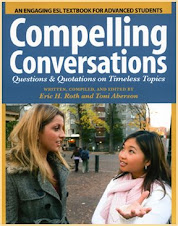
The Easy English Times (EET) editors also generously added seven photographs to the monthly “instant activity: conversation” column written by Toni Aberson and myself. This month’s topic is Enjoying the Beach. The beautifully illustrated excerpt from Compelling Conversations, modified for beginning and intermediate ESL student readers should be popular. The column also inspired me to take a long walk on Santa Monica beach with my dog to celebrate. We must practice what we preach!

The summer issue also lead me to revisit the Easy English Times website. Unfortunately, the EET website doesn’t include the entire current and past issues so the conversation column isn’t online. The clean website, although in need of an update, includes several valuable chunks of information for ESL educators and people teaching in adult literacy and prisons.

The section titled Immigration Issues features first person essays from immigrants and refugees and an evocative photo essay by Betty Malmgren that documents the intense passions and political symbols used at immigration protest marches. Malmgren deserves credit for showing both sides of this heated and very American debate in a fair, nuanced manner. I’m also fond of the section titled internet resources which includes archived columns from Andrea Uram for teachers of beginning ESL students and Susan Gaer’s columns on using the internet in ESL classrooms.

Yet my favorite part of the Easy English Times website remains student writing where you can read first person stories from immigrants and refugees who have created new lives in the United States for themselves and their families. This short essays and poems, written by adult ESL students living and working across the country, provide a riveting glimpse into our often troubled world. The range and diversity of writers and writings is quite impressive. I can’t help but be moved and proud to be an English teacher while reading this section.

Website visitors can request a free copy of Easy English Times newspaper, and subscribers can access the entire adult education newspaper online for $15. It’s a good buy, especially for American ESL teachers working with beginning and intermediate adult ESL students. In a far better world, there would be fewer refugees from wars, famines, and persecution – and more than enough money to buy class sets of this ESL newspaper for more adult schools.

Ask more. Know more. Share more.
Create Compelling Conversations.
Visit www.CompellingConversations.com

Friday, June 27, 2008

Looking for Teaching Ideas? Check out English Teaching Forum!

Have you read English Teaching Forum magazine yet? It’s another outstanding resource for English language teachers whether working with adults in Africa, Eastern Europe, Southeast Asia, South America, or teaching English to immigrants and future citizens inside the United States. Published by the U.S. State Department, the excellent quarterly magazine includes concise lesson plans, reflective essays, and reproducible exercises.

I’ve subscribed for a year, and consistently been impressed at the depth, range, and creativity of the articles. The practical articles offer classroom suggestions that can be immediately used, putting many more academic publications on teaching English to shame. I’m keeping all my past issues of English Teaching Forum. I also wish more government sponsored educational efforts attained this high-quality. Perhaps excellence in public education will become fashionable again.

Fortunately, older issues of English Teaching Forum are also available online. The archives go back several years. You can read the Winter 2007 issue online. Each article can be downloaded in a separate PDF file, allowing teachers to pick and choose their favorite articles. Unfortunately, the 2008 issues remain in print form only. You can also find other valuable teacher resources at

http://exchanges.state.gov/education/engteaching/ .


Ask more. Know more. Share more.
Create Compelling Conversations.
Visit www.CompellingConversations.com

Tuesday, June 24, 2008

Can Google Do For K-12 Students What It Has For Graduate Students?

Teachers Urge Google to Create Search Engine for K-12 Students

How do K-12 students actually conduct online research for their classes? Do they systematically pursue a topic, use critical thinking to evaluate sources, and focus on the assigned topics? Or do they wander, often confused and easily distracted, from site to site? Is it possible for Google, the creator of the best online search engine,to create a specialized search engine just for K-12 students? Could Google, in other words, do for the K-12 students, teachers, and librarians what it has done for elite graduate students with the excellent search engine Google Scholar?

That’s the question that Dorit Eilon and a group of tech savvy teachers and educators are asking at Classroom 2.0 .

“We are a group of educators who for the past 7 months did an extensive research about on-line research and the education world. According to studies most students (and teachers) have difficulty conducting an efficient on-line research and most do not understand how Google or other search engines work.

Students, well versed in IM and SN (Social Networking) stumble when they conduct on-line research.
Even with technology many teachers still use the web in isolation. Teachers find great links that… stay on their computer, on their own website or their own blog.

So a group of us, educators, would like things to change.
We dream of a search engine that is unique to the education community with searches that produce text, video, audio results at the same time, where both commercial and school created material is accessible and monitored (we have a whole plan), where the resources will be identified, contributed and monitored by educators in phase one and Middle School / High School students in phase two. A search engine that it’s content will grow by the education community. and we want Google to be a part of it, to work with us to develop it and provide the technology.

But, we need librarians, teachers and students to talk about the day-to-day difficulties of navigating the web. We need educators to speak up so we can show that there is a real need not just plain statistics.

We imagine a search tool that will allow you to search within sites created by teachers, ability to rate sites / review, ability to search by “author” (person contributing links) , connection to Google Maps and much more.

If you feel the same way please go to our blog to look at comments and votes. While there, please take a vote and leave a comment to have your voice and opinion heard. http://cangooglehearus.blogspot.com/

Together we can make a difference.”

Sounds right to me. As the leading search engine and innovative technology company, Google can play an even more prominent role in improving education across the globe. Let’s hope Google hears this eloquent plea for a more student and teacher friendly search engine.

The gap between what could be done and what is being done in American public schools, especially in terms of teaching technological literacy and critical thinking skills, remains huge. I recently heard about a student that examined 55 professions and evaluated their use of modern technologies. Unfortunately, public education in the United States ranked in the bottom 5 institutions in terms of using new technologies. This oversight, perhaps born of inertia and lack of funds, must be corrected. Google, a relatively enlightened socially conscious company, should lend a helping hand and lead - again - the way.

If you feel the same way, please visit http://cangooglehearus.blogspot.com/and sign the petition.

Ask more. Know more. Share more.
Create Compelling Conversations.
Visit www.CompellingConversations.com

Thursday, June 19, 2008

Tuesday, June 17, 2008

We learn by stumbling

Sometimes modern mishaps, like a website going down or losing email for a long 100-hour period, illuminates an ancient proverb.

"We learn by stumbling," an old Bulgarian proverb, has provided solace to this ESL teacher and novice blogger this week.

My evolving website, Compelling Conversations for English Language Learners, Teachers, and Tutors, has been moved and resurrected. The turmoil has passed. I feel both relieved and satisfied.

Please drop by www.CompellingConversations.com for free conversation lesson plans, tips on creating lively ESL/EFL classrooms, and an extensive collection of recommended educational and cultural links for ESL teachers, tutors, and maybe even administrators and advanced students. Enjoy the free downloads, and let me know how to further improve the website.
Like almost every aspect of modern life, the website remains a work in progress.

As ever, you can contact me at talktome@compellingconversations.com with suggestions, proverbs, and quotations.

Thanks for visiting!

Ask more. Know more. Share more.
Create Compelling Conversations.
Visit www.CompellingConversations.com

Monday, June 9, 2008

Let's Encourage English Students to Make Good Mistakes"

How can English language teachers create a rigorous, tolerant, and focused classroom atmosphere?

One effective technique is encouraging English students, especially ESL students, to “make good mistakes” as they expand their vocabulary, experiment with new sentence structures, and use English more in their daily lives. A good mistake, as I explain on the first day of class, is a logical error that makes sense, but just happens to be wrong. For example, a young boy might think 2+2= 22. You can see the logic, but the answer is wrong. The student needs to know that 2+2=4. But you can also acknowledge that “22″ is a good mistake. Some teachers might consider this mistake a 'systems error' or 'category confusion.'

Far too many ESL students, especially in countries that still worship standardized exams, have created psychological barriers to experimenting in English. These English language learners often want to avoid making any mistakes, and prefer to remain silent in conversation class to expanding their verbal skills. The ESL teacher, therefore, has to directly confront this trend or learned behavior. You can’t learn to speak a new language without making mistakes.

So I encourage English students, in both conversation and writing classes, to make good mistakes. Take chances. Try something new. Stretch your learning muscles. And make good mistakes. A good mistake is also a mistake that we acknowledge and learn from and avoid repeating. A good mistake is not a good mistake if you’ve made it ten times before in a class or on previous papers. Students usually understand, relax a bit, and proceed to experiment a bit more in our crazy, confusing, and misspelled English language.

Our goal, I sometimes joke on that first day, is to make many good mistakes, learn from these good mistakes, and move forward to make new, different, and even better good mistakes.” We usually realize this goal in our English classes!

Ask more. Know more. Share more.
Create Compelling Conversations.
Visit www.CompellingConversations.com

Tuesday, June 3, 2008

Creating Top Ten Tip Lists for Advanced ESL Classes

Americans love to create top ten lists. Naturally, many English teachers use this format in their classrooms to express ideas and create discussions.

Sometimes, however, students will simply create a list and avoid providing clear reasons. In order to emphasize the need to share information and exchange insights, I often ask for a "top ten tips" to doing something. This twist also invites a wider range of topics from the practical to more philosophical.

You can ask students for their top ten tips for:

choosing a school?

saving money?

staying healthy and happy?

making and keeping friends?

avoiding boredom and finding satisfaction?

getting good grades?

learning English?

traveling to a new city/country?


Break students into groups of 3-4. Give them 20 minutes to come up their top ten tips on a given topic. Ask them to provide at least one reason and/or example for each answer.

Pass out different colors of chalk for each group. Have students write their answers on the board.

The instructor goes through the list, asking questions - both soft and hard, and engages student groups. Finally, after the instructor lead discussion, the entire class votes on the top ten tips.

This flexible, communicative activity can be constantly used to create engaging, lively classroom conversations. Students enjoy sharing information, telling stories, and helping each other make sense of an often strange land where people speak a strange language. By giving students a chance to offer advice, you also get to learn as you teach!

Ask more. Know more. Share more.
Create Compelling Conversations.
Visit www.CompellingConversations.com