Friday, June 27, 2008

Looking for Teaching Ideas? Check out English Teaching Forum!

Have you read English Teaching Forum magazine yet? It’s another outstanding resource for English language teachers whether working with adults in Africa, Eastern Europe, Southeast Asia, South America, or teaching English to immigrants and future citizens inside the United States. Published by the U.S. State Department, the excellent quarterly magazine includes concise lesson plans, reflective essays, and reproducible exercises.

I’ve subscribed for a year, and consistently been impressed at the depth, range, and creativity of the articles. The practical articles offer classroom suggestions that can be immediately used, putting many more academic publications on teaching English to shame. I’m keeping all my past issues of English Teaching Forum. I also wish more government sponsored educational efforts attained this high-quality. Perhaps excellence in public education will become fashionable again.

Fortunately, older issues of English Teaching Forum are also available online. The archives go back several years. You can read the Winter 2007 issue online. Each article can be downloaded in a separate PDF file, allowing teachers to pick and choose their favorite articles. Unfortunately, the 2008 issues remain in print form only. You can also find other valuable teacher resources at

http://exchanges.state.gov/education/engteaching/ .


Ask more. Know more. Share more.
Create Compelling Conversations.
Visit www.CompellingConversations.com

Tuesday, June 24, 2008

Can Google Do For K-12 Students What It Has For Graduate Students?

Teachers Urge Google to Create Search Engine for K-12 Students

How do K-12 students actually conduct online research for their classes? Do they systematically pursue a topic, use critical thinking to evaluate sources, and focus on the assigned topics? Or do they wander, often confused and easily distracted, from site to site? Is it possible for Google, the creator of the best online search engine,to create a specialized search engine just for K-12 students? Could Google, in other words, do for the K-12 students, teachers, and librarians what it has done for elite graduate students with the excellent search engine Google Scholar?

That’s the question that Dorit Eilon and a group of tech savvy teachers and educators are asking at Classroom 2.0 .

“We are a group of educators who for the past 7 months did an extensive research about on-line research and the education world. According to studies most students (and teachers) have difficulty conducting an efficient on-line research and most do not understand how Google or other search engines work.

Students, well versed in IM and SN (Social Networking) stumble when they conduct on-line research.
Even with technology many teachers still use the web in isolation. Teachers find great links that… stay on their computer, on their own website or their own blog.

So a group of us, educators, would like things to change.
We dream of a search engine that is unique to the education community with searches that produce text, video, audio results at the same time, where both commercial and school created material is accessible and monitored (we have a whole plan), where the resources will be identified, contributed and monitored by educators in phase one and Middle School / High School students in phase two. A search engine that it’s content will grow by the education community. and we want Google to be a part of it, to work with us to develop it and provide the technology.

But, we need librarians, teachers and students to talk about the day-to-day difficulties of navigating the web. We need educators to speak up so we can show that there is a real need not just plain statistics.

We imagine a search tool that will allow you to search within sites created by teachers, ability to rate sites / review, ability to search by “author” (person contributing links) , connection to Google Maps and much more.

If you feel the same way please go to our blog to look at comments and votes. While there, please take a vote and leave a comment to have your voice and opinion heard. http://cangooglehearus.blogspot.com/

Together we can make a difference.”

Sounds right to me. As the leading search engine and innovative technology company, Google can play an even more prominent role in improving education across the globe. Let’s hope Google hears this eloquent plea for a more student and teacher friendly search engine.

The gap between what could be done and what is being done in American public schools, especially in terms of teaching technological literacy and critical thinking skills, remains huge. I recently heard about a student that examined 55 professions and evaluated their use of modern technologies. Unfortunately, public education in the United States ranked in the bottom 5 institutions in terms of using new technologies. This oversight, perhaps born of inertia and lack of funds, must be corrected. Google, a relatively enlightened socially conscious company, should lend a helping hand and lead - again - the way.

If you feel the same way, please visit http://cangooglehearus.blogspot.com/and sign the petition.

Ask more. Know more. Share more.
Create Compelling Conversations.
Visit www.CompellingConversations.com

Thursday, June 19, 2008

Tuesday, June 17, 2008

We learn by stumbling

Sometimes modern mishaps, like a website going down or losing email for a long 100-hour period, illuminates an ancient proverb.

"We learn by stumbling," an old Bulgarian proverb, has provided solace to this ESL teacher and novice blogger this week.

My evolving website, Compelling Conversations for English Language Learners, Teachers, and Tutors, has been moved and resurrected. The turmoil has passed. I feel both relieved and satisfied.

Please drop by www.CompellingConversations.com for free conversation lesson plans, tips on creating lively ESL/EFL classrooms, and an extensive collection of recommended educational and cultural links for ESL teachers, tutors, and maybe even administrators and advanced students. Enjoy the free downloads, and let me know how to further improve the website.
Like almost every aspect of modern life, the website remains a work in progress.

As ever, you can contact me at talktome@compellingconversations.com with suggestions, proverbs, and quotations.

Thanks for visiting!

Ask more. Know more. Share more.
Create Compelling Conversations.
Visit www.CompellingConversations.com

Monday, June 9, 2008

Let's Encourage English Students to Make Good Mistakes"

How can English language teachers create a rigorous, tolerant, and focused classroom atmosphere?

One effective technique is encouraging English students, especially ESL students, to “make good mistakes” as they expand their vocabulary, experiment with new sentence structures, and use English more in their daily lives. A good mistake, as I explain on the first day of class, is a logical error that makes sense, but just happens to be wrong. For example, a young boy might think 2+2= 22. You can see the logic, but the answer is wrong. The student needs to know that 2+2=4. But you can also acknowledge that “22″ is a good mistake. Some teachers might consider this mistake a 'systems error' or 'category confusion.'

Far too many ESL students, especially in countries that still worship standardized exams, have created psychological barriers to experimenting in English. These English language learners often want to avoid making any mistakes, and prefer to remain silent in conversation class to expanding their verbal skills. The ESL teacher, therefore, has to directly confront this trend or learned behavior. You can’t learn to speak a new language without making mistakes.

So I encourage English students, in both conversation and writing classes, to make good mistakes. Take chances. Try something new. Stretch your learning muscles. And make good mistakes. A good mistake is also a mistake that we acknowledge and learn from and avoid repeating. A good mistake is not a good mistake if you’ve made it ten times before in a class or on previous papers. Students usually understand, relax a bit, and proceed to experiment a bit more in our crazy, confusing, and misspelled English language.

Our goal, I sometimes joke on that first day, is to make many good mistakes, learn from these good mistakes, and move forward to make new, different, and even better good mistakes.” We usually realize this goal in our English classes!

Ask more. Know more. Share more.
Create Compelling Conversations.
Visit www.CompellingConversations.com

Tuesday, June 3, 2008

Creating Top Ten Tip Lists for Advanced ESL Classes

Americans love to create top ten lists. Naturally, many English teachers use this format in their classrooms to express ideas and create discussions.

Sometimes, however, students will simply create a list and avoid providing clear reasons. In order to emphasize the need to share information and exchange insights, I often ask for a "top ten tips" to doing something. This twist also invites a wider range of topics from the practical to more philosophical.

You can ask students for their top ten tips for:

choosing a school?

saving money?

staying healthy and happy?

making and keeping friends?

avoiding boredom and finding satisfaction?

getting good grades?

learning English?

traveling to a new city/country?


Break students into groups of 3-4. Give them 20 minutes to come up their top ten tips on a given topic. Ask them to provide at least one reason and/or example for each answer.

Pass out different colors of chalk for each group. Have students write their answers on the board.

The instructor goes through the list, asking questions - both soft and hard, and engages student groups. Finally, after the instructor lead discussion, the entire class votes on the top ten tips.

This flexible, communicative activity can be constantly used to create engaging, lively classroom conversations. Students enjoy sharing information, telling stories, and helping each other make sense of an often strange land where people speak a strange language. By giving students a chance to offer advice, you also get to learn as you teach!

Ask more. Know more. Share more.
Create Compelling Conversations.
Visit www.CompellingConversations.com

Tuesday, May 27, 2008

Do you ask questions on your attendance sheet in ESL class?

What makes you smile? Can you recommend a good movie? What's your favorite song? How do you prepare for a test? How do you relax? Do you have a favorite English word?

Can you turn a bureaucratic requirement into a communication tool to express personal ideas and build classroom community? Absolutely.

Taking attendance remains a vital part of our teaching duties. Some schools even require student signatures to prevent fraud and inflated student numbers or covering for weak students. When faced with this situation years ago, I started adding simple questions to the attendance sheets. What's your favorite month? How will you revise your paper? What's your favorite sports team? What are you grateful for?

Students appreciate the opportunity to express their ideas and perceptions, and learn more about their classmates. The questions also help build a better classroom atmosphere and provide ice-breakers for students to talk with each other during break. Finally, this extra line turns a boring procedure into an educational tool that works for administrators, teachers, and students.

I consider that a win-win-win situation. What's not to like? As an old American TV commercial used to say, "try it - you'll like it."

Visit my website www.compellingconversations.com for free conversation materials, teaching tips for ESL/EFL classrooms, and information on an innovative conversation book for advanced ESL classes.

Ask more. Know more. Share more.
Create Compelling Conversations.
Visit www.CompellingConversations.com

Sunday, May 25, 2008

Paraphrasing matters in conversation too!

Paraphrasing remains a critical skill in academic classrooms and in the larger world.

The ability to re-phrase and re-state, usually called paraphrasing, allows students to confirm information, accurately convey information, and avoid plagiarism problems in writing papers. Paraphrasing, usually quite emphasized in ESL and EFL writing classes, deserves some attention in conversation class too.

Students should learn to confirm information by asking clarification questions. Some useful phrases for a listener to ask include:

Are you saying…?

Do you mean?

What are you getting at?

If I understand you correctly, you are saying …

Did I get that right?


Speakers can also check to see if their group members understand their directions.

Can you understand me?
Do you follow?
Is that clear?
Should I repeat the directions?
Do you want me to repeat that?

Asking advanced students to repeat directions, in different words, can be an effective group activity. Student A tells a story, and Student B retells it to Student C. It also helps build vocabulary.

Another technique that I’ve found useful is asking students to paraphrase proverbs and quotations. This exercise, done in groups of two, is often followed by asking if students agree or disagree with the proverb or quotation. Of course, students have to give a reason and/or an example. ESL tutors and lucky teachers with small classes can further elaborate this technique to match student interests.

If students can accurately paraphrase a reading, a radio segment, or a verbal statement, they can actively participate in common conversations and classroom discussions. Many English teachers underestimate the importance of this skill, ansd assume students understand more than they might. Verbal paraphrasing activities allow both students and teachers to assess a listening comprehension in a natural, authentic manner.

Verbal paraphrasing, therefore, deserves more attention in speaking activities - especially in high intermediate and advanced levels!

Ask more. Know more. Share more.
Create Compelling Conversations.
Visit www.CompellingConversations.com

Thursday, May 22, 2008

ESL Classes Should Let Students Speak More!

Conversation remains a vital social skill for our English students. Naturally, immigrants and international students want to fully participate in their schools, their jobs, and their communities. Speaking clearly in English allows individuals to express their life experiences, insights, and perceptions in fluent conversations – both inside and outside classrooms. Limited English fluency, in contrast, often causes additional stress. "Speech is civilization itself," wrote Thomas Mann, the great 20th century German novelist."It is silence which isolates."

Therefore, conversation skills deserve far greater attention in English language classrooms for academic, social, and cultural reasons. Conversation skills also require practice, practice, and more practice. So let's give our students more chances to express themselves, share their experiences, and develop their discussion skills in our English language classrooms - especially our high intermediate and advanced students. Teachers need to create encouraging, yet rigorous, classroom atmospheres where students can learn by doing.

Speaking skills, I'd suggest, deserve at least as much attention as grammar in our classrooms. Do students who know grammar, but can't hold a conversation really speak English?
Conversation skills often matter more at work, at school, at parties, and at home. Whether ESL students seek better work opportunities, higher grades, or closer relations with native English speakers, our students also want to become fluent in English. So let's meet both our students needs and wishes, and add more conversation activities and time to our ESL classes.

"English saved my life."
Joseph Conrad (1857-1924), English novelist born in Poland


Ask more. Know more. Share more.
Create Compelling Conversations.
Visit www.CompellingConversations.com

Tuesday, May 20, 2008

Do you teach the difference between "a" and "the" in conversation class?

Does teaching articles (a, an, the) make sense in a conversation class?

Context matters.

Conversation class should encourage English students to express their ideas, practice familiar words and syntax, and develop greater confidence in effectively communicating in English. Content remains king. Given how little most of our ESL students speak English outside of classes, we need to provide many speaking opportunities for them to develop greater fluency.

Starting from these assumptions, I generally prefer indirect correction of student errors during conversation class. I often circle around a class, listen in, join small discussion groups, and make a few notes. If I hear some grammatical error, I usually demonstrate correct language – but without explicitly or publicly correcting the student.

This indirect correction – modeling the correct syntax – seems especially important with adult students with limited academic backgrounds. I prefer encouraging these sometimes reluctant, shy and often insecure students to insisting on perfect grammar.

Yet article errors matter in English, and provide what native speakers consider significant information. Just as some languages divide nouns or adjectives into masculine and feminine, English highlights the difference between a definite (or known) member of a group and an indefinite (or unknown) member of a group. Article errors are also very common – even with immigrants who have lived in the United States for 20 years.

After collecting overheard student errors during conversation lessons, I tend to pick one “good mistake” and give several examples when the class comes back for a general discussion. It is here, more for college students and future college students, that I remind students of the differences between articles “a”, “an” and “the”. Because I teach in the United States, I often pick examples from current events to make the general grammar point before focusing on the precise errors made in class.

One example that I often use comes from the Iraq war. Some Iraqi citizens believe Islam be a source – one of many sources – for Iraq’s laws and constitution. Other Iraqi citizens believe Islam should it be the one and only source for Iraq’s laws and constitution. Another group of Iraqi citizens, and apparently a small minority, believe Islam should play no official role in Iraq’s laws and constitution. This explanation helps students understand the importance of and distinctions between “a” and “the”, connect a grammar point to current events, and provides memorable examples.

Finally, I’m also far more likely to spend precious class time on this advanced grammar point with current college students or academic ESL classes than with typical adult education classes. Students planning to take standardized exams like the TOEFL or TOEIC have far more need for this type of focused attention on grammar. I tend to tailor my approach to error correction, in both conversation and writing classes, to student needs. Minimum wage workers, street vendors, and elderly immigrants learning English in their spare time have less immediate need for extended grammar points in a conversation class. Or so it seems to me.

Context, as so often in teaching English, matters.

Ask more. Know more. Share more.
Create Compelling Conversations.
Visit www.CompellingConversations.com

Thursday, May 15, 2008

Conversation starter #10 - Can you recommend any good books to read?

Books and literature still matter in our 21st century global culture of blogs, especially for starting conversations. In the past few days, I have had three engaging, satisfying conversations with strangers about books. How?
  • Is that a good book?
  • Can you recommend a good book?
  • What’s the best book you’ve read this year?
Once I broke the ice standing in line, the conversation just flowed. I asked a few questions, shared a few reading suggestions, and enjoyed what had been “dead” time waiting to mail books to customers.

English language learners can develop and deepen their conversation skills with classroom practice. As English students practice more, they also develop the confidence to start conversations with co-workers, fellow English students, fellow bus passengers, or strangers in line. Conversation skills can be practiced almost anywhere, but our English classrooms provide a safe, tolerant, and natural environment to develop and deepen speaking skills.

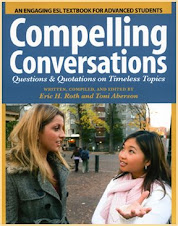
Here is a link to a conversation lesson called “Reading Pleasures and Tastes” that ESL teachers, English teachers, literature lovers and casual readers might enjoy. It’s chapter #16 from Compelling Conversations: Questions and Quotations on Timeless Topics.

http://compellingconversations.com/pdf/reading_pleasures.pdf

Talking about books feels good, collects information, and helps keep our literary traditions alive!

Ask more. Know more. Share more.
Create Compelling Conversations.
Visit www.CompellingConversations.com

Monday, May 12, 2008

Choosing to Speak English Opens Doors

Our students have chosen to speak English because it opens more doors. We should help them realize their ambitions, support their dreams, and avoid judging their motives.

For better or for worse, knowing English makes life easier and better. For instance, the ability to speak English allows individuals to communicate with millions of other people from around the world. Some globalization critics and ethnic nationalists, especially in smaller countries, have attacked English as subverting national and group identities. English speakers tend to be the more educated, more affluent, and more successful individuals in several developing countries. This fact apparently offends many people, including a surprisingly number of ESL teachers, who feel seeking worldly success, money, status, or an international spouse is elitist.

You will also find a rich literature on the use of English in advertisements in non-English speaking countries for the same reasons. Modern technological products and companies, such as LG, advertise in Europe in English their message that "Life is Good". The clear implication is that buying their LG product makes "Life Good" and as does speaking English since only English speakers can understand their ads. Hence, English has also become a symbol of modernism and stylish consumerism. LG is a Korean company!

Attacking the prevalence of English remains popular, and questioning the "morality" of choosing to speak English in some academic circles. This obsession seems misguided and ironic. As English teachers and tutors, we need to carefully assess the full range of aspirations and skills that our students as we choose and develop materials. But assessing does not mean judging them! A teacher should support the legal goals of their students.

If our students need a certain score on a standardized exam (TOEFL, TOEIC, citizenship), we need to choose appropriate materials to meet their immediate goals – including active skills like speaking and writing. The new TOEFL, by the way, is a huge improvement over the old, grammar-focused one used for decades. Speaking has been recognized as a vital life skill.

Yet we also need to help students develop authentic language skills that transcend immediate test scores. Many administrators, for understandable reasons, attempt to force all instruction toward standardized tests. Many English instructors feel that standardized test scores have displaced traditional educational goals. Professor Charles Talcott, for instance, has passionately argued against “The Tyranny of Standardized Testing in English Language Classrooms.”

How many times have you encountered ESL students who have collected impressive test scores yet struggled to express themselves in a simple conversation in English? Students need the chance to develop their conversation skills – in and out of the classroom. Listening and speaking remain essential skills so students can express themselves – even be themselves – in English.

English, an optional language for a majority of the globe, remains a smart choice for our students. They have chosen to be English language learners. Compelling Conversations: Questions and Quotations on Timeless Topics helps English language learners go from students to authentic speakers. Speaking English opens many doors. Can you think of a door you would like to open for your students?