Let ESL students give consumer product reviews in the New Year!
Do you let your students write and deliver product reviews? Consumer reviews help ESL students develop research skills, use critical thinking, and share their consumer choices.
The giving and receiving of gifts has become a central feature of Christmas, Hanukkah, winter solstice and New Year celebrations. We live – for worse or for better – in a consumer age. English language learners, around the world, share in this winter shopping spree. Product reviews allow them to talk about their gift selections and holiday gifts.
Many ESL students, especially young, hip, and wealthy teenagers and college students have also bought into - literally - the odd belief that "you are what you have". Therefore, these English language learners and experienced consumers often love to share their "insights" about consumer products. Product reviews speak to their lifestyles, passions, and curiosity.
As an ESL teacher, I use consumer product reviews to teach the difference between fact and opinion and identify critical thinking skills. The assignment lends itself to reviewing a few key concepts like “details matter” and “numbers add precision” while introducing hedging language. Of course, engaging student interests also leads to better classroom discussions and more use of authentic language.
You can also design a very simple presentation form so everyone can provide peer feedback. Result? The students receive written feedback on their product reviews from you (the teacher) and their classmates. Again, teenagers being teenagers, they love to read about themselves and the feedback. If possible, I also suggest videotaping the student reviews and posting them on a class website for both self and peer reviews.
Teaching high school students possess many challenges, beginning with capturing and holding their interest. Personally, I have found teaching slightly older undergraduate students far more satisfying - and far easier. But I have also had considerable success in short term IEP summer programs with that tough audience. Product reviews have always been a hit!
Here is both my short assignment sheet and a product review worksheet for ESL students.
----------------------------------------------------------------------------------------------------------
YOUR TURN: GIVING A PRODUCT REVIEW
You have probably bought thousands of items as a consumer. You have looked at and considered thousands more. You can’t buy everything; you have to pick and choose the products that fit you and your lifestyle.
Choose a single product and prepare to give a brief product review.
Your product review should include:
• a description of the product
• the way the product is used
• the cost of the product
• a comparison with other, similar products
• a recommendation to buy or not buy the product
• a reason for your recommendation
• a rating on a scale of 1-5
-----------------------------------------------------------------------------------------
PRODUCT REVIEW WORKSHEET
PRODUCT:
PURPOSE:
AUDIENCE:
USE:
COST:
COMPETITORS:
RECOMMENDATION:
REASON:
RATING:
_____________________________________________________________
As an old American cereal commercial used to say, “try it – you’ll like it!”
Ask more. Know more. Share more.
Create Compelling Conversations.
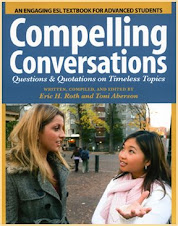
Visit www.CompellingConversations.com
Showing posts with label ESOL. Show all posts
Showing posts with label ESOL. Show all posts
Tuesday, December 23, 2008


Monday, June 9, 2008
Let's Encourage English Students to Make Good Mistakes"
One effective technique is encouraging English students, especially ESL students, to “make good mistakes” as they expand their vocabulary, experiment with new sentence structures, and use English more in their daily lives. A good mistake, as I explain on the first day of class, is a logical error that makes sense, but just happens to be wrong. For example, a young boy might think 2+2= 22. You can see the logic, but the answer is wrong. The student needs to know that 2+2=4. But you can also acknowledge that “22″ is a good mistake. Some teachers might consider this mistake a 'systems error' or 'category confusion.'
Far too many ESL students, especially in countries that still worship standardized exams, have created psychological barriers to experimenting in English. These English language learners often want to avoid making any mistakes, and prefer to remain silent in conversation class to expanding their verbal skills. The ESL teacher, therefore, has to directly confront this trend or learned behavior. You can’t learn to speak a new language without making mistakes.
So I encourage English students, in both conversation and writing classes, to make good mistakes. Take chances. Try something new. Stretch your learning muscles. And make good mistakes. A good mistake is also a mistake that we acknowledge and learn from and avoid repeating. A good mistake is not a good mistake if you’ve made it ten times before in a class or on previous papers. Students usually understand, relax a bit, and proceed to experiment a bit more in our crazy, confusing, and misspelled English language.
Our goal, I sometimes joke on that first day, is to make many good mistakes, learn from these good mistakes, and move forward to make new, different, and even better good mistakes.” We usually realize this goal in our English classes!
Ask more. Know more. Share more.Create Compelling Conversations.
Visit www.CompellingConversations.com
Subscribe to:
Posts (Atom)

 Posts
Posts