Showing posts with label ELL workshops. Show all posts

Wednesday, April 16, 2008

Negative headlines and trendlines for ESL in California public schools

Immigrants remain the future . Smart countries invest in their people, including new immigrants seeking to improve their language skills. Enlightened leadership in California, and the entire United States, would invest in teaching English to immigrants .

Yet the gap between "ought" and "is" remains very wide in Bush's America and in California's public schools.

The dollar continues to decline in value. The national budget, seldom balanced, has zoomed deep into mega-debt during the Bush II era with two expensive wars, a deepening recession, and record tax cuts for the wealthy. The California state budget runs at least a $14 billion dollar deficit. Cutbacks in public education, therefore, seem inevitable.

In California, the governor has pushed for a 10% across the board cut in government programs. Adult education, almost always a step-child to K-12 programs, has been hit exceptionally hard as school boards try to minimize the impact. Of course, many adult education students do not vote so elected officials find cuts easier to make. The growing anti-illegal immigrant sentiment has also helped made ESL programs a natural target for budget cutting. The acute need for far more effective, modern, and well-funded programs to restore some standards to public education gets overlooked - again.

These abstract concerns about cutbacks took a very visible shape at the statewide California Teachers of English to Speakers of Other Languages convention last week. Total attendance was officially down by more than 25% since school districts had few available funds to send administrators, let alone teachers, to the conference. Yet I suspect the real numbers are far, far more dramatic than the reduction from 1600 t0 1200 attendees. Here are some signs of pervasive cutbacks:

  • only a single school district recruited teachers
  • the exhibition hall seemed like a ghost town
  • publishers and vendors were eager to talk about the freezing of public education spending in many districts
  • vendors expressed hope that teachers would buy even more supplies from their personal pockets
  • many workshops collected rather sparse crowds
  • the few job board postings were for summertime Intensive English Programs that attract private, international students
  • the mood, despite many fantastic new educational resources and software programs, seemed very downbeat

Perhaps it's unfair to juxtapose a very hectic, chaotic international teachers' convention in New York City with a far smaller state teachers' convention in Sacramento. Yet this year the two ESL teachers' conventions occurred on consecutive weekends. The contrast could not be clearer.

Teaching English, on a global level, continues to dramatically improve and expand. The development of new software for English language learners, better teaching techniques that respect students and encourage authentic communication, and the increase in international educational point to a better tomorrow. Meanwhile, the news from California's public education system, always troubled, seems to worsen almost daily - especially for immigrant students and ESL teachers. The draconian cutbacks will, again, disproportionately fall on English language programs. Instead of helping immigrants join the national family and learn English, lawmakers will maintain low taxes on the wealthy and eliminate vital educational programs for low-income children and adults. Perhaps improved educational technology and the exceptional efforts of ESL teachers will preserve the under-financed system, but the trends seem to be running in the wrong direction.

Teaching at an elite private university in Los Angeles, I could pretend these cutbacks don't matter to me. Yet that's a dangerous illusion. The collapse of public education, especially for immigrants, will have both immediate and long-term consequences. The expanding gap between the wealthy who can afford a truly wonderful 21st century education and the expanding number of under-educated, over-stressed poor indicates a worsening future for too many Californians. As a stoic philosopher Epictetus noted so long ago, "only the educated are free."

As an American, a Californian, and an English teacher, I don't like the trendlines and headlines for American public education. Do you?

Ask more. Know more. Share more.

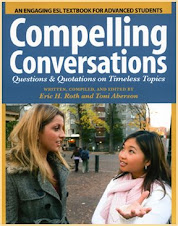
Create Compelling Conversations.

Visit www.compellingconversations.com

Thursday, April 10, 2008

Excellent ESL Teaching resources at TESOL convention

Time flies. Or, as the Romans used to say, "tempus fugit."

Five days after the TESOl convention in New York City ended, I'm finally having a chance to sort through the numerous books, doublecheck website leads, and evaluate materials that I picked up. Sometimes "the eyes are too hungry", and I went a bit overboard in collecting ESL materials and resources for advanced English language learners. Of course, English teachers love books, new curriculum materials, and free ESL materials. I also have the excuse of working as a consultant for a workplace ESL program so I went hunting for some particular products for healthcare workers.

Here is a short list of promising materials:

VSOE ideas from TESOL convention

American Speech Sounds program for Healthcare workers. Also www.eslrules.com has powerful training materials for focused workshops for non-native English speakers working in hospital, clinics, and across the medical field.

- software and textbook designed for foreign doctors and nurses

- great reviews from professional journals (medical, language)

  1. Effective Practices in Workplace Language Training (TESOL)
  2. Getting Ahead in the US (Living Language) – videotape/textbook series
  3. New Citizenship DVD for future naturalization tests. This free DVD, perfect for adult educators, confirms that the new citizenship test will only require a "high beginning" level of ESL to qualify for American citizenship. Personally, I consider this an absurdly low standard that implies new American citizens can speak worse English than at least a half a billion English speakers outside of the United States, the United Kingdom, Canada, and Australia.
    Of course, low standards have many fans in the world of adult education and with many immigrant groups. More on this topic later.
  4. The Center for Applied Linguistics www.cal.org continues to offer wider and deeper variety of resources for ESL teachers, especially for adult education.
  5. I had several fascinating conversations about various English competency tests and their possible use in the workplace. The TOEIC test, on its merits, seems the strongest by far. Unfortunately, this test - used by millions in the workplace worldwide - has become almost forbidden due to lawsuits claiming discrimination in the United States. What does this mean? Millions of applicants and employees in Japan, Korea, Taiwan, France, Germany, and other non-English speaking countries have taken this test of English skills. Why? Because English has become a global language and competency in English has become an essential workplace skill.
  6. But not in the United States! So-called labor and civil rights activists have promoted the concept that requiring English proficiency, as tested by the TOEIC, is discrimination unless the ad explicitly states "English skills required." This strange situation means that American workers can, and so often do , speak at a lower level than educated workers in Asia and Europe. What's wrong with this picture!!!
  7. Software programs continue to become stronger day by day, minute by minute. English language learners, international ESL students, and adult ESL educators have more choices than ever. I will spend a solid chunk of time researching these language programs during my summer break. So far, however, it's clear that www.openbookenglish.com and www.spokenskills.com offer great values for administrators, teachers, and students. ESL teachers will also find www.lessonwriter.com a wonderful, innovative, and time-saving site.
More later, but I must return to a large pile of research reports that need grading!

Ask more. Know more. Share more.
Create Compelling Conversations.
Visit www.CompellingConversations.com

Sunday, March 30, 2008

The Center for Applied Linguistics Suggests Workshops at TESOL

How do you choose which of the many tempting ESL workshops at an international convention of ESL teachers and researchers?

Naturally, I chat with friends and co-workers picking up a few leads. I also exchanged emails. Finally, I consult and explore the internet.

First stop is the outstanding Center for Applied Linguistics website, featuring many resources for ESL teachers, program administrators, and university researchers. Their goal, which I share, is to bridge the huge gap between academic theory and classroom practice, finding effective ways to help adult English language learner gain fluency in our confusing tongue. Adult educators will find a plethora of valuable materials here. Yet ESL teachers working with children will also discover practical information such as an introduction to Student Oral Proficiency Assessment .

As part of my preparation for the TESOL convention, I checked the CAL website for
a list of recommended workshops by CAL researchers. As ever, the Center for Applied Linguistics website provides some practical suggestions.

“World of TESOL, Worlds of Refugees”, “Strategies for Serving High Advanced Adult ESL Students”, and “Building Academic Language Through Scaffolded Instructional Conversations”, and “Analyzing Oral Proficiency to Guide Instruction” sound like sensible, smart choices. “Applying Teacher Input to Improve Assessment” also sounds like an excellent idea. Two other workshops that caught my eye, “Interested in Working as as ESOL Consultant” and “Connecting Culture and Language in ELL Instruction”, but I’m not going to any workshops that start at 7:30 AM or 7:30 PM while visiting New York City.

English teachers, teacher trainers, program administrators should consider bookmarking the site to stay current on research to help ESL, ELL, or EFL students.

Ask more. Know more. Share more. Create Compelling Conversations .

Please visit www.CompellingConversations.com .


Thursday, March 27, 2008

Are you going to the TESOL convention next week?

Are you going to the TESOL conference next week? Did you see all those narrow, niche topics? Have you created a schedule? How did you decide which workshops to attend?

Personally, I found the selections simply overwhelming. For work, I'm going to focus on the workshops on testing language skilsl, especially oral skills and writing. For personal interest, I'll probably go to the workshops on technology and ESL. I might also wander into a few workshops on the internationalization of higher education. But consider me flexible. Do you have any recommendations?

For now, I’m playing it by ear.

I'd be glad to exchange ideas.

Thanks


Eric

eric@compellingconversations.com

www.compellingconversations.com