Why Bring ‘This I Believe’ Essays and Podcasts Into Your English Classroom?
What are your core beliefs? More importantly, what are the core beliefs of your English students? How do you know? Do you like listening to quality radio essays to improve listening skills and critical thinking skills? Are you looking for a friendly way to gently nudge your EFL students into reflecting on their experiences and expressing their ideas?
If so, you might want to consider adding This I Believe radio essays to your curriculum. This I Believe, originally a radio program hosted by legendary journalist Edward R. Murrow in the 1950s, has been resurrected by National Public Radio as a weekly feature.
While the 1950s version sought out short personal essays by leading intellectuals, artists, and prominent personalities, the 21st century version is far more democratic. Anybody can submit an essay – and thousands and thousands of individuals around the world – have.
English teachers and global travelers might appreciate the sample podcast This I Believe: Inviting the World to Dinner by travel writer and Parisian resident Jim Haynes. Students might also appreciate the open spirit and generosity, but if not, they can choose from over 200 other radio essays. In short, The This I Believe website includes a tremendous amount of free resources for teachers and students. Teachers can sign up for the free mailing list and download an exceptional discussion guide. Amazon also sells several collections of This I Believe essays from both the modern version (with audio) and the original collections from over 50 years ago.
Why don’t you try it in your English class? Here is a simple reproducible homework worksheet that allows English students to find, summarize, and share their own favorite podcasts. I usually have students “introduce” their choice in both small groups and before the entire class. After students have listened to several “this I believe” radio essays, they feel more comfortable writing their essay and presenting it before the class for a final project.
So far, my intermediate and advanced students have both enjoyed the assignment and produced original, reflective work. The flexible format also means that English teachers can modify it to meet student or course requirements. Writing instructors can ask for essays; speech instructors can require a speech. Yet students get an often rare chance to hear intelligent voices reveal their personal philosophies in an engaging manner. Further, our students get to speak their minds and share their insights in our strange, wonderful language. I believe that makes a compelling English class too!
As Mr. Murrow would say, “good night and good luck.”
-------------------------------------------------------------------------------
This I Believe Homework Worksheet
Links: This I Believe
http://www.npr.org/templates/story/story.php?storyId=4538138
Please select one radio segment, based on a personal essay, and read by writers. Find a story that resonates with you. Listen carefully. Take notes. Fill out the worksheet below. You will be asked to share your selection with classmates in both a small group and the entire class.
Student:
This I Believe Title:
Author/Reader:
Length:
Who is the author?
What’s the main idea?
Why did you choose this podcast?
Did you hear any new words or phrases?
1.
2.
3.
Who do you imagine is the audience for this podcast? Why?
What is your reaction? Why?
-------------------------------------------------------------------------------------
Ask more. Know more. Share more.
Create Compelling Conversations.
Visit www.CompellingConversations.com
Showing posts with label English teachers. Show all posts
Showing posts with label English teachers. Show all posts
Friday, September 18, 2009


Friday, January 16, 2009
Classroom Experience Trumps Paper Credentials - But Only in the Classroom!
Experience trumps pieces of paper – but only in the classroom!
Let me explain. Many educational institutions, especially in some places, remain paper-driven. Let me give a sad example. I currently teach English at an elite private university and write articles for numerous publications, but I couldn't get a teaching position in a California public school teaching English because I lack the right MA.
Expertise and experience, for many educational institutions, remain of limited use. Former President Clinton could not teach government, history, or social studies in California public schools. Academy Award winning actors can not teach theater in the schools. World class musicians can't teach music. It's utterly absurd.
As a result of this obsession with paper credentials and undervaluing of experience, experts and experienced teachers work with more upper-income students and elite institutions. The considerable gap between public schools and private schools becomes even larger. The public school system continually turns away experienced, quality teachers because of their very narrow notions of what qualifies one to teach students. Sometimes creative, talented teachers decide to teach English abroad to practice their craft, see more of our fascinating world, and share their love of English.
It's also self defeating for public school systems. Students and parents are voting with their feet, and leaving the system. The charter school movement is a direct response to this bureaucratic paradigm. Flexibility and commonsense would encourage professions to teach in schools and make mid-career shifts. I personally know three professionals - a banker and two lawyers - that would also love to teach high school for a few years as a change. Yet rigid regulations and narrow definitions of what makes someone qualified to teach in a California public school classroom prohibit this possibility. Again, students, parents, and potential teachers lose. Who wins by this obsession with paper credentials?
"We learn to walk by stumbling", goes the Bulgarian proverb. Teachers, and students, learn by doing and making good mistakes. Larry M. Lynch, a prolific author, recently examined this problem in “Are Some Credentials Overrated?” on his BetterEFLteacher blog. He nailed the problem with reading 500 books to become a recognized expert instead of just throwing yourself in and gaining experience.
The best teachers are often autotelic (self-directed), and share their passion for learning and model love of knowledge. Adding a PhD after your name doesn't magically transform a student into a dynamic, quality English teacher. Nor does proving one’spatience with boring bureaucratic procedures and reciting the latest educational jargon.
As Ms.Lucy, another English teacher and coordinator, notes, "you either have it - or you don't."
Ask more. Know more. Share more.
Create Compelling Conversations.
Visit www.CompellingConversations.com
Let me explain. Many educational institutions, especially in some places, remain paper-driven. Let me give a sad example. I currently teach English at an elite private university and write articles for numerous publications, but I couldn't get a teaching position in a California public school teaching English because I lack the right MA.
Expertise and experience, for many educational institutions, remain of limited use. Former President Clinton could not teach government, history, or social studies in California public schools. Academy Award winning actors can not teach theater in the schools. World class musicians can't teach music. It's utterly absurd.
As a result of this obsession with paper credentials and undervaluing of experience, experts and experienced teachers work with more upper-income students and elite institutions. The considerable gap between public schools and private schools becomes even larger. The public school system continually turns away experienced, quality teachers because of their very narrow notions of what qualifies one to teach students. Sometimes creative, talented teachers decide to teach English abroad to practice their craft, see more of our fascinating world, and share their love of English.
It's also self defeating for public school systems. Students and parents are voting with their feet, and leaving the system. The charter school movement is a direct response to this bureaucratic paradigm. Flexibility and commonsense would encourage professions to teach in schools and make mid-career shifts. I personally know three professionals - a banker and two lawyers - that would also love to teach high school for a few years as a change. Yet rigid regulations and narrow definitions of what makes someone qualified to teach in a California public school classroom prohibit this possibility. Again, students, parents, and potential teachers lose. Who wins by this obsession with paper credentials?
"We learn to walk by stumbling", goes the Bulgarian proverb. Teachers, and students, learn by doing and making good mistakes. Larry M. Lynch, a prolific author, recently examined this problem in “Are Some Credentials Overrated?” on his BetterEFLteacher blog. He nailed the problem with reading 500 books to become a recognized expert instead of just throwing yourself in and gaining experience.
The best teachers are often autotelic (self-directed), and share their passion for learning and model love of knowledge. Adding a PhD after your name doesn't magically transform a student into a dynamic, quality English teacher. Nor does proving one’spatience with boring bureaucratic procedures and reciting the latest educational jargon.
As Ms.Lucy, another English teacher and coordinator, notes, "you either have it - or you don't."
Ask more. Know more. Share more.
Create Compelling Conversations.
Visit www.CompellingConversations.com
Thursday, January 8, 2009
Surprise Bulk Orders of Compelling Conversations From Amazon
"Next to money, English is the leading international language."
Evan Esar, American humorist
A new semester means more last minute orders of class sets of textbooks, including ESL books. I'm now seeing this situation as both an ESL instructor and a small publisher.
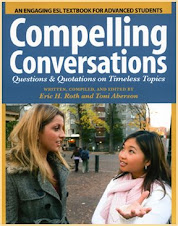
During the last week, several schools and English teachers have purchased class sets of Compelling Conversations: Questions and Quotations on Timeless. Naturally, that development pleases me for many reasons. English teachers using the book in Chile, Rwanda, Hungary, Russia, Canada, and Italy feeds my global soul.
Yet I’ve also been surprised at how many institutions have placed their orders on Amazon where they pay the full price of $24.50 . While ordering on Amazon puts more money in my book, it seems what I call a “good mistake” in my classes. Why?
Because schools, churches, and bookstores can place their orders with Booksurge directly, receive a 40% discount, and save money. Each book will cost $14.70 instead of $24.50. If the adult school or English language school sells the books to student, the institution can even make a nice profit. Schools that provide free ESL textbooks to their students should appreciate the savings because they can also provide more materials to English language learners.
• Bottomline: If you choose to buy Compelling Conversations for your oral skills class, conversation club, or advanced ESL class, save your school and yourself some money. Order your class set from Booksurge, the book’s publisher for wholesale orders.. Call customer service the BookSurge wholesale ordering hotline at 866-308-6235 and select option #6.
Of course, textbook prices do not matter equally to all. Some elite private schools, school administrators, and wealthy English language learners might even prefer to pay full price. Perhaps ordering class sets of hard to find quality ESL books directly on Amazon better fits their needs. Amazon also works better for individual English tutors and teachers.
Yet adult schools, public programs, churches, and smaller language schools ordering 10 or more copies should be - especially in these difficult economic times – more cost conscious. As the old proverb goes, a penny saved is a penny earned.
Thank you to everyone who has already brought Compelling Conversations into their classroom, and thank you to everyone considering Compelling Conversations . I hope that deepening the connections between individuals through smarter, better conversations will help create a better, more humane, and peaceful world.
"Conversation means being able to disagree and still continue the conversation."
Dwight McDonald (1906-1982), American editor
Ask more. Know more. Share more.
Create Compelling Conversations.
Visit www.CompellingConversations.com
Evan Esar, American humorist
A new semester means more last minute orders of class sets of textbooks, including ESL books. I'm now seeing this situation as both an ESL instructor and a small publisher.
During the last week, several schools and English teachers have purchased class sets of Compelling Conversations: Questions and Quotations on Timeless. Naturally, that development pleases me for many reasons. English teachers using the book in Chile, Rwanda, Hungary, Russia, Canada, and Italy feeds my global soul.
Yet I’ve also been surprised at how many institutions have placed their orders on Amazon where they pay the full price of $24.50 . While ordering on Amazon puts more money in my book, it seems what I call a “good mistake” in my classes. Why?
Because schools, churches, and bookstores can place their orders with Booksurge directly, receive a 40% discount, and save money. Each book will cost $14.70 instead of $24.50. If the adult school or English language school sells the books to student, the institution can even make a nice profit. Schools that provide free ESL textbooks to their students should appreciate the savings because they can also provide more materials to English language learners.
• Bottomline: If you choose to buy Compelling Conversations for your oral skills class, conversation club, or advanced ESL class, save your school and yourself some money. Order your class set from Booksurge, the book’s publisher for wholesale orders.. Call customer service the BookSurge wholesale ordering hotline at 866-308-6235 and select option #6.
Of course, textbook prices do not matter equally to all. Some elite private schools, school administrators, and wealthy English language learners might even prefer to pay full price. Perhaps ordering class sets of hard to find quality ESL books directly on Amazon better fits their needs. Amazon also works better for individual English tutors and teachers.
Yet adult schools, public programs, churches, and smaller language schools ordering 10 or more copies should be - especially in these difficult economic times – more cost conscious. As the old proverb goes, a penny saved is a penny earned.
Thank you to everyone who has already brought Compelling Conversations into their classroom, and thank you to everyone considering Compelling Conversations . I hope that deepening the connections between individuals through smarter, better conversations will help create a better, more humane, and peaceful world.
"Conversation means being able to disagree and still continue the conversation."
Dwight McDonald (1906-1982), American editor
Ask more. Know more. Share more.
Create Compelling Conversations.
Visit www.CompellingConversations.com
Friday, December 26, 2008
Do Words Fascinate You? Check out A Way With Words Public Radio Program
A Way With Words: Another Resource for English Teachers and Word Mavens
Do you have a way with words? Are you a lover of word trivia and origins? Are you an English teacher? If so, consider listening to the celebrated public radio show!
Forget forcing students to memorize boring vocabulary lists. Get your English students engaged in the story of English words, their origins, and multiple uses.
A Way with Words, another outstanding public radio show, is co-hosted by Martha Barnette and Grant Barrett (who writes an annual buzzwords of the year survey for the New York Times.) The hour long program examines the English language as the hosts answer listeners' questions about intriguing aspects of the English language, including grammar, vocabulary, idioms, slang, dialects, speaking, and writing. The friendly format also demonstrates excellent discussion skills. Web visitors can also listen to episodes online, down MP3s, and subscribe to podcasts for free.
While the show is better for English teachers and writers than most English language learners or adult ESL students, listeners will gain a greater appreciation for and knowledge of our strange, fascinating language.
Features:
• Free downloads
• Thematic episodes accompanied by a reading text
• Discussion points
• All past episodes are archived chronologically for easy browsing
• Free subscriptions
Site URL: http://www.waywordradio.org/
Check it out!
Word mavens might also be interested in New York Times column on buzzwords:
http://ideas.blogs.nytimes.com/2008/12/22/whats-your-buzzword-of-2008/#comment-2671
As you might suspect, I recommended "lifequake" as a buzzword for 2008 because so many lives suffered sudden changes, like in earthquakes.
Ask more. Know more. Share more.
Create Compelling Conversations.
Visit www.CompellingConversations.com
Do you have a way with words? Are you a lover of word trivia and origins? Are you an English teacher? If so, consider listening to the celebrated public radio show!
Forget forcing students to memorize boring vocabulary lists. Get your English students engaged in the story of English words, their origins, and multiple uses.
A Way with Words, another outstanding public radio show, is co-hosted by Martha Barnette and Grant Barrett (who writes an annual buzzwords of the year survey for the New York Times.) The hour long program examines the English language as the hosts answer listeners' questions about intriguing aspects of the English language, including grammar, vocabulary, idioms, slang, dialects, speaking, and writing. The friendly format also demonstrates excellent discussion skills. Web visitors can also listen to episodes online, down MP3s, and subscribe to podcasts for free.
While the show is better for English teachers and writers than most English language learners or adult ESL students, listeners will gain a greater appreciation for and knowledge of our strange, fascinating language.
Features:
• Free downloads
• Thematic episodes accompanied by a reading text
• Discussion points
• All past episodes are archived chronologically for easy browsing
• Free subscriptions
Site URL: http://www.waywordradio.org/
Check it out!
Word mavens might also be interested in New York Times column on buzzwords:
http://ideas.blogs.nytimes.com/2008/12/22/whats-your-buzzword-of-2008/#comment-2671
As you might suspect, I recommended "lifequake" as a buzzword for 2008 because so many lives suffered sudden changes, like in earthquakes.
Ask more. Know more. Share more.
Create Compelling Conversations.
Visit www.CompellingConversations.com
Tuesday, December 23, 2008
Consumer Product Reviews: Get Your ESL Students Talking About their Consumer Choices
Let ESL students give consumer product reviews in the New Year!
Do you let your students write and deliver product reviews? Consumer reviews help ESL students develop research skills, use critical thinking, and share their consumer choices.
The giving and receiving of gifts has become a central feature of Christmas, Hanukkah, winter solstice and New Year celebrations. We live – for worse or for better – in a consumer age. English language learners, around the world, share in this winter shopping spree. Product reviews allow them to talk about their gift selections and holiday gifts.
Many ESL students, especially young, hip, and wealthy teenagers and college students have also bought into - literally - the odd belief that "you are what you have". Therefore, these English language learners and experienced consumers often love to share their "insights" about consumer products. Product reviews speak to their lifestyles, passions, and curiosity.
As an ESL teacher, I use consumer product reviews to teach the difference between fact and opinion and identify critical thinking skills. The assignment lends itself to reviewing a few key concepts like “details matter” and “numbers add precision” while introducing hedging language. Of course, engaging student interests also leads to better classroom discussions and more use of authentic language.
You can also design a very simple presentation form so everyone can provide peer feedback. Result? The students receive written feedback on their product reviews from you (the teacher) and their classmates. Again, teenagers being teenagers, they love to read about themselves and the feedback. If possible, I also suggest videotaping the student reviews and posting them on a class website for both self and peer reviews.
Teaching high school students possess many challenges, beginning with capturing and holding their interest. Personally, I have found teaching slightly older undergraduate students far more satisfying - and far easier. But I have also had considerable success in short term IEP summer programs with that tough audience. Product reviews have always been a hit!
Here is both my short assignment sheet and a product review worksheet for ESL students.
----------------------------------------------------------------------------------------------------------
YOUR TURN: GIVING A PRODUCT REVIEW
You have probably bought thousands of items as a consumer. You have looked at and considered thousands more. You can’t buy everything; you have to pick and choose the products that fit you and your lifestyle.
Choose a single product and prepare to give a brief product review.
Your product review should include:
• a description of the product
• the way the product is used
• the cost of the product
• a comparison with other, similar products
• a recommendation to buy or not buy the product
• a reason for your recommendation
• a rating on a scale of 1-5
-----------------------------------------------------------------------------------------
PRODUCT REVIEW WORKSHEET
PRODUCT:
PURPOSE:
AUDIENCE:
USE:
COST:
COMPETITORS:
RECOMMENDATION:
REASON:
RATING:
_____________________________________________________________
As an old American cereal commercial used to say, “try it – you’ll like it!”
Ask more. Know more. Share more.
Create Compelling Conversations.
Visit www.CompellingConversations.com
Do you let your students write and deliver product reviews? Consumer reviews help ESL students develop research skills, use critical thinking, and share their consumer choices.
The giving and receiving of gifts has become a central feature of Christmas, Hanukkah, winter solstice and New Year celebrations. We live – for worse or for better – in a consumer age. English language learners, around the world, share in this winter shopping spree. Product reviews allow them to talk about their gift selections and holiday gifts.
Many ESL students, especially young, hip, and wealthy teenagers and college students have also bought into - literally - the odd belief that "you are what you have". Therefore, these English language learners and experienced consumers often love to share their "insights" about consumer products. Product reviews speak to their lifestyles, passions, and curiosity.
As an ESL teacher, I use consumer product reviews to teach the difference between fact and opinion and identify critical thinking skills. The assignment lends itself to reviewing a few key concepts like “details matter” and “numbers add precision” while introducing hedging language. Of course, engaging student interests also leads to better classroom discussions and more use of authentic language.
You can also design a very simple presentation form so everyone can provide peer feedback. Result? The students receive written feedback on their product reviews from you (the teacher) and their classmates. Again, teenagers being teenagers, they love to read about themselves and the feedback. If possible, I also suggest videotaping the student reviews and posting them on a class website for both self and peer reviews.
Teaching high school students possess many challenges, beginning with capturing and holding their interest. Personally, I have found teaching slightly older undergraduate students far more satisfying - and far easier. But I have also had considerable success in short term IEP summer programs with that tough audience. Product reviews have always been a hit!
Here is both my short assignment sheet and a product review worksheet for ESL students.
----------------------------------------------------------------------------------------------------------
YOUR TURN: GIVING A PRODUCT REVIEW
You have probably bought thousands of items as a consumer. You have looked at and considered thousands more. You can’t buy everything; you have to pick and choose the products that fit you and your lifestyle.
Choose a single product and prepare to give a brief product review.
Your product review should include:
• a description of the product
• the way the product is used
• the cost of the product
• a comparison with other, similar products
• a recommendation to buy or not buy the product
• a reason for your recommendation
• a rating on a scale of 1-5
-----------------------------------------------------------------------------------------
PRODUCT REVIEW WORKSHEET
PRODUCT:
PURPOSE:
AUDIENCE:
USE:
COST:
COMPETITORS:
RECOMMENDATION:
REASON:
RATING:
_____________________________________________________________
As an old American cereal commercial used to say, “try it – you’ll like it!”
Ask more. Know more. Share more.
Create Compelling Conversations.
Visit www.CompellingConversations.com
Saturday, November 15, 2008
Talking About Urban Pleasures, Perils in ESL Classrooms
Cities attract the young, the strong, and the ambitious. Cities also provide housing, jobs, and hope for those fleeing boredom, economic crisis, and war. Our 21st century cities, like our English classrooms, reflect the diversity of the human experience.
Millions move from the countryside and across the globe to live in new cities every year. Cities provide employment, culture, and education. Cities are exciting. Yet, sometimes danger also lurks in cities. Many students struggle with economic pressures, culture shock, and criminal activity. Shouldn't we discuss these conflicting pressures in our ESL classrooms?
Teaching English in Los Angeles and Santa Monica I’ve found that students, who come from across the globe, eager to talk about cities. Some English students share stories about moving from rural areas and small towns to an international city; other students enjoy telling about their travel experiences. Discussions naturally touch on housing, employment, and lifestyle choices. English language learners – whether adult immigrants creating a new home or university students living abroad – can reflect on their experiences and share insights discussing urban life.
Are you a city person? Why?
How are cities different from small towns?
What cities have you visited? Lived in?
What attracted you to this city?
What do you find stressful about city life?
What do you find satisfying about living in a city?
This month Exploring Cities, one of my favorite chapters, is highlighted as a free chapter on Compelling Conversations. Perhaps you will create some compelling conversations about cities in your classroom too. Check it out.
Ask more. Know more. Share more.
Create Compelling Conversations.
Visit www.CompellingConversations.com
Millions move from the countryside and across the globe to live in new cities every year. Cities provide employment, culture, and education. Cities are exciting. Yet, sometimes danger also lurks in cities. Many students struggle with economic pressures, culture shock, and criminal activity. Shouldn't we discuss these conflicting pressures in our ESL classrooms?
Teaching English in Los Angeles and Santa Monica I’ve found that students, who come from across the globe, eager to talk about cities. Some English students share stories about moving from rural areas and small towns to an international city; other students enjoy telling about their travel experiences. Discussions naturally touch on housing, employment, and lifestyle choices. English language learners – whether adult immigrants creating a new home or university students living abroad – can reflect on their experiences and share insights discussing urban life.
Are you a city person? Why?
How are cities different from small towns?
What cities have you visited? Lived in?
What attracted you to this city?
What do you find stressful about city life?
What do you find satisfying about living in a city?
This month Exploring Cities, one of my favorite chapters, is highlighted as a free chapter on Compelling Conversations. Perhaps you will create some compelling conversations about cities in your classroom too. Check it out.
Ask more. Know more. Share more.
Create Compelling Conversations.
Visit www.CompellingConversations.com
Thursday, November 6, 2008
Who Makes the Rules? Who Chooses the Rulers? Obama Confirms Power of American Democracy!
Who makes the rules? Who chooses the rulers? Can citizens peacefully replace corrupt leaders?
In the United States of America, voters enjoy their opportunity to hire and fire the President. On Tuesday, American citizens voted, selected a new leader, and millions of people around the nation smiled, laughed, and felt hopeful again. Senator Obama, as so often, captured the power and beauty of the peaceful transfer of power in his eloquent victory speech.
"If there is anyone out there who still doubts that America is a place where all things are possible; who still wonders if the dream of our founders is alive in our time; who still questions the power of our democracy, tonight is your answer. "
Barack Hussein Obama (1961- ), President-elect of the United States
I, like so many Americans, feel very proud. We are coming back – to our ideals, our citizens, and our best traditions! The United States, the first nation explicitly created on enlightenment ideals, will become an inspiring 21st century nation.
This surprising election seems like a very teachable moment. Immigrants and international students can rest assured that they made the right decision to come to the United States. English language learners around the world should feel the enlarged possibilities that come with our strange tongue. European sceptics and Arab critics should candidly reassess their prejudices about Americans and the American government. After all, Obama – the son of an international African student and an adventurous Midwestern scholar – has just won the Presidency of the United States. Where else could that happen?
Let's talk about the power of elections and democratic values in our English classes. Let's discuss the possibilities for peaceful reform, voting, and the rights of citizens to choose their own leaders. ESL/Civics classes always discuss these questions, but English teachers should also celebrate this Anglo-American tradition in English language classes around the world. Let's start defending Western values in our classes- and even promoting western democratic principles. Human rights matter. Democracy matters. Freedom counts. The good society can face its problems, openly debate vital public policy issues, and peacefully elect new leaders.
Click here for a free advanced ESL conversation lesson on Voting from Compelling Conversations.
Ask more. Know more. Share more.
Create Compelling Conversations.
Visit www.CompellingConversations.com
In the United States of America, voters enjoy their opportunity to hire and fire the President. On Tuesday, American citizens voted, selected a new leader, and millions of people around the nation smiled, laughed, and felt hopeful again. Senator Obama, as so often, captured the power and beauty of the peaceful transfer of power in his eloquent victory speech.
"If there is anyone out there who still doubts that America is a place where all things are possible; who still wonders if the dream of our founders is alive in our time; who still questions the power of our democracy, tonight is your answer. "
Barack Hussein Obama (1961- ), President-elect of the United States
I, like so many Americans, feel very proud. We are coming back – to our ideals, our citizens, and our best traditions! The United States, the first nation explicitly created on enlightenment ideals, will become an inspiring 21st century nation.
This surprising election seems like a very teachable moment. Immigrants and international students can rest assured that they made the right decision to come to the United States. English language learners around the world should feel the enlarged possibilities that come with our strange tongue. European sceptics and Arab critics should candidly reassess their prejudices about Americans and the American government. After all, Obama – the son of an international African student and an adventurous Midwestern scholar – has just won the Presidency of the United States. Where else could that happen?
Let's talk about the power of elections and democratic values in our English classes. Let's discuss the possibilities for peaceful reform, voting, and the rights of citizens to choose their own leaders. ESL/Civics classes always discuss these questions, but English teachers should also celebrate this Anglo-American tradition in English language classes around the world. Let's start defending Western values in our classes- and even promoting western democratic principles. Human rights matter. Democracy matters. Freedom counts. The good society can face its problems, openly debate vital public policy issues, and peacefully elect new leaders.
Click here for a free advanced ESL conversation lesson on Voting from Compelling Conversations.
Ask more. Know more. Share more.
Create Compelling Conversations.
Visit www.CompellingConversations.com
Thursday, September 11, 2008
Revising the ESL Curriculum and Finding Solace with Quotes
“Do what you can, with what you have, where you are,” advised President Theodore (Teddy) Roosevelt. These words of solace often comfort me when I stress myself out trying to cram too much material into lessons.
How can I cover everything that I want in a single semester? It’s just impossible. For every new activity, I must let an old one go. If I add a Youtube homework assignment, than I should eliminate another homework assignment to maintain the balance. For instance, I asked every student to find and review a YouTube video on interview skills so I had to cut the assignment where students found and summarize an article on job hunting skills.
By the way, the international graduate English students found and reviewed a wonderful collection of smart, informative, current, and funny videos. Then I combined into a single email for the entire class with one of my own selections. On their own time and initiative, students watched many of the videos leading to the best mock job interviews that I’ve seen at the intermediate speaking skill level yet. Again, a democratic classroom atmosphere often creates a far more interesting and effective classroom.
As I continue to plan, adjust, and readjust assignments, I once again find solace in these words. Yet these continual curriculum revisions remain voluntary tasks in pursuit of excellence. “A problem,” noted Duke Ellington, “is a chance for you to do your best.”
Ask more. Know more. Share more.
Create Compelling Conversations.
Visit www.CompellingConversations.com
How can I cover everything that I want in a single semester? It’s just impossible. For every new activity, I must let an old one go. If I add a Youtube homework assignment, than I should eliminate another homework assignment to maintain the balance. For instance, I asked every student to find and review a YouTube video on interview skills so I had to cut the assignment where students found and summarize an article on job hunting skills.
By the way, the international graduate English students found and reviewed a wonderful collection of smart, informative, current, and funny videos. Then I combined into a single email for the entire class with one of my own selections. On their own time and initiative, students watched many of the videos leading to the best mock job interviews that I’ve seen at the intermediate speaking skill level yet. Again, a democratic classroom atmosphere often creates a far more interesting and effective classroom.
As I continue to plan, adjust, and readjust assignments, I once again find solace in these words. Yet these continual curriculum revisions remain voluntary tasks in pursuit of excellence. “A problem,” noted Duke Ellington, “is a chance for you to do your best.”
Ask more. Know more. Share more.
Create Compelling Conversations.
Visit www.CompellingConversations.com
Friday, September 5, 2008
A new semester, new English students, and new forms
What are you doing differently this semester in your English class?
As a new semester begins, I face the familiar task - and pleasure - of selecting new materials and creating new forms for my oral skills class. One goal is to have students use the internet more; another to provide more opportunities for peer feedback on oral presentations.
Although I do not have a conversation class this semester, I do teach a high intermediate oral skills class that focuses on academic presentations. The students come from several Asian countries and are all graduate students - almost exclusively in engineering. Workplace surveys continue to identify communication skills, including speaking skills, as a top priority for employers - especially in engineering!
The class will include several informal, short presentations in addition to the longer, more formal presentations that receive a grade. Whenever possible, I prefer to give students to receive fairly immediate feedback, from their peers and me, on their presentations. Students, as a result, will read peer evaluations from the entire class after giving a short presentation like a product review, extended definition, or process description. To be effective, the form must be both simple and open… with some guidance. This collective feedback often validates instructor comments and prepares students to view their videotaped presentations in a more objective manner.
Here is my new form for peer evaluations of oral presentations.It emphasizes the positive aspects, inquires about what can be improved, allows more detailed observations, and provides a simple rating system. I have used a similar format with my engineering communication courses and expect that it will work in my ESL class too. Time will tell.
Feel free to copy, modify, or share the form to fit your ESL/EFL/speech classroom needs.
————————————————————————————-
STUDENT: ____________________________________________________
TOPIC: ____________________________________________________
PEER: ____________________________________________________
GOOD TO SEE:
POINTS TO WORK ON:
BEST PART:
WEAKEST PART:
OTHER OBSERVATIONS/TIPS:
Please circle the appropriate overall rating:
1 2 3 4 5 6 7 8 9 10
Ask more. Know more. Share more.
Create Compelling Conversations.
Visit www.CompellingConversations.com
As a new semester begins, I face the familiar task - and pleasure - of selecting new materials and creating new forms for my oral skills class. One goal is to have students use the internet more; another to provide more opportunities for peer feedback on oral presentations.
Although I do not have a conversation class this semester, I do teach a high intermediate oral skills class that focuses on academic presentations. The students come from several Asian countries and are all graduate students - almost exclusively in engineering. Workplace surveys continue to identify communication skills, including speaking skills, as a top priority for employers - especially in engineering!
The class will include several informal, short presentations in addition to the longer, more formal presentations that receive a grade. Whenever possible, I prefer to give students to receive fairly immediate feedback, from their peers and me, on their presentations. Students, as a result, will read peer evaluations from the entire class after giving a short presentation like a product review, extended definition, or process description. To be effective, the form must be both simple and open… with some guidance. This collective feedback often validates instructor comments and prepares students to view their videotaped presentations in a more objective manner.
Here is my new form for peer evaluations of oral presentations.It emphasizes the positive aspects, inquires about what can be improved, allows more detailed observations, and provides a simple rating system. I have used a similar format with my engineering communication courses and expect that it will work in my ESL class too. Time will tell.
Feel free to copy, modify, or share the form to fit your ESL/EFL/speech classroom needs.
————————————————————————————-
STUDENT: ____________________________________________________
TOPIC: ____________________________________________________
PEER: ____________________________________________________
GOOD TO SEE:
POINTS TO WORK ON:
BEST PART:
WEAKEST PART:
OTHER OBSERVATIONS/TIPS:
Please circle the appropriate overall rating:
1 2 3 4 5 6 7 8 9 10
Ask more. Know more. Share more.
Create Compelling Conversations.
Visit www.CompellingConversations.com
Sunday, August 3, 2008
Solzhenitsyn, Free Speech, and Teaching English
“Own only what you can always carry with you; know languages, know countries, know people. Let your memory be your travel bag.”
Alexander Solzhenitsyn (1918-2008), Russian writer and Nobel Prize winner
Alexander Solzhenitsyn, an exceptional writer of rare courage, died today. English teachers, lovers of literature, and people conscience will find his long obituary in the International Herald Tribune worth reading.
While far too many western leftists preferred to close their eyes to the nature and brutality of the Soviet slave labor system, Solzhenitsyn wrote novels that detailed the misery and repression created by the communists. His writings also made it impossible for even the most naïve leftist intellectuals to deny Stalin’s gulags – and how millions looked away. He won the Nobel Prize for Literature in 1970, but the Soviet authorities naturally prevented him from accepting his award. He spent 20 years in prison camps for his writings.
Do you have English language students from Russia? Do you know immigrants and refugees who spent their youth under the Soviet system? How did living under a communist dictatorship distort human relationships? Solzhenitsyn’s writings, once censored, may help you better understand some of the historical and cultural factors that have influenced your students and their worldviews.
Personally, I found working with Russian refugees and immigrants a very eye-opening experience. The more you learn about the old Soviet system, the more you appreciate the American tradition of individual rights and political freedom. Solzhenitsyn wrote in his 1967 novel, The Cancer Ward, about the consequences of silent conformity with Stalin’s crimes. "Suddenly all the professors and engineers turned out to be saboteurs — and they believed it? ... Or all of Lenin's old guard were vile renegades — and they believed it? Suddenly all their friends and acquaintances were enemies of the people — and they believed it?" Everyone, as in Nazi Germany, knew and didn’t want to know.
Free speech and free press remain under siege – in the United States, often from self-righteous idealists. Solzhenitsyn’s writings serve as a powerful rebuke to coercive utopians, and illuminate the power of personal choices under the most severe stress.
ESL teachers, especially EL/Civics teachers in adult education, need to emphasize the beauty, rarity, and wisdom of the first amendment guaranteeing free speech and a free press. Educators and librarians need to resist the pressure, and the temptation, to censor themselves "for the children." Classrooms must remain rare zones where ideas are openly discussed.
I chose Solzhenitsyn’s quote for the dedication page of Compelling Conversations: Questions and Quotations on Timeless Topics to remind myself – and others – to look beyond material possessions. We need to stay awake and remain sane – even if our society begins to sprout social cancers and asking simple questions becomes dangerous.
Solzhenitsyn provides a model of resistance to tyranny.
Ask more. Know more. Share more.
Create Compelling Conversations.
Visit www.CompellingConversations.com
Alexander Solzhenitsyn (1918-2008), Russian writer and Nobel Prize winner
Alexander Solzhenitsyn, an exceptional writer of rare courage, died today. English teachers, lovers of literature, and people conscience will find his long obituary in the International Herald Tribune worth reading.
While far too many western leftists preferred to close their eyes to the nature and brutality of the Soviet slave labor system, Solzhenitsyn wrote novels that detailed the misery and repression created by the communists. His writings also made it impossible for even the most naïve leftist intellectuals to deny Stalin’s gulags – and how millions looked away. He won the Nobel Prize for Literature in 1970, but the Soviet authorities naturally prevented him from accepting his award. He spent 20 years in prison camps for his writings.
Do you have English language students from Russia? Do you know immigrants and refugees who spent their youth under the Soviet system? How did living under a communist dictatorship distort human relationships? Solzhenitsyn’s writings, once censored, may help you better understand some of the historical and cultural factors that have influenced your students and their worldviews.
Personally, I found working with Russian refugees and immigrants a very eye-opening experience. The more you learn about the old Soviet system, the more you appreciate the American tradition of individual rights and political freedom. Solzhenitsyn wrote in his 1967 novel, The Cancer Ward, about the consequences of silent conformity with Stalin’s crimes. "Suddenly all the professors and engineers turned out to be saboteurs — and they believed it? ... Or all of Lenin's old guard were vile renegades — and they believed it? Suddenly all their friends and acquaintances were enemies of the people — and they believed it?" Everyone, as in Nazi Germany, knew and didn’t want to know.
Free speech and free press remain under siege – in the United States, often from self-righteous idealists. Solzhenitsyn’s writings serve as a powerful rebuke to coercive utopians, and illuminate the power of personal choices under the most severe stress.
ESL teachers, especially EL/Civics teachers in adult education, need to emphasize the beauty, rarity, and wisdom of the first amendment guaranteeing free speech and a free press. Educators and librarians need to resist the pressure, and the temptation, to censor themselves "for the children." Classrooms must remain rare zones where ideas are openly discussed.
I chose Solzhenitsyn’s quote for the dedication page of Compelling Conversations: Questions and Quotations on Timeless Topics to remind myself – and others – to look beyond material possessions. We need to stay awake and remain sane – even if our society begins to sprout social cancers and asking simple questions becomes dangerous.
Solzhenitsyn provides a model of resistance to tyranny.
Ask more. Know more. Share more.
Create Compelling Conversations.
Visit www.CompellingConversations.com
Sunday, July 20, 2008
Volume Matters
Speaking too loud can be annoying and push people away. Speaking too softly, however, can be an even larger obstacle to simple communication and a satisfying conversation.
During classroom discussions in English class, some students to will boldly speak their mind. Other students tend to hold back, offer only the safest comments, and other share their wit. One overlooked, essential quality to speech in class, however, is volume. Students must speak loud enough that their fellow students can hear them - whether seated in the front or back row.
One can, however, sympathize with the timid English students who speak softer than ideal in a large classroom.
Being inaudible, however, in personal conversations remains a far more serious problem - especially for English as a Second Language (ESL) students.
Ask more. Know more. Share more.
Create Compelling Conversations.
Visit www.CompellingConversations.com
During classroom discussions in English class, some students to will boldly speak their mind. Other students tend to hold back, offer only the safest comments, and other share their wit. One overlooked, essential quality to speech in class, however, is volume. Students must speak loud enough that their fellow students can hear them - whether seated in the front or back row.
One can, however, sympathize with the timid English students who speak softer than ideal in a large classroom.
Being inaudible, however, in personal conversations remains a far more serious problem - especially for English as a Second Language (ESL) students.
Student conferences, especially with shy students worried about their grade or academic performance, can often be a bit awkward for both the professor and student. ESL (English as a Second Language) students, sometimes insecure about their pronunciation or vocabulary, can feel particularly anxious. ESL and other English teachers have to find ways to reduce student anxiety, provide a safe place for English students to speak, provide feedback on student work, and uphold academic standards. (Adult education, by the way, would be greatly improved if ESL teachers had more opportunities for student conferences.)
In general, I find student conferences very productive and satisfying because you get a chance to really work with a college student on their writings and assignments. I often feel that I learn as much as I teach in these 20-30 minute student conferences.
Sometimes, however, I have awkward conferences. If the student has plagiarized, then this can’t be avoided. Those moments, which I dread, can not be avoided. So it goes.
Yet sometimes, as occurred last semester, an ESL (English as a Second Language) student is so shy, so timid, and so unsure that they speak so softly that I can’t even hear. Sometimes I lean forward and ask them to please speak a bit louder. If a student continues in the same low volume, I might apologize for my poor hearing and again request they speak up. What does one do on the third request?
“Please speak a bit louder so I can hear you.”
Was this too direct? I wanted to say, “If I can’t hear you, you will be misunderstood. I want to understand you. Speak up!!”
Patience, this time, paid off. The student raised her voice to an audible level, and replied, “okay.”
“Good to hear you,” I replied. We proceeded to have a productive end of semester conference.
English and ESL teachers at all levels, from elementary school and high school to adult school and university, need to emphasize the importance of student speech being comprehensible. That includes speaking loud enough that conversation partners, classmates, and instructors can hear.
Bottomline: students must speak up in conversations, conferences, and class discussions. Volume matters.Ask more. Know more. Share more.
Create Compelling Conversations.
Visit www.CompellingConversations.com
Friday, June 27, 2008
Looking for Teaching Ideas? Check out English Teaching Forum!
Have you read English Teaching Forum magazine yet? It’s another outstanding resource for English language teachers whether working with adults in
I’ve subscribed for a year, and consistently been impressed at the depth, range, and creativity of the articles. The practical articles offer classroom suggestions that can be immediately used, putting many more academic publications on teaching English to shame. I’m keeping all my past issues of English Teaching Forum. I also wish more government sponsored educational efforts attained this high-quality. Perhaps excellence in public education will become fashionable again.
Fortunately, older issues of English Teaching Forum are also available online. The archives go back several years. You can read the Winter 2007 issue online. Each article can be downloaded in a separate PDF file, allowing teachers to pick and choose their favorite articles. Unfortunately, the 2008 issues remain in print form only. You can also find other valuable teacher resources at
http://exchanges.state.gov/education/engteaching/ .
Ask more. Know more. Share more.
Create Compelling Conversations.
Visit www.CompellingConversations.com
Monday, June 9, 2008
Let's Encourage English Students to Make Good Mistakes"
One effective technique is encouraging English students, especially ESL students, to “make good mistakes” as they expand their vocabulary, experiment with new sentence structures, and use English more in their daily lives. A good mistake, as I explain on the first day of class, is a logical error that makes sense, but just happens to be wrong. For example, a young boy might think 2+2= 22. You can see the logic, but the answer is wrong. The student needs to know that 2+2=4. But you can also acknowledge that “22″ is a good mistake. Some teachers might consider this mistake a 'systems error' or 'category confusion.'
Far too many ESL students, especially in countries that still worship standardized exams, have created psychological barriers to experimenting in English. These English language learners often want to avoid making any mistakes, and prefer to remain silent in conversation class to expanding their verbal skills. The ESL teacher, therefore, has to directly confront this trend or learned behavior. You can’t learn to speak a new language without making mistakes.
So I encourage English students, in both conversation and writing classes, to make good mistakes. Take chances. Try something new. Stretch your learning muscles. And make good mistakes. A good mistake is also a mistake that we acknowledge and learn from and avoid repeating. A good mistake is not a good mistake if you’ve made it ten times before in a class or on previous papers. Students usually understand, relax a bit, and proceed to experiment a bit more in our crazy, confusing, and misspelled English language.
Our goal, I sometimes joke on that first day, is to make many good mistakes, learn from these good mistakes, and move forward to make new, different, and even better good mistakes.” We usually realize this goal in our English classes!
Ask more. Know more. Share more.Create Compelling Conversations.
Visit www.CompellingConversations.com
Tuesday, May 27, 2008
Do you ask questions on your attendance sheet in ESL class?
What makes you smile? Can you recommend a good movie? What's your favorite song? How do you prepare for a test? How do you relax? Do you have a favorite English word?
Create Compelling Conversations.
Visit www.CompellingConversations.com
Can you turn a bureaucratic requirement into a communication tool to express personal ideas and build classroom community? Absolutely.
Students appreciate the opportunity to express their ideas and perceptions, and learn more about their classmates. The questions also help build a better classroom atmosphere and provide ice-breakers for students to talk with each other during break. Finally, this extra line turns a boring procedure into an educational tool that works for administrators, teachers, and students.
I consider that a win-win-win situation. What's not to like?
Create Compelling Conversations.
Visit www.CompellingConversations.com
Thursday, April 24, 2008
Please speak a bit louder so I can hear you
Student conferences, especially with shy students worried about their grade or academic performance, can often be a bit awkward for both the professor and student. ESL students, sometimes insecure about their pronunciation or vocabulary, can feel particularly anxious. ESL teachers have to find ways to reduce student anxiety, provide a safe place for students to speak, provide feedback on student work, and uphold standards.
In general, I love student conferences because you get a chance to really work with a student on their writings and assignments. I often feel that I learn as much as I teach in these 20-30 minute conferences.
Sometimes, however, I have awkward conferences. If the student has plagiarized, then this can’t be avoided. Those moments, which I dread, can not be avoided. So it goes.
Yet sometimes, as occurred last semester, an ESL student is so shy, so timid, and so unsure that they speak so softly that I can’t even hear. Sometimes I lean forward and ask them to please speak a bit louder. If a student continues in the same low volume, I might apologize for my poor hearing and again request they speak up. What does one do on the third request?
“Please speak a bit louder so I can hear you.”
Was this too direct? I wanted to say, “If I can’t hear you, you will be misunderstood. I want to understand you. Speak up!!”
Patience, this time, paid off. The student raised her voice to an audible level, and replied, “okay.”
“Good to hear you,” I replied. We proceeded to have a productive end of semester conference.
Bottomline: students must speak up in conversations, conferences, and class discussions. Volume matters.
Ask more. Know more. Share more.
Create Compelling Conversations.
Visit www.CompellingConversations.com
Monday, April 21, 2008
Investing in quality ESL classes improves daily life
A good society helps its citizens flourish and visitors feel welcome.
A good society also invests in education, including teaching immigrants enough English that they can use their considerable intelligence, creativity, and skills in the workplace.
Unfortunately, low standards in public education have eroded support for government sponsored education programs. Worse, the few underfunded English as a Second Language programs usually provide the most basic English skills. Students learn to listen and read at about 4th grade level, and speak like a child with a very limited vocabulary.
From my perspective as an English instructor and former adult ESL teacher, the current adult ESL standards too often only teach immigrants passive skills like listening and some minimum reading. English language programs, whether designed for vocational skills or general language, must include speaking and writing. If people can’t hold a conversation in English, their job prospects remain rather limited!
A frontpage article in today’s Los Angeles Times points out the obvious problem.
When will the employers and voters decide to invest in real, serious, quality English languages for immigrants? And why are immigrants trained in English programs abroad so much stronger, better, and more effective than the adult ESL programs here? After all, immigrants have many more opportunities to speak English and learn outside of the classroom than students in
Again, the case for dramatically expanding and raising the standards of our English as a Second Language programs seems clear.
Unfortunately, reason and government policy do not always co-exist in the
Ask more. Know more. Share more.
Create Compelling Conversations.
Friday, April 18, 2008
Does Uncle Sam Want Immigrants to Learn English?
Learning to read, write, and speak English remains a legal requirement for legal immigrants to become citizens in the
Yet funding for English language classes, especially for adults, remains quite limited. Government programs only help students learn rather basic English, often around 1200 essential words. Students can "pass" all their ESL classes and learn enough English to hold low-level jobs. ESL students learn to listen more than speak, and read more than write. These low standards, by the way, also include a very, very low level definition of "can read, write, and speak" English for citizenship. (More on this subject in future posts.)
Many states, like
" Uncle Sam wants you to speak English" reads a popular bumper-sticker. Uncle Sam, the traditional symbol for the
I saw this bumper-sticker on the way back from an English teacher's conference again last week. I also wondered about the driver. Does he support helping immigrants learn English? Does he really think immigrants who don't speak English will understand his message? Would a Spanish speaking immigrant, for instance, know who Uncle Sam is? Or is the driver simply stating that immigrants - who might speak two, three, four, or more languages - should only speak English in the
Unfortunately, I never had a chance to talk with the gentleman who placed this provocative message on his car. I don't really know what he meant by his "Uncle Sam wants you to speak English" bumper-sticker. I hope, however, that he supports adding, not cutting, English language classes. We both would like more people to be able to speak to him and ask him questions in his best language too. How does the driver expect his wish to come true?
Perhaps if "Uncle Sam wants you to speak English", than he could find more ways to help immigrants and refugees learn English!
Create Compelling Conversations.
Visit www.compellingconversations.com .
Wednesday, April 16, 2008
Negative headlines and trendlines for ESL in California public schools
Yet the gap between "ought" and "is" remains very wide in Bush's America and in California's public schools.
The dollar continues to decline in value. The national budget, seldom balanced, has zoomed deep into mega-debt during the Bush II era with two expensive wars, a deepening recession, and record tax cuts for the wealthy. The
In
These abstract concerns about cutbacks took a very visible shape at the statewide California Teachers of English to Speakers of Other Languages convention last week. Total attendance was officially down by more than 25% since school districts had few available funds to send administrators, let alone teachers, to the conference. Yet I suspect the real numbers are far, far more dramatic than the reduction from 1600 t0 1200 attendees. Here are some signs of pervasive cutbacks:
- only a single school district recruited teachers
- the exhibition hall seemed like a ghost town
- publishers and vendors were eager to talk about the freezing of public education spending in many districts
- vendors expressed hope that teachers would buy even more supplies from their personal pockets
- many workshops collected rather sparse crowds
- the few job board postings were for summertime Intensive English Programs that attract private, international students
- the mood, despite many fantastic new educational resources and software programs, seemed very downbeat
Perhaps it's unfair to juxtapose a very hectic, chaotic international teachers' convention in
Teaching English, on a global level, continues to dramatically improve and expand. The development of new software for English language learners, better teaching techniques that respect students and encourage authentic communication, and the increase in international educational point to a better tomorrow. Meanwhile, the news from
Teaching at an elite private university in Los Angeles, I could pretend these cutbacks don't matter to me. Yet that's a dangerous illusion. The collapse of public education, especially for immigrants, will have both immediate and long-term consequences. The expanding gap between the wealthy who can afford a truly wonderful 21st century education and the expanding number of under-educated, over-stressed poor indicates a worsening future for too many Californians. As a stoic philosopher Epictetus noted so long ago, "only the educated are free."
As an American, a Californian, and an English teacher, I don't like the trendlines and headlines for American public education. Do you?
Ask more. Know more. Share more.
Create Compelling Conversations.
Visit www.compellingconversations.com
Thursday, April 10, 2008
Excellent ESL Teaching resources at TESOL convention
Time flies. Or, as the Romans used to say, "tempus fugit."
Five days after the TESOl convention in New York City ended, I'm finally having a chance to sort through the numerous books, doublecheck website leads, and evaluate materials that I picked up. Sometimes "the eyes are too hungry", and I went a bit overboard in collecting ESL materials and resources for advanced English language learners. Of course, English teachers love books, new curriculum materials, and free ESL materials. I also have the excuse of working as a consultant for a workplace ESL program so I went hunting for some particular products for healthcare workers.
Here is a short list of promising materials:
VSOE ideas from TESOL convention
- software and textbook designed for foreign doctors and nurses
- great reviews from professional journals (medical, language)
- Effective Practices in Workplace Language Training (TESOL)
- Getting Ahead in the
- New Citizenship DVD for future naturalization tests. This free DVD, perfect for adult educators, confirms that the new citizenship test will only require a "high beginning" level of ESL to qualify for American citizenship. Personally, I consider this an absurdly low standard that implies new American citizens can speak worse English than at least a half a billion English speakers outside of the United States, the United Kingdom, Canada, and Australia.
Of course, low standards have many fans in the world of adult education and with many immigrant groups. More on this topic later. - The Center for Applied Linguistics www.cal.org continues to offer wider and deeper variety of resources for ESL teachers, especially for adult education.
- I had several fascinating conversations about various English competency tests and their possible use in the workplace. The TOEIC test, on its merits, seems the strongest by far. Unfortunately, this test - used by millions in the workplace worldwide - has become almost forbidden due to lawsuits claiming discrimination in the United States. What does this mean? Millions of applicants and employees in Japan, Korea, Taiwan, France, Germany, and other non-English speaking countries have taken this test of English skills. Why? Because English has become a global language and competency in English has become an essential workplace skill.
- But not in the United States! So-called labor and civil rights activists have promoted the concept that requiring English proficiency, as tested by the TOEIC, is discrimination unless the ad explicitly states "English skills required." This strange situation means that American workers can, and so often do , speak at a lower level than educated workers in Asia and Europe. What's wrong with this picture!!!
- Software programs continue to become stronger day by day, minute by minute. English language learners, international ESL students, and adult ESL educators have more choices than ever. I will spend a solid chunk of time researching these language programs during my summer break. So far, however, it's clear that www.openbookenglish.com and www.spokenskills.com offer great values for administrators, teachers, and students. ESL teachers will also find www.lessonwriter.com a wonderful, innovative, and time-saving site.
Ask more. Know more. Share more.
Create Compelling Conversations.
Visit www.CompellingConversations.com
Sunday, March 30, 2008
The Center for Applied Linguistics Suggests Workshops at TESOL
How do you choose which of the many tempting ESL workshops at an international convention of ESL teachers and researchers?
As part of my preparation for the TESOL convention, I checked the
a list of recommended workshops by CAL researchers. As ever, the Center for Applied Linguistics website provides some practical suggestions.
“World of TESOL, Worlds of Refugees”, “Strategies for Serving High Advanced Adult ESL Students”, and “Building Academic Language Through Scaffolded Instructional Conversations”, and “Analyzing Oral Proficiency to Guide Instruction” sound like sensible, smart choices. “Applying Teacher Input to Improve Assessment” also sounds like an excellent idea. Two other workshops that caught my eye, “Interested in Working as as ESOL Consultant” and “Connecting Culture and Language in ELL Instruction”, but I’m not going to any workshops that start at 7:30 AM or 7:30 PM while visiting New York City.
Please visit www.CompellingConversations.com .
Subscribe to:
Posts (Atom)

 Posts
Posts