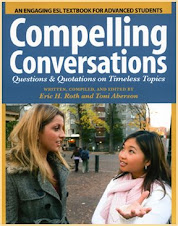
What do you do while students are having conversations or talking in pairs? Do you have a “formula” for taking notes? Do you focus more on fluency or accuracy in conversation activities?
Many English teachers, especially novice ESL instructors, talk more than ideal - and allow their English students to talk too little. Ironically, many ESL instructors make this “good mistake” because they are so dedicated. What, after all, are English teachers supposed to do while students exchange ideas and practice their speaking skills?
Listen. Take notes. Politely, and indirectly, correct by modeling better speech. Sometimes, for brief periods, join in the student conversations. Listen. Ask questions. Take notes. Repeat.
When I taught an advanced ESL conversation class to immigrants and international students from many different countries at Santa Monica Community College, I developed a little routine for the popular two-hour class.
First, I introduced conversation topics with a quotation or proverb and briefly introduce the day’s topic. Then I distribute worksheets (which became chapters in Compelling Conversations) with 30 or so questions, 10 or 12 key vocabulary words, and a few selected quotations or proverbs. Then students would be paired up to interview each other and share experiences for 20-30 minutes.
What did I do? I simply circled around the room, briefly joining in conversations, taking notes, and indirectly correcting students by modeling a better way to ask or respond to questions. I also jotted down key comments and “good mistakes” - both grammar and pronunciation - that I would later share with the entire class. Further, I focused on the content of student comments so fluency and meaning was more important than accuracy. Ideas and perceptions mattered more than perfect grammar.
These notes, however, helped me guide the classroom discussion because it closely echoed their previous conversations. It also lead to dynamic discussions because several perspectives were acknowledged and considered. Discussions were usually for another 20-30 minutes.
Taking notes also gave me a chance to emphasize certain sound groups or related word forms. While the students were talking to each other, I was playing reporter and taking notes. This group activity would often take another 10-15 minutes. Class ended with everyone asking a question on that same topic so they could continue the discussions outside of the classroom.
Here is a reproducible worksheet that captures that process of monitoring conversations and leading discussions. Although designed to be used with Compelling Conversations: Questions and Quotations on Timeless Topics, it can be used for any ESL classroom discussing almost any topic.
—————————————————–
Compelling Conversation Classroom Worksheet for Teachers
Topic:
Pages:
Date:
# of participants:
# of groups:
Class:
Opening Quote:
Opening comments to class:
Starting time for conversations:
Conversation content:
- What did you hear the students say? Summarize.
Follow-up class discussion questions:
Review Vocabulary:
Pronunciation tips:
Grammar issues:
Other comments/observations:
———————————————————
Is this a lesson plan? Sort of, but it's completely responsive to your students' comments, questions, and conversations. You take the "good mistakes" from that day's actual events. Whether you consider this a worksheet or lessonplan, this document has helped me teach and lead many satisfying ESL classes.
As an old American cereal commercial used to say, "try it - you'll like it."
Ask more. Know more. Share more.
Create Compelling Conversations.
Visit www.CompellingConversations.com
Showing posts with label ESL classes. Show all posts
Showing posts with label ESL classes. Show all posts
Monday, March 2, 2009


Friday, January 30, 2009
More Ideas for Using Videoclips in English Lessons
Are you looking for more excellent videoclips for your English classes or private lessons?
As blog readers know, I'm a huge fan of encouraging students to find their own materials to summarize for homework on particular topics. For instance, students in my high intermediate oral skills found and reviewed videos offering advice on job interviews. Students emailed me their recommended clips with a short descriptive paragraph and a few sentences evaluating the video. Then I edited their writing, combined their reviews into a single document, and emailed the entire class the videoclips.
"Use or lose" was my comment. "Viewing these videoclips is an opportunity, not an obligation. Enjoy!" Almost every student chose to watch the videos and our 10-15 minute mock job interviews were quite strong. Allowing students to select their own materials lead to more authentic, student centered learning both in and out of the classroom.
Yet sometimes both students and teachers lack time. It's a real pleasure to have someone systematically collect and sort through potential video materials for class.
Hall Houston, the author of The Creative Classroom: Teaching Languages Outside the Box, recently posted about Jamie Keddie's excellent website TEFLclips.com on his blog:
Hall writes, "This website ( http://www.teflclips.com/ ) contains over 30 clever lesson plans for using video clips in the TEFL classroom. The lessons are well-written and contain teacher's notes and handouts. I am looking forward to using some of these lessons in my classes this year (2009)." As so often, I share Hall's tastes and concerns for creating a dynamic, creative classroom where students learn English and critical thinking skills.
By the way, Hall recently wrote a long, very positive review of Compelling Conversations: Questions and Quotations on Timeless Topics for English Teaching Professional. (Here's a shout out to Hall. Thanks for the review and tip on videoclips!)
We live in a wonderful time to teach English. The technology allows us to gently cajole students to become autotelic, or self-directed, in their studies. Teaching with videoclips, both as homework and in class, adds visual information and builds rapport with our 21st century English students.
Use it or lose it. You choose. Will video work in your class?
Ask more. Know more. Share more.
Create Compelling Conversations.
Visit www.CompellingConversations.com
As blog readers know, I'm a huge fan of encouraging students to find their own materials to summarize for homework on particular topics. For instance, students in my high intermediate oral skills found and reviewed videos offering advice on job interviews. Students emailed me their recommended clips with a short descriptive paragraph and a few sentences evaluating the video. Then I edited their writing, combined their reviews into a single document, and emailed the entire class the videoclips.
"Use or lose" was my comment. "Viewing these videoclips is an opportunity, not an obligation. Enjoy!" Almost every student chose to watch the videos and our 10-15 minute mock job interviews were quite strong. Allowing students to select their own materials lead to more authentic, student centered learning both in and out of the classroom.
Yet sometimes both students and teachers lack time. It's a real pleasure to have someone systematically collect and sort through potential video materials for class.
Hall Houston, the author of The Creative Classroom: Teaching Languages Outside the Box, recently posted about Jamie Keddie's excellent website TEFLclips.com on his blog:
Hall writes, "This website ( http://www.teflclips.com/ ) contains over 30 clever lesson plans for using video clips in the TEFL classroom. The lessons are well-written and contain teacher's notes and handouts. I am looking forward to using some of these lessons in my classes this year (2009)." As so often, I share Hall's tastes and concerns for creating a dynamic, creative classroom where students learn English and critical thinking skills.
By the way, Hall recently wrote a long, very positive review of Compelling Conversations: Questions and Quotations on Timeless Topics for English Teaching Professional. (Here's a shout out to Hall. Thanks for the review and tip on videoclips!)
We live in a wonderful time to teach English. The technology allows us to gently cajole students to become autotelic, or self-directed, in their studies. Teaching with videoclips, both as homework and in class, adds visual information and builds rapport with our 21st century English students.
Use it or lose it. You choose. Will video work in your class?
Ask more. Know more. Share more.
Create Compelling Conversations.
Visit www.CompellingConversations.com
Subscribe to:
Posts (Atom)

 Posts
Posts