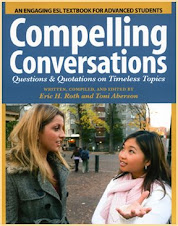
Are you looking for quality, free conversation materials for your advanced English class? Do you teach ESL to adult or community college students? Or do you teach English as a Foreign language (EFL) thousands of miles from home? And do you sometimes tutor private students to improve their conversation skills?
If so, do yourself a favor and check out the free quality conversation materials from the innovative textbook Compelling Conversations: Questions and Quotations on Timeless Topics now.
Enjoy these five free sample chapters including this month's feature PDF Making and Keeping Friends.
Enjoy!
Ask more. Know more. Share more.
Create Compelling Conversations.
Visit www.CompellingConversations.com
Friday, October 8, 2010


Tuesday, April 13, 2010
A Pleasant Surprise!
Sometimes people appreciate our ideas. Sometimes we find an educational site that shares our goals, perceptions, and priorities. Sometimes our efforts draw praise. April 13, 2010 provided a pleasant surprise as ESL teacher.
Under the title "Great Tips", a small, but influential American librarian's blog called eslconversationclubs.blogspot.com shared some ideas from Compelling Conversations. Naturally, I am quite pleased to both be recommended - and to discover an entire community of like-minded educators.
Here's the link to today's blog post to ESL educators, librarians, and conversation club coordinators:
http://eslconversationclubs.blogspot.com/2010/04/great-tips.html
After reading the article, I spent a satisfying hour exploring the deep resources on the blog that dates back several years. Among the excellent resources is a short two page document called ESL Conversation Clubs Best Practices by Jean Kaleda of webjunction.com that deserves a wider audience. Check it out here:
http://eslconversationclubs.blogspot.com/search/label/bestpractices
Enough said. Today provided some surprising validation that conversation clubs fill a vital, often overlooked, need for many American immigrants, ESL students, and other English language learners. And many experts find my little niche, self-published book a valuable, accessible resource. Consider me satisfied!
Ask more. Know more. Share more.
Create Compelling Conversations.
Visit www.CompellingConversations.com
Sunday, February 14, 2010
What Qualities Do Adult English Language Learners Want in a Teacher?
What makes a great English teacher? Children and Adults apparently disagree.
Marisa Constantinides, a prominent EFL teacher and blogger, wrote a fascinating article that explores this issue in a fascinating post. Here it is.
http://marisaconstantinides.edublogs.org/2010/02/14/what-kind-of-teacher-are-you-are-you-in-your-students-hall-of-fame/comment-page-1/
While I have no experience teaching young child, the survey confirms my perceptions about the educational desires of adult students. Many adult students work and struggle in boring, stressful positions so they seek more creativity and passion in their English classes – and English teachers. Further, given the time pressures, instructors who both efficiently manage their classes and display patience are appreciated.
I would be curious, however, to know if there is a difference between various types of adult learners. For instance, many Business English classes in an EFL context include many middle-class professionals while many more working class adults attend ESL classes in English speaking classes. I also wonder if different ages of adults would provide different responses. Would younger working adults look for the same qualities as seniors taking an English class? Would creativity and passion still top the list of desired characteristics for English teachers?
The bottomline remains the same: our English students invest considerable time, energy, and often money into their studies. It behooves us to create compelling English lessons, exude energy, and patiently, clearly their "good mistakes".
“I cannot teach anybody anything, I can only make them think.”
Socrates (BC 469-BC 399) Greek philosopher of Athens
Ask more. Know more. Share more.
Create Compelling Conversations.
Visit www.CompellingConversations.com
Wednesday, February 10, 2010
The Dogma of Dogme | Kalinago English
What makes a compelling classroom conversation, anyway?
This excellent overview of the Dogme teaching style, by ELT and Business English expert Karenne Joy Sylvester provides a solid primer. It also provides an intellectual "defense" of simple, authentic, and meaningful conversations in our ESL and EFL classrooms. If you are taking a methods class, you will especially appreciate this article. Check it out!
The Dogma of Dogme | Kalinago English
Ask more. Know more. Share more.
Create Compelling Conversations.
Visit www.CompellingConversations.com
Saturday, January 2, 2010
Happy New Decade! How Will We Change? Will We Discuss Change in Our ESL Classes?
Happy New Decade! How Will We Change? Will We Discuss Change in Our ESL Classes?
Ask more. Know more. Share more.
Create Compelling Conversations.
Visit www.CompellingConversations.com
Ask more. Know more. Share more.
Create Compelling Conversations.
Visit www.CompellingConversations.com
Sunday, September 27, 2009
Add Informational Interviews to Your ESL Classroom
Almost everyone agrees that adult ESL teachers should help their English students develop their job skills and practice mock job interviews in our English classes.
During these difficult economic times, however, I would suggest that ESL and even EFL instructors working with college and university students also should focus on practical employment skills. Videotaping practice interviews – and longer is better – remains an invaluable tool.
Yet ESL teachers can also help ESL/EFL students conduct research for possible jobs with information interviews. A common practice in the United States, informational interviews allow job seekers to meet working professionals in their field, collect detailed information on working lives, and expand their network of valuable contacts. Sometimes it also leads to job leads, internships, and even jobs.
More About Informational Interviews on the Web
Vanderbilt University, an elite private university in Tennessee, has compiled an impressive list of 60 informational interviews from a wide variety of disciplines and professions. (Peabody is a leading school of Education within Vanderbilt University). These provide illuminating examples of real-life informational interviews. Note: some speakers have a strong southern accent.
http://streams.peabody.vanderbilt.edu/hod1210/sort_field.htm
Here’s a solid collection of typical informational interview questions from About.com, a fairly reliable New York Times-owned website. Questions are divided into Occupational and Functional categories.
http://jobsearch.about.com/od/infointerviews/a/infointervquest.htm
Here’s a basic video, perhaps targeted for adult education and community college students, that reviews the fundamentals of conducting an informational interview.
http://education-portal.com/videos/Conducting_an_Informational_Interview_Video.html
Naturally, many students hope to find job leads from their informational interviews. ESL students can always use more practice job interviews. This chapter of potential job interview questions and quotations comes from Compelling Conversations that I have used with community college, adult education, and university students.
http://www.compellingconversations.com/pdf/practicing_job_interview.pdf
From my perspective, holding both long mock job interviews and hearing trip reports of information interviews are practical, effective uses of precious classroom time.
Ask more. Know more. Share more.
Create Compelling Conversations.
Visit www.CompellingConversations.com
Friday, September 18, 2009
What Do Your ESL Students Believe? Find Out!
Why Bring ‘This I Believe’ Essays and Podcasts Into Your English Classroom?
What are your core beliefs? More importantly, what are the core beliefs of your English students? How do you know? Do you like listening to quality radio essays to improve listening skills and critical thinking skills? Are you looking for a friendly way to gently nudge your EFL students into reflecting on their experiences and expressing their ideas?
If so, you might want to consider adding This I Believe radio essays to your curriculum. This I Believe, originally a radio program hosted by legendary journalist Edward R. Murrow in the 1950s, has been resurrected by National Public Radio as a weekly feature.
While the 1950s version sought out short personal essays by leading intellectuals, artists, and prominent personalities, the 21st century version is far more democratic. Anybody can submit an essay – and thousands and thousands of individuals around the world – have.
English teachers and global travelers might appreciate the sample podcast This I Believe: Inviting the World to Dinner by travel writer and Parisian resident Jim Haynes. Students might also appreciate the open spirit and generosity, but if not, they can choose from over 200 other radio essays. In short, The This I Believe website includes a tremendous amount of free resources for teachers and students. Teachers can sign up for the free mailing list and download an exceptional discussion guide. Amazon also sells several collections of This I Believe essays from both the modern version (with audio) and the original collections from over 50 years ago.
Why don’t you try it in your English class? Here is a simple reproducible homework worksheet that allows English students to find, summarize, and share their own favorite podcasts. I usually have students “introduce” their choice in both small groups and before the entire class. After students have listened to several “this I believe” radio essays, they feel more comfortable writing their essay and presenting it before the class for a final project.
So far, my intermediate and advanced students have both enjoyed the assignment and produced original, reflective work. The flexible format also means that English teachers can modify it to meet student or course requirements. Writing instructors can ask for essays; speech instructors can require a speech. Yet students get an often rare chance to hear intelligent voices reveal their personal philosophies in an engaging manner. Further, our students get to speak their minds and share their insights in our strange, wonderful language. I believe that makes a compelling English class too!
As Mr. Murrow would say, “good night and good luck.”
-------------------------------------------------------------------------------
This I Believe Homework Worksheet
Links: This I Believe
http://www.npr.org/templates/story/story.php?storyId=4538138
Please select one radio segment, based on a personal essay, and read by writers. Find a story that resonates with you. Listen carefully. Take notes. Fill out the worksheet below. You will be asked to share your selection with classmates in both a small group and the entire class.
Student:
This I Believe Title:
Author/Reader:
Length:
Who is the author?
What’s the main idea?
Why did you choose this podcast?
Did you hear any new words or phrases?
1.
2.
3.
Who do you imagine is the audience for this podcast? Why?
What is your reaction? Why?
-------------------------------------------------------------------------------------
Ask more. Know more. Share more.
Create Compelling Conversations.
Visit www.CompellingConversations.com
Wednesday, September 2, 2009
Starting, and Building, a Compelling Conversation
How do start and build a satisfying conversation?
There are a million ways, but here's a simple slogan.
Ask more. Know more. Share more.
You can create compelling conversations by asking simple, yet deep, questions like:
Create Compelling Conversations.
Visit www.CompellingConversations.com
There are a million ways, but here's a simple slogan.
Ask more. Know more. Share more.
You can create compelling conversations by asking simple, yet deep, questions like:
|
|
“Colors fade, temples crumble, empires fall, but wise words endure.”
- Edward Thorndike (1874-1949), American psychologist
Create Compelling Conversations.
Visit www.CompellingConversations.com
Sunday, August 30, 2009
Sound Comparisons: What is the correct way to say this in English?
How do you say that again? Which is correct? What is a sound comparison?
Create Compelling Conversations.
Visit www.CompellingConversations.com
English teachers and linguists might also find website www.soundcomparisions.com worth a visit. Focusing on the many different dialects of English across the world, it implicitly challenges the notion of a “correct” or “accurate” pronunciation of English. The sound files come from
Of course, context matters. If international students plan to study at an American university, it behooves them to listen to North American dialects – and make sure that their pronunciation is clear and comprehensible to American listeners. If they hope to attend a Scottish university, students might want to try out that accent as the target sound. Being audience focused, after all, is part of effective communication and good manners.
That is also why I very seldom "correct" international friends on their pronunciation if I can understand the word. If asked, I will gladly observe the standard "American" pronunciation and repeat what I heard. Yet focusing, perhaps even obsessing, on "correct" pronunciation can often block English language learners from communicating ideas and being themselves in English. Let's keep the focus on comprehensibility and ideas - and remember the wide, wonderful world of English accents!
Create Compelling Conversations.
Visit www.CompellingConversations.com
Saturday, April 18, 2009
Welcome To Compelling Conversations for ESL/EFL Teachers
Welcome to Compelling Conversations!
Volume 1: Issue 1
This is a monthly newsletter from CompellingConversations.com.
Ask more. Know more. Share more.
Create Compelling Conversations.
Visit www.CompellingConversations.com
Volume 1: Issue 1
This issue has been long overdue, and for our first 2009 issue, we would like to personally thank you for subscribing to our newsletter for English teachers. We appreciate your visit to our website and, for this reason, we have good news:
A discount coupon for our book! If you've haven't had the opportunity to get a copy of our book, we have lowered the price for our subscribers: you can get $5 off the regular price for Compelling Conversations: Questions and Quotations on Timeless Topics (for ESL learners and teachers)! Click here to get your copy for $15 (instead of $20).
Or just download our free Compelling Conversations chapters on Change and on Job Interviews.
Don't forget to check out our special thank you offer again at the end of this newsletter.
| In This Issue Articles of Interest The Compelling Conversations Blog recently had a post on World Englishes, which linked to a review on a book by the same name. In this newsletter you will find an intro to Eric Roth's review (to the right), and for the sake of providing different perspectives on the subject matter, here are a few articles that have caught our attention.
The radio program This I Believe was also reviewed on the Compelling Conversations Blog. We offer an assignment/worksheet on the post, and you will find an intro and direct link on the right. | World Englishes Review by Eric Roth Do the English in England speak the same English as the Americans, the Jamaicans, the South Africans, the Australians, the Irish, and the Indians? Do they even speak the same English as they did 100 years ago before radio, television, and the internet? Should there be a global standard for all English speakers? Linguist Andy Kirkpatrick raises these and many other provocative questions in his exceptionally documented book “World Englishes: Implications for International Communication and English Language Teaching” published by Cambridge University Press. Read more » This I Believe Tuesday, March 24, 2009 What are your core beliefs? More importantly, what are your students’ core beliefs? How can you help English language learners improve their listening skills while exploring their own personal philosophy? Do you use radio podcasts in your English classrooms or ask students to write personal essays? If so, you might want to visit www.ThisIBelieve.org for excellent, fascinating authentic listening materials. Read more » |
Speaking of radio programs, do you like podcasts? VOA News makes Special English podcasts; check out Baseball Terms: This Is a Whole New Ballgame!
Vietnam Embraces English Classes - and Looks for Communicative English Teachers By the way, the Compelling Conversations Blog will be getting a make-over! Yes, we'll soon be incorporating more digital media, changing our theme, and we'll be making it easier for you to get a copy of our class worksheets. We want to move beyond mere text and incorporate more pictures and sound to create a livelier, more 21st century look. Again, as a newsletter subscriber, you qualify for a $5 discount on our downloadable ESL ebook that makes teaching conversation in English class a simple joy. Why not buy your copy today? Click here for your copy of Compelling Conversations: Questions and Quotations on Timeless Topics (for ESL learners and teachers) for $15 (instead of $20)! |
Ask more. Know more. Share more.
Create Compelling Conversations.
Visit www.CompellingConversations.com
Monday, March 23, 2009
More Practical Tips to Help English Students Ace the Job Interview
During these difficult economic times, English teachers should take every possible opportunity to focus on job interview skills. As blog readers know, I'm a big fan of both videotaping practice interviews and having ESL/EFL students conduct research for possible jobs with information interviews.
Here is an excellent, concise list of simple practical steps for English language learners to take when preparing for a job interview - and a few post-interview suggestions worth noting. The fine article comes from the Q Blog for English language learners. It's a fine resource. Check it out.
Official Q Blog: How to Succeed in an Interview
Ask more. Know more. Share more.
Create Compelling Conversations.
Visit www.CompellingConversations.com
Monday, March 2, 2009
What Does the English Teacher Do While ESL Students Converse?
What do you do while students are having conversations or talking in pairs? Do you have a “formula” for taking notes? Do you focus more on fluency or accuracy in conversation activities?
Many English teachers, especially novice ESL instructors, talk more than ideal - and allow their English students to talk too little. Ironically, many ESL instructors make this “good mistake” because they are so dedicated. What, after all, are English teachers supposed to do while students exchange ideas and practice their speaking skills?
Listen. Take notes. Politely, and indirectly, correct by modeling better speech. Sometimes, for brief periods, join in the student conversations. Listen. Ask questions. Take notes. Repeat.
When I taught an advanced ESL conversation class to immigrants and international students from many different countries at Santa Monica Community College, I developed a little routine for the popular two-hour class.
First, I introduced conversation topics with a quotation or proverb and briefly introduce the day’s topic. Then I distribute worksheets (which became chapters in Compelling Conversations) with 30 or so questions, 10 or 12 key vocabulary words, and a few selected quotations or proverbs. Then students would be paired up to interview each other and share experiences for 20-30 minutes.
What did I do? I simply circled around the room, briefly joining in conversations, taking notes, and indirectly correcting students by modeling a better way to ask or respond to questions. I also jotted down key comments and “good mistakes” - both grammar and pronunciation - that I would later share with the entire class. Further, I focused on the content of student comments so fluency and meaning was more important than accuracy. Ideas and perceptions mattered more than perfect grammar.
These notes, however, helped me guide the classroom discussion because it closely echoed their previous conversations. It also lead to dynamic discussions because several perspectives were acknowledged and considered. Discussions were usually for another 20-30 minutes.
Taking notes also gave me a chance to emphasize certain sound groups or related word forms. While the students were talking to each other, I was playing reporter and taking notes. This group activity would often take another 10-15 minutes. Class ended with everyone asking a question on that same topic so they could continue the discussions outside of the classroom.
Here is a reproducible worksheet that captures that process of monitoring conversations and leading discussions. Although designed to be used with Compelling Conversations: Questions and Quotations on Timeless Topics, it can be used for any ESL classroom discussing almost any topic.
—————————————————–
Compelling Conversation Classroom Worksheet for Teachers
Topic:
Pages:
Date:
# of participants:
# of groups:
Class:
Opening Quote:
Opening comments to class:
Starting time for conversations:
Conversation content:
- What did you hear the students say? Summarize.
Follow-up class discussion questions:
Review Vocabulary:
Pronunciation tips:
Grammar issues:
Other comments/observations:
———————————————————
Is this a lesson plan? Sort of, but it's completely responsive to your students' comments, questions, and conversations. You take the "good mistakes" from that day's actual events. Whether you consider this a worksheet or lessonplan, this document has helped me teach and lead many satisfying ESL classes.
As an old American cereal commercial used to say, "try it - you'll like it."
Ask more. Know more. Share more.
Create Compelling Conversations.
Visit www.CompellingConversations.com
Subscribe to:
Posts (Atom)

 Posts