Do American immigrants want to learn English? Are the children of Spanish-speaking adult immigrants learning English? What are the recent trends in California and Los Angeles?
A recently released Census Bureau report, based on the 2007 Census information, shows that – shock, shock – immigrants overwhelmingly want to improve their English skills. It also shows that a slight majority (51%) of immigrants in Los Angeles claim that they can speak English fluently – an increase from just a few years ago. The study also notes that 88% of immigrant children claim to speak English – and want to learn more.
Yesterday’s Los Angeles Times editorial “Speak English? Yes, more immigrants do “ provides a solid introduction to the heated debate over language and immigration in California. The editorial also argues that immigration reform should include a provision to keep families united so the American children of illegal immigrant parents are not separated from their parents. Finally, the editorial concludes that both the United States and the English language continue to evolve and Americans should embrace change.
The fine editorial, however, could and should have called for both expanding and improving the quality of public education programs so immigrants – including adult immigrants - can learn English quicker. A better Census report also would have included the legal status of immigrants and gone beyond self-reported data by immigrants with evolving language skills.
The editorial’s strong, humane conclusion is worth repeating verbatim:
“American culture grows and adapts as new immigrants redefine it over the generations, and the same can be said of the English language. We should embrace that evolution, not hold it at bay with false and alarmist arguments about the threat to American values.”
Los Angeles Times, September 24, 2008 editorial
Doesn’t that sound sane and civilized?
Ask more. Know more. Share more.
Create Compelling Conversations.
Visit www.CompellingConversations.com
Thursday, September 25, 2008


Saturday, September 20, 2008
Who ranks ESL programs? How would you choose an English language school?
How would you choose an English language school? What if you lived in Korea, Spain, China, Brazil, Turkey, or Vietnam? What factors would influence your decision? How would you find out the school’s reputation? Who ranks ESL programs? What is their criteria?
Hundreds of thousands of students travel thousands of miles each semester to attend ESL schools. These intensive English language programs, often affiliated at universities, provide an opportunity to study English, live abroad, and prepare for the all-important TOEFL test. Given the importance of English to the business, scientific, and political events, the ability to read, write, and speak English often seems mandatory to ambitious 21st century students.
Yet, like any consumer product, the quality of the schools widely varies. How would a student make a rational choice?
This question emerged as I spoke with several dozen international students this week about their resumes, educational backgrounds, and training in English. While this elite group of mostly graduate students had succeeded in the academic game, several shared stories of unpleasant experiences at language schools. Sometimes students found a huge gap between their expectations and their actual American classroom experiences.
The apparent randomness of significant decisions often surprises me. Normally, I consult friends and established rankings as part of a decision making process. Yet a single thin piece of information, or casual conversation, can easily alter plans. Still I remember systematically searching through numerous guidebooks while selecting my college.
Where can students looking for a quality English language programs abroad find this sort of information? Does TESOL have some list of approved or sanctioned schools? Does somebody else – perhaps even local governments – track the effectiveness of schools? Further, what is their criteria? Where can individuals – students, teachers, parents – get that simple, yet vital bit of information? Is any of this information available in English, instead of the first language?
I would suspect, especially for international students of considerable income, that there would have to be somebody who attempts to grade, evaluate, and rank ESL schools. If I was going to travel to the United States, Australia, or the United Kingdom, I would certainly want to know the quality of the program and teachers. Even I was just going to a local English school or attending a public adult education center, I would still check on the school's reputation. Of course, recruiters provide some information too – often with a twist. Given the potential investment in money and time, I assume that guides must exist – and probably not in English.
The best English language source that I have found, so far, is a site called http://www.eslreview.org/ . It rates schools on a scale of 1-5 on teaching, location, housing services, price-quality relationship, and overall satisfaction. You can find basic information and read student reviews. You can also browse through the course catalog and contact the schools. This website review is a starting point, but not much more. The listings look like they could easily be gamed. They also don’t list school accreditations, average TOEFL scores, or hire staff to inspect the schools. Further, the list doesn’t include some prominent IEP schools in California. So it’s a valuable starting point to compare ESL schools, but it is hardly a Petersen’s Guide to IEP programs.
Does anybody know a better resource in English?
Ask more. Know more. Share more.
Create Compelling Conversations.
Visit www.CompellingConversations.com
Hundreds of thousands of students travel thousands of miles each semester to attend ESL schools. These intensive English language programs, often affiliated at universities, provide an opportunity to study English, live abroad, and prepare for the all-important TOEFL test. Given the importance of English to the business, scientific, and political events, the ability to read, write, and speak English often seems mandatory to ambitious 21st century students.
Yet, like any consumer product, the quality of the schools widely varies. How would a student make a rational choice?
This question emerged as I spoke with several dozen international students this week about their resumes, educational backgrounds, and training in English. While this elite group of mostly graduate students had succeeded in the academic game, several shared stories of unpleasant experiences at language schools. Sometimes students found a huge gap between their expectations and their actual American classroom experiences.
The apparent randomness of significant decisions often surprises me. Normally, I consult friends and established rankings as part of a decision making process. Yet a single thin piece of information, or casual conversation, can easily alter plans. Still I remember systematically searching through numerous guidebooks while selecting my college.
Where can students looking for a quality English language programs abroad find this sort of information? Does TESOL have some list of approved or sanctioned schools? Does somebody else – perhaps even local governments – track the effectiveness of schools? Further, what is their criteria? Where can individuals – students, teachers, parents – get that simple, yet vital bit of information? Is any of this information available in English, instead of the first language?
I would suspect, especially for international students of considerable income, that there would have to be somebody who attempts to grade, evaluate, and rank ESL schools. If I was going to travel to the United States, Australia, or the United Kingdom, I would certainly want to know the quality of the program and teachers. Even I was just going to a local English school or attending a public adult education center, I would still check on the school's reputation. Of course, recruiters provide some information too – often with a twist. Given the potential investment in money and time, I assume that guides must exist – and probably not in English.
The best English language source that I have found, so far, is a site called http://www.eslreview.org/ . It rates schools on a scale of 1-5 on teaching, location, housing services, price-quality relationship, and overall satisfaction. You can find basic information and read student reviews. You can also browse through the course catalog and contact the schools. This website review is a starting point, but not much more. The listings look like they could easily be gamed. They also don’t list school accreditations, average TOEFL scores, or hire staff to inspect the schools. Further, the list doesn’t include some prominent IEP schools in California. So it’s a valuable starting point to compare ESL schools, but it is hardly a Petersen’s Guide to IEP programs.
Does anybody know a better resource in English?
Ask more. Know more. Share more.
Create Compelling Conversations.
Visit www.CompellingConversations.com
Sunday, September 14, 2008
Seeing photographs, hearing languages, and appreciating my life in Los Angeles
Sometimes living in Los Angeles feels fantastic. Beauty - in many forms - pervades. You look around, and you smile. The sun shines, the scene looks great, and many languages fill the day.
I visited the Huntington Gardens, a beautiful oasis near California Institute of Technology, yesterday to catch a large photography exhibit documenting 150 years of Los Angeles history. Inevitably, I fell in love with the city again - and gained a new appreciation for how cars, film, oil, and immigration have created this global city of dreams and demons. The show, “This Side of Paradise: Body and Landscape in LA Photographs”, starred evocative photographs by numerous great photographers and attracted a fine crowd.
While moving through the city or going to tourist sites, I often ask myself a simple question. “How many languages did you hear today?” It’s a way to nudge me to pay more attention to sounds, along with the sights, around me. It also reminds me that I’ve traveled quite some distant from Crawfordsville, Indiana where I went to college or even Indianapolis, Indiana where I mostly grew up. This simpe question is also a lively conversation starter in cosmopolitian areas.
Los Angeles is both a great American city and an international magnet for artists, seekers, immigrants, and students. Yesterday I heard Russian, Spanish, Japanese, Korean, Chinese, Italian, German, Hebrew - and lots of English. Many other languages were also spoken, but I didn’t have the pleasure of hearing them. Art, photography, gardens, and culture brought all these people to share a common experience in multiple tongues.
“As one went to Europe to see the living past, so one must visit Southern California to see the future,” wrote Alison Lurie, an American novelist. Her words still ring true. And living here provides still more possibilities!
Ask more. Know more. Share more.
Create Compelling Conversations.
Visit www.CompellingConversations.com
I visited the Huntington Gardens, a beautiful oasis near California Institute of Technology, yesterday to catch a large photography exhibit documenting 150 years of Los Angeles history. Inevitably, I fell in love with the city again - and gained a new appreciation for how cars, film, oil, and immigration have created this global city of dreams and demons. The show, “This Side of Paradise: Body and Landscape in LA Photographs”, starred evocative photographs by numerous great photographers and attracted a fine crowd.
While moving through the city or going to tourist sites, I often ask myself a simple question. “How many languages did you hear today?” It’s a way to nudge me to pay more attention to sounds, along with the sights, around me. It also reminds me that I’ve traveled quite some distant from Crawfordsville, Indiana where I went to college or even Indianapolis, Indiana where I mostly grew up. This simpe question is also a lively conversation starter in cosmopolitian areas.
Los Angeles is both a great American city and an international magnet for artists, seekers, immigrants, and students. Yesterday I heard Russian, Spanish, Japanese, Korean, Chinese, Italian, German, Hebrew - and lots of English. Many other languages were also spoken, but I didn’t have the pleasure of hearing them. Art, photography, gardens, and culture brought all these people to share a common experience in multiple tongues.
“As one went to Europe to see the living past, so one must visit Southern California to see the future,” wrote Alison Lurie, an American novelist. Her words still ring true. And living here provides still more possibilities!
Ask more. Know more. Share more.
Create Compelling Conversations.
Visit www.CompellingConversations.com
Thursday, September 11, 2008
Revising the ESL Curriculum and Finding Solace with Quotes
“Do what you can, with what you have, where you are,” advised President Theodore (Teddy) Roosevelt. These words of solace often comfort me when I stress myself out trying to cram too much material into lessons.
How can I cover everything that I want in a single semester? It’s just impossible. For every new activity, I must let an old one go. If I add a Youtube homework assignment, than I should eliminate another homework assignment to maintain the balance. For instance, I asked every student to find and review a YouTube video on interview skills so I had to cut the assignment where students found and summarize an article on job hunting skills.
By the way, the international graduate English students found and reviewed a wonderful collection of smart, informative, current, and funny videos. Then I combined into a single email for the entire class with one of my own selections. On their own time and initiative, students watched many of the videos leading to the best mock job interviews that I’ve seen at the intermediate speaking skill level yet. Again, a democratic classroom atmosphere often creates a far more interesting and effective classroom.
As I continue to plan, adjust, and readjust assignments, I once again find solace in these words. Yet these continual curriculum revisions remain voluntary tasks in pursuit of excellence. “A problem,” noted Duke Ellington, “is a chance for you to do your best.”
Ask more. Know more. Share more.
Create Compelling Conversations.
Visit www.CompellingConversations.com
How can I cover everything that I want in a single semester? It’s just impossible. For every new activity, I must let an old one go. If I add a Youtube homework assignment, than I should eliminate another homework assignment to maintain the balance. For instance, I asked every student to find and review a YouTube video on interview skills so I had to cut the assignment where students found and summarize an article on job hunting skills.
By the way, the international graduate English students found and reviewed a wonderful collection of smart, informative, current, and funny videos. Then I combined into a single email for the entire class with one of my own selections. On their own time and initiative, students watched many of the videos leading to the best mock job interviews that I’ve seen at the intermediate speaking skill level yet. Again, a democratic classroom atmosphere often creates a far more interesting and effective classroom.
As I continue to plan, adjust, and readjust assignments, I once again find solace in these words. Yet these continual curriculum revisions remain voluntary tasks in pursuit of excellence. “A problem,” noted Duke Ellington, “is a chance for you to do your best.”
Ask more. Know more. Share more.
Create Compelling Conversations.
Visit www.CompellingConversations.com
Saturday, September 6, 2008
Why do school boards so often make problematic decisions?
"God made the idiot for practice. Then he made school boards."
Mark Twain (1835-1910), American novelist and humorist
As the quality of American public schools continues to decline and more classes and program get cutback, this quip remains painfully current.
Ask more. Know more. Share more.
Create Compelling Conversations.
Visit www.CompellingConversations.com
Mark Twain (1835-1910), American novelist and humorist
As the quality of American public schools continues to decline and more classes and program get cutback, this quip remains painfully current.
Ask more. Know more. Share more.
Create Compelling Conversations.
Visit www.CompellingConversations.com
Friday, September 5, 2008
A new semester, new English students, and new forms
What are you doing differently this semester in your English class?
As a new semester begins, I face the familiar task - and pleasure - of selecting new materials and creating new forms for my oral skills class. One goal is to have students use the internet more; another to provide more opportunities for peer feedback on oral presentations.
Although I do not have a conversation class this semester, I do teach a high intermediate oral skills class that focuses on academic presentations. The students come from several Asian countries and are all graduate students - almost exclusively in engineering. Workplace surveys continue to identify communication skills, including speaking skills, as a top priority for employers - especially in engineering!
The class will include several informal, short presentations in addition to the longer, more formal presentations that receive a grade. Whenever possible, I prefer to give students to receive fairly immediate feedback, from their peers and me, on their presentations. Students, as a result, will read peer evaluations from the entire class after giving a short presentation like a product review, extended definition, or process description. To be effective, the form must be both simple and open… with some guidance. This collective feedback often validates instructor comments and prepares students to view their videotaped presentations in a more objective manner.
Here is my new form for peer evaluations of oral presentations.It emphasizes the positive aspects, inquires about what can be improved, allows more detailed observations, and provides a simple rating system. I have used a similar format with my engineering communication courses and expect that it will work in my ESL class too. Time will tell.
Feel free to copy, modify, or share the form to fit your ESL/EFL/speech classroom needs.
————————————————————————————-
STUDENT: ____________________________________________________
TOPIC: ____________________________________________________
PEER: ____________________________________________________
GOOD TO SEE:
POINTS TO WORK ON:
BEST PART:
WEAKEST PART:
OTHER OBSERVATIONS/TIPS:
Please circle the appropriate overall rating:
1 2 3 4 5 6 7 8 9 10
Ask more. Know more. Share more.
Create Compelling Conversations.
Visit www.CompellingConversations.com
As a new semester begins, I face the familiar task - and pleasure - of selecting new materials and creating new forms for my oral skills class. One goal is to have students use the internet more; another to provide more opportunities for peer feedback on oral presentations.
Although I do not have a conversation class this semester, I do teach a high intermediate oral skills class that focuses on academic presentations. The students come from several Asian countries and are all graduate students - almost exclusively in engineering. Workplace surveys continue to identify communication skills, including speaking skills, as a top priority for employers - especially in engineering!
The class will include several informal, short presentations in addition to the longer, more formal presentations that receive a grade. Whenever possible, I prefer to give students to receive fairly immediate feedback, from their peers and me, on their presentations. Students, as a result, will read peer evaluations from the entire class after giving a short presentation like a product review, extended definition, or process description. To be effective, the form must be both simple and open… with some guidance. This collective feedback often validates instructor comments and prepares students to view their videotaped presentations in a more objective manner.
Here is my new form for peer evaluations of oral presentations.It emphasizes the positive aspects, inquires about what can be improved, allows more detailed observations, and provides a simple rating system. I have used a similar format with my engineering communication courses and expect that it will work in my ESL class too. Time will tell.
Feel free to copy, modify, or share the form to fit your ESL/EFL/speech classroom needs.
————————————————————————————-
STUDENT: ____________________________________________________
TOPIC: ____________________________________________________
PEER: ____________________________________________________
GOOD TO SEE:
POINTS TO WORK ON:
BEST PART:
WEAKEST PART:
OTHER OBSERVATIONS/TIPS:
Please circle the appropriate overall rating:
1 2 3 4 5 6 7 8 9 10
Ask more. Know more. Share more.
Create Compelling Conversations.
Visit www.CompellingConversations.com
Saturday, August 23, 2008
Conversation Tip #15: Seek First to Understand - ESL Worksheet
Seek to Understand
Have you ever seen two emotional people talk past each other? Both talk and neither listen. Both want to tell the other, and don’t want to hear – or understand – what the other person is saying. This happens too often in stressful workplaces.
Stephen Covey, author of the international bestseller called “Seven Habits of Highly Effective People, advises people “to seek first to understand, then to be understood.” Following this traditional wisdom can improve workplace relationships and communication.
What are some techniques that can help understand other people? Here are some tips:
• Listen first and avoid interrupting.
• Pause before speaking.
• Look people in the eye.
• Be curious.
• Ask “what” and “how” questions to get more information.
• Keep the voice down. Stay calm. Talk slow.
• Repeat or rephrase what people say to avoid misunderstandings.
What are some other tips to avoid misunderstandings or conflicts at work?
1.
2.
3.
4.
What are some advantages of staying calm at work?
1.
2.
3.
Ask more. Know more. Share more.
Create Compelling Conversations.
Visit www.CompellingConversations.com
Have you ever seen two emotional people talk past each other? Both talk and neither listen. Both want to tell the other, and don’t want to hear – or understand – what the other person is saying. This happens too often in stressful workplaces.
Stephen Covey, author of the international bestseller called “Seven Habits of Highly Effective People, advises people “to seek first to understand, then to be understood.” Following this traditional wisdom can improve workplace relationships and communication.
What are some techniques that can help understand other people? Here are some tips:
• Listen first and avoid interrupting.
• Pause before speaking.
• Look people in the eye.
• Be curious.
• Ask “what” and “how” questions to get more information.
• Keep the voice down. Stay calm. Talk slow.
• Repeat or rephrase what people say to avoid misunderstandings.
What are some other tips to avoid misunderstandings or conflicts at work?
1.
2.
3.
4.
What are some advantages of staying calm at work?
1.
2.
3.
Ask more. Know more. Share more.
Create Compelling Conversations.
Visit www.CompellingConversations.com
Tuesday, August 19, 2008
Watching the Olympics and Starting Conversations
How often do a billion people share a smile, a sigh, or a televised event?
Have you been watching the Olympics? What has surprised you the most? Why? Who has inspired you? How?
The Olympics reminds us of heroism, sacrifice, excellence, and beauty. It can also spark many conversations.
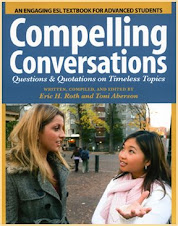
Although I have not had the pleasure of teaching a conversation class recently, talking about sports always sparked many enjoyable exchanges - even among non-sports fans. This lesson, an except from Compelling Conversations: Questions and Quotations on Timeless Topics for Advanced ESL students, remains a favorite.
Feel free to use it in your English classes. Let the conversations begin!
————————————————————————————–
PLAYING AND WATCHING SPORTS
“The game is my wife. It demands loyalty and responsibility.”
Michael Jordan (1963- ) NBA superstar
Chatting: Talking about sports can be a great ice-breaker. Just do it!
1. Did you play any sports as a child? Which ones? Which was your favorite?
2. Do you play any sports now? Which ones? Which is your favorite? Why?
3. Do girls and women play sports in your native country? If so, which ones?
4. What is the most popular sport in your native country?
5. What equipment or uniform is needed for this sport?
6. How is the game scored? How is a tie decided? What is considered a high score?
7. How long is a game? Are there referees? How do fans usually behave?
8. Which athlete is best known in your homeland? Which sport does he or she play? What do people admire about this athlete?
9. Does your native country participate in the Olympics? In which sports are your countrymen most competitive?
10. What are some team sports? Which do you play?
11. What are some individual sports that you know? Which do you play?
12. Do you prefer to play team sports or individual sports? Why?
13. Which is your favorite sport to watch? Do watch any annual televised sporting event? Have you ever gone to a sporting event? How did the fans behave?
14. Are you a fan of any special team? What do you like about them?
15. What is their nickname e.g. Chicago Bulls, New England Patriots?
16. What does their nickname hope to convey about the team?
17. Does your favorite team have a main rival? Why? Is there a team mascot?
18. Which American athletes are well known in your native land? Which ones?
19. What are some of the ways that athletes train for competition?
20. What do you think is the difference between a game and a sport? Is chess a sport? Is weight lifting a sport? Is golf a sport? Is politics a sport?
21. Who is your favorite athlete? Why do you especially admire this athlete?
22. Do you buy a certain brand of shoes or clothes because of an athlete’s endorsement? If so, which brand? Which athlete?
23. Can you name some sports that involve animals?
24. Is there any sport that you don’t play now, but that you’d like to learn?
25. Do you think any sport rules should be changed? Why?
26. If you could, would you outlaw any sports? Why?
27. Are there any sports which are legal in your homeland, but illegal in the United States? Why? Do you think these sports should be legal?
28. What are the differences between the way athletes are treated in your native country and the way athletes are treated in the U.S.? Which ways do you think are preferable?
29. Are there any disadvantages to playing sports? Examples?
30. What are some advantages to playing sports? How do you feel while playing?
31. If you could play against any athlete in any sport, what sport would you choose?
32. If you could go back in time and attend any sporting event, which would you pick? Why?
33. What makes a great athlete? Who do you think is the greatest athlete of our time? Why?
Vocabulary: Do you know all these words? Can you add 4 more words to this list?
athlete score mascot equipment competition referee nickname rival
endorse endorsement fan brand
Idioms: Try to guess the meanings of these idioms with your partner.
She’s a team player. She knows the game plan.
The biology test was a slamdunk.
The price you’re asking is in the ballpark.
When I caught Bob’s finger in the car door, he was a good sport about it.
You dropped the ball.
Quotations: Which quotations do you like? Can you add one more?
1. “Sports do not build character. They reveal it.”
Heywood Hale Broun (1888-1939), American sports journalist
1. “If you don’t try to win, you might as well hold the Olympics in somebody’s backyard.” Jesse Owns (1913-1980), American with 4 Gold Olympic medals
1. “Sports is the toy department of human life.”
Howard Cosell (1918-1995), sportscaster
1. “Sports is like a war without the killing.” Ted Turner (1938- ), founder of CNN
1. “It ain’t over till it’s over.” Yogi Berra (1925- ), American baseball coach
1. “Whoever wants to know the heart and mind of America had better learn baseball.” Jacques Barzun (1907- ), American historian
1. “The less effort, the faster and more powerful you will be.”
Bruce Lee (1940-1973), film star
1. “Golf is a good walk spoiled.” Mark Twain (1835-1910), humorist
1. “Aggressive fighting for the right is the noblest sport in the world.”
Theodore Roosevelt (1859-1919), U.S. President, sportsman
1. “…no boy from a rich family ever made the big leagues.”
Joe Dimaggio (1914- ), American baseball player
1. “Friendships born on the field of athletic strife are the real gold of competition. Awards become corroded, friends gather no dust.”
Jesse Owns (1913-1980), 4 time Gold medalist in 1936 Olympic Games
1. “Good teams become great ones when the members trust each other enough to surrender the ‘me’ for the ‘we.’” Phil Jackson (1945- ), L.A. Lakers’ coach
1. “How can you think and hit at the same time?”
Yogi Berra (1925-), baseball player and coach
14. “There is no “I” in team, but there is in win.”
Michael Jordan (1963- ) NBA superstar
EXTENSION: Find a picture of an athlete, professional or amateur, playing your favorite sport. Cut it out, bring it to class, and describe the picture and its context.
WWW. Compelling Conversations.com
----------------------------------------------------------------------------------
Ask more. Know more. Share more.
Create Compelling Conversations.
Visit www.CompellingConversations.com
Have you been watching the Olympics? What has surprised you the most? Why? Who has inspired you? How?
The Olympics reminds us of heroism, sacrifice, excellence, and beauty. It can also spark many conversations.
Although I have not had the pleasure of teaching a conversation class recently, talking about sports always sparked many enjoyable exchanges - even among non-sports fans. This lesson, an except from Compelling Conversations: Questions and Quotations on Timeless Topics for Advanced ESL students, remains a favorite.
Feel free to use it in your English classes. Let the conversations begin!
————————————————————————————–
PLAYING AND WATCHING SPORTS
“The game is my wife. It demands loyalty and responsibility.”
Michael Jordan (1963- ) NBA superstar
Chatting: Talking about sports can be a great ice-breaker. Just do it!
1. Did you play any sports as a child? Which ones? Which was your favorite?
2. Do you play any sports now? Which ones? Which is your favorite? Why?
3. Do girls and women play sports in your native country? If so, which ones?
4. What is the most popular sport in your native country?
5. What equipment or uniform is needed for this sport?
6. How is the game scored? How is a tie decided? What is considered a high score?
7. How long is a game? Are there referees? How do fans usually behave?
8. Which athlete is best known in your homeland? Which sport does he or she play? What do people admire about this athlete?
9. Does your native country participate in the Olympics? In which sports are your countrymen most competitive?
10. What are some team sports? Which do you play?
11. What are some individual sports that you know? Which do you play?
12. Do you prefer to play team sports or individual sports? Why?
13. Which is your favorite sport to watch? Do watch any annual televised sporting event? Have you ever gone to a sporting event? How did the fans behave?
14. Are you a fan of any special team? What do you like about them?
15. What is their nickname e.g. Chicago Bulls, New England Patriots?
16. What does their nickname hope to convey about the team?
17. Does your favorite team have a main rival? Why? Is there a team mascot?
18. Which American athletes are well known in your native land? Which ones?
19. What are some of the ways that athletes train for competition?
20. What do you think is the difference between a game and a sport? Is chess a sport? Is weight lifting a sport? Is golf a sport? Is politics a sport?
21. Who is your favorite athlete? Why do you especially admire this athlete?
22. Do you buy a certain brand of shoes or clothes because of an athlete’s endorsement? If so, which brand? Which athlete?
23. Can you name some sports that involve animals?
24. Is there any sport that you don’t play now, but that you’d like to learn?
25. Do you think any sport rules should be changed? Why?
26. If you could, would you outlaw any sports? Why?
27. Are there any sports which are legal in your homeland, but illegal in the United States? Why? Do you think these sports should be legal?
28. What are the differences between the way athletes are treated in your native country and the way athletes are treated in the U.S.? Which ways do you think are preferable?
29. Are there any disadvantages to playing sports? Examples?
30. What are some advantages to playing sports? How do you feel while playing?
31. If you could play against any athlete in any sport, what sport would you choose?
32. If you could go back in time and attend any sporting event, which would you pick? Why?
33. What makes a great athlete? Who do you think is the greatest athlete of our time? Why?
Vocabulary: Do you know all these words? Can you add 4 more words to this list?
athlete score mascot equipment competition referee nickname rival
endorse endorsement fan brand
Idioms: Try to guess the meanings of these idioms with your partner.
She’s a team player. She knows the game plan.
The biology test was a slamdunk.
The price you’re asking is in the ballpark.
When I caught Bob’s finger in the car door, he was a good sport about it.
You dropped the ball.
Quotations: Which quotations do you like? Can you add one more?
1. “Sports do not build character. They reveal it.”
Heywood Hale Broun (1888-1939), American sports journalist
1. “If you don’t try to win, you might as well hold the Olympics in somebody’s backyard.” Jesse Owns (1913-1980), American with 4 Gold Olympic medals
1. “Sports is the toy department of human life.”
Howard Cosell (1918-1995), sportscaster
1. “Sports is like a war without the killing.” Ted Turner (1938- ), founder of CNN
1. “It ain’t over till it’s over.” Yogi Berra (1925- ), American baseball coach
1. “Whoever wants to know the heart and mind of America had better learn baseball.” Jacques Barzun (1907- ), American historian
1. “The less effort, the faster and more powerful you will be.”
Bruce Lee (1940-1973), film star
1. “Golf is a good walk spoiled.” Mark Twain (1835-1910), humorist
1. “Aggressive fighting for the right is the noblest sport in the world.”
Theodore Roosevelt (1859-1919), U.S. President, sportsman
1. “…no boy from a rich family ever made the big leagues.”
Joe Dimaggio (1914- ), American baseball player
1. “Friendships born on the field of athletic strife are the real gold of competition. Awards become corroded, friends gather no dust.”
Jesse Owns (1913-1980), 4 time Gold medalist in 1936 Olympic Games
1. “Good teams become great ones when the members trust each other enough to surrender the ‘me’ for the ‘we.’” Phil Jackson (1945- ), L.A. Lakers’ coach
1. “How can you think and hit at the same time?”
Yogi Berra (1925-), baseball player and coach
14. “There is no “I” in team, but there is in win.”
Michael Jordan (1963- ) NBA superstar
EXTENSION: Find a picture of an athlete, professional or amateur, playing your favorite sport. Cut it out, bring it to class, and describe the picture and its context.
WWW. Compelling Conversations.com
----------------------------------------------------------------------------------
Ask more. Know more. Share more.
Create Compelling Conversations.
Visit www.CompellingConversations.com
Saturday, August 16, 2008
How do you teach the difference between "make" and "do" in your English classes?
Make vs. Do
What do you do? What do you make?
These simple words cause lots of confusion for English language learners. I’ve spent time helping a very wide range of ESL classes – from advanced adult education and community college students to intermediate English students in summer courses and regular university courses – struggle with idioms with “make” and “do.”
Here is a quick, imprecise guide that helps clarify the issue.
Look at some common expressions with “do”.
• Do the dishes.
• Do some chores.
• Do your work.
• Do exercises.
• Do your best.
• Do it over.
• Do the report.
Do is used to describe an activity that you have to do, often over and over again. For instance, we “do the dishes” and “do the laundry” many times. Do also contains an element of duty and responsibility.
Now, take a look at some expressions with “make”.
• Please make time.
• You make dinner.
• You make drawings.
• You make decisions.
• You make plans.
• Your make reservations.
• You make money.
• You make friends.
Make is used to describe a creative activity or something you choose to do. You choose, for instance, to make plans, make friends, and make decisions. You have choices.
Why do we say “make dinner” if we have to do it over and over? Perhaps because cooking is seen more as a creative activity than a chore. But cleaning the table, and cleaning the dishes are just chores so we say “do the table” and “do the dishes.” That’s also why Americans say “make money” instead of “do money.” Making money is seen as both creative and a choice. Idioms are cultural. Sometimes Americans will use the verb “make” in a way that might seem strange, but “make a decision” to “do your best” and learn practical workplace expressions.
Finally, I encourage students to work together in small groups and create their own list of idioms with make and do. When I’m lucky and have time, I like to ask students to come to the white board and write their collection of idioms on the board. Homework, of course, is asking them to choose 5-10 idioms and write complete sentences.
So how do you teach the difference between do and make to your English students?
Ask more. Know more. Share more.
Create Compelling Conversations.
Visit www.CompellingConversations.com
What do you do? What do you make?
These simple words cause lots of confusion for English language learners. I’ve spent time helping a very wide range of ESL classes – from advanced adult education and community college students to intermediate English students in summer courses and regular university courses – struggle with idioms with “make” and “do.”
Here is a quick, imprecise guide that helps clarify the issue.
Look at some common expressions with “do”.
• Do the dishes.
• Do some chores.
• Do your work.
• Do exercises.
• Do your best.
• Do it over.
• Do the report.
Do is used to describe an activity that you have to do, often over and over again. For instance, we “do the dishes” and “do the laundry” many times. Do also contains an element of duty and responsibility.
Now, take a look at some expressions with “make”.
• Please make time.
• You make dinner.
• You make drawings.
• You make decisions.
• You make plans.
• Your make reservations.
• You make money.
• You make friends.
Make is used to describe a creative activity or something you choose to do. You choose, for instance, to make plans, make friends, and make decisions. You have choices.
Why do we say “make dinner” if we have to do it over and over? Perhaps because cooking is seen more as a creative activity than a chore. But cleaning the table, and cleaning the dishes are just chores so we say “do the table” and “do the dishes.” That’s also why Americans say “make money” instead of “do money.” Making money is seen as both creative and a choice. Idioms are cultural. Sometimes Americans will use the verb “make” in a way that might seem strange, but “make a decision” to “do your best” and learn practical workplace expressions.
Finally, I encourage students to work together in small groups and create their own list of idioms with make and do. When I’m lucky and have time, I like to ask students to come to the white board and write their collection of idioms on the board. Homework, of course, is asking them to choose 5-10 idioms and write complete sentences.
So how do you teach the difference between do and make to your English students?
Ask more. Know more. Share more.
Create Compelling Conversations.
Visit www.CompellingConversations.com
Thursday, August 14, 2008
Do your EL/Civics students know about the electoral college?
How could George W. Bush be elected President of the United States? Really.
Let me be more precise. How could Al Gore win the popular vote and still lose the 2000 U.S. Presidential election to the second George Bush? The short, unpleasant answer is that the popular vote doesn’t count – and the only vote that matters in electing presidents in the United States is the electoral college.
What is the electoral college? How many votes does your state have in the real United States presidential election? If you teach U.S. history, EL/Civics, or just vote in U.S. elections, you already know these answers – and your students and friends should too!
Check out the easy to use electoral college map hosted by the Los Angeles Times.
Among the many interesting features is that the default setting, based on the 2004 U.S. Presidential election, shows Senator McCain with a clear electoral college advantage over Senator Obama. Amidst the daily national polls, it’s easy for U.S. citizens – let alone adult immigrants and citizenship students – to forget this vital fact. You can also go to the fine Wikipedia article on the peculiar history and strange institution called the United_States_Electoral_College.
By the way, I’m one of those folks that wants to abolish the electoral college as a sad legacy of both aristocratic ideals and slave-era logic. Direct elections work just fine. Since abolishing the electoral college seems very, very difficult, we should – it seems to me – at least switch from a winner take all system for each state to a fairer system where each congressional district chooses its own electors. Adopting this more transparent, honest “tiered” system would quickly reveal the huge divide between urban and rural America across the country. If Senator Obama wins the popular vote and still loses the electoral college, I expect more Democrats to rediscover their discomfort with the very undemocratic electoral college. Let’s hope that doesn’t happen!
Ask more. Know more. Share more.
Create Compelling Conversations.
Visit www.CompellingConversations.com
Let me be more precise. How could Al Gore win the popular vote and still lose the 2000 U.S. Presidential election to the second George Bush? The short, unpleasant answer is that the popular vote doesn’t count – and the only vote that matters in electing presidents in the United States is the electoral college.
What is the electoral college? How many votes does your state have in the real United States presidential election? If you teach U.S. history, EL/Civics, or just vote in U.S. elections, you already know these answers – and your students and friends should too!
Check out the easy to use electoral college map hosted by the Los Angeles Times.
Among the many interesting features is that the default setting, based on the 2004 U.S. Presidential election, shows Senator McCain with a clear electoral college advantage over Senator Obama. Amidst the daily national polls, it’s easy for U.S. citizens – let alone adult immigrants and citizenship students – to forget this vital fact. You can also go to the fine Wikipedia article on the peculiar history and strange institution called the United_States_Electoral_College.
By the way, I’m one of those folks that wants to abolish the electoral college as a sad legacy of both aristocratic ideals and slave-era logic. Direct elections work just fine. Since abolishing the electoral college seems very, very difficult, we should – it seems to me – at least switch from a winner take all system for each state to a fairer system where each congressional district chooses its own electors. Adopting this more transparent, honest “tiered” system would quickly reveal the huge divide between urban and rural America across the country. If Senator Obama wins the popular vote and still loses the electoral college, I expect more Democrats to rediscover their discomfort with the very undemocratic electoral college. Let’s hope that doesn’t happen!
Ask more. Know more. Share more.
Create Compelling Conversations.
Visit www.CompellingConversations.com
Sunday, August 10, 2008
Conversation Tip #14: Ask a question, listen!
"Want to have a conversation? Ask a question, listen."
Robert Bly (1926- ), American poet and activist
Is that concise enough?
Ask more. Know more. Share more.
Create Compelling Conversations.
Visit www.CompellingConversations.com
Robert Bly (1926- ), American poet and activist
Is that concise enough?
Ask more. Know more. Share more.
Create Compelling Conversations.
Visit www.CompellingConversations.com
Monday, August 4, 2008
Workplace Conversation tip: Tone, Volumen, and Context Matter!
Style matters – especially when we talk with our co-workers, consumers, patients, and supervisors. English language learners, recent immigrants, and far too many other people who work in English sometimes seem to forget this!
Consider the difference in how these requests sound.
Shut off the TV!
Please turn off the TV?
Could you turn off the TV?
Would you please turn off the TV?
Close the door!
Close the door; it’s noisy out there.
Shut the damn door!
Would you please close the door; it’s noisy out there.
Could you get the door?
Can you close the door?
Sometimes, especially in an emergency, it is appropriate to warn other people with a short command.
Call the police!
Help!
Shut the door!
We recognize it is an emergency because of the way the request is made. It’s an order.
I. When would it be appropriate to give a warning on your job? Please give 3 examples.
1.
2.
3.
But, usually, we also make our requests that are not emergencies. We can – and should- give suggestions in a kinder, gentler way.
We can use many words to make requests and suggestions:
May Can Could Would Should Might
II. Please write a request that you might give or hear at work with these words.
1. Can ______________________________________________?
2. May ______________________________________________?
3. Could _____________________________________________?
4. Would_____________________________________________?
5. Should_____________________________________________?
6. Might _____________________________________________?
Adding the word “please” makes your requests and suggestions sound nicer too!
Ask more. Know more. Share more.
Create Compelling Conversations.
Visit www.CompellingConversations.com
Consider the difference in how these requests sound.
Shut off the TV!
Please turn off the TV?
Could you turn off the TV?
Would you please turn off the TV?
Close the door!
Close the door; it’s noisy out there.
Shut the damn door!
Would you please close the door; it’s noisy out there.
Could you get the door?
Can you close the door?
Sometimes, especially in an emergency, it is appropriate to warn other people with a short command.
Call the police!
Help!
Shut the door!
We recognize it is an emergency because of the way the request is made. It’s an order.
I. When would it be appropriate to give a warning on your job? Please give 3 examples.
1.
2.
3.
But, usually, we also make our requests that are not emergencies. We can – and should- give suggestions in a kinder, gentler way.
We can use many words to make requests and suggestions:
May Can Could Would Should Might
II. Please write a request that you might give or hear at work with these words.
1. Can ______________________________________________?
2. May ______________________________________________?
3. Could _____________________________________________?
4. Would_____________________________________________?
5. Should_____________________________________________?
6. Might _____________________________________________?
Adding the word “please” makes your requests and suggestions sound nicer too!
Ask more. Know more. Share more.
Create Compelling Conversations.
Visit www.CompellingConversations.com
Subscribe to:
Posts (Atom)

 Posts
Posts