“Own only what you can always carry with you; know languages, know countries, know people. Let your memory be your travel bag.”
Alexander Solzhenitsyn (1918-2008), Russian writer and Nobel Prize winner
Alexander Solzhenitsyn, an exceptional writer of rare courage, died today. English teachers, lovers of literature, and people conscience will find his long obituary in the International Herald Tribune worth reading.
While far too many western leftists preferred to close their eyes to the nature and brutality of the Soviet slave labor system, Solzhenitsyn wrote novels that detailed the misery and repression created by the communists. His writings also made it impossible for even the most naïve leftist intellectuals to deny Stalin’s gulags – and how millions looked away. He won the Nobel Prize for Literature in 1970, but the Soviet authorities naturally prevented him from accepting his award. He spent 20 years in prison camps for his writings.
Do you have English language students from Russia? Do you know immigrants and refugees who spent their youth under the Soviet system? How did living under a communist dictatorship distort human relationships? Solzhenitsyn’s writings, once censored, may help you better understand some of the historical and cultural factors that have influenced your students and their worldviews.
Personally, I found working with Russian refugees and immigrants a very eye-opening experience. The more you learn about the old Soviet system, the more you appreciate the American tradition of individual rights and political freedom. Solzhenitsyn wrote in his 1967 novel, The Cancer Ward, about the consequences of silent conformity with Stalin’s crimes. "Suddenly all the professors and engineers turned out to be saboteurs — and they believed it? ... Or all of Lenin's old guard were vile renegades — and they believed it? Suddenly all their friends and acquaintances were enemies of the people — and they believed it?" Everyone, as in Nazi Germany, knew and didn’t want to know.
Free speech and free press remain under siege – in the United States, often from self-righteous idealists. Solzhenitsyn’s writings serve as a powerful rebuke to coercive utopians, and illuminate the power of personal choices under the most severe stress.
ESL teachers, especially EL/Civics teachers in adult education, need to emphasize the beauty, rarity, and wisdom of the first amendment guaranteeing free speech and a free press. Educators and librarians need to resist the pressure, and the temptation, to censor themselves "for the children." Classrooms must remain rare zones where ideas are openly discussed.
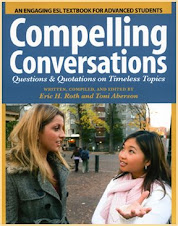
I chose Solzhenitsyn’s quote for the dedication page of Compelling Conversations: Questions and Quotations on Timeless Topics to remind myself – and others – to look beyond material possessions. We need to stay awake and remain sane – even if our society begins to sprout social cancers and asking simple questions becomes dangerous.
Solzhenitsyn provides a model of resistance to tyranny.
Ask more. Know more. Share more.
Create Compelling Conversations.
Visit www.CompellingConversations.com
Sunday, August 3, 2008


Thursday, July 31, 2008
Learning about Phrases, Idioms, and Slang terms
Are you curious about the origins of common phrases and idioms in English?
I like it. You might too.
Check out their website at www.phrases.org.uk/a-phrase-a-week/add.html)
Here is their latest email on the term “upside-down” - minus their excellent illustrations:
Upside down' is one of a longish list of English expressions that refer to things being inverted or in disorder - head over heels, '**** over tea-kettle' etc. The mediaeval English also had the terms 'overset', 'overtumble' and 'topset downe', which have now gone out of use. This profusion of similar phrases suggests a widespread interest in the recounting of stories of people falling over - matched today by the popularity of home video television shows.
The interest is common in other languages too; the French even have a specialist term for a sequence of stamps in which some are printed upside down - 'Upside down' was originally 'up so down', i.e. 'up as if down'. The 'so' part migrated into various forms, 'upsa', 'upse' (which spawned 'upset') etc., in the same way as upset the applecart. The change from 'up so down' to forms like 'upset-down' and eventually 'upside-down' appear to be for no better reason than to make the expression's meaning more intuitive.
'Upside down' doesn't sound especially old but, in its early forms, it can claim to be one of the oldest expressions in English. It joins the handful of phrases that can be dated from the first part of the 14th century or before, for example, haven't slept a wink" and "in the twinkling of an eye" The earliest version of 'upside down' known in print is in The proces of the seuyn. The precise publication date of that text isn't known, but it is accepted as being before 1340: The cradel and the child thai found Up so doun upon the ground."
The Phrase A Week newsletter goes out to 71,500 subscribers. As one of their loyal subscribers, I urge you to consider reading this informative, enjoyable newsletter.
Ask more. Know more. Share more.
Create Compelling Conversations.
Visit www.CompellingConversations.com
Wednesday, July 30, 2008
It was an Earthquake, not a Lifequake! We're Lucky!!
It was an Earthquake, not a Lifequake!
As CNN and the other global news organizations rushed to tell the world, a 5.4 earthquake hit
Yet nobody was killed, no bridges fell, and very few injuries were reported. This hometown earthquake was, in many ways, a non-event.
It was an earthquake, not a lifequake!
A lifequake, as slang experts and blog readers know, is an event that suddenly changes your life. Being hit by a falling building, injured in a car accident, getting diagnosed with a terrible illness, or losing a job is a lifequake. The 5.4 earthquake spooked many
Let’s hope that the next earthquake is just as harmless – and lifequakes stay far away!
--------------------------------------------------------------------------------------------------
P.S. Yesterday’s earthquake reminds
Bake cake fake lake
make take wake shake
quake earthquake milkshake lifequake
Ask more. Know more. Share more.
Create Compelling Conversations.
Visit www.CompellingConversations.com
Sunday, July 27, 2008
Conversation Starter - Make a Sincere Comment About a Car
Sometimes a simple comment leads to a delightful conversation.
Today I noticed a very, very old truck parked on the street while walking my dog.
"She's as old as I am," replied the owner from his frontyard. He soon came to the sidewalk. "Made in 1931."
Although I'm hardly a car guy, we proceeded to have a rather detailed and informative conversation about Ford, Model AA, and vocational education. That ancient truck, donated to a local veterans group, still runs. The local adult education high school will help train mechanics on it - and restore it. Cool.
I have an old 1981 Volvo with 249,000 - and the antique truck owner, Deano, has several Toyotas with over 300,000. We both find something wonderful with quality cars built to last - unlike so many models today. Car companies could - and still can - make quality cars that last decades.
Deano, by the way, is a former high school teacher who volunteers at the local Veterans Administration (VA) hospital. You can't help but respect a man who helps soldiers and veterans recover from war wounds - visible and invisible.
Friendly and folksy, I instantly felt comfortable with him and traded a few teachers' tales. We shared a few frustrations with standardized tests too. We will, I suspect, have other fine conversations in the future.
A casual comment, "nice truck", lead to a satisfying exchange. with a neighbor. That's my conversation tip #12: make a sincere comment about a situation and be curious about your neighbors. You never know what you will learn or who you will meet - even in your own neighborhood!
Ask more. Know more. Share more.
Create Compelling Conversations.
Visit www.CompellingConversations.com
Today I noticed a very, very old truck parked on the street while walking my dog.
"She's as old as I am," replied the owner from his frontyard. He soon came to the sidewalk. "Made in 1931."
Although I'm hardly a car guy, we proceeded to have a rather detailed and informative conversation about Ford, Model AA, and vocational education. That ancient truck, donated to a local veterans group, still runs. The local adult education high school will help train mechanics on it - and restore it. Cool.
I have an old 1981 Volvo with 249,000 - and the antique truck owner, Deano, has several Toyotas with over 300,000. We both find something wonderful with quality cars built to last - unlike so many models today. Car companies could - and still can - make quality cars that last decades.
Deano, by the way, is a former high school teacher who volunteers at the local Veterans Administration (VA) hospital. You can't help but respect a man who helps soldiers and veterans recover from war wounds - visible and invisible.
Friendly and folksy, I instantly felt comfortable with him and traded a few teachers' tales. We shared a few frustrations with standardized tests too. We will, I suspect, have other fine conversations in the future.
A casual comment, "nice truck", lead to a satisfying exchange. with a neighbor. That's my conversation tip #12: make a sincere comment about a situation and be curious about your neighbors. You never know what you will learn or who you will meet - even in your own neighborhood!
Ask more. Know more. Share more.
Create Compelling Conversations.
Visit www.CompellingConversations.com
Saturday, July 26, 2008
Make Change Your Friend: Lesson for ESL class
How do you close an excellent ESL summer class that has shared experiences, insights, and laughs for a short month?
Create Compelling Conversations.
Visit www.CompellingConversations.com
Class bookends, both beginnings and endings, deserve special attention. This teaching proverb becomes more important in short term summer English programs where ESL students have traveled thousands of miles to study English.
As so often, I tend to learn by stumbling. Yet, over the years, I’ve developed a rather effective last class ESL lecture around a simple theme: Make Change Your Friend.
Working in an Intensive English Program (IEP) during the summer provides many satisfactions., but sometimes it feels like the course ends just when you have finally begun to really know your students. The students, often college age and less focused on grades than regular university students, come to study English, but also to enjoy themselves in Southern California. The classes tend to more relaxed, looser, and casual than my usual teaching situations, but more goal-focused and academic than adult education classes filled with working immigrants. The students, often unused to choosing their own readings and talking with an interested instructor, appreciate the personal feedback. Many students are also on their first trip to California and the United States, and have had rather disappointing experiences with rigid educational institutions back in their native countries.Therefore, many students enter their last class feeling rather down. Vacation is almost over. Few exude excitement about returning home. How do you change that atmosphere to emphasize the positive and provide an exceptional last ESL class?
What are you looking forward to? That's the question I ask on the attendance sheet.
Next, the lesson begins with a review of changes in their own lives over the last 10 years, and small personal chit-chats with each student. I tend to focus, just a bit, on the present perfect as they write 5 questions to ask their conversation partner and classmates. Most students are in college, but a few are working professionals a bit older. Studying - and living in -
By zooming out a bit more, we shift the conversation to changes - social, economic, or cultural - in our native countries over the last 10 years. The students usually provide a wide range of examples. Sometimes we also indicate how we would like our countries and cultures to change.
We soon shift to technological changes - and students share their experiences with different technologies. Of course, technology continues to improve - providing an optimistic twist. Computers are faster, video editing easier, and cell phones better. The evidence for material progress seems overwhelming.
Taking this theme a bit further, I note how the many uses of medical technology. People can live longer, new hearts installed, even limbs restored. From implants to cosmetic surgery, medical devices are changing our experience as humans. Are humans changing too? We live in fantastic times - unlike any previous generation.
I proceed to review themes from previous class readings and discussions from healthy relationships and elections to changes in human reproduction and evolving definitions of marriage. With a nod toward the great science fiction film Blade Runner, I ask “what makes humans human?” Let’s be humane as long as we human, as a Roman stoic philosopher advised.
Finally, quoting former President Clinton, I urge them to embrace change. “Make change your friend,” advised
Then, students write down three ways they can make change their friend. It’s a positive, look forward conclusion to a short English program. Soon class ends, students snap pictures with digital cameras, and exchange emails.
We make change our friend - even if the change is ending a wonderful, educational vacation. Students say goodbye to their
The journey of life continues. Make change your friend.
What do you on your last lesson?
Create Compelling Conversations.
Visit www.CompellingConversations.com
Monday, July 21, 2008
So What Does Current Research Show About Teaching English in American Public Schools?
Do English language learners, or English as a Second language students, learn better in sheltered programs? Should students receive some instruction in their native language – and if so, for how long in American public schools? What does current research show about teaching English to children who speak another language at home? What language programs seem to work best? Which seem to produce the weakest results?
Teaching Language Learners: What the Research Does – and Does Not – Say , a 19- page article published in American Educator attempts to summarize current studies, detail the differences between studies, and introduce a more nuanced language to a very passionate debate. Claude Goldenberg, the author, writes in a clear, accessible style – and explains various bureaucratic jargon as he goes reviews the material. This article, written for American public education teachers in a union publication, deserves a large readership from English teachers, ESL teachers, ELL administrators, bilingual advocates, and journalists writing about language politics.
The article made numerous important points, including:
- the rapid growth of English Language Learners (ELL) students in public schools;
- a solid majority of ELL students are actually born in the United States (Why????);
- smaller class sizes matter;
- some intensive instruction in the primary language, for an unknown duration, helps improve target language abilities in writing;
- a huge debate continues over best practices over duration and purpose of primary language instruction;
- teaching English language learners from countries with low literacy than teaching students who bring strong academic skills in their native language (shock, shock!)
- written skills of ELLs remain far below national standards, especially in high school;
- oral skills often lack written skills in ESL/ELL students;
- students have difficulty moving from intermediate oral skills to achieving actual fluency;
- standard tests seldom test oral skills, leading to speaking skills being somewhat neglected in ESL/ELL classrooms.
Personally, I found the first two pages a bit annoying with its predictable complaints implying the impossibility of a second grader, particularly an ELL second grader, learning everything that is expected by state mandates. Yet when Goldenberg moved beyond the predictable “union” frame “our impossible job” and actually starting summarizing two major meta-studies of ELL practices, he provided a balanced, informative, and level-headed article filled with illuminating details.
As an adult educator, I also thought the article made a powerful argument for a huge expansion and deepening of adult education programs if a solid majority of ELL students are actually born in the United States. Why should millions of children born and raised in the United States be unable to speak English? If you believe that speaking English helps students live in the United States and language and culture are related, then this article provides a litany of troubling details about the state of ELL instruction and public education programs in general.
I strongly urge ELL and ESL instructors to read the long, ambitious, and satisfying article. It may become a seminal work in MA programs for ESL teachers, especially for people working in American public schools. http://www.aft.org/pubs-reports/american_educator/issues/summer08/goldenberg.pdf
This sometimes ugly debate over language policy will probably heat up as McCain and Obama attempt to make distinctions in their immigration and education policies. Perhaps this article will help clarify the complicated issues that go beyond bumpersticker solutions.
Ask more. Know more. Share more.Create Compelling Conversations.
Visit www.CompellingConversations.com
Sunday, July 20, 2008
Volume Matters
Speaking too loud can be annoying and push people away. Speaking too softly, however, can be an even larger obstacle to simple communication and a satisfying conversation.
During classroom discussions in English class, some students to will boldly speak their mind. Other students tend to hold back, offer only the safest comments, and other share their wit. One overlooked, essential quality to speech in class, however, is volume. Students must speak loud enough that their fellow students can hear them - whether seated in the front or back row.
One can, however, sympathize with the timid English students who speak softer than ideal in a large classroom.
Being inaudible, however, in personal conversations remains a far more serious problem - especially for English as a Second Language (ESL) students.
Ask more. Know more. Share more.
Create Compelling Conversations.
Visit www.CompellingConversations.com
During classroom discussions in English class, some students to will boldly speak their mind. Other students tend to hold back, offer only the safest comments, and other share their wit. One overlooked, essential quality to speech in class, however, is volume. Students must speak loud enough that their fellow students can hear them - whether seated in the front or back row.
One can, however, sympathize with the timid English students who speak softer than ideal in a large classroom.
Being inaudible, however, in personal conversations remains a far more serious problem - especially for English as a Second Language (ESL) students.
Student conferences, especially with shy students worried about their grade or academic performance, can often be a bit awkward for both the professor and student. ESL (English as a Second Language) students, sometimes insecure about their pronunciation or vocabulary, can feel particularly anxious. ESL and other English teachers have to find ways to reduce student anxiety, provide a safe place for English students to speak, provide feedback on student work, and uphold academic standards. (Adult education, by the way, would be greatly improved if ESL teachers had more opportunities for student conferences.)
In general, I find student conferences very productive and satisfying because you get a chance to really work with a college student on their writings and assignments. I often feel that I learn as much as I teach in these 20-30 minute student conferences.
Sometimes, however, I have awkward conferences. If the student has plagiarized, then this can’t be avoided. Those moments, which I dread, can not be avoided. So it goes.
Yet sometimes, as occurred last semester, an ESL (English as a Second Language) student is so shy, so timid, and so unsure that they speak so softly that I can’t even hear. Sometimes I lean forward and ask them to please speak a bit louder. If a student continues in the same low volume, I might apologize for my poor hearing and again request they speak up. What does one do on the third request?
“Please speak a bit louder so I can hear you.”
Was this too direct? I wanted to say, “If I can’t hear you, you will be misunderstood. I want to understand you. Speak up!!”
Patience, this time, paid off. The student raised her voice to an audible level, and replied, “okay.”
“Good to hear you,” I replied. We proceeded to have a productive end of semester conference.
English and ESL teachers at all levels, from elementary school and high school to adult school and university, need to emphasize the importance of student speech being comprehensible. That includes speaking loud enough that conversation partners, classmates, and instructors can hear.
Bottomline: students must speak up in conversations, conferences, and class discussions. Volume matters.Ask more. Know more. Share more.
Create Compelling Conversations.
Visit www.CompellingConversations.com
Saturday, July 19, 2008
What is the opposite of jealous? "Gratitude is Heaven itself."
A bright college student asked a simple vocabulary question that threw me this week. "What is the opposite of jealous"?
What is the opposite of jealous? Generous? Selfless? Confident? I found myself discussing various possibilities with students adding in situations. The simple vocabulary building exercise (create 25 pairs of opposite adjectives) took a more philosophical turn. We had a lively, if a bit wandering, class discussion. I apologized for my memory lapse, urged them to check a dictionary, and promised to get back to students with a better answer.
In the teacher's room, a fellow teacher noted "The world jealousy includes the word lousy." We shared a laugh. That's a good answer. How did he instantly come up with that? Why couldn't I do that?
I felt discontent, dissatisfied, and displeased with my weak classroom answers. Perhaps the opposite of "jealous" is content, satisfied, and pleased.
Stress comes naturally when driving in Los Angeles, and my commute back home fit the familiar pattern. Many words popped into my head that captured negative feelings, including jealous. Could I be jealous of bus riders? Really? I started to visualize a bus ride home from UCLA, sitting - no, probably standing up, for 40 minutes next to exhausted strangers. Memories of less pleasant commutes on subway rides in New York from 20 years ago returned. No, I didn't envy or feel jealous of the bus riders.
I eventually arrived home. Boomer, my dog, barked to announce my arrival and licked my face as I entered the front door. He's great. "Dogs are our link to paradise," wrote Milan Kundera. Absolutely.
Gratitude. That's the opposite of jealousy. Gratitude. Why didn't I think of that in class? Next time.
"Gratitude is heaven itself." Who said that? Blake? Yeah, William Blake. The great poet-painter-mystic man. Remember that quote the next time an English student asks, "what is the opposite of jealous?"
Teaching English, especially to bright international college students, helps keep me focused and clear. This week I learned the opposite of jealousy and rediscovered a favorite quotation. Consider me satisfied, content, and grateful.
Ask more. Know more. Share more.
Create Compelling Conversations.
Visit www.CompellingConversations.com
Friday, July 18, 2008
What is a lifequake? Is that a real word?
Earthquakes remain a concern for people living in many places, including Southern California. This awareness, and fear of sudden shaking and buildings falling, enters into many conversations.
I recently read a wonderful term and vocabulary word: lifequake. What does it mean? An event that suddenly changes your life – a car accident, being laid off, terrible illness, or getting divorced – in the same dramatic way that an earthquake might destroy a building.
Now I have a new way to ask friends to share more about awkward situations.
- How did you deal with that lifequake?
- What lifequakes have you survived?
- How will you manage that lifequake?
Is lifequake a real word? Can educated English speakers use it? Absolutely. New words and slang terms enter English dictionaries all the time, partly because our world continues to change and evolve. Lifequake clearly describes a common experience. It's pithy and practical. While I would might hesisitate about using the term on a TOEFL or TOEIC test, I plan to incorporate into my daily vocabulary with family, friends, and students.
A fellow ESL teacher and longtime California resident believes that “lifequake” was a widely used term in the 1970s among “young, hip people.” Perhaps. Whether old hipster slang or a new Californian term, lifequake conveys an understanding that sometimes life can shock and hurt. Lifequake is a fast way to communicate a harsh reality. Lifequakes happen.
Don't you agree?
Ask more. Know more. Share more.
Create Compelling Conversations.
Visit www.CompellingConversations.com
Wednesday, July 16, 2008
After grading too many ESL papers, this quote appears!
"There's only one corner of the universe you can be certain of improving, and that's your own self... Every man who knows how to read has it in his power to magnify himself, to multiply the ways in which he exists, to
make his life full, significant and interesting." —Aldous Huxley
Ask more. Know more. Share more.
Create Compelling Conversations.
Visit www.CompellingConversations.com
make his life full, significant and interesting." —Aldous Huxley
Ask more. Know more. Share more.
Create Compelling Conversations.
Visit www.CompellingConversations.com
Sunday, July 6, 2008
Adding Classic Quotations Adds Depth, Diversity to ESL Classrooms
“If a nation expects to be ignorant and free…it expects what never was and never will be.”
Thomas Jefferson (1743-1826),
U.S. President and principal author of the Declaration of Independence
Classic quotations, like proverbs, brings in many insights from religious leaders and philosophers that go back even more than 2,000 years such as Buddha, Confucius, Aristotle, and the Biblical prophets in a compelling, succinct manner. These quotations remind us that some conversations have spanned centuries and cultures.
John Adams (1735-1826)
U.S. President and contributor to the Declaration of Independence
Create Compelling Conversations.
Visit www.CompellingConversations.com
Wednesday, July 2, 2008
A New Issue of Easy English Times Makes Me Smile!
The “Summer Fun” issue of Easy English Times arrived yesterday, and it made me smile. It’s another wonderful issue of ESL student essays, teaching tips, and classroom exercises for English language learners.
The Easy English Times (EET) editors also generously added seven photographs to the monthly “instant activity: conversation” column written by Toni Aberson and myself. This month’s topic is Enjoying the Beach. The beautifully illustrated excerpt from Compelling Conversations, modified for beginning and intermediate ESL student readers should be popular. The column also inspired me to take a long walk on
The summer issue also lead me to revisit the Easy English Times website. Unfortunately, the EET website doesn’t include the entire current and past issues so the conversation column isn’t online. The clean website, although in need of an update, includes several valuable chunks of information for ESL educators and people teaching in adult literacy and prisons.
The section titled Immigration Issues features first person essays from immigrants and refugees and an evocative photo essay by Betty Malmgren that documents the intense passions and political symbols used at immigration protest marches. Malmgren deserves credit for showing both sides of this heated and very American debate in a fair, nuanced manner. I’m also fond of the section titled internet resources which includes archived columns from Andrea Uram for teachers of beginning ESL students and Susan Gaer’s columns on using the internet in ESL classrooms.
Yet my favorite part of the Easy English Times website remains student writing where you can read first person stories from immigrants and refugees who have created new lives in the
Website visitors can request a free copy of Easy English Times newspaper, and subscribers can access the entire adult education newspaper online for $15. It’s a good buy, especially for American ESL teachers working with beginning and intermediate adult ESL students. In a far better world, there would be fewer refugees from wars, famines, and persecution – and more than enough money to buy class sets of this ESL newspaper for more adult schools.
Ask more. Know more. Share more.Create Compelling Conversations.
Visit www.CompellingConversations.com
Subscribe to:
Posts (Atom)

 Posts
Posts